Podcast to Study Notes: A 4-Step AI Transcribe + Structure + Spaced-Review Workflow (2026)
Podcast to Study Notes: A 4-Step AI Transcribe + Structure + Spaced-Review Workflow
You’re probably like this too: on your commute, while doing chores, while working out, you’ve got earbuds in listening to a podcast, thinking this episode is great, so insightful. And then? Then nothing. A week later someone asks “what did that podcast cover,” and all you remember is “it was good.” The specifics are a total blank.
100-word direct answer: Forgetting podcasts isn’t because you didn’t listen carefully — the root cause is not turning what you heard into a reviewable structure. An effective podcast-to-study-notes workflow has 4 steps: use BibiGPT to AI-transcribe the podcast and summarize it into structured key points → organize into your own study notes → review on a spaced-repetition rhythm → distill into a knowledge base. This article breaks down the repeatable process step by step.
Podcasts are the medium best suited to “passive learning” — they don’t take up your eyes and can run alongside other things. But precisely because they’re passive, their retention rate is extremely low. To truly turn podcasts into learning, you need to add three steps beyond “listening”: transcribe, structure, and review. That’s the complete methodology this article covers.
Table of Contents
1. Why “listening to a podcast equals not listening”
The retention problem with podcasts is fundamentally a learning-science problem, not a matter of you not trying hard enough.
Audio information heard passively, without any active processing (recording, restating, reviewing), is forgotten extremely fast. According to the widely cited Ebbinghaus forgetting curve, new information without review loses most of itself within days — that’s an objective law of human memory, true for even the most attentive listener.
Podcasts also have two extra retention barriers:
-
Linear and non-searchable: to revisit a point, you have to scrub through and find it, which is so costly you just don’t bother
-
Companion listening: you’re doing something else while listening, attention is already split, so processing is even less likely
-
Professionals: you listen to industry podcasts hoping to keep up with trends, but you only “heard it” rather than “learned it”
-
Students: you listen to knowledge podcasts as extracurricular supplements, but they’re useless at exam time because they never became a system
-
Creators: you want to mine podcasts for topic ideas, but the inspiration vanishes in an instant — not written down, it’s gone
Practical rule: Listening to a podcast is only “input.” Without the three processing steps — transcribe, structure, review — input never becomes “learned.”
The demo below shows “audio content → structured key points” — watch once to build intuition:
Source: YouTube · AI audio/podcast summary demo
2. Step one: AI transcribe and summarize — turn sound into readable structure
The first step is turning a “listen-only” podcast into a “readable, searchable, editable” text structure. Doing this by hand is unrealistic — a one-hour podcast’s verbatim transcript is tens of thousands of words. Hand it to AI.
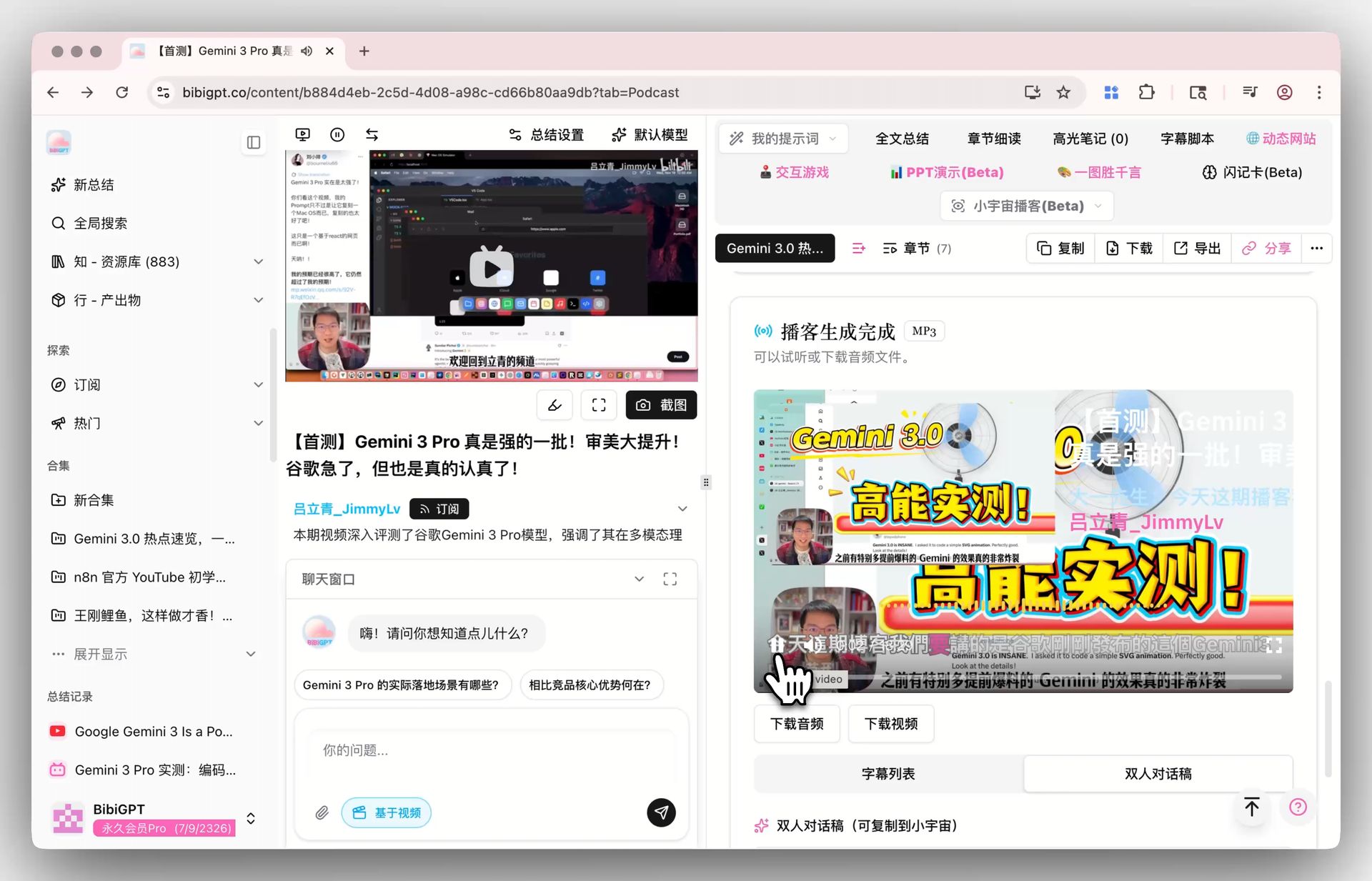
Open BibiGPT podcast summary, paste links from Xiaoyuzhou, Apple Podcasts, YouTube podcasts, etc., or upload local audio directly. In minutes you get:
- A full-episode TL;DR: what this episode’s core is about
- Segment points + timestamps: the core view of each topic segment, with clickable timestamps that jump back to the original audio
- Key quotes: the lines the guest said that are worth writing down
Timestamped transcription has a hidden value: it makes the podcast searchable. Later, when you want to find “the part about compounding in that investing podcast,” you don’t scrub anymore — search the text, click the timestamp, jump right there.
In the interactive demo below, pick a sample and see the AI’s TL;DR + segment points + timestamps:
Summarize any video in seconds
Pick a sample below to see the AI summary — TL;DR, key points, and jump-to timestamps.
TL;DR: Karpathy builds a GPT-style language model from scratch in code, explaining every piece — from a tiny character-level model up to the full Transformer.
Key points
- Start with a bigram model, then add self-attention so tokens can "talk" to each other
- A Transformer block = multi-head attention + feed-forward + residual connections + layer norm
- Training is just predicting the next token; scale and data do the rest
- The same architecture behind nanoGPT is what scales up to ChatGPT
Jump to
- 00:07 Why build GPT from scratch
- 08:23 Self-attention, intuitively
- 1:00:00 Assembling the Transformer block
- 1:35:00 From nanoGPT to ChatGPT
Practical rule: Transcription isn’t the goal; timestamped structured key points are. They turn linear, non-searchable audio into readable, searchable, jumpable knowledge material.
3. Step two: structure it into your own study notes
The points the AI gives are “raw material.” To turn them into your own study notes, you need one more round of active processing — and this step is precisely the key to memory sticking.
Learning science has a core principle: active processing (elaboration) retains better than passive reception. The same content reorganized in your own words is retained far better than collected verbatim. So don’t just copy the AI points here — do three things:
- Rewrite the core views in your own words: for each point, ask yourself “what is this actually saying” and rewrite it in plain language
- Build connections: what does this view relate to that you already know? How does it connect to what you’re working on?
- Pose questions: write down what you didn’t understand and what you’re unsure of — questions themselves are the best review anchors
Organizing notes into a mind map is one of the most efficient ways to structure — you can see an episode’s logical skeleton at a glance. Use BibiGPT mind map to turn points directly into an interactive map:
Turn a video into a mind map
A linear talk becomes a structured tree. Drag to pan, click nodes to fold.
| Note processing action | Learning-science basis | Effect |
|---|---|---|
| Rewrite in your own words | active elaboration | higher retention |
| Connect to what you know | associative memory | easier recall |
| Record questions | generative questions | review anchors |
| Convert to mind map | visual structure | global at a glance |
4. Step three: review on a spaced-repetition rhythm
Notes you make and don’t review are notes wasted. This step uses one of the most repeatedly validated methods in learning science — spaced repetition.
The core idea of spaced repetition: reviewing right at the point you’re “about to forget” gives the highest retention efficiency. According to research reviews on the spacing effect, spreading review across multiple time points produces significantly better long-term memory than one-time massed review.
A simple, actionable review rhythm:
- Day of listening: spend 5 minutes going over the AI-summarized points, confirm understanding
- Day 2: close the notes and try to recall which core points the episode covered (active recall)
- Day 7: review once more, focusing on the parts you couldn’t recall last time
- Day 30: a final review — what you remember has truly entered long-term memory
The key here is “active recall,” not “rereading” — cover the notes first and recall on your own, then look if you can’t. That “effortful retrieval” process is the core of memory consolidation.
Practical rule: When reviewing, cover the notes and recall on your own first; only look at the answer when stuck. The process of “effortfully remembering” beats “rereading” for memory by a wide margin.
5. Step four: distill into a knowledge base so notes compound
A single note has limited value; distilling them into an accumulable, connectable knowledge base is what produces compounding.
Export each episode’s structured notes (Markdown / text), file them into your note tool (Notion, Obsidian, etc.), and tag by topic. Over time, you’ll find:
- Under the same topic, views from multiple podcasts can corroborate or conflict — which is itself deeper learning
- When writing articles, giving talks, or making content, the knowledge base is your ammunition depot of material, ready to draw on
- Your understanding of a field is no longer a scattered “heard it” but a systematic “accumulation”
Frequently Asked Questions (FAQ)
For podcast-to-study-notes, is AI transcription accurate?
AI transcription accuracy is already quite reliable for most clear podcasts (mainly Mandarin/English, normal audio quality), enough to support study notes. Even with occasional word recognition errors, because you’re taking “timestamped structured key points” rather than a verbatim transcript, minor errors don’t affect overall understanding and review.
What if I don’t have time to do the full 4 steps for every episode?
You don’t have to do all 4 every time. Grade by importance: podcasts worth deep learning get the full 4 steps; ones you just want a rough sense of, do step one (AI transcribe and summarize) for a TL;DR — that’s enough. The key is to build the minimum habit of “at least going over the AI summary after listening,” better than aiming for perfection you can’t sustain.
Does spaced review have to be 1/7/30 days?
It’s not a hard rule. 1/7/30 days is a simple, memorable starting point; the core principle is “review right before forgetting.” You can adjust based on content difficulty and your own forgetting rate — shorten intervals for hard content, lengthen for easy. The point is “spaced review” rather than “one-time massed.”
Does this method only work for podcasts?
Not only. This “transcribe → structure → spaced review → distill” workflow works equally for online courses, lectures, industry interviews, and long videos. Podcasts are just the most typical “passive listening, easily forgotten” scenario, so they make the most intuitive example.
6. Get the workflow running: a repeatable loop
String the four steps together and you have a pipeline that turns “podcasts you heard” into “knowledge you learned”:
- Finished listening → paste the podcast link into BibiGPT; AI transcribes and summarizes into structured points
- Structure → rewrite in your own words, build connections, note questions, convert to a mind map
- Review → active recall on a 1/7/30-day rhythm
- Distill → export and file into a knowledge base, accumulate by topic
This methodology relies on no talent, only a stable tool entry to clear the labor of step one. BibiGPT has served over 1 million users, generated 5M+ AI summaries, and supports 30+ platforms — what it does is turn every podcast you hear on your commute into knowledge you actually retain and use.
Further reading:
- Video to Xiaohongshu Notes: turn videos into viral picture-text notes with AI
- What Claude Opus 4.8’s 1M context means for long-content summary
- Qwen AI Video Summary vs BibiGPT: a free comparison
- Video to Slides: extract PPT from any video with AI
Want to actually remember your next podcast? Open BibiGPT podcast summary, paste a link, and start from step one.
BibiGPT Team