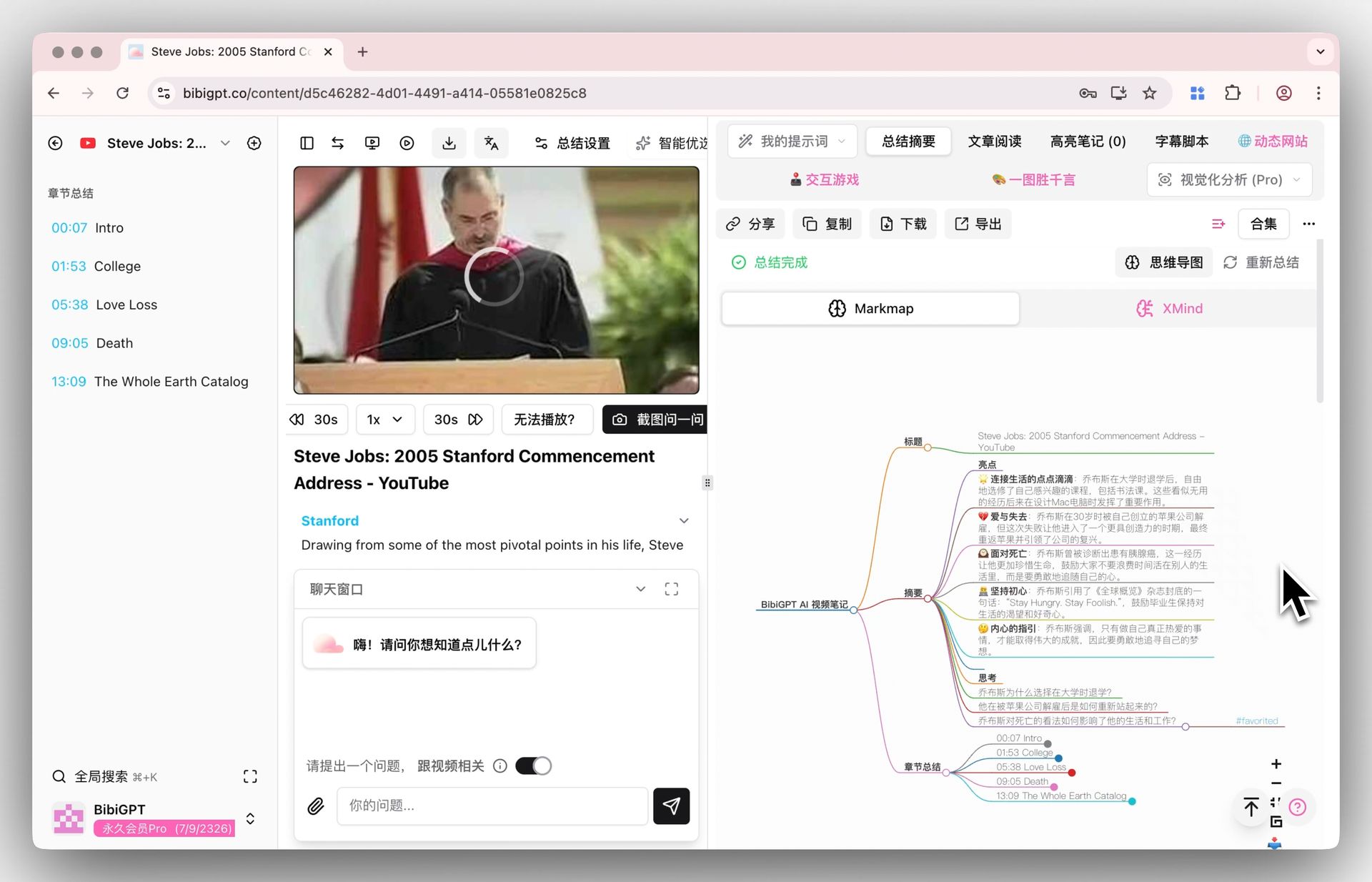
Claude Opus 4.7 Fast Mode vs BibiGPT 2026: Which Is Worth Using for Long Video Streaming Summary
Claude Opus 4.7 Fast Mode vs BibiGPT 2026: Which Is Worth Using for Long Video Streaming Summary
Last updated: 2026-05-17
100-word direct answer: Anthropic added Fast mode to Claude Opus 4.7 in 2026 — single-shot 1M context streaming output, leveling up long-text comprehension. If you’re a heavy Claude API user with in-house engineering, calling Fast mode directly for long text is reasonable. But video isn’t text. It needs platform parsing, subtitle extraction, chapter segmentation, visual analysis, timestamp jumping. BibiGPT already did all that. Below: scenario-driven decision guide.
30-Second Decision Table
| Your Need | Recommendation |
|---|---|
| Already have subtitle text, just need summary | Claude Opus 4.7 Fast mode direct API |
| Want to summarize Bilibili / YouTube / Douyin video links | BibiGPT |
| Need timestamp jumps back to original video | BibiGPT |
| Need mind map / subtitle translation / visual analysis | BibiGPT |
| Want cheapest long-text solution | Claude Opus 4.7 Fast mode + custom build |
| Want a stable product workflow without pitfalls | BibiGPT |
Background: What Claude Opus 4.7 Fast Mode Is
Per Anthropic’s 2026 public releases, key Fast mode features:
- Streaming output speed: 2–3x faster than standard Opus 4.7
- 1M context window: ~750k English words or ~500k Chinese characters per single shot
- Pricing: Slightly higher output token price than standard, but materially lower latency
- Typical use: Direct feed of long docs (contracts, papers, books) for summary, Q&A, extraction
In theory, for long video summary the wins are:
- Feed an entire 3-hour video’s subtitles (~300k chars) in one shot
- Streaming lets users see output without waiting for completion
Practical rule: Fast mode solves the “text-in → text-out” speed problem. 90% of video processing difficulty isn’t in that step.
Why Long Video Summary Is Actually Hard: 6 Engineering Hurdles
If you DIY a “long video summary tool” with Claude Opus 4.7 Fast mode, you’ll hit these:
Hurdle 1: Platform Link Parsing
YouTube / Bilibili / TikTok / Xiaohongshu / Douyin / podcasts / Loom / Wistia / Substack video… each platform has different URL structures, subtitle APIs, anti-bot strategies. Hand-rolling coverage for major platforms = 1–2 months minimum.
Hurdle 2: Subtitle Extraction Quality
Not every video has captions. Even when they exist:
- Timestamp precision varies
- Multilingual mixing
- Auto-captions (YouTube auto-caption) have 5–15% error rates
You need a Whisper fallback layer.
Hurdle 3: Long-text Structured Segmentation
3-hour video = ~300k chars of subtitles. You can feed it into Fast mode, but you get back “one giant blob.” Users actually want:
- Chunked into 10–15 topic-based chapters
- Each chapter has title, key points, timestamps
- Click chapter title to jump back to the original video moment
The “segment → anchor → jump” engineering logic isn’t solved by a model alone.
Hurdle 4: Visual Information Extraction
Video value isn’t all in audio. Tech conference demos, product launch slides, code walkthroughs — key info lives on-screen. You need:
- Keyframe extraction
- OCR on-screen text
- Visual models understanding scene content
BibiGPT Visual Content Analysis ships this pipeline.
Hurdle 5: Multi-model Routing
Different videos fit different models:
- Chinese podcast → Qwen / DeepSeek tend to be more accurate on Chinese
- English tech conference → Claude Opus 4.7
- Very long video → Gemini 2M context cheaper
- Real-time scenarios → GPT-4o / Gemini Flash
BibiGPT multi-model routing handles 30+ models. Building a routing strategy yourself is months of work.
Hurdle 6: UI + Notes Integration
What users actually want isn’t an API response:
- A web page to paste links into
- Where summary shows, how mind maps export, how subtitles translate
- How to sync to Notion / Obsidian / Lark Docs
- How teams collaborate
This is 10x the work of model integration.
Practical rule: “Model capability” is 10% of the product. “Product workflow” is 90%. Fast mode strengthens the former, doesn’t replace the latter.
6-Dimension Comparison: Claude Fast Mode Direct vs BibiGPT
| Dimension | Claude Opus 4.7 Fast Mode (direct) | BibiGPT |
|---|---|---|
| Video link parsing | None (DIY) | One-click parsing for 30+ platforms |
| Subtitle fallback transcription | None (wire up Whisper yourself) | Built-in multi-ASR engine |
| Chapter segmentation | Long-text output, post-process yourself | Auto topic-based, click-to-jump |
| Visual content analysis | No video frame support | Visual analysis built-in |
| Mind map export | DIY | One-click .mm export |
| Subtitle translation | Text translation, no timestamp alignment | Bilingual subtitles with timestamps |
| Multi-model routing | Claude models only | 30+ models switchable (Claude included) |
| Pricing | Long-text token cost adds up; pay-per-use | Subscription; no token-anxiety ceiling |
| Learning curve | Need API, prompt, post-processing know-how | Paste link |
| Collaboration / Teams | Build UI yourself | Built-in sharing / team subscription |
Real Scenario: 3-hour Tech Conference
Context: You want to watch a 3-hour Anthropic Engineering Summit 2026 talk to assess whether to adopt their practices.
Option A: Claude Opus 4.7 Fast Mode DIY
- yt-dlp subtitles
- Stitch into prompt for Fast mode
- Get back text summary
- Manually look up timestamps in original video for verification
Time: ~25 minutes (including script wiring). Issues: No structured chapters, no jumps, no visual info.
Option B: BibiGPT
- Paste YouTube URL into bibigpt.co
- Pick Claude Opus 4.7 from the model selector
- 30 seconds for structured chapters + mind map
Time: 1 minute. Artifacts: Topic-segmented chapters, click-to-jump to original video, mind map exportable.
Practical rule: Value isn’t in the model — it’s in “link-to-usable-artifact” total time.
Is BibiGPT Just a Model Aggregator? Clearing Up a Misconception
Many treat BibiGPT as “a multi-model UI on top of Claude/GPT/Gemini.” That’s a misread.
BibiGPT’s actual product anatomy:
- Platform layer: link parsing for 30+ video platforms (foundation)
- Pipeline layer: subtitle extraction + Whisper fallback + multi-ASR engine correction (core)
- Structure layer: chapter segmentation + timestamp anchoring + mind map generation (differentiation)
- Multimodal layer: Visual analysis extracts on-screen info (moat)
- Collaboration layer: Notion / Obsidian / Lark sync + team subscription (stickiness)
- Model layer: route to the right LLM (last layer)
Fast mode strengthens the “model layer.” Calling BibiGPT “a model aggregator” is like calling a car “a wheel aggregator” — inaccurate and you’d underestimate the moat.
Forward Look: Will Fast Mode Affect BibiGPT
Short term, no — BibiGPT users actually benefit:
- BibiGPT model selector will surface Claude Opus 4.7 Fast mode as an option
- Users get the full workflow + Fast mode’s speed advantage
- Pricing stays transparent (no DIY token math)
Long term, model capability will keep converging toward “cheaper + faster + larger context.” That actually lowers BibiGPT’s cost structure — free quota gets more generous, subscription pricing more friendly.
When You Should Skip BibiGPT and Use Claude API Directly
Honestly, these scenarios fit direct Claude Opus 4.7 Fast Mode better:
- You already have subtitle text (no video parsing needed)
- You’re doing non-video long text (papers, contracts, code)
- You’re building AI features embedded in your own product (need API integration)
- You’re willing to handle chapter segmentation, UI, notes sync yourself
If any of the above applies, call Claude API directly. If you only want “paste a video link → get usable artifacts,” BibiGPT saves enough time to justify a subscription.
FAQ: Common Follow-ups
Q1: Does BibiGPT integrate Claude Opus 4.7 Fast Mode? BibiGPT’s multi-model routing supports rapid model integration. Claude Opus 4.7 Fast mode will land in the model selector when it clearly improves long-video streaming summary.
Q2: Is BibiGPT just a Claude / OpenAI wrapper? No. BibiGPT’s moat is the 5-layer engineering capability: video platform parsing + subtitle pipeline + chapter segmentation + visual analysis + notes integration. LLMs are only the last layer.
Q3: Fast mode is much more expensive than standard — will BibiGPT raise prices for it? BibiGPT’s subscription model doesn’t raise prices because a new model integrated. Users see price labels in the selector (e.g., “Plus only” / “Pro only”) and choose freely.
Q4: Can I use BibiGPT’s subtitles and feed them to Claude API myself? Yes. BibiGPT supports subtitle export (Subtitle translation) — get original + translated subtitles, stitch your own prompt for Claude.
Q5: What’s the ceiling for long video summary? “Depth of content understanding” and “usability of presentation.” The former depends on model capability gains; the latter on product workflow polishing. BibiGPT has spent recent years on the latter.
Try BibiGPT’s Long-Video Processing
Next time you see a 2+ hour video, paste it into bibigpt.co for a 30-second preview before deciding whether to spend 2 hours.
—— BibiGPT Team