
Seedance 2.5 Explained: What Native 30-Second 4K Changes

Short answer: On June 23, 2026, ByteDance unveiled Seedance 2.5 at its Volcano Engine FORCE conference — single-shot 30-second clips, native 4K, and up to 50 multimodal reference inputs. As of July 18, 2026, it has been rolling out in stages through July. This post does not rehash the keynote. It answers one question: when AI can produce 30 seconds of usable footage in a single pass, how should you change the way you consume information?
1. Catch-Up: What Seedance 2.5 Actually Changed
Seedance 2.5 is the latest video generation model from ByteDance’s Seed team. Three things changed: single-shot duration jumped to 30 seconds, resolution became native 4K, and the reference-material ceiling went from 12 to 50. This is not a quality tweak — it is the threshold where a “clip” becomes a “shot sequence.”
The timeline is short, but every node has a primary source:
- June 23, 2026 — First shown at the Volcano Engine FORCE conference, positioned by ByteDance around embodied intelligence and industrial production scenarios;
- June 24, 2026 — Tencent News reported that a single prompt produces a 30-second 4K video, with references accepting images, video and audio;
- Early July 2026 — Per IT Home, the experience center opened first, with API access following roughly a week later — a staged rollout, not a single launch;
- As of July 18, 2026 — Access is available via Dreamina or the Volcano Engine’s official site.
The specs make more sense side by side:
| Dimension | Seedance 2.0 | Seedance 2.5 |
|---|---|---|
| Single-shot duration | Up to 15 seconds | 30 seconds in one pass |
| Resolution | Upgraded to native 4K | Native 4K |
| Reference inputs | 12 | 50 (images / video / audio / 3D white models / style refs) |
| Local editing | Limited | Region repaint preserving visual consistency |
Three numbers are worth remembering. First, 30 seconds — according to TheNextWeb’s report, most commercially available video models start losing temporal coherence after 5 to 10 seconds; publicly stated ceilings among Chinese peers cluster around 15 to 20 seconds — Seedance 2.0 itself topped out at 15. Thirty seconds is the line where a tech demo becomes something you can actually ship to social media, advertising or short film. Second, 50 reference inputs — four times the previous generation’s 12, which means consistent characters, products and scenes can be reused reliably. Third, a cost reference point: the previous generation, Seedance 2.0, published pricing that averaged roughly 1 RMB per second — putting the marginal cost of a 30-second finished clip squarely in individually affordable territory.
Practical rule: To judge whether a model update matters, ignore the spec sheet and ask whether it crossed a “directly usable” threshold. Fifteen seconds to 30 seconds is more than a doubling — it is the jump from raw material to finished work.
Screenshot: BibiGPT · Chapter deep reading
2. Three Layers of Knock-On Effects
The real impact of Seedance 2.5 is not on the generation side. It is downstream: total video supply grows faster than anyone’s capacity to consume it. This script has replayed after every video-model threshold crossing over the past year — this time the amplitude is simply larger.
Technical layer: consistency matters more than duration
Thirty seconds is a watershed not because it is long, but because sustaining 30 seconds requires characters that do not deform, lighting that does not jump, and camera logic that holds together. The 50 reference inputs and local editing exist precisely for this. PingWest described it as video generation entering its “long-sequence era,” emphasizing that it “significantly reduces the cost of stitching fragmented long video and improves narrative coherence.” Put differently: the most time-consuming part of the editing bay has moved upstream into generation.
Market layer: generation is being commoditized
When a usable finished clip costs a few dozen RMB at the margin and takes minutes to produce, “knowing how to use the model” stops being a moat. Through the first half of 2026, the capability curve for video models has been steep enough that users have not had time to form brand loyalty — today’s leader may be merely tied for first three months from now. Scarcity is migrating from “who can generate” to “who can judge what is worth generating, and what is worth watching.”
Practical rule: The cost of generation is going to zero. The cost of judgment is not. The cheaper the tool, the more expensive your attention.
Ecosystem layer: the dark matter is exploding
Here is the structurally underrated problem. Nearly all discussion of content distribution today revolves around optimizing web text so AI engines will cite it. But the bulk of incremental internet content is rapidly becoming video and audio — and AI search engines cannot read it. This is the largest pool of dark matter in the AI search era. Every time a model like Seedance 2.5 lowers the barrier to video production, that dark matter expands: more information gets sealed into containers AI cannot parse and you do not have time to watch.
The implication is direct — whoever reliably turns audio and video into structured, searchable, quotable text controls the entrance to that content. Once it is text, every sentence in the video becomes something you can interrogate and trace back:
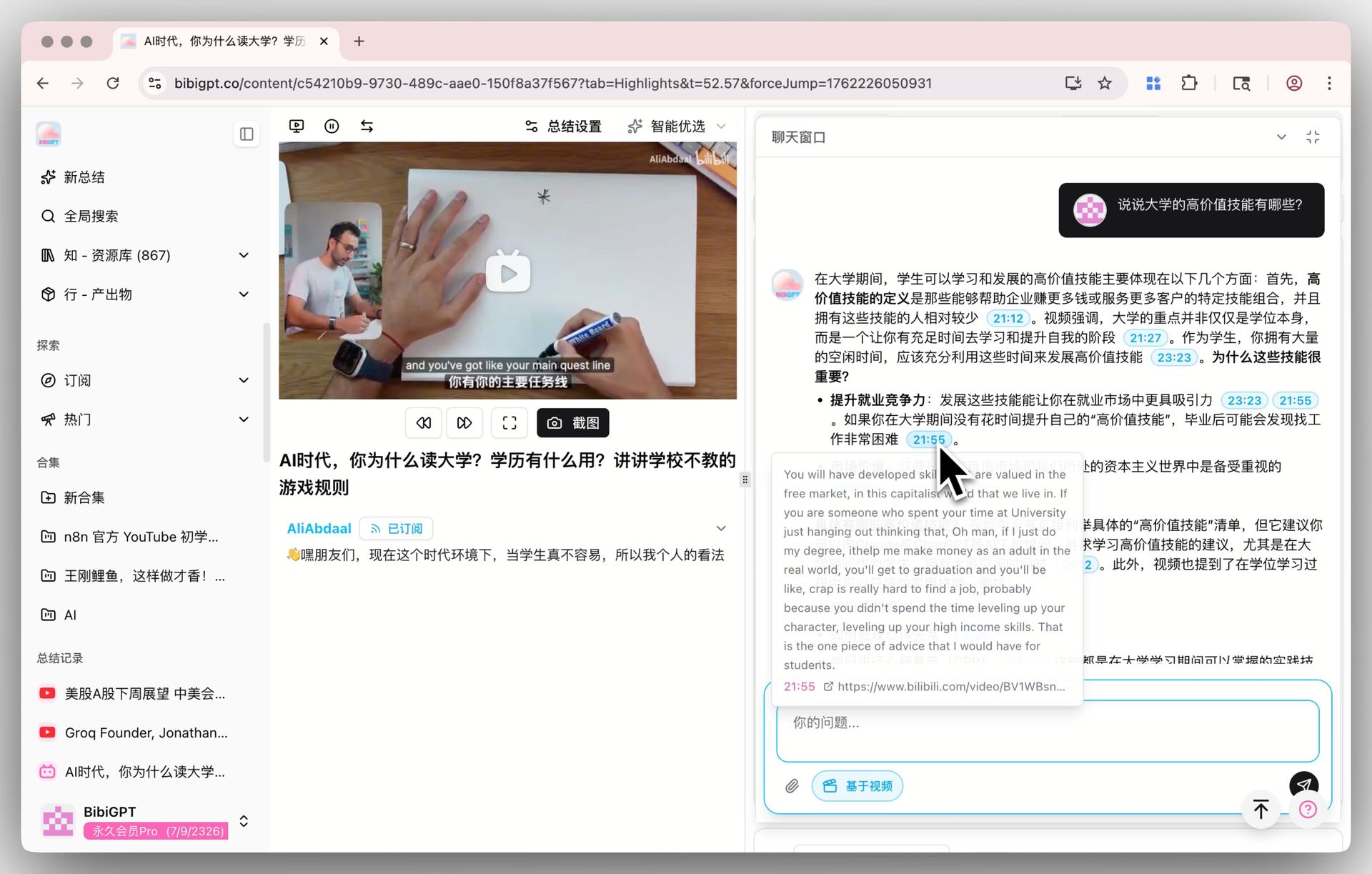
Screenshot: BibiGPT · AI chat with source tracing
3. What It Actually Means for Three Groups
The same event is a completely different problem depending on who you are:
- Creators and independent publishers — Opportunity outweighs threat. Thirty-second output plus 50 reference inputs means one person can hold a consistent character and visual style across serialized content. But the competitive surface widens at the same time: your rivals are no longer just peers, but everyone who can write a prompt. Real differentiation moves back to topic selection and point of view.
- Students and researchers — Pressure outweighs opportunity. AI-remixed versions of lectures, talks and interviews will multiply, and a sizable share will be low-density restatement. Deciding whether something is worth watching matters more than watching it faster. The real sequence is not “watch, then summarize” — it is “summarize first, then decide whether to invest the two hours.”
- Knowledge workers and teams — Efficiency and noise rise together. Industry analysis, product demos and internal training will increasingly arrive as video. Meeting recordings were already unwatchable; add a layer of AI-generated long video and manually keeping up becomes hopeless.
What all three share: the supply side has accelerated while the consumption side is still dragging a progress bar. That gap will not close on its own.
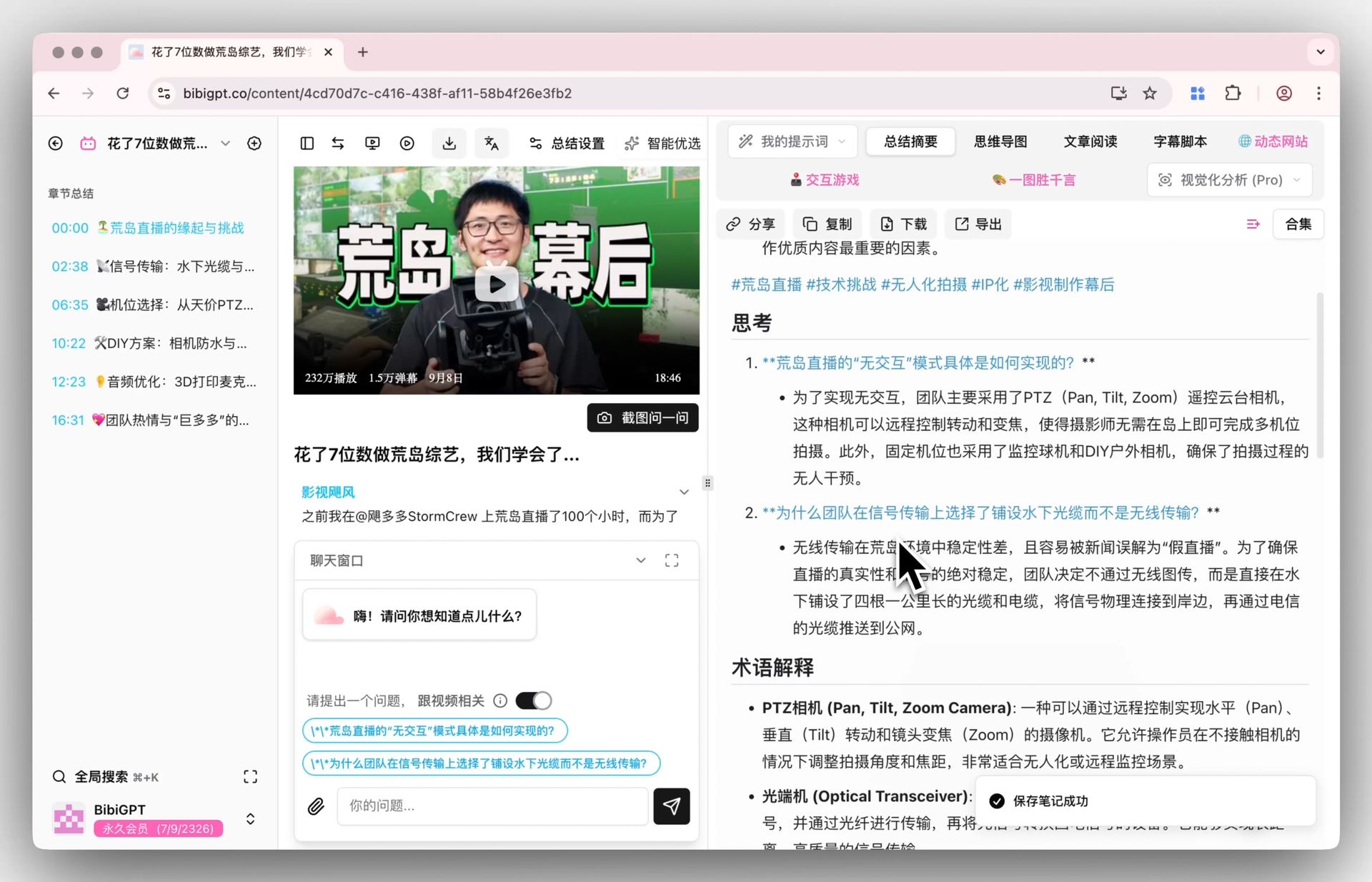
Screenshot: BibiGPT · Smart deep summary
4. Practical Workflows for the AI Long-Video Flood
News only counts when it turns into action. The two workflows below depend on no particular model and can be run today. They solve the question of what to do once there is simply more video.
Workflow one: vet first, then decide whether to watch. When you hit a 30-minute model breakdown, product demo or long interview — whether it lives on YouTube, Bilibili or a podcast — paste the link into BibiGPT first and get chaptered takeaways and a structured summary in under a minute. Read the summary, then decide whether the full runtime is worth it — skip what is not, and jump straight to the key segment in what is. This turns attention from passive drain into active allocation.
Workflow two: turn what is worth it into a searchable asset. For content that survives the first filter, go one layer deeper: generate a mind map to see the structure, jump back to the exact timestamp by keyword, ask follow-up questions on what you did not catch, and export to your notes app. What you save is not the 30 minutes today — it is the retrieval cost of every future moment when you think “I remember someone explained this.”
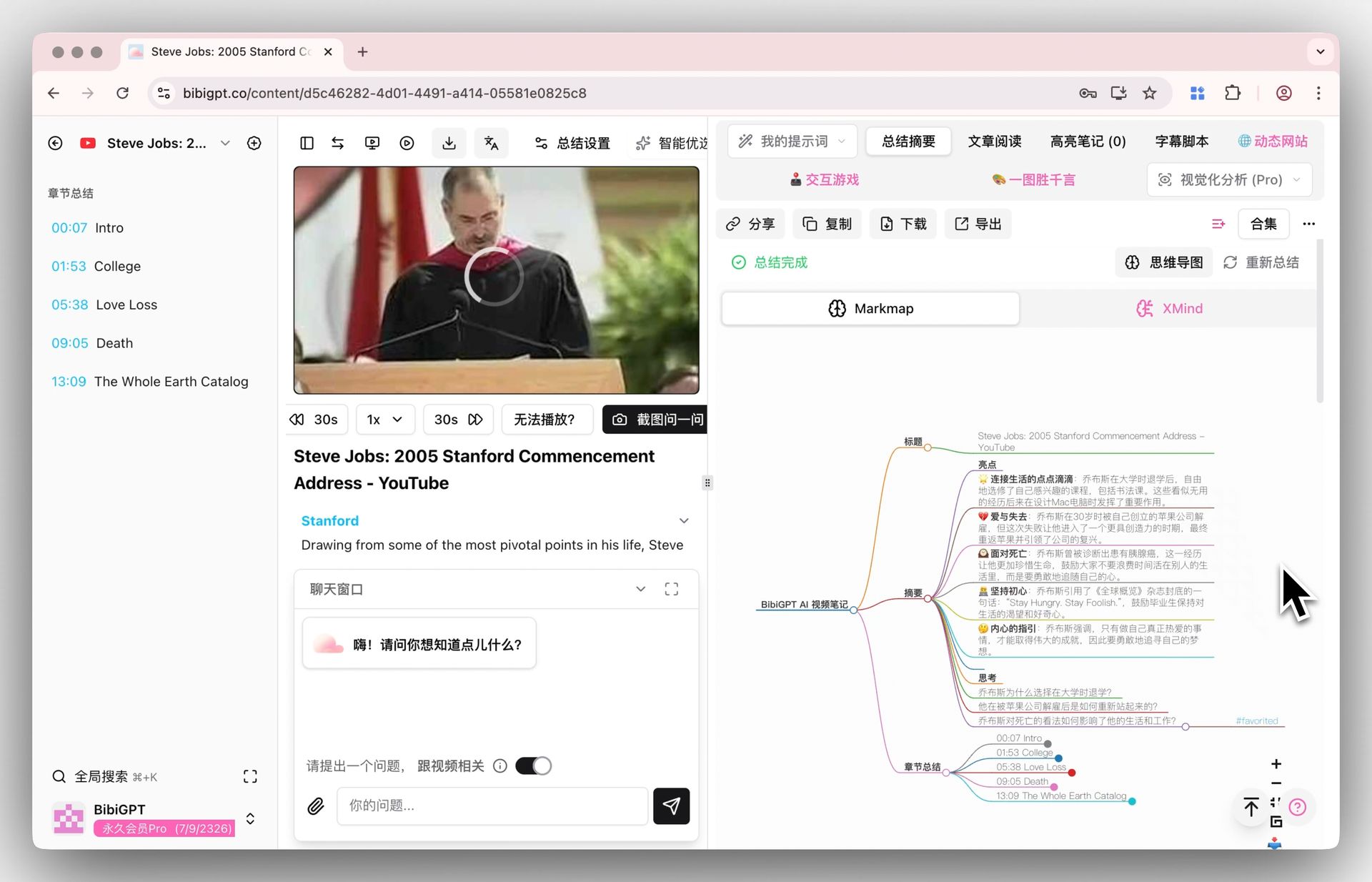
Screenshot: BibiGPT · Video mind map
BibiGPT supports 30+ mainstream audio and video platforms including Bilibili, YouTube and podcasts, plus local file upload. It also routes automatically across multiple advanced AI models that you can switch freely — you never need to think about which one is running behind the scenes.
Practical rule: The easier AI video gets to make, the more “summarize before watching” should become your default. Summarization is not a post-viewing filing tool. It is the gatekeeper that runs before you watch.
5. Our Take: Three Predictions You Can Hold Us To
Facts are commodity. A position is scarce. Each prediction below carries a deadline — come back and check the answers.
Prediction one: by June 2027, 30 seconds becomes the baseline, not the headline. The duration race will not stop here; competitors will likely follow within 6 to 12 months. If flagship models across the field are still stuck under 20 seconds by then, mark this one wrong.
Prediction two: within 2027, “AI-generated” labeling moves from platform-optional to mandatory. Once a 30-second 4K clip costs single-digit RMB, platforms that do not label voluntarily will be pushed into it by regulators. If major video platforms still have no mandatory generation labeling by the end of 2027, this one is wrong.
Prediction three: the searchable text layer over video becomes the next competitive position. The arms race on the generation side will continue, but the real bottleneck shifts to turning the flood of audio and video into text that both humans and AI can read. This overlaps with our commercial interest and needs an explicit disclosure: BibiGPT builds exactly this layer, so treat this prediction as a biased view. The falsification condition is equally clear — if by the end of 2027 the native captioning and summarization built into major video platforms is good enough to leave no room for third-party tools, this call was wrong.
Practical rule: A prediction you can be wrong about is a judgment. A prediction with no deadline and no falsification condition is a horoscope.
6. Frequently Asked Questions
Q1: Can I use Seedance 2.5 right now? Per the official rollout, access opened in stages from early July 2026 — the experience center first, API afterward. You can apply through Dreamina or Volcano Engine’s official channels.
Q2: Is 30 seconds really that different from 15? The difference is usability, not multiples. Anything under 15 seconds is raw material. Thirty seconds can carry a complete shot sequence and a narrative beat, which makes it directly shippable to social, advertising and short film.
Q3: What do 50 reference inputs actually buy you? The previous ceiling was 12. Fifty means the same character, product, scene and style can be reused consistently across a whole piece — consistency moves from post-production cleanup into the generation step itself.
Q4: How much does a 30-second video cost to generate? Official Seedance 2.5 pricing has not been published as of writing. The reference point is the previous generation, Seedance 2.0, which published pricing averaging roughly 1 RMB per second. Check official channels for current figures.
Q5: There is more AI video than ever — how do I keep up? Make “summarize first, decide second” your default. Get chaptered takeaways from AI first, then decide whether to spend the full runtime, so your attention goes to what actually deserves it.
7. Closing: Models Are No Longer Scarce — Consumption Speed Is
Seedance 2.5 is worth paying attention to, but the most useful takeaway is not the name of a model. It is this: from today onward, the amount of video you need to get through only goes up.
Pick one long video or podcast you have been meaning to watch, paste it into BibiGPT, get chaptered takeaways in under a minute, and decide whether it earns your half hour before you spend it. Making audio and video as fast to consume as text only matters more now that AI video has entered its long-form era. Free to try for new users.
Further reading: How to choose an AI video summarizer · Complete video-to-text guide
BibiGPT Team
Popular tools
More in this series
- GPT-Transcribe vs Whisper vs Grok Voice 2.0 vs MAI-Transcribe:2026 语音转文字模型怎么选
- Apple iOS 27 Opens Third-Party AI: The Era of Switchable Assistants Is Here — How to Choose for Audio and Video (2026)
- DeepSeek R1 + BibiGPT: A Practical Guide to AI-Powered Audio/Video Understanding in 2025
- DeepSeek-V4 आ गया! BibiGPT ने पहले ही दिन चार नए मॉडल + 1M कॉन्टेक्स्ट लॉन्च किए — AI वीडियो और पॉडकास्ट सारांश अब और बेहतर
- BibiGPT vs DeepSeek-V4 + Granite Speech Plus 2026: Self-Hosted Open Source vs Productized Stack
मॉडल अपडेट के सभी 7 लेख देखें →