YouTube to Mind Map: 5 Best AI Tools Compared + BibiGPT Workflow (2026 Guide)
YouTube to Mind Map: 5 Best AI Tools Compared + BibiGPT Workflow (2026 Guide)
80-word direct answer: The best YouTube-to-mind-map AI tool in 2026 is BibiGPT (30+ platforms supported, clickable nodes that jump to video timestamps, Markdown/OPML/Notion/Obsidian export, multi-model routing). Best for learners, creators, and knowledge workers. Mindgrasp suits academic English. Eightify is short-summary only. Glasp is annotation-first. If you want “one click → full editable mind map → notes integration,” BibiGPT wins.
People say “video learning is inefficient,” but the real bottleneck isn’t the video — it’s that videos lack structure. After watching, you remember a few highlights, not the spine. Mind maps reduce a video into a visualizable skeleton. AI tools compress this from 1 hour to 1 minute.
This guide tests every tool on the same source: Andrej Karpathy — State of GPT, 30 minutes.
TL;DR: 5-Tool Comparison
| Tool | Platforms | Node Quality | Click-to-Jump | Export | Languages | Pricing | Best For |
|---|---|---|---|---|---|---|---|
| BibiGPT | YouTube + Bilibili + Xiaohongshu + Douyin + Podcasts (30+) | ★★★★★ Auto 3-5 levels | ✅ Jump to timestamp | Markdown / OPML / Notion / Obsidian | EN/ZH/JA/KO/zh-TW | Free + Plus from $19.8/mo | Multi-platform users, learners, creators |
| Mindgrasp | YouTube + PDF + Docs | ★★★★ Academic-leaning | ⚠️ Partial | PDF / Docs | English-first | Free + Pro $9.99/mo | Academic, English papers |
| Eightify | YouTube only | ★★★ Short summaries | ❌ No | Markdown | English-first | Free + Premium $9.99/mo | Quick scan English videos |
| Glasp | YouTube + Web | ★★★ Highlights, not auto-structure | ⚠️ Highlight anchor | HTML / Markdown | English-first | Free | Heavy annotators |
| NoteGPT | YouTube + some Bilibili | ★★★ Auto structure | ✅ Jump | Markdown | Multilingual | Free + Pro $9.99/mo | Basic needs |
Test data based on 2026-05-07 public versions, same source video.
1. Why YouTube-to-Mind-Map Needs AI
Traditional flow:
- Watch a 30-minute video
- Pause N times to capture key points
- Organize into a mind map (XMind / MindNode / FreeMind)
- ~60-90 minutes per finished map
AI compresses this to 30s-3min and decides the hierarchy automatically:
- Level 1: Core themes (typically 3-5)
- Level 2: Key arguments per theme
- Level 3: Examples, data, citations
- Leaf: Click to jump to source timestamp
The biggest win: AI handles depth selection so you don’t think about it.
2. Tool-by-Tool Reviews
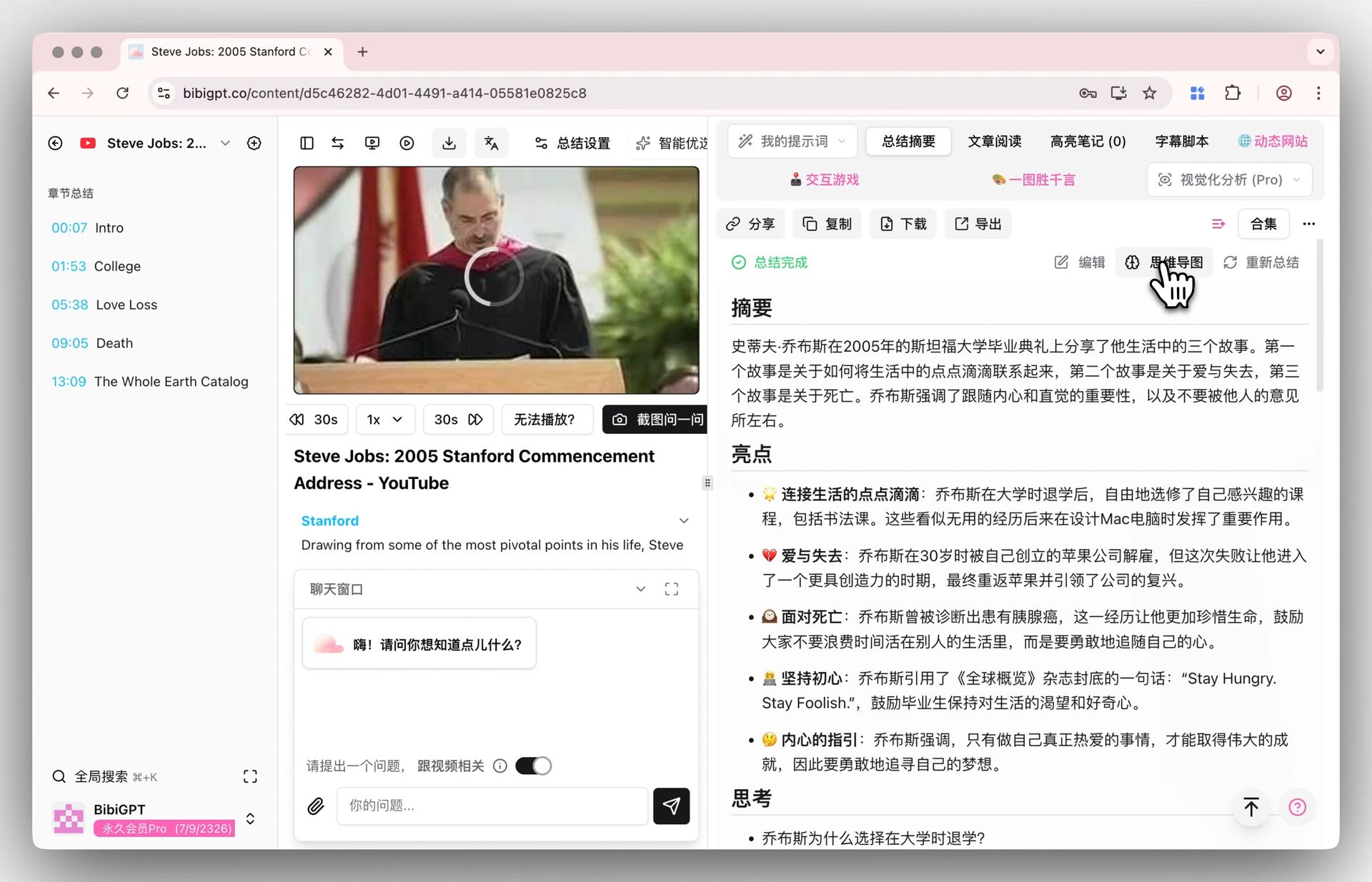
2.1 BibiGPT — Multi-Platform Aggregator + Clickable Mind Map

Pros:
- Paste links from YouTube / Bilibili / Xiaohongshu / Douyin / podcasts (30+ platforms) → instant structured mind map
- Clickable nodes — hover for timestamp, click to jump back to the source video
- Auto 3-5 hierarchical levels, follows the video’s natural flow
- One-click export to Markdown / OPML (universal for XMind & MindNode) / Notion / Obsidian
- Multi-model routing: finance / science / learning videos pick the optimal model automatically
- Native multilingual: EN / ZH / JA / KO / zh-TW
Cons:
- Free tier has daily summary limits
- Visual styling is less customizable than XMind (but content structure is stronger)
Demo: Karpathy 30-min talk → BibiGPT → 1m20s → 4-level mind map: ① 4 stages of GPT training → ② method per stage (pretraining / SFT / reward modeling / RLHF) → ③ key tricks (datasets, loss, hyperparams) → ④ cited papers + timestamps. Each leaf clicks back to video position.
2.2 Mindgrasp — Academic & English-First
Pros: PDF + YouTube dual mode. Nodes follow “premise / argument / conclusion” structure — great for paper reading.
Cons: Weak Chinese support. $9.99/mo. No timestamp jump.
2.3 Eightify — Short-Summary Style
Pros: Fast (under 30 seconds), free tier usable, great for “is this video worth watching?”
Cons: “Mind map” is closer to “summary + list” with shallow hierarchy. YouTube only.
2.4 Glasp — Annotation-First
Pros: Treats highlights as nodes — great for heavy annotators.
Cons: Not “auto mind map” — it’s “highlight + organize.” YouTube + web only.
2.5 NoteGPT — Basic Pick
Pros: Free tier, click-to-jump, multilingual.
Cons: Shallow structure (typically 2-3 levels), unclear node relationships, limited Bilibili support.
3. Deep-Dive Comparison Dimensions
3.1 Node Structure Quality
Most important metric. On the same 30-min video, can the AI:
- Auto-detect 3-5 main themes?
- Mine 2-4 key arguments per theme?
- Provide examples and data?
Result: BibiGPT > Mindgrasp > NoteGPT > Eightify > Glasp (Glasp isn’t really auto-structure).
3.2 Click-to-Timestamp
Top feature for learners.
Result: BibiGPT and NoteGPT fully support; Mindgrasp partial; Eightify, Glasp do not.
3.3 Export Formats
Mind maps are not the endpoint — you need them in XMind / MindNode / Notion / Obsidian.
Result: BibiGPT supports Markdown + OPML (OPML opens directly in XMind). Most others output Markdown only.
3.4 Platform Coverage
If you watch only YouTube, almost any tool works. If you also watch Bilibili / Xiaohongshu / Douyin / podcasts, only BibiGPT supports them natively.
3.5 Multilingual
BibiGPT: native EN/ZH/JA/KO/zh-TW. Other tools are English-first; Chinese / Japanese output often breaks.
4. The 5-Step BibiGPT Workflow: From Video to Actionable Knowledge
Step 1: Paste the link
Copy a YouTube / Bilibili URL, paste at bibigpt.co, choose “Mind Map” mode.
Step 2: Wait 30s-3min
AI builds a 3-5 level mind map with timestamps embedded.
Step 3: Interactive exploration
Hover for timestamp; click to jump; collapse/expand levels.
Step 4: AI follow-up
Ask questions on the mind map directly (“What’s the counter-argument to point #3?”). AI grounds answers in the video.
Step 5: Export + notes integration
One-click to Notion / Obsidian / Feishu / Markdown. The map joins your knowledge system.
5. SEO-Friendly FAQ
Q1: Best free YouTube-to-mind-map tool?
A: BibiGPT free tier covers daily quota with click-to-jump and multi-platform. Eightify free is OK but English-only.
Q2: Can I export to XMind?
A: Yes — BibiGPT exports OPML (XMind opens it directly).
Q3: Do these tools support Chinese videos?
A: BibiGPT, NoteGPT support Chinese output. Mindgrasp, Eightify, Glasp are mainly English.
Q4: Can mind map nodes link back to the video?
A: BibiGPT and NoteGPT yes. Most others no. This is the most important feature for learning.
Q5: Do long videos (>30 min) work?
A: Yes. BibiGPT handles 4+ hour videos and playlists, automatically chunking into multi-level mind maps.
Q6: Can a tool replace manual organization?
A: ~80% of it. AI gives the skeleton; you spend 5-10 min adding your own annotations and trimming redundant nodes.
Try BibiGPT to turn YouTube videos into mind maps: bibigpt.co. Related reads: YouTube Video Summarizer Tools — Comprehensive Guide | Granola vs BibiGPT: Meeting Notes vs Multi-Platform Summarization | AI Video Learning Methodology: Mind Maps + Spaced Repetition