
Quizlet Acquires Coconote: AI Study Tools Consolidate — Why BibiGPT Still Stands Apart
Quizlet's acquisition of AI note-taking app Coconote marks a new wave of EdTech consolidation. Here's what it means for students and why BibiGPT's video-first approach remains irreplaceable.
Quizlet Acquires Coconote: AI Study Tools Consolidate — Why BibiGPT Still Stands Apart
Quizlet's acquisition of AI note-taking app Coconote signals that the EdTech AI market has entered a consolidation phase. What does this mean for students? How will the AI learning landscape shift? And does BibiGPT — focused on video and audio learning — face any disruption?
According to edtechinnovationhub.com, Quizlet officially acquired AI note-taking app Coconote in April 2026 and immediately launched an integrated AI learning experience — combining flashcards, notes, and AI Q&A in one workflow. This move continues the EdTech consolidation trend: large platforms acquiring vertical tools to quickly fill feature gaps.
動画リンクを貼り付けてみてください
YouTube、Bilibili、TikTok、小紅書など 30+ プラットフォームに対応
Quizlet + Coconote: What Changed, and What It Means for Students
Quizlet is the world's leading flashcard and quiz platform (60M+ monthly active users), while Coconote was a specialized AI tool for converting lecture recordings into structured notes.
Key changes after integration:
- Lecture notes can now directly generate Quizlet study sets
- AI recommends practice questions and review plans based on note content
- Unified account system eliminates app switching
Potential impact on students:
- Short-term convenience: Students using both tools save switching time
- Risk: Coconote's innovation pace may slow under Quizlet's platform constraints
- Pricing uncertainty: Quizlet's free tier may shrink; some Coconote free features could go behind a paywall
This pattern repeats: NotebookLM integrating into Gemini, Microsoft Teams Meeting Notes into Microsoft 365, Notion AI into the Notion subscription. Independent AI learning tools are being absorbed — but students' specific needs remain only partially met.
The AI EdTech Consolidation Wave: Who Gets Left Behind?
The global AI in education market is projected to grow from $10.6 billion in 2026 to $42.48 billion by 2030, according to GlobeNewswire. Large platforms are expanding aggressively — but one core learning scenario remains underserved: deep learning from video and audio content.
The gap in current AI study tools:
| Tool | Strength | Gap |
|---|---|---|
| Quizlet/Coconote | Text notes → flashcards | Cannot process video/podcast content directly |
| NotebookLM | PDF/document knowledge base | Limited video support, no Chinese video platforms |
| Microsoft Teams Notes | Meeting audio transcription | Limited to enterprise meeting scenarios |
| BibiGPT | Video/audio → notes + summary + flashcards | Covers where students actually learn from |
What do students actually watch? YouTube lectures, Bilibili courses, podcast interviews, recorded classes — all video and audio. Quizlet + Coconote starts from text notes; students must first convert video content to text themselves before the learning workflow begins.
BibiGPT's Learning Workflow: From Video Directly to Flashcards
BibiGPT's core advantage is that it bridges "video and audio learning content" and "structured note review" — starting from the media itself, not from text.
The BibiGPT student workflow:
- Paste a course video link (YouTube, Bilibili, Xiaoyuzhou, and 30+ platforms)
- AI generates structured summary + mind map automatically
- Click "Flashcards" — AI creates Q&A cards from the video content
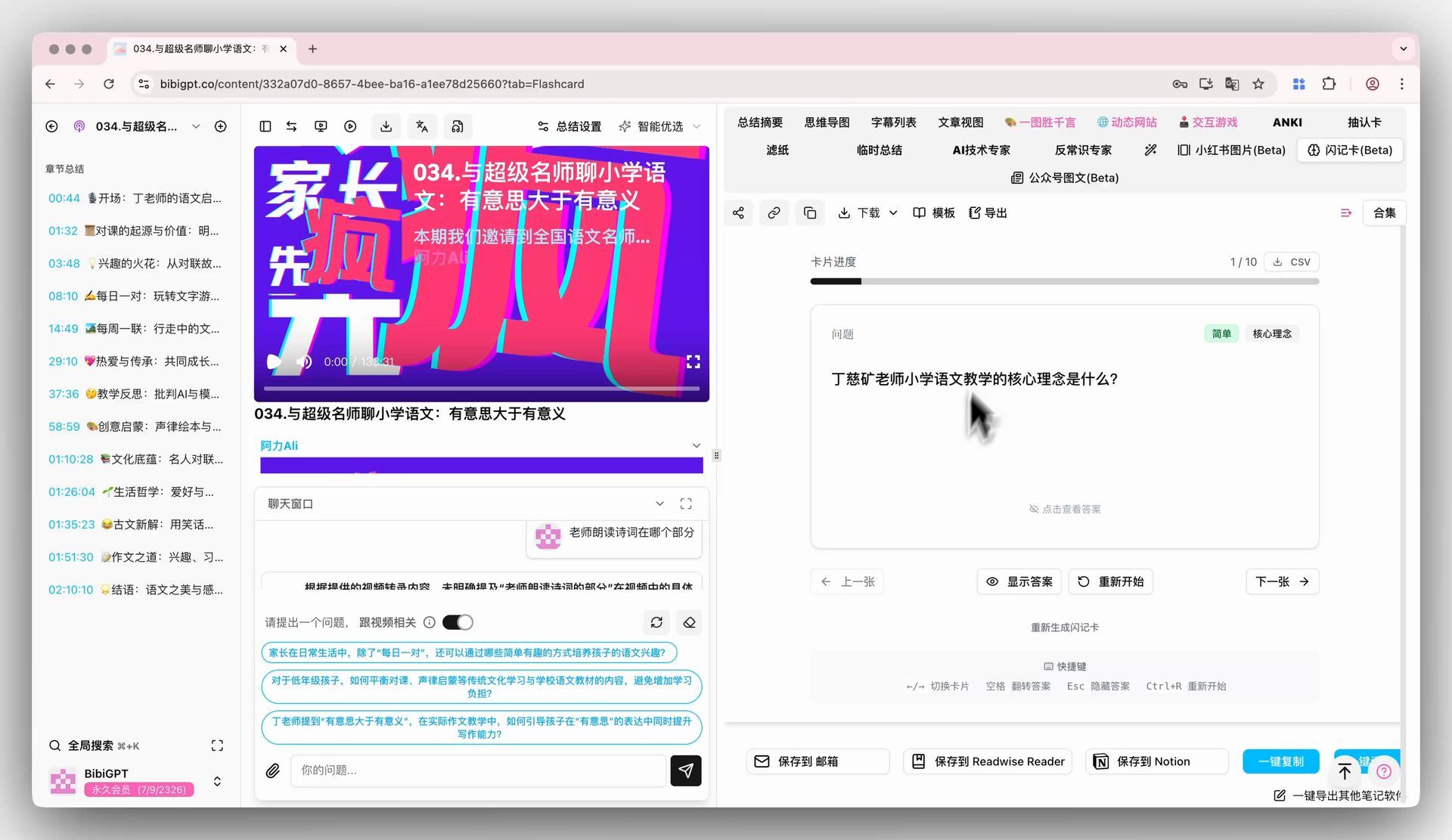 BibiGPT Flashcard Interface
BibiGPT's flashcard feature auto-generates difficulty-rated Q&A cards from video content. You can review them in-app or export as CSV to import into Anki for spaced repetition. This capability is what Quizlet + Coconote can't replace — they start from text; BibiGPT starts from video.
For more student learning workflows, see: AI Video Note-Taking Workflow Guide and Best AI Lecture Summarizer Tools 2026. Also explore free audio transcription online for your lecture recordings.
Tool Recommendation Guide
Quizlet + Coconote is right for:
- Students whose notes are already in text form
- Learners primarily using textbooks and slide decks
- Heavy existing Quizlet users
BibiGPT is right for:
- Students watching online courses (YouTube, Bilibili, MOOCs)
- Anyone learning from lecture videos, podcasts, or interviews
- People who want to turn video content directly into reviewable notes
The two tools can complement each other: BibiGPT processes video content and exports text notes or flashcard CSVs; Quizlet handles long-term memory reinforcement. The key is knowing your starting point — text versus video.
FAQ
Q: Can I still use Coconote for free after the Quizlet acquisition? A: Core Coconote features remain available for now, but based on historical M&A patterns, pricing often shifts during integration. Check official announcements for updates.
Q: Can BibiGPT and Quizlet work together? A: Yes. Export BibiGPT's generated flashcards as a CSV file, then import into Quizlet to create a study set. This bridges video-derived knowledge with Quizlet's spaced repetition testing.
Q: Is BibiGPT's flashcard feature free? A: BibiGPT offers a free tier including basic summarization. Flashcard generation and CSV export are available in the membership plan.
Start your AI efficient learning journey now:
- 🌐 Official Website: https://aitodo.co
- 📱 Mobile Download: https://aitodo.co/app
- 💻 Desktop Download: https://aitodo.co/download/desktop
- ✨ Learn More Features: https://aitodo.co/features
BibiGPT Team