Douyin's Daily AI News Feed + Ask for More: Why BibiGPT Is Still the Deep-Read Layer (May 2026)
Douyin’s Daily AI News Feed + Ask for More: Why BibiGPT Is Still the Deep-Read Layer (May 2026)
80-word direct answer: As of 2026-05-12, Douyin (China’s TikTok) shipped a “Daily AI News” channel with one-tap “Ask for More” Q&A. It’s great for fast headlines, but the Q&A only works on the current video — there’s no cross-video, cross-platform, or long-video deep read. Paste Douyin links into BibiGPT to get timestamped deep summaries, mind maps, multi-video AI chat, and 30+ platform coverage. Douyin builds the news flash; BibiGPT builds the deep read.
Background: Douyin Ships AI News Daily + Ask for More in May 2026
Per 36kr’s 2026-05-06 report, Douyin officially launched a “Daily AI News” channel that aggregates trending news-style short videos with AI-generated summary cards, plus an “Ask for More” button on each video that lets users chat with an AI about its content. The roll-out follows three clear steps:
- Daily AI News: each day’s trending news clips are surfaced with a one-line AI summary attached to the card, so users see the conclusion before deciding to play.
- Ask for More: tap the button on any video to start a chat — “what’s the backstory?”, “who are the people involved?”, “what’s the broader context?”
- In-app loop: the entire experience stays inside Douyin — no jumping to external tools.
This is the first time a major Chinese short-video platform has shipped “summary + follow-up Q&A” as a default surface, signalling a real shift from “swipe-to-watch” to “read-and-ask”.
Timeline:
| Date | Event |
|---|---|
| H2 2025 | Douyin beta-tests AI summary cards internally |
| 2026-05-06 | 36kr reports official launch of Daily AI News + Ask for More |
| 2026-05-12 (today) | Users see the AI summary + Ask for More button in the Douyin app news tab |
Deep Analysis: Tech, Market, Ecosystem
Tech: Short-Video AI Summaries Hit “Daily Refresh” Scale
The headline isn’t “can Douyin make summaries” — most platforms have beta-tested this since 2024. The signal is that Douyin’s video-to-text + LLM summary pipeline is now stable and cheap enough to run daily across the entire trending news set.
Reference point: BibiGPT has generated over 5 million AI summaries cumulatively across 30+ platforms over the past four years, serving over 1 million users — that’s what a focused third-party tool can do at scale. Now that a major platform itself is doing daily refreshes, “AI summarization” graduates from a tool capability to baseline infrastructure.
Market: Information Consumption Speed Gets Redefined
Watching video used to be a time-expensive action — one minute of content costs one minute of attention. AI summary + Q&A lets users substitute “read a 5-second card → decide whether to ask follow-ups” for “watch the full 60 seconds”. Information density per unit of time goes up sharply.
This cuts both ways for creators:
- Upside: the AI surfaces the core conclusion from your video to impatient viewers who would have scrolled past.
- Downside: completion rate and engagement may drop because users get their answer from the summary layer and move on.
Ecosystem: “Short-Video AI” Becomes Standardized
Douyin sets the template: “news-style short video → AI summary → one-tap Q&A”. Other platforms (YouTube Shorts, Bilibili, Xiaohongshu, WeChat Channels) will follow in months, not years. This creates a clean division of labor for third-party tools: platforms own the “single-video news flash”; third-party tools own “cross-video, cross-platform, cross-format deep reads”.
What This Means for BibiGPT Users (by Role)
Creators: Turn Douyin Trends Into Your Own Assets
Douyin’s Daily AI News helps you spot hot topics fast, but its Ask for More only loops on one clip. To write a long-form post, shoot a follow-up video, or produce a Xiaohongshu carousel, you need to feed a group of related videos (Douyin clips + Bilibili long-form + relevant podcasts) to an AI together.
Practical flow:
- Scan Douyin’s “Daily AI News” feed and pick 5-10 short videos on today’s hot topic.
- Add Douyin URLs + related Bilibili long videos + a podcast episode or two — paste them all into BibiGPT in a single batch.
- BibiGPT produces a unified collection summary plus a cross-video AI chat — ask “what are the different angles across these clips on the same event?”
- Export as long-form article directly for your newsletter / blog / WeChat / Xiaohongshu.
Douyin’s Ask for More tells you “what’s in this clip”; BibiGPT tells you “what’s the full understanding around this topic”.
Students / Researchers: Douyin Is the Discovery Surface, BibiGPT Is the Archive
Students use Douyin to discover topics (“what’s everyone talking about?”). But for essays, lecture notes, research archives, you need:
- Full timestamped transcripts (include original subtitles in note export);
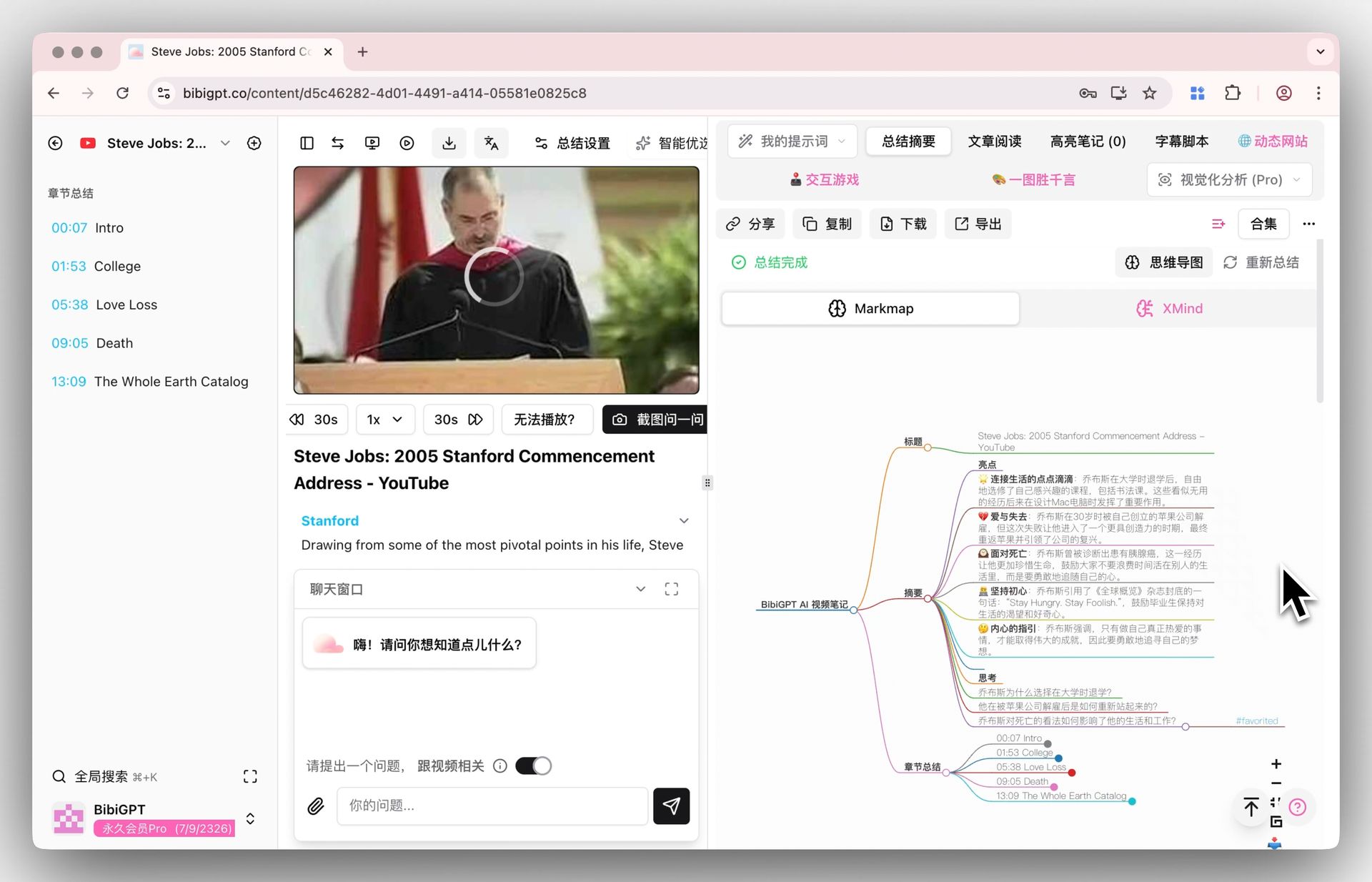
- Chapter splitting + mind map;
- Multi-language translation (native zh / en / ja / ko output);
- Cross-video AI follow-up chat.
Douyin’s Ask for More is one-shot and ephemeral. BibiGPT’s summaries and conversations get archived into collections, so months later you can still find the source link and the original conversation.
Professionals / Indie Media: Turn the Douyin Stream Into a Searchable Knowledge Base
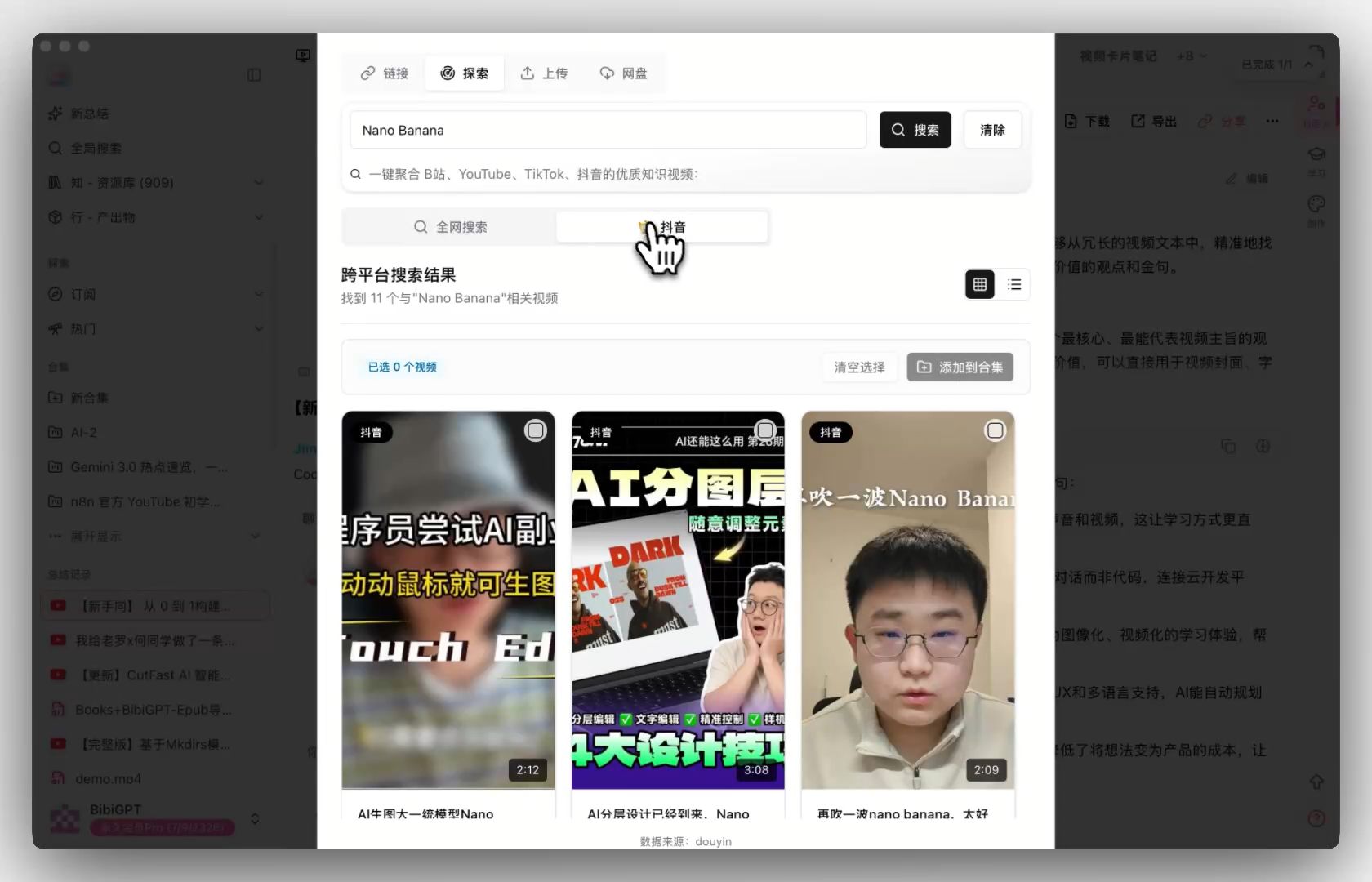
Douyin’s Daily AI News refreshes fast but it’s hard to find a specific video from three days ago — the algorithm favors fresh content. To turn Douyin into a searchable, re-usable knowledge base, BibiGPT’s global search with Douyin as a data source is the better entry point: enter a keyword, BibiGPT searches Douyin, Bilibili, and YouTube together, then batches them into summaries.
Douyin × BibiGPT: Three Concrete Workflows
Here are the three recommended “Douyin → BibiGPT” workflows as of May 2026.
Workflow 1: Ride a Trend for a Long-Form Post
- Swipe Douyin’s Daily AI News for 2 minutes, grab 3-5 short-video links;
- Open BibiGPT on desktop or mobile, paste multiple links at once;
- Wait 30-60 seconds — BibiGPT produces a collection summary + mind map;
- Switch to the AI chat window and ask “what’s the core tension across these videos?”, “draft an 800-word post emphasizing angle X”;
- Convert to long-form article, paste into your editor of choice.
Total time: 5-10 minutes. Roughly 60% faster than watching every clip end-to-end and stitching together your own notes.
Workflow 2: Reverse-Engineer a Viral Douyin Creator
- In BibiGPT, run global search with Douyin as data source, enter the creator’s name / keyword;
- Batch-add 10-20 clips into a collection;
- The collection produces a unified deep summary + chapter splits;
- In collection AI chat ask “what patterns recur in this creator’s content?”, “what’s the most-cited argument across their videos?”;
- Export to Markdown / Notion.
Workflow 3: Build an Academic or Course Archive
- Drop relevant Douyin clips into BibiGPT;
- Use include original subtitles in note export to retain full transcripts;
- For multilingual work, auto-translate on upload in zh / en / ja / ko;
- Archive into a collection — searchable by keyword months later.
Forward Outlook: Three Trends + Where Spin-Off Products Will Emerge
- “AI summary on short videos” will become default across every platform. Expect YouTube Shorts, Bilibili, Xiaohongshu, WeChat Channels to ship similar daily news channels before H2 2026 ends. Third-party value won’t come from “can you do summaries” — it’ll come from “can you do cross-platform, cross-format deep consumption”.
- “Ask for More” will evolve from single-video → multi-video → knowledge-base Q&A. Douyin is at step one. Step two — Q&A across a topic’s video cluster — is what BibiGPT’s collection AI chat already does, just packaged for power users instead of mass-market.
- AI-era content tools will split into “live consumption” vs “archive + re-use” layers. Platforms own immediate consumption. Third-party tools own long-term archival and reuse. BibiGPT’s collections, Cubox integration, Notion / Obsidian sync are all moves in that direction.
Spin-off product opportunity: “cross-platform asset aggregation → auto-rewrite-and-publish” workflows for creators. Expect this to be one of the fastest-growing creator-tools categories in the next 12 months.
FAQ
Q1: Douyin’s Ask for More already supports follow-up Q&A — why use BibiGPT?
Douyin’s Ask for More is scoped to one video at a time, and the chat history isn’t exportable. BibiGPT’s AI chat ranges across multiple videos, multiple platforms, entire collections, with full exportable conversation logs. In short: Douyin is “in-video Q&A”, BibiGPT is “topic-level Q&A”.
Q2: Can BibiGPT handle Douyin videos directly? Do I need to log in?
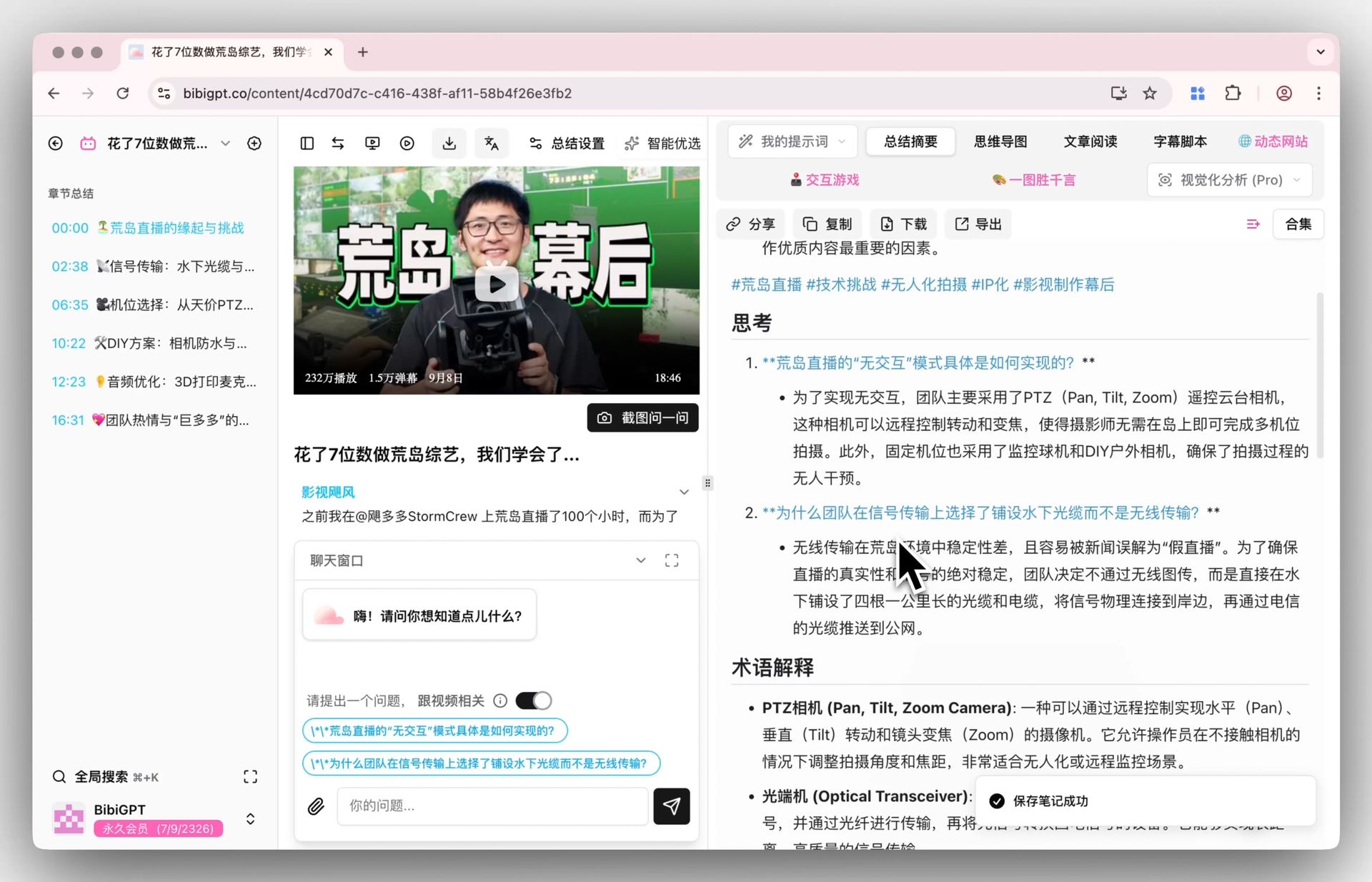
Yes. Paste the Douyin video URL into the BibiGPT input box — no Douyin login required. BibiGPT extracts subtitles and generates the AI summary automatically.
Q3: Will BibiGPT be replaced by Douyin’s Daily AI News?
No — they’re complementary. Douyin’s Daily AI News is a discovery surface (telling you what’s hot today). BibiGPT is a deep-read tool (turning what you discover into your own assets or archive). Best workflow: discover on Douyin, deep-read on BibiGPT.
Q4: How fast does BibiGPT process a Douyin video?
A single Douyin short clip typically goes from “paste link” to “AI summary ready” in 10-30 seconds; batch jobs are queued sequentially. BibiGPT has generated over 5 million summaries across more than 1 million users — processing speed and stability are among the strongest in the third-party tool space.
Q5: Does BibiGPT support TikTok, Bilibili, YouTube too?
Yes. BibiGPT supports 30+ major audio/video platforms including Douyin, TikTok, Bilibili, YouTube, Xiaohongshu, podcasts, Apple Podcasts, Spotify. Paste the link — no tool switching.
Q6: Languages other than Chinese?
Yes. Native zh / en / ja / ko output. Auto-translate on upload for English / Japanese / Korean clips works particularly reliably.
Q7: What’s available on the free tier?
Basic video summary, subtitle extraction, and core AI chat all work for free users. Batch processing, advanced deep-summary configs, custom transcription engines, and other Pro features need Pro / Lifetime.
Further Reading
- Douyin & TikTok: Global search with Douyin source | Douyin short video generation
- Deep reading: Smart deep summary | Mind map inline with summary | AI conversation window
- Cross-platform workflows: Batch summarize multi-link | Video to long-form article
- Platform comparisons: Top Douyin video summary tools 2025
Douyin shipped “Daily AI News + One-tap Q&A” and nailed the news-flash layer. BibiGPT sits in the adjacent niche — making short videos deep-readable, archivable, and cross-platform-aggregatable. Models aren’t scarce anymore; speed of consuming content is. Wherever consumption gets faster, that’s where value accrues.
Open BibiGPT and paste a few clips from today’s Douyin Daily AI News. In ten minutes you’ll have a ready-to-publish article in hand.
—— BibiGPT Team