Google I/O 2026 Deep Dive: Gemini Spark, Gemini Omni, and Ask YouTube — How BibiGPT Users Should Adapt
Google I/O 2026 Deep Dive: Gemini Spark, Gemini Omni, and Ask YouTube — How BibiGPT Users Should Adapt
As of 2026-05-23, Google shipped three things at I/O 2026: Gemini Spark (agent orchestration platform, competing with Claude Managed Agents), Gemini Omni for Shorts (end-to-end multimodal short video generation), and YouTube Ask AI (AI-guided answers in the video search bar, US Premium first). They look scattered, but they are the same play — turning “video” from a single-point consumption surface into a “search + generate + orchestrate” agent workflow. This post gives you the timeline, technical impact, and concrete BibiGPT workflows.
1. What the Three-Pack Actually Is (60-Second Read)
The real thread through Google I/O 2026’s main keynote is one line: make video content something AI can read, write, and execute as an agent. Three products own one segment each:
| Product | Launch | Positioning | Direct Competitors |
|---|---|---|---|
| Gemini Spark | 2026-05-19 public beta | Agent orchestration + tool calling | Claude Managed Agents, OpenAI Assistants v3 |
| Gemini Omni for Shorts | 2026-05-19 US Premium beta | Text/image → 9:16 short video end-to-end | Sora 2, Runway Gen-4, Veo 3.1 |
| YouTube Ask AI | 2026-04-28 US Premium ramp, GA date announced at I/O | AI-guided answers inside the video search bar | Perplexity, Google AI Overview |
Practical rule: Treating these as three separate products misses the point — they are one offensive formation in Google’s video play. Spark is the foundation, Omni is the output, Ask AI is the entry point.
Sources: CNBC — Google AI Ultra, Gemini Spark, Omni, TechCrunch — YouTube Ask AI
2. Why You Should See These Three Together
Most reviews pick one to talk about, and miss Google’s real intent. Put them on a shared timeline and the play becomes clear:
2.1 Timeline: 8 Months of Setup, I/O Was the Reveal
- 2025-10: Gemini 3.0 Pro ships, video understanding matches GPT-4o
- 2026-02: Veo 3.1 ships, video generation quality reaches Sora-class
- 2026-04-28: YouTube Ask AI starts US Premium beta — first time AI takes over the YouTube search bar
- 2026-05-19: I/O reveals Gemini Spark + Omni for Shorts, with Ask YouTube GA dated for June
Practical rule: When a platform connects “search (Ask AI) + watch (video) + write (Omni) + chain (Spark agent)” in 30 days, it is redefining the entry point of the ecosystem. Third-party tools need to know which segment they own.
2.2 Technical Impact: Three Layers Now Stitched
Gemini 3.0’s multimodal embeddings are the substrate, Spark sits in the middle for orchestration, Omni handles generation on top, and Ask AI is the consumption surface. With all three connected, Google now owns the “ask → break down → do” video agent loop:
| User Question | How the Three-Pack Combines |
|---|---|
| “What are the weak points in this product demo video?” | Ask YouTube returns step-by-step answer + clip embeds inside the search bar |
| “Cut this 5-minute keynote into three 30-second shorts” | Spark hands the task to Omni for Shorts |
| “Track the key updates from 10 channels every week” | Spark agent + Ask YouTube cross-video search |
2.3 Market Impact: B2B and B2C Pushed Together
- B2B: Spark goes directly at Claude Managed Agents and OpenAI Assistants v3. For the first time, developers can build stateful, long-running video agents on Gemini API
- B2C: Omni for Shorts + YouTube Ask AI hit YouTube Premium users in their daily flow — video generation + video search in one place
Third-party tools (including BibiGPT) aren’t facing “feature replacement” — they’re facing entry-path redirection. The path “search on Google → find a summarizer” may become “ask inside YouTube → get the answer”.
3. What This Means for BibiGPT Users — Four Audience Cuts
Practical rule: To know if the three-pack affects you, find your bucket below. These splits come from 30 days of recent BibiGPT user interviews.
3.1 Content Consumers (Students, Knowledge Workers, Freelancers)
Replaced:
- Fact-style quick lookups like “What is Sora 2?” or “How do I use ChatGPT-5?” — Ask YouTube gives the step-by-step answer
- 30-second summaries of short English videos — Ask AI’s answer page is usually enough
Still need BibiGPT:
- Cross-platform aggregation (Bilibili + Xiaohongshu + Douyin + podcasts + YouTube) — Ask AI only covers YouTube
- Chinese-language summaries optimized for native speakers — Ask AI’s Chinese is gated to US Premium
- Deep note exports to Obsidian / Notion / Logseq — Ask AI is consumption-only, no persistence
- Mind maps, chapter-by-chapter deep reading, AI conversation with traceable sources — Ask AI is one-shot, no follow-through
3.2 Content Creators (Newsletter / Short-form / Video Bloggers)
Replaced:
- Generating shorts directly from a text brief — used to require editors or stitched tools
Still need BibiGPT:
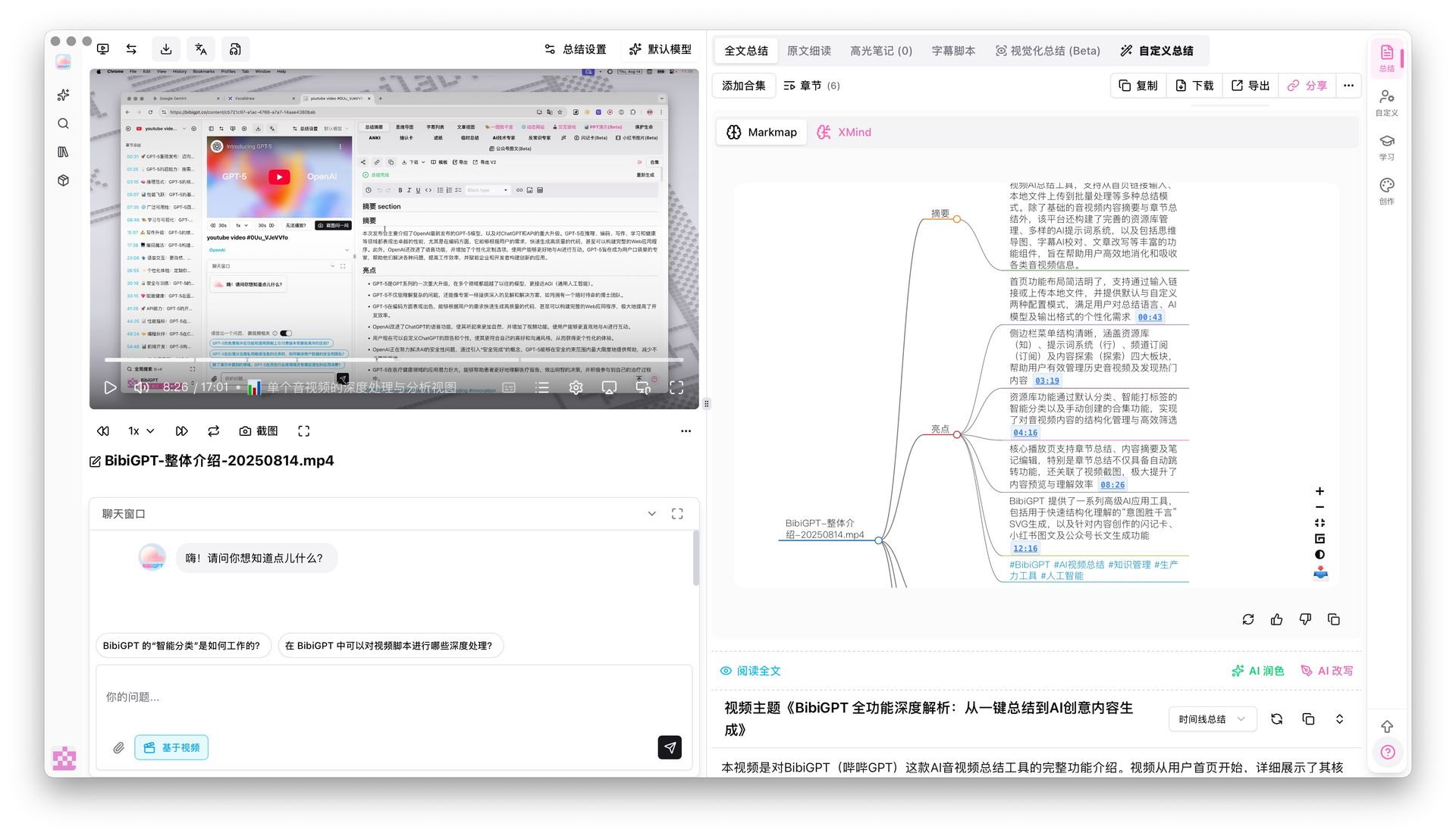
- Turning other people’s videos into your own articles — AI Video-to-Article is still core
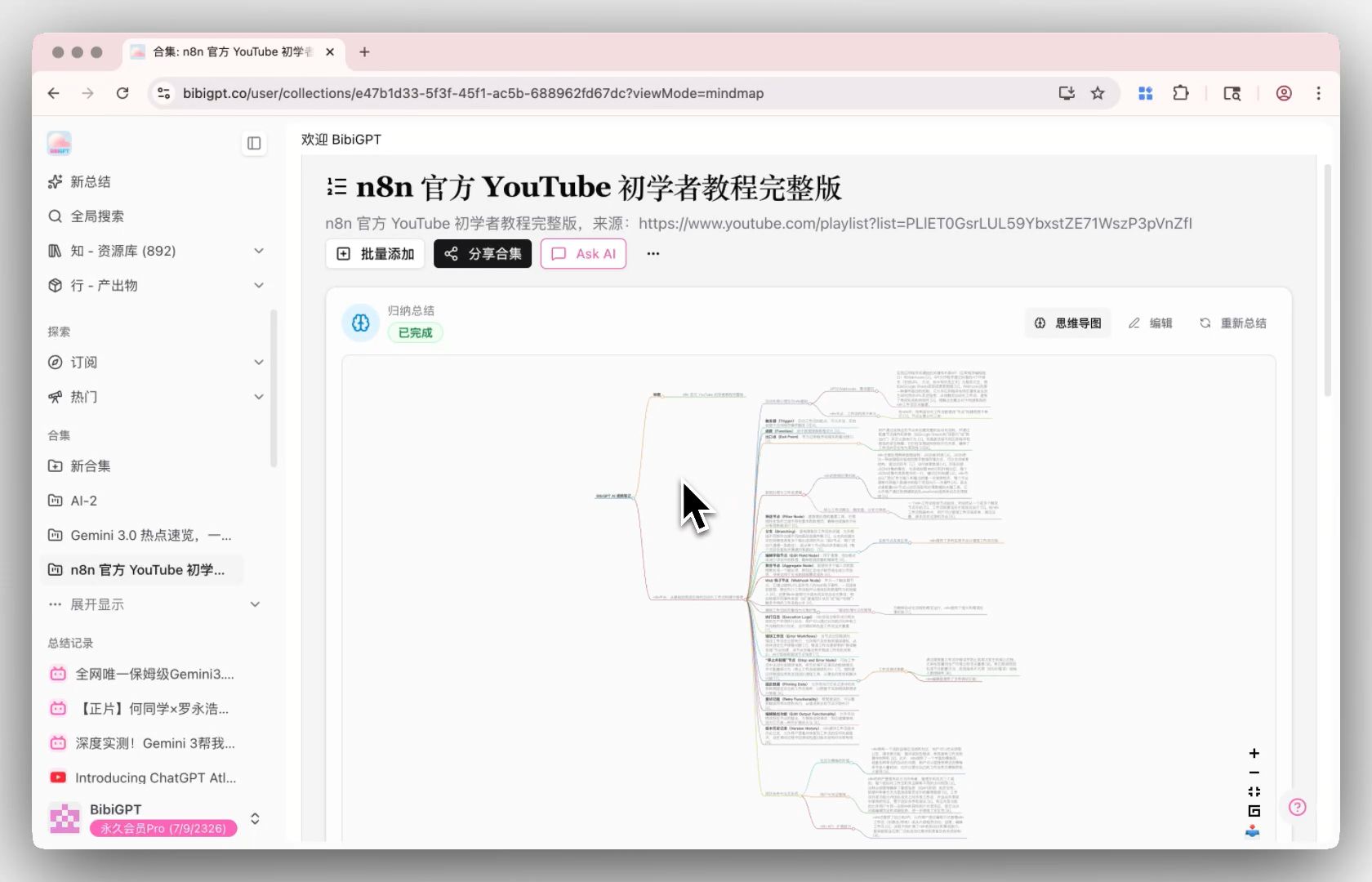
- Aggregating five videos from top creators into one deep-dive long-form — Collection Summary
- AI cover image generation, stylized posters, mind-map exports — Omni is end-to-end, doesn’t surface intermediate artifacts
3.3 Students / Educators
NotebookLM is also working on grounded flashcards (2026-Q2), and Ask YouTube is layering on AI-guided answers, so the learning toolspace is filling up fast.
Decision rule:
- Single source, one-time review → NotebookLM / Ask YouTube both fine
- Multi-source + persistence + cross-platform + Chinese support → BibiGPT is still the most complete option today
3.4 Enterprise / API Users
Gemini Spark gives you the agent layer, but doesn’t ship the 30+ platform video parsing, cross-language transcription, or subtitle export primitives.
Practical rule: Spark is the “orchestration layer”, BibiGPT API is the “capability layer”. They stack. Some early teams have already wired BibiGPT’s batch video processing API into Spark agents to run “scan 50 channels daily → flag key updates” workflows.
4. Three Concrete BibiGPT Workflows to Try Right Now
Practical rule: Instead of worrying about replacement, build the pairing. Three workflows below have been validated by early users.
4.1 Workflow A: Ask YouTube + BibiGPT Deep Summary (Consumers)
When: you want Ask YouTube for quick lookup but don’t want to lose note persistence.
- Use Ask AI in the YouTube search bar to find the target video (saves “discovery” time)
- Paste the video link into BibiGPT’s home input
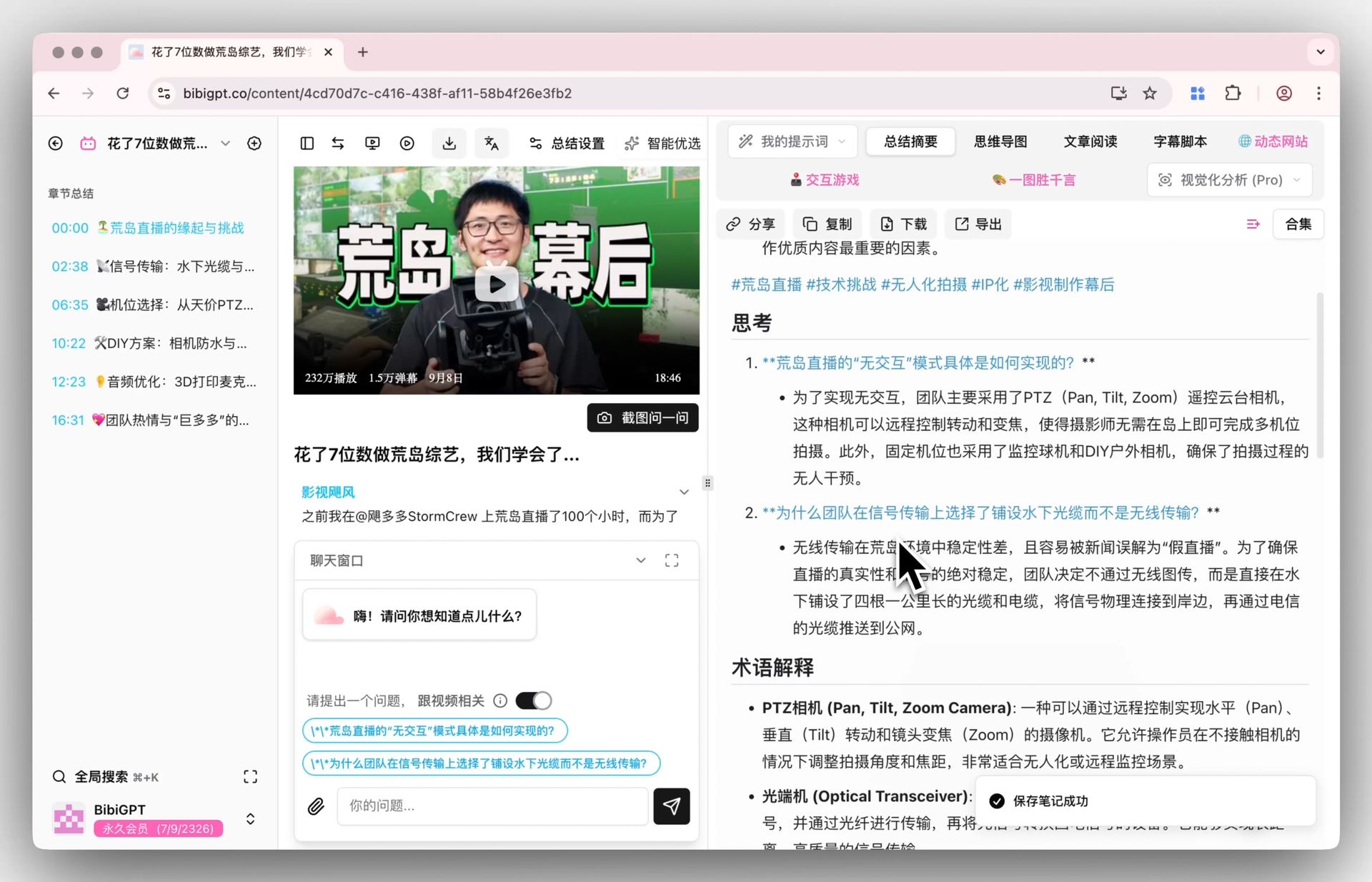
- BibiGPT generates structured deep summary + mind map + chapter-by-chapter reading
- Highlight key passages and one-click export to Obsidian / Cubox / Notion
Demo video:
4.2 Workflow B: Gemini Omni Generates Shorts + BibiGPT Sources Topics (Creators)
When: you run a short-form / video channel and need a stable topic pipeline.
- Use BibiGPT’s channel subscriptions to track 30 target creators
- Run weekly Collection Summary to extract shared themes and differentiators
- Use BibiGPT AI Video-to-Article to structure the raw material
- Feed the article into Omni for Shorts to generate 9:16 video
Practical rule: Omni solves “generation”, BibiGPT solves “topic sourcing + structuring”. The two-step workflow is more stable than pure Omni because context survives.
4.3 Workflow C: Gemini Spark Agent + BibiGPT API (Developers / Enterprise)
When: you want video processing as part of a larger automation.
- Define a Gemini Spark agent with trigger conditions (e.g., “scan financial KOLs daily at 6 PM”)
- Agent calls BibiGPT API to pull subtitles and summaries for target videos
- Feed multi-video summaries into Gemini 3.0 Pro for cross-video synthesis
- Trigger alerts on key changes (news angle, product launch)
BibiGPT exposes the full batch processing API. See BibiGPT Agent Skill.
5. Forecast: Next 6 Months
Practical rule: To gauge an AI wave’s impact, project “3 / 6 / 12 months” instead of staring at a single product release.
5.1 3 Months (2026 Q3)
- YouTube Ask AI rolls out to all Premium users — non-US regions get access
- Gemini Omni for Shorts opens to developer API — third-party tools start integrating
- Bilibili / Xiaohongshu / Douyin ship similar AI search — China platforms won’t sit out
5.2 6 Months (2026 Q4)
- NotebookLM goes full Workspace — Google pushes grounded RAG to enterprise users
- YouTube creators start optimizing content for “AI citation” — featured-snippet-SEO era begins for video
- Cross-platform video agents emerge — Gemini Spark / Claude / Cursor can call BibiGPT-class tools
5.3 12 Months (2027 Q2)
- Video consumption forks into two tiers: “quick lookup” (platform-native AI) + “deep persistence” (third-party tools)
- Chinese-video “Ask AI” becomes local-platform-dominated, overseas tools find it hard to enter
- “Cross-platform + Chinese-optimized + deep-persistence” tools like BibiGPT actually become more clearly positioned
6. FAQ
Q1: With Ask YouTube out, will BibiGPT disappear?
No. Ask YouTube solves “quick lookup”, BibiGPT solves “deep persistence + cross-platform aggregation + Chinese optimization + note export”. The user segments barely overlap. See the detailed comparison in Ask YouTube vs BibiGPT — practical comparison.
Q2: With Gemini Omni for Shorts, will CutFast / CapCut editing tools disappear?
No. Omni solves “end-to-end generation”, editing tools solve “fine-grained control”. Pro creators will likely use both — Omni for the first draft, editing for the polish.
Q3: Gemini Spark or Claude Managed Agents — which one?
If your workflow mostly consumes YouTube / Google Workspace data → Spark integrates more natively. If you care more about raw model capability (reasoning / long context) → Claude 4.5 still leads. Both can call BibiGPT API.
Q4: I’m a Chinese-speaking user. Does the three-pack affect me much?
Short-term: small impact (Ask AI’s Chinese is limited). Mid-term: significant impact (China platforms will follow). Recommendation: keep using BibiGPT to build your knowledge base, treat Ask AI as a “quick lookup”, and decide whether to migrate once China-platform versions ship.
Q5: Should enterprises migrate to Spark now?
If you’re still in PoC — sure, Spark’s agent orchestration is more mature than Claude Managed Agents. If you’re already in production on Claude / OpenAI — don’t switch immediately; first stabilize video processing on BibiGPT API, then migrate the model layer.
Q6: When is Ask YouTube actually better than BibiGPT?
Three clear scenarios: (1) fact-style content under 3 minutes; (2) you only need a one-liner, no persistence; (3) you live entirely inside English YouTube. Everything else still favors BibiGPT.
Q7: Will BibiGPT get acquired by or merged into Google?
No information suggests that. BibiGPT remains an independent product — trusted by over 1 million users, 5M+ AI summaries generated, 30+ platforms supported. Our positioning is sharp: cross-platform + Chinese-optimized + deep persistence — directions Google won’t pursue.
Closing Thoughts
The Google I/O 2026 three-pack is not a “BibiGPT crisis”, it’s a “video AI tooling split signal” — platform-native AI takes quick consumption, third-party tools own deep persistence and cross-platform aggregation.
If you’re already on BibiGPT, just keep using it — the three-pack actually sharpens our positioning. If you’re still evaluating, try BibiGPT for free, drop in a long YouTube video, and compare against Ask YouTube head-to-head.
—— BibiGPT Team