Bluedot Apple Watch vs BibiGPT: Which AI Note-Taking Tool Is Better for International Students?
Bluedot Apple Watch vs BibiGPT: Which AI Note-Taking Tool Is Better for International Students?
Picture this: you’re sitting in a lecture hall, the professor is racing through slide 20, your hand is writing as fast as it can, and in the back of your mind you’re wondering — when does the Zoom recording come out? Should I tap my Apple Watch to start recording right now? During exam season, every decision about how you capture and process course content can make or break your study efficiency.
In 2026, AI note-taking tools for international students have split into two clear camps: real-time recording and post-hoc digestion. Bluedot launched an Apple Watch lecture recording feature, built around wrist-based, bot-free capture. BibiGPT focuses on processing recorded video after the fact — helping you quickly extract the key points from Zoom replays, Coursera courses, and YouTube lectures. This isn’t a question of which is better overall; it’s a question of which fits your specific learning context.
This article compares both tools honestly, from the perspective of what actually matters during June exam season — and gives you a clear, opinionated recommendation, not a wishy-washy “it depends.”
What Is Bluedot Apple Watch, and What Problem Does It Solve?
Bluedot launched its Apple Watch lecture recording feature in May 2026. The core idea is simple: move the recording trigger to your wrist so you never have to pull out your phone in class.
Tap once on your watch to start, record throughout the session, and the audio is automatically uploaded and transcribed afterward. Bluedot supports transcription in 100+ languages — English, Mandarin, Spanish, French, Japanese, and more — making it genuinely useful in multilingual university environments. Critically, it uses a “bot-free” approach: no meeting bot needs to be added to your Zoom or Teams call, so it works equally well for in-person and hybrid classes.
Key specs:
- Hardware: Apple Watch (Series 4 and above)
- Free tier: 180 minutes/month
- Paid plan: $14/month (unlimited recording)
- Features: Real-time audio capture → automatic transcription → AI Q&A across your last 10 lectures
- Best for: In-person lectures, classroom discussions, office hours, group meetings
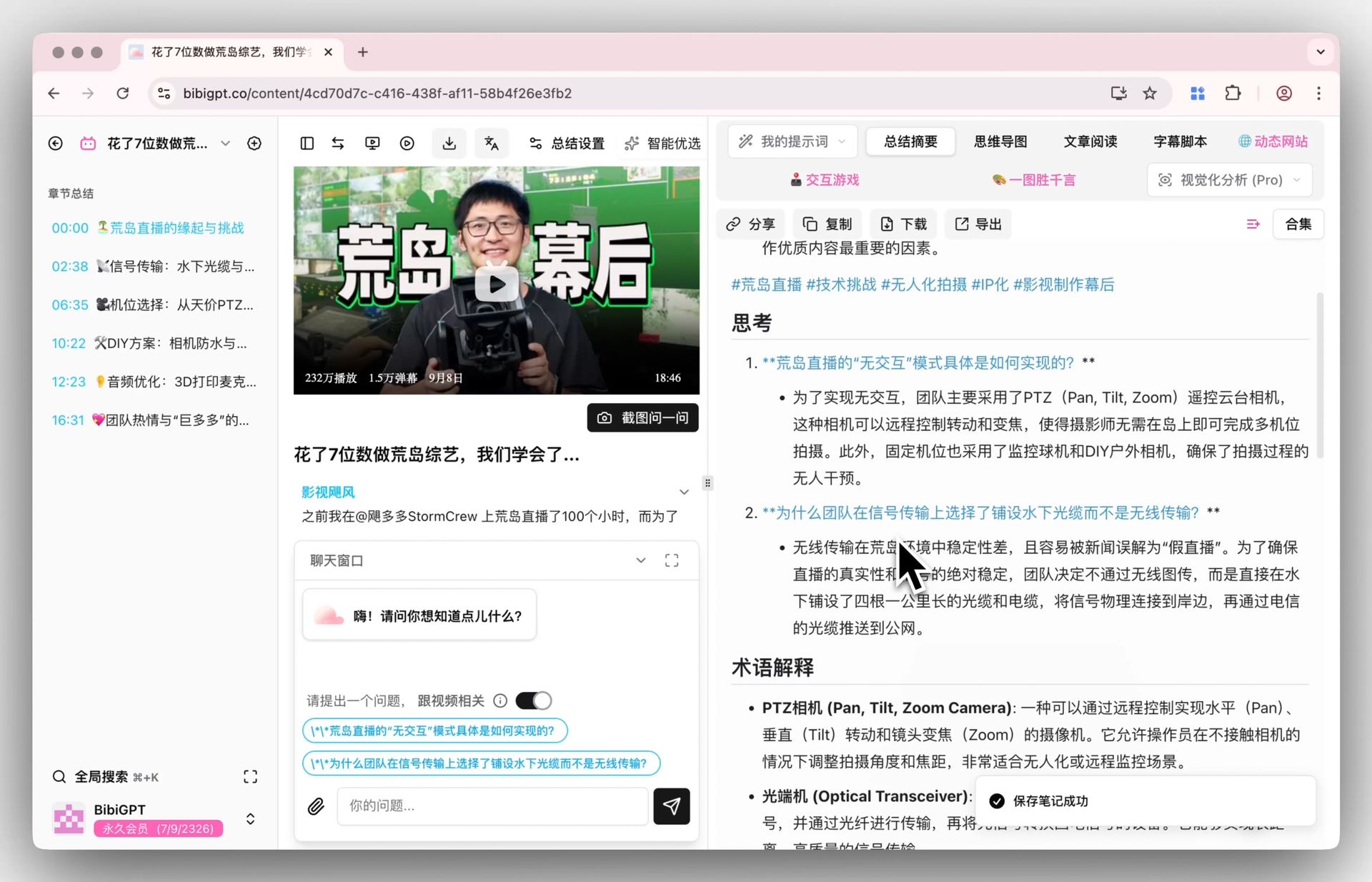
Screenshot: BibiGPT’s AI conversation lets you ask the video what’s likely to appear on your exam
Practical rule: Bluedot’s Apple Watch mode solves the specific awkwardness of “I can’t pull out my phone in this lecture” — a tap on the wrist, and you’re recording invisibly.
Bluedot’s limitations are equally clear: its strength is live, in-person capture. For students whose courses are primarily delivered through Zoom recordings or online platforms, it offers no particular advantage. And the free 180 minutes per month — about one two-hour lecture per week — runs out quickly for anyone taking a full course load.
What Is BibiGPT, and What Problem Does It Solve?
BibiGPT operates on a completely different premise: you don’t need to do anything during class at all — just wait for the recording, paste the link, and let AI do the digesting for you.
It supports 30+ content platforms: Zoom replay links, Coursera, edX, YouTube, and local file uploads. The output isn’t just a raw transcript — it’s a structured summary with timestamps, a mind map, and most importantly, full-context AI Q&A: you can ask things like “How did the professor derive that formula at minute 45?” and get a contextual answer grounded in the whole video.
Key specs:
- Hardware required: None (works on phone, computer, or any browser)
- Price: approx. ¥99/month (~$14)
- Features: Video link/file → AI summary + timestamps + mind map + AI conversation
- Languages: Chinese, English, Japanese, Korean, Traditional Chinese
- Best for: Reviewing Zoom replays, catching up on Coursera/edX, consuming YouTube lectures, digesting recorded seminars
- Supported platforms: Zoom recording summary, YouTube, podcasts, and 30+ more
Screenshot: Paste a Zoom replay link and get a structured, queryable lecture summary in minutes
Practical rule: Your study efficiency isn’t measured by how much you recorded — it’s measured by how quickly you can pull “what will be on the exam” out of a recording. That’s the actual problem worth solving.
According to a 2023 study on lecture note-taking, students typically retain less than 30% of lecture content from memory alone. AI-assisted review isn’t a shortcut — it’s how you fill in the other 70%.
BibiGPT’s limitation: it works on recordings that already exist. Real-time classroom discussions, whiteboard content, and in-the-moment Q&A that wasn’t captured on video simply can’t be processed after the fact.
Feature Comparison Table
| Dimension | Bluedot Apple Watch | BibiGPT |
|---|---|---|
| Core mode | Real-time wrist recording + transcription | Post-hoc processing of video links/files |
| Hardware required | Apple Watch (Series 4+) | Phone / computer / any browser |
| Platform coverage | In-person lectures / live Zoom capture | Zoom replays / Coursera / YouTube / 30+ platforms |
| Free tier | 180 minutes/month | Daily quota |
| Paid price | $14/month | |
| AI Q&A | Yes (across last 10 lectures) | Yes (full-context across whole video) |
| Languages | 100+ transcription languages | Chinese / English / Japanese / Korean / Traditional Chinese output |
| Offline recording | ✓ | ✗ |
| Structured summary / mind map | ✗ | ✓ |
| Timestamp navigation | ✗ | ✓ |
Decision filter: Ask yourself one question — is the majority of my course content delivered in live in-person lectures, or in recorded video form? Live lectures → Bluedot. Recorded video → BibiGPT.
Scenario-by-Scenario Recommendations for Exam Season
Scenario A: Your courses are mostly in-person lectures, and you have an Apple Watch
Recommendation: Bluedot
For a full semester with 3–4 in-person lectures per week, the 180-minute free tier won’t last. Subscribe to the $14/month plan. Use Bluedot to capture every lecture, then review the AI transcript within 1–2 hours while the content is still fresh in your memory.
Scenario B: Your courses are primarily delivered via Zoom recordings / Coursera / edX
Recommendation: BibiGPT
Paste each Zoom replay link directly into BibiGPT. You don’t need to watch the full 2-hour recording — read the AI summary, ask targeted follow-up questions, and you can digest a 2-hour lecture in under 30 minutes.
Scenario C: Mixed (both in-person lectures and substantial recorded course content)
Recommendation: Use both, divided by content type
Here’s an executable workflow:
- In-person lecture: Start Bluedot on your Apple Watch — invisible, hands-free
- After class: Bluedot auto-transcribes; scan through to confirm key concepts
- Zoom replays / online courses: Paste into BibiGPT and get a structured summary
- One week before exams: Use BibiGPT’s AI conversation feature to batch-query across all your recorded lectures
- Three days before exams: Build a cheat sheet based on BibiGPT’s mind maps, with your own edits
- Night before: Ask BibiGPT “what question types are most likely for this topic”
- Exam day: Study only from your hand-curated cheat sheet — close all AI tools
The core principle of this workflow: let AI cover everything first, then apply your own judgment as the final filter — not as a substitute for thinking, but as a first-pass that surfaces the 20% of content worth your focused attention.
Pricing and Real-World Cost Analysis
International students in the US typically spend $20–50 per month on study tools (including Office 365, Grammarly, academic databases, etc.). In that context:
| Tool | Monthly cost | Ideal usage | Annual cost |
|---|---|---|---|
| Bluedot free | $0 | 180 min/month, ~1 lecture/week | $0 |
| Bluedot Pro | $14/month | Unlimited — good for 3+ in-person lectures/week | $168/year |
| BibiGPT Plus | Multiple videos per day, ideal for online-heavy schedules | ~$168/year | |
| Both combined | ~$28/month | Mixed learners | ~$336/year |
Practical rule: Both tools cost roughly the same. The value is in how well each fits your course format. If more than 50% of your courses are in-person, Bluedot alone makes more sense. If recorded video dominates, BibiGPT alone is enough. For genuinely mixed schedules, stacking both at ~$28/month still delivers strong ROI — the time you save on review during exam season is worth far more than the monthly fee.
FAQ
Can Bluedot process Zoom recording files?
Yes, but it’s not Bluedot’s core strength. Bluedot is optimized for real-time recording scenarios. If your main need is processing Zoom replay links, BibiGPT’s Zoom recording summary feature is more direct — just paste the link, no file download required.
Can BibiGPT handle a real-time recording from today’s class?
Not in real time. BibiGPT requires an existing recording file or video link. After class, you can upload an audio or video file (MP3, MP4, etc.) for processing — but there’s no live capture mode. For real-time needs, Bluedot is the right tool.
Can I use Bluedot without an Apple Watch?
Yes. Bluedot has Mac and Windows desktop apps that can record your computer’s Zoom or Teams meetings without an Apple Watch. But if your primary use case is discreet in-class recording, the Apple Watch is where its unique value lies.
Does BibiGPT support English video with Chinese output?
Absolutely — and this is one of BibiGPT’s most useful features for international students. Paste an English Zoom recording or YouTube lecture link, select Chinese output, and you get a Chinese summary with full Chinese AI Q&A. For students whose English comprehension hasn’t yet hit “real-time note-taking fluency,” this is the highest-leverage feature available.
In the last two weeks of exam season, which tool helps more?
If your exam prep relies primarily on reviewing existing recordings (Zoom replays, Coursera lectures), BibiGPT delivers more value in those two weeks — rapid digestion of multiple courses’ video content, with AI Q&A to zero in on key points. If you still have in-person review sessions or professor office hours those two weeks, use Bluedot to capture them as supplemental material.
Summary: Two Tools, Two Learning Paths
Bluedot Apple Watch and BibiGPT both address the same large problem — how to digest more course content in less time — but they each solve a different piece of it.
- If your courses happen primarily in a physical classroom, Bluedot’s hands-free capture is genuinely irreplaceable.
- If your courses primarily exist as recorded video (Zoom replays, Coursera, YouTube), BibiGPT’s post-hoc digestion efficiency is higher, with no extra hardware required.
- If you’re a mixed learner, combining both tools — each handling its own optimal scenario — is the highest-ROI study workflow available right now.
A few weeks of exam season remain. Run the workflow from this article with a real example — paste your first Zoom replay link into BibiGPT and see how much you can digest in 30 minutes. Let the results guide your decision.
Further reading: