Memories.ai vs BibiGPT: Which Is Better for Bilibili Video Summary? 2026 Full Comparison & Picker
Memories.ai vs BibiGPT: Which Is Better for Bilibili Video Summary? 2026 Full Comparison & Picker
Last updated: 2026-06-11 | Updated for the launch of Memories.ai’s free Bilibili video analyzer (transcript generation + subtitle extraction + video chat); refreshed comparison matrix and picker advice
Direct answer: For Bilibili-only occasional summaries, Memories.ai’s free tier is enough. For full transcripts + mind maps + AI video chat + visual analysis + one tool handling 30+ platforms (YouTube, TikTok, podcasts) -> pick BibiGPT — 1M+ users, 5M+ AI summaries, web + desktop + mobile + browser extension.
Two-line decision lens:
- If you only ever process Bilibili videos and just need a paragraph-level summary → Memories.ai’s free Bilibili feature is enough
- If you want full transcripts, mind maps, video chat, visual analysis, and one tool that also handles YouTube / TikTok / podcasts → pick BibiGPT — 1M+ users, 5M+ AI summaries, with web + desktop + mobile + browser-extension coverage
✅ Want to try it in 30 seconds? Paste any Bilibili link into BibiGPT homepage — get a full transcript + structured summary + mind map. Free quota, no card needed.
Bilibili-Specific Entry Points (BibiGPT side)
Whether your need lives in “subtitles,” “search,” or “full video-to-text,” BibiGPT has a dedicated landing page:
- Pure subtitle export → Bilibili subtitle downloader (SRT / TXT one-click)
- Search across Bilibili + summarize → Bilibili video search
- Full transcript + AI summary for long videos → Bilibili video-to-text
Memories.ai recently launched a free Bilibili video analysis feature, entering the Chinese video content processing space. This article compares the two tools across platform coverage, feature depth, AI capability, and knowledge-management integration to help you make the best choice.
June 2026 Update: Memories.ai’s Free Bilibili Video Analyzer Is Live
As of 2026-06-11, Memories.ai has officially shipped a free Bilibili video analyzer — a rare case of an overseas vendor entering Bilibili content analysis with a dedicated tool page. Note that the Bilibili analyzer is one of its standalone free tool pages; the main product also offers video analysis across 15+ platforms including YouTube and TikTok. The launch covers three capabilities:
- Transcript generation: paste a Bilibili link and get a transcript of the video
- Subtitle extraction: pull subtitle content out of the video
- Chat with the video: Q&A-style interaction scoped to a single video
This means Memories.ai is no longer “basic summary only” — it has filled in transcription and chat at the single-video level. But as the full comparison below shows, mind maps, visual analysis, flashcards, video-to-article, collection summaries, and note-app integrations — plus deep coverage of Chinese platforms (Bilibili, Douyin, Xiaohongshu, Chinese podcasts) and a four-client lineup — remain BibiGPT’s core differentiators.
What Is Memories.ai’s Bilibili Video Summarizer?
Direct answer: Memories.ai is an online AI tool that launched a free Bilibili video analyzer in June 2026. Users can paste a Bilibili link to generate a transcript, extract subtitles, and chat with the video. The Bilibili analyzer is one of its standalone free tool pages, focused on single-video processing; the main product also offers video analysis across 15+ platforms such as YouTube and TikTok.
Memories.ai positions its Bilibili tool as a “free, online, use-and-go” lightweight solution. For users who only need to occasionally summarize one or two Bilibili videos, it is a decent option.
However, if your needs extend beyond that — processing Douyin, Xiaohongshu, Chinese podcasts, local files, or requiring mind maps, AI chat, knowledge management — the gap between the two tools becomes very clear.
Quick Comparison: Core Differences at a Glance
| Dimension | Memories.ai | BibiGPT |
|---|---|---|
| Platform coverage | Bilibili via a standalone free tool page; main site also covers 15+ platforms (YouTube, TikTok, etc.) | 30+ platforms (Bilibili, YouTube, Douyin, TikTok, Xiaohongshu, podcasts, etc.) |
| Output formats | Transcripts, subtitle extraction, basic summary | Structured summaries, mind maps, flashcards, AI chat, PPT, video-to-article |
| AI depth | Basic summarization + single-video chat (new in June 2026) | Deep summary + visual analysis + terminology parsing + source tracing |
| Clients | Primarily web | Web + desktop client + mobile app + browser extension |
| Note integration | None | Notion, Obsidian, Readwise deep integration |
| API access | Developer API available | API + bibigpt-skill Agent tooling |
| User base | New product | 1M+ users, 5M+ AI summaries |
| Multilingual | Not stated on official site | Chinese, English, Japanese, Korean full support |
Dimension 1: Platform Coverage
BibiGPT supports 30+ platforms, covering virtually all major audio and video sources:
- Chinese video platforms: Bilibili, Douyin, Xiaohongshu, Weibo Video
- International video platforms: YouTube, TikTok, Twitter/X Video
- Podcast platforms: Xiaoyuzhou, Apple Podcasts, Spotify
- Local files: MP4, MP3, WebM, MXF direct upload
- Cloud storage: Baidu Drive, Aliyun Drive, Dropbox integration
Memories.ai’s platform coverage: the Bilibili analyzer is one of its standalone free tool pages; the main product also analyzes videos across 15+ platforms including YouTube and TikTok.
Both tools offer multi-platform capability — the difference lies in how deeply the Chinese ecosystem is covered. BibiGPT handles Bilibili, Douyin, Xiaohongshu, Weibo Video, and Chinese podcasts in one place, plus local files and cloud-drive links — so English tech tutorials on YouTube, short knowledge videos on Douyin, and in-depth podcast interviews can all be processed in a single tool. Try BibiGPT’s AI Bilibili summary feature to experience the difference. For a deeper dive into Bilibili AI summarization, check out our 2026 Best Bilibili AI Video Summary Tool Guide.
Dimension 2: Feature Depth and Output Formats
Memories.ai output formats (as of June 2026):
- Video transcript generation
- Subtitle extraction
- Basic text summary/abstract
- Single-video Q&A chat
BibiGPT output formats (as of June 2026):
- Structured deep summaries: abstract, key points, chapter breakdown with timestamps
- Mind maps: hierarchical visualization, one-click knowledge structure generation
- AI video chat: ask questions about the video, get answers with clickable timestamp tracing
- Flashcards: auto-generated Q&A cards, exportable to Anki
- AI video-to-article: convert video content into publish-ready illustrated articles
- PPT presentations: auto-generate slide decks from summaries
- Highlight notes: select key content, generate shareable visual cards
- Collection summaries: aggregate summaries across entire video series
- Bilibili video to text: complete subtitle extraction and formatting
Don’t take our word for it — the product screenshot below shows the mind map BibiGPT generates from a single Bilibili video with one click, with the knowledge hierarchy laid out at a glance:
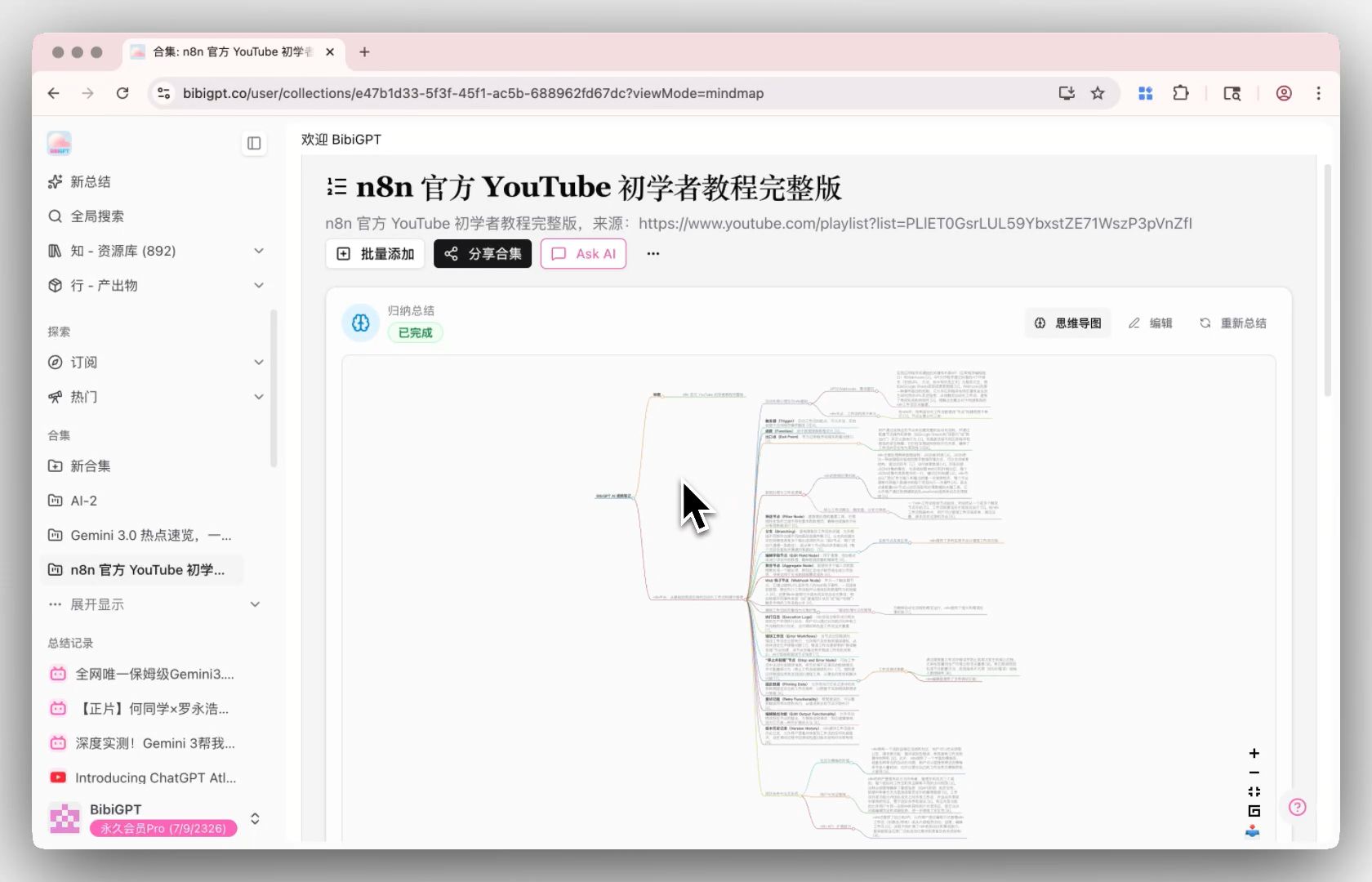
Screenshot: BibiGPT · mind map feature demo
For content creators, BibiGPT’s video-to-article feature addresses a use case Memories.ai does not cover — turning a video into a publishable written post is an entirely different creative workflow.
Dimension 3: AI Capabilities and Deep Understanding
Memories.ai provides basic AI-driven text summarization, suitable for quickly grasping the gist of a video.
BibiGPT’s AI capabilities go further:
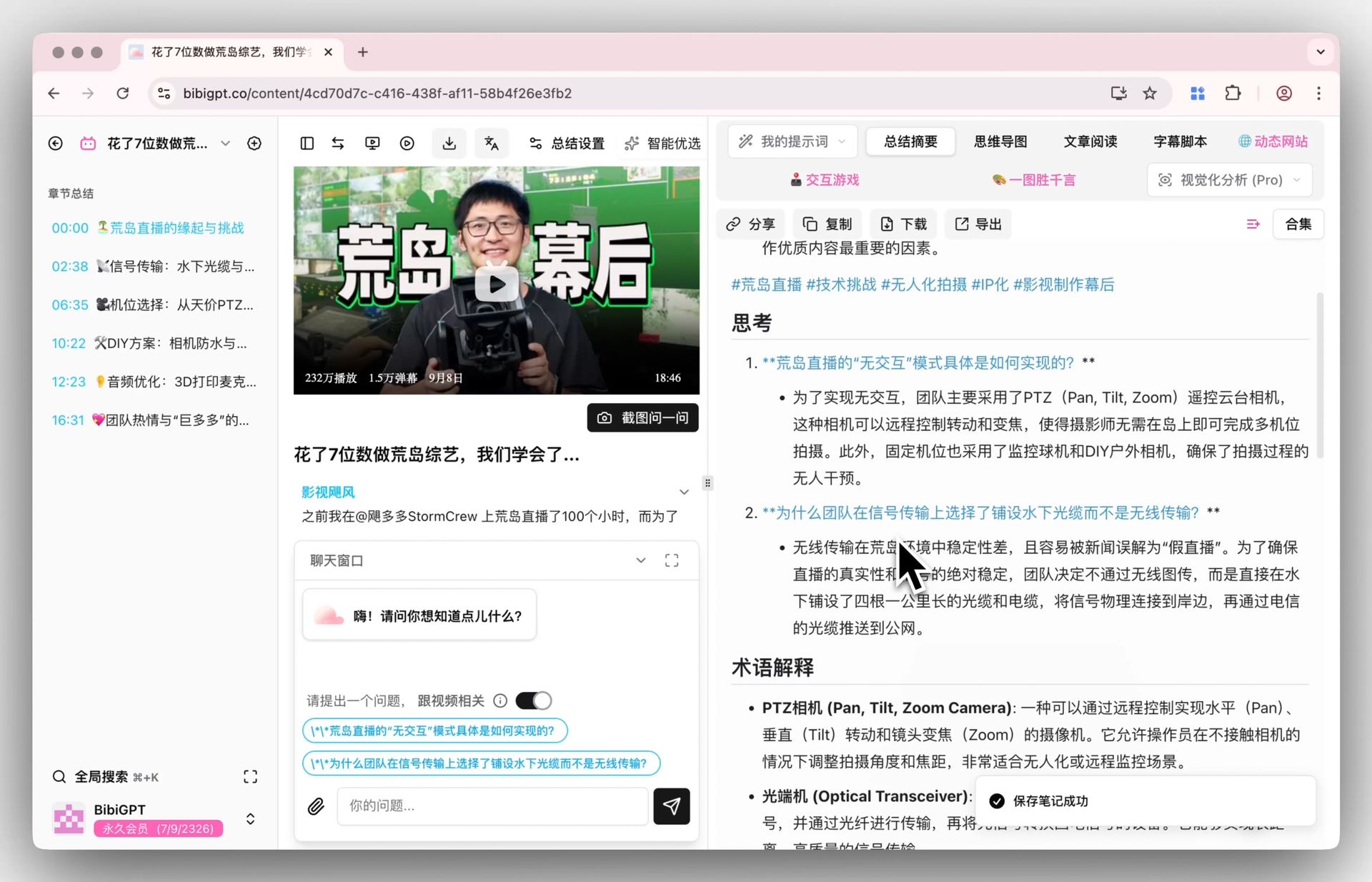
- Deep summary mode: not just extracting key sentences from subtitles, but understanding content logic and restructuring knowledge. See the screenshot below — deep summary proactively surfaces the key questions inside the video:
Screenshot: BibiGPT · deep summary feature demo
- Visual content analysis: identifies and analyzes charts, slides, code screenshots, and other visual elements within videos
- Terminology parsing: automatically identifies and explains technical terms, as shown below:
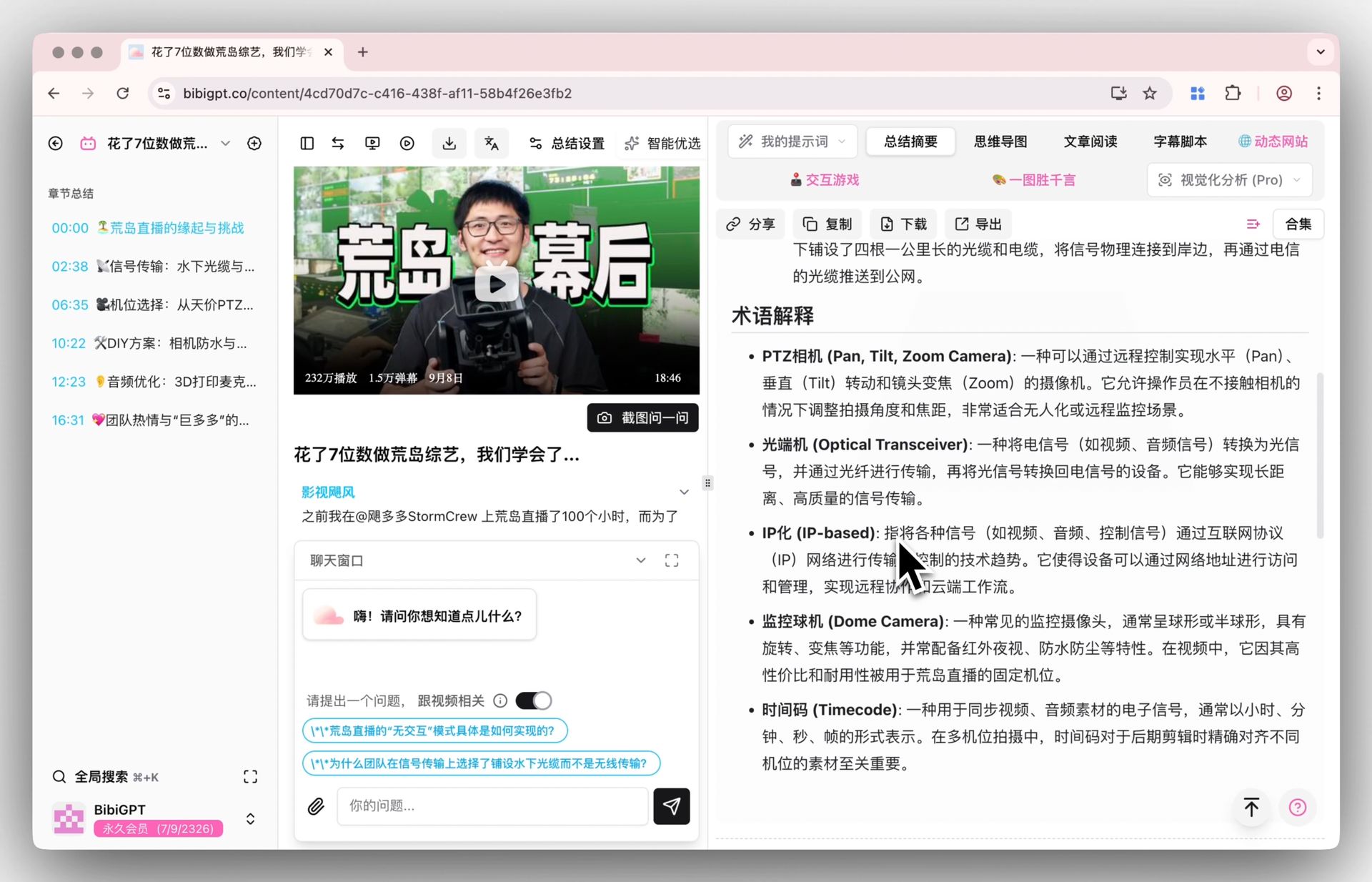
Screenshot: BibiGPT · terminology parsing demo
- Intelligent source tracing: every AI response can be traced to a specific timestamp in the original video
- Custom prompts: users can customize summary templates for their specific needs
These capabilities are particularly critical for learning scenarios. When watching a 2-hour technical tutorial, a simple “this video covers XX” is insufficient — you need complete knowledge structures, key concept explanations, and traceable notes. For a systematic approach to AI-powered video learning, see our AI Video Learning System: 5 Steps Guide.
Key Differentiators: What Makes BibiGPT Irreplaceable
Beyond the feature comparison above, BibiGPT offers several differentiating core capabilities:
1. Full Client Coverage
- Desktop client (macOS/Windows): process local files even offline
- Mobile app (iOS/Android): process videos anytime, anywhere
- Browser extension (Chrome/Firefox/Edge): one-click summaries on Bilibili and YouTube pages
2. Knowledge Management Ecosystem Integration
- Deep integration with Notion, Obsidian, Readwise
- AI video summary visual analysis: integrate video knowledge into your second brain
- Export to Markdown, PDF, HTML formats
3. Agent Native Capabilities
- bibigpt-skill gives AI Agents (like Claude) the ability to “watch videos”
- API access enables enterprise batch video processing
- Integrate video processing into automated workflows
If you are evaluating more AI video summary tools, see our 2026 Best AI Audio & Video Summary Tool Comparison.
4. Complete Content Creation Pipeline
- AI YouTube summary: cross-platform content repurposing
- AI podcast summary: extract insights from podcasts with one click
- Douyin video summary: process Chinese short-form video content
Related Reading
- Pair with a note workflow: Second Brain + Knowledge Graph: Wire Video Learning With BibiGPT
- Model deep-dive: GPT-5.5 vs Claude Opus 4.7 Video Summary Hands-On
- For podcast workflows: ChatPods vs BibiGPT: AI Podcast vs All-Platform Audio/Video
FAQ
Q1: Memories.ai’s Bilibili summarizer is free. Does BibiGPT offer free usage too?
A: BibiGPT provides a free tier with monthly summary credits upon registration. For advanced features (deep summaries, visual analysis, video-to-article), you can choose Plus/Pro subscriptions or pay-as-you-go credits.
Q2: I only use Bilibili. Is BibiGPT still worth it?
A: Even for Bilibili-only users, BibiGPT’s deep summaries, mind maps, and AI chat features far exceed basic summarization. More importantly, when you eventually need to process YouTube, Douyin, or podcast content, you will not need to switch tools.
Q3: What is bibigpt-skill?
A: bibigpt-skill is BibiGPT’s tool interface for AI Agents, enabling them to “watch videos” and retrieve structured content. This is a critical capability in the Agent Native era, suitable for developers and advanced AI workflow users.
Q4: Can I use both tools together?
A: You can. That said, BibiGPT goes deeper on structured outputs (mind maps, video-to-article, flashcards) and Chinese-platform scenarios, so most users find BibiGPT sufficient for their video processing needs.
Conclusion
Memories.ai entering the Bilibili video summarization space validates the demand — more tools are recognizing that video content processing is a genuine user need. But the gap between “functional” and “excellent,” and between “basic summaries” and “deep knowledge management,” reflects years of product iteration and technical accumulation.
BibiGPT has served over 1 million users, generated more than 5 million AI summaries, and supports 30+ platforms — not just numbers, but product capabilities refined across every use case on Bilibili, YouTube, Douyin, podcasts, and beyond.
Start using BibiGPT to unlock video knowledge with advanced AI:
- 🌐 Official Website: https://bibigpt.co/en/desktop?utm_source=growth-pages&utm_medium=blog-inline-cta&utm_campaign=memories-ai-bilibili-vs-bibigpt-comparison-2026
- 📱 Mobile Download: https://bibigpt.co/app
- 💻 Desktop Download: https://bibigpt.co/download/desktop
- ✨ Learn More Features: https://bibigpt.co/features
BibiGPT Team