
AI Competitive Intelligence Workflow: Build Industry Monitoring with BibiGPT Video Summaries
Build an AI competitive intelligence workflow using BibiGPT: subscribe to competitor YouTube/Bilibili channels, batch summarize with AI, extract key signals, and generate insight reports for product managers and market analysts.
AI Competitive Intelligence Workflow: Build Industry Monitoring with BibiGPT Video Summaries
Product managers spend 8+ hours per week watching competitor launch videos, industry conference recordings, and KOL reviews. That time should go toward making decisions, not transcribing information. When competitive signals are scattered across YouTube, Bilibili, podcasts, and 30+ other platforms, you don't need more headcount — you need an AI-powered competitive intelligence workflow. This guide walks you through building a complete system from subscription to insight output using BibiGPT.
试试粘贴你的视频链接
支持 YouTube、B站、抖音、小红书等 30+ 平台
Why Competitive Intelligence Needs AI Video Summarization
Video Is the New Primary Signal Source
In 2026, the first disclosure channel for critical industry information has shifted from text to video:
- Product launches: Apple WWDC, Google I/O, AI startup demos — core features and strategic direction debut in video
- Industry conferences: CES, Web Summit, and vertical industry summits produce hours of recordings packed with trend signals
- KOL reviews and teardowns: Tech reviewers often cover details missing from official documentation, including head-to-head comparisons
- Executive interviews: CEOs on podcasts and YouTube interviews reveal more authentic strategic intent than press releases
Traditional competitive intelligence tools excel at monitoring text — news, social media posts, patent filings. But video content has been a blind spot. A 90-minute launch recording might contain only 3 minutes about the competitor move you care about most, but you won't find those 3 minutes without watching the whole thing.
Three Bottlenecks of the Manual Approach
If your competitive intelligence still relies on "watch and take notes," you've likely hit these walls:
Time sink: One launch recording runs 2 hours. One deep review runs 30 minutes. One podcast episode runs 60 minutes. Multiply by 10 competitors producing 3-5 videos each per week, and your team burns 20+ hours just watching.
Signal leakage: Human attention drifts. The feature adjustment a competitor mentioned at the 47-minute mark gets missed — and that was the insight your Q2 roadmap needed.
Fragmented insights: Different people watch different videos and take separate notes scattered across Google Docs, Slack threads, and email attachments. When quarterly review comes, nobody has the full competitive picture.
BibiGPT has served over 1 million users and completed 5 million+ AI summaries across 30+ platforms. The workflow below combines our users' best practices into a proven competitive intelligence system.
Five-Step Workflow: From Signal Collection to Insight Output
Step 1: Build Your Competitive Source List
Quality competitive intelligence starts with precise information sources. Create a video source list for each competitor:
YouTube channels: Most tech companies maintain official YouTube channels for product demos, launches, and tutorials. This is the most standardized source. BibiGPT's YouTube AI summary feature handles channel and playlist URLs directly.
Bilibili channels: For Chinese market competitors, Bilibili is the primary platform for product launches, official tutorials, and user case studies. BibiGPT's Bilibili AI summary is the most mature solution in the market.
Podcast feeds: Founders and executives regularly appear on industry podcasts, revealing strategic thinking in relatively unguarded conversations.
Industry KOL channels: Third-party reviewers provide more objective assessments than official marketing, often including cross-competitor comparisons.
Practical steps:
- List your top 5-10 competitors
- Identify 2-3 core video sources per competitor (official channel + KOL reviews)
- Organize all source links using BibiGPT's collections feature, categorized by competitor
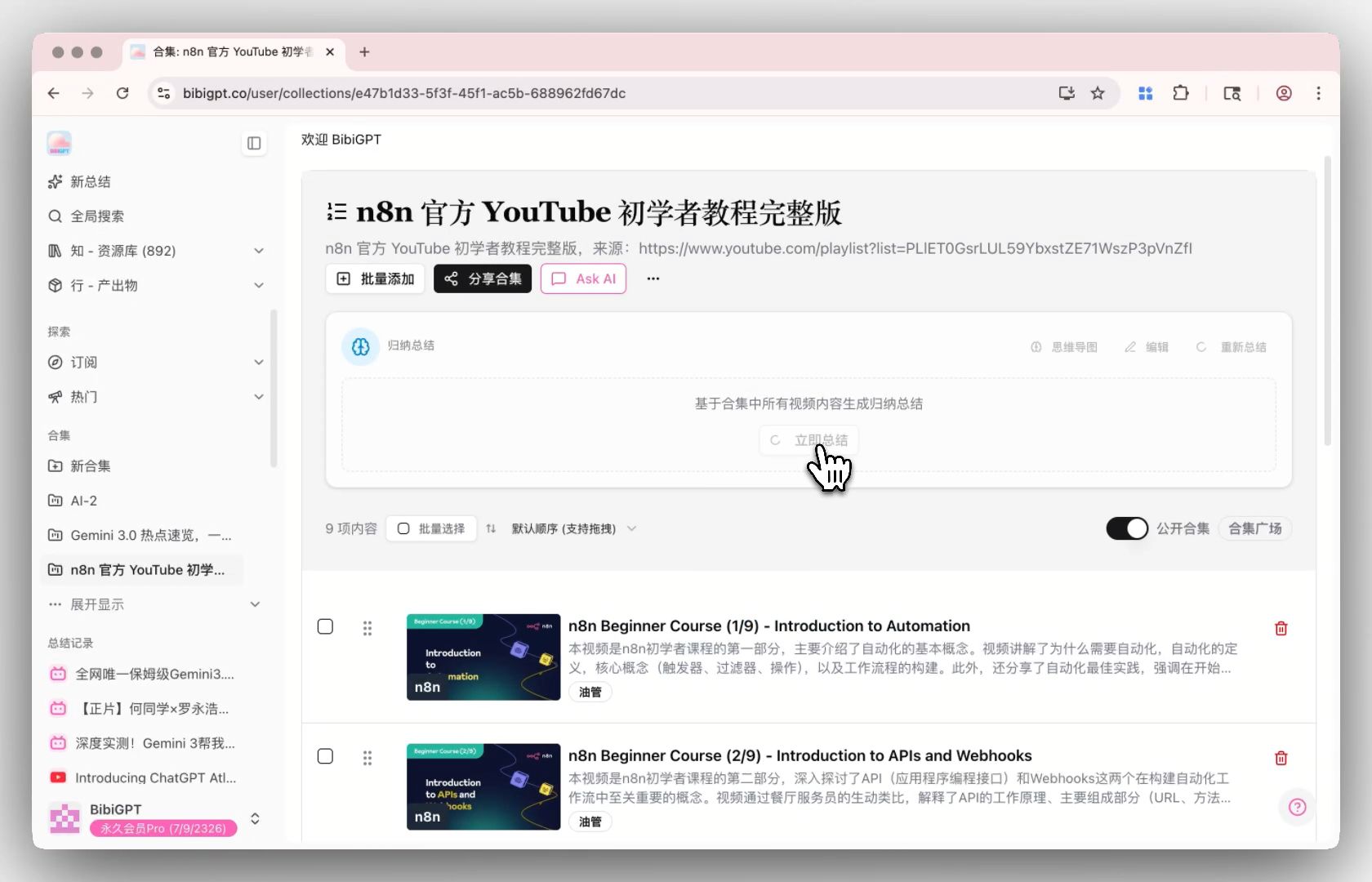 Managing competitor sources with collections
Step 2: Batch Collection and AI Summarization
With sources established, move to daily collection. The key is batch processing — replace manual watching with AI-powered digestion.
Single video processing: Paste a video URL into BibiGPT and get results in 30 seconds:
- Full subtitle transcription
- Structured AI summary (core arguments, key evidence, timeline)
- Mind map visualization
Batch URL processing: When a competitor publishes multiple videos in one week, paste all URLs at once and let the system queue them automatically.
Playlist summarization: For competitor YouTube series (e.g., product update logs), paste the playlist URL directly.
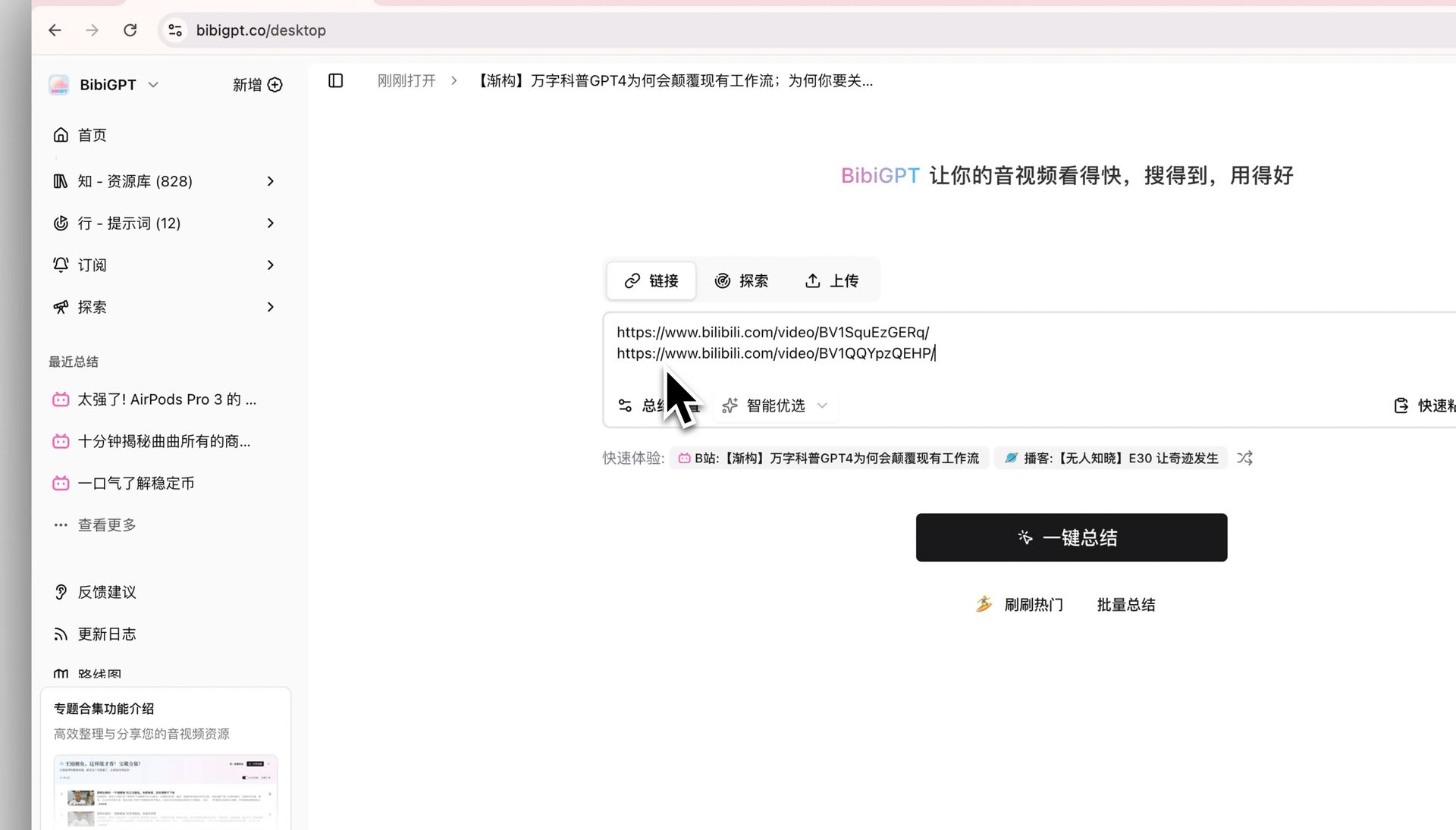 Batch link input interface
Pro tip: Use BibiGPT's YouTube transcript generator to get raw subtitle text for keyword searches and text analysis.
看看 BibiGPT 的 AI 总结效果
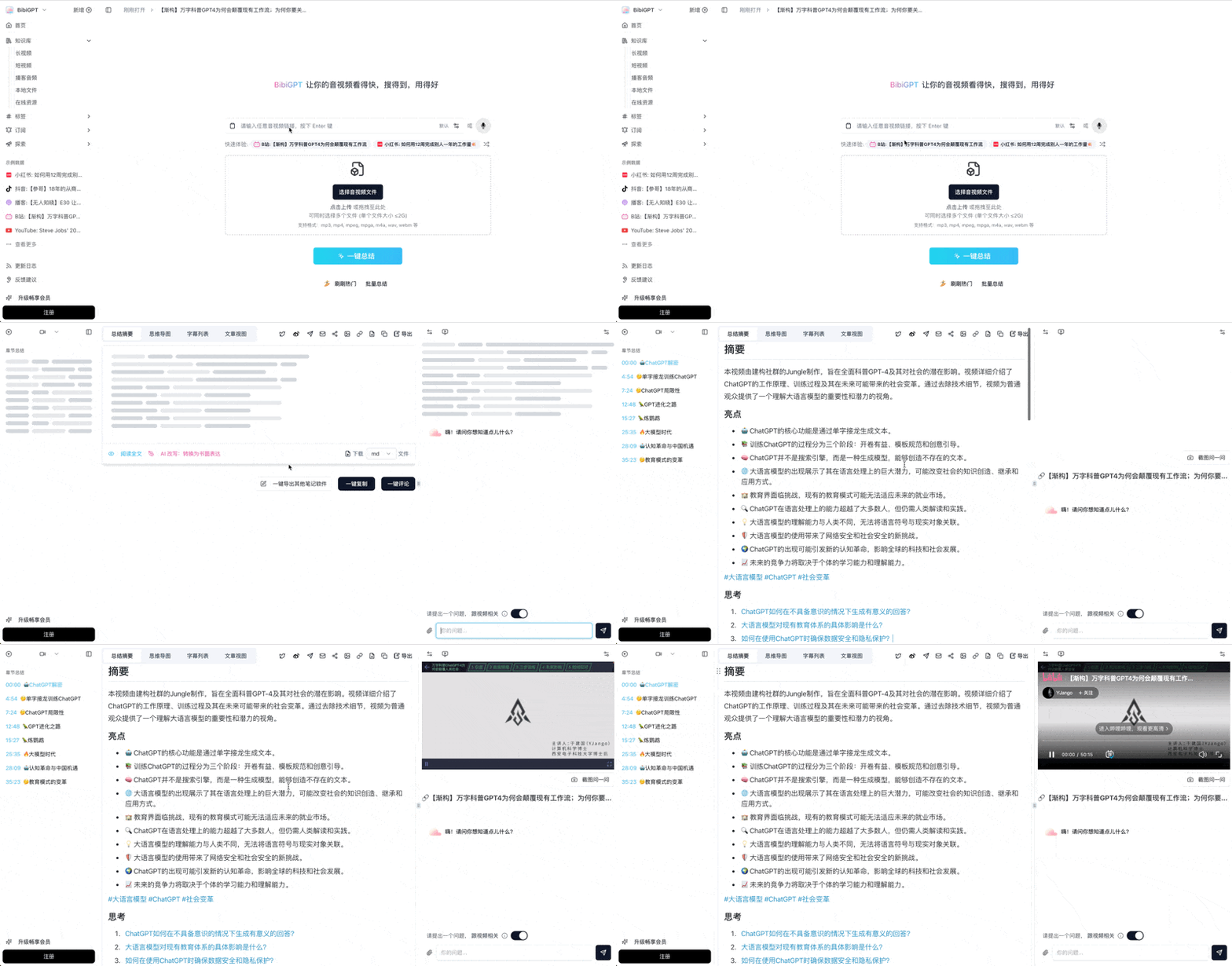
Bilibili: GPT-4 & Workflow Revolution
A deep-dive explainer on how GPT-4 transforms work, covering model internals, training stages, and the societal shift ahead.
Step 3: Extract Competitive Signals
With AI summaries in hand, extract actionable competitive signals using a structured classification framework:
Product signals:
- New feature launches or previews
- Feature deprecations or adjustments
- Technical architecture changes (e.g., switching AI models, adding platform support)
- Pricing strategy adjustments
Market signals:
- Target audience shifts (B2C to B2B? Domestic to international?)
- Marketing messaging changes (what's emphasized? what's avoided?)
- Partnership and ecosystem developments
Strategic signals:
- Funding or IPO hints (executive comments in interviews)
- Team expansion direction (what roles are being hired?)
- Changes in long-term vision statements
BibiGPT's AI Q&A feature is especially valuable here. After reviewing a summary, ask targeted questions:
- "What new features were announced in this video?"
- "What did the speaker say about competitor X?"
- "What pricing strategy information was revealed?"
Every answer includes source timestamps, so you can jump to the original video to verify. This is 10x faster than watching the full video and manually compiling notes.
For more on how different AI models compare for summarization, read our best AI summarizer multi-model comparison.
Step 4: Generate Insight Reports
Single-video signal extraction is the foundation, but competitive intelligence's real value lies in cross-video, cross-competitor synthesis. This step aggregates fragmented signals into structured insights.
Suggested weekly report template:
## Competitive Weekly Report — Week X

### Key Findings This Week
1. [Top 1-2 competitive signals]

### By Competitor
#### Competitor A
- Product updates: ...
- Market moves: ...
- Source: [video link + BibiGPT summary link]

#### Competitor B
- ...

### Trend Observations
- [Cross-competitor patterns]

### Recommended Actions
- [Impact on your product/strategy and suggested responses]
BibiGPT's article rewriting feature can merge and restructure summaries from multiple videos into a single coherent report. You can also use the mind map feature to visualize signal relationships across videos before exporting.
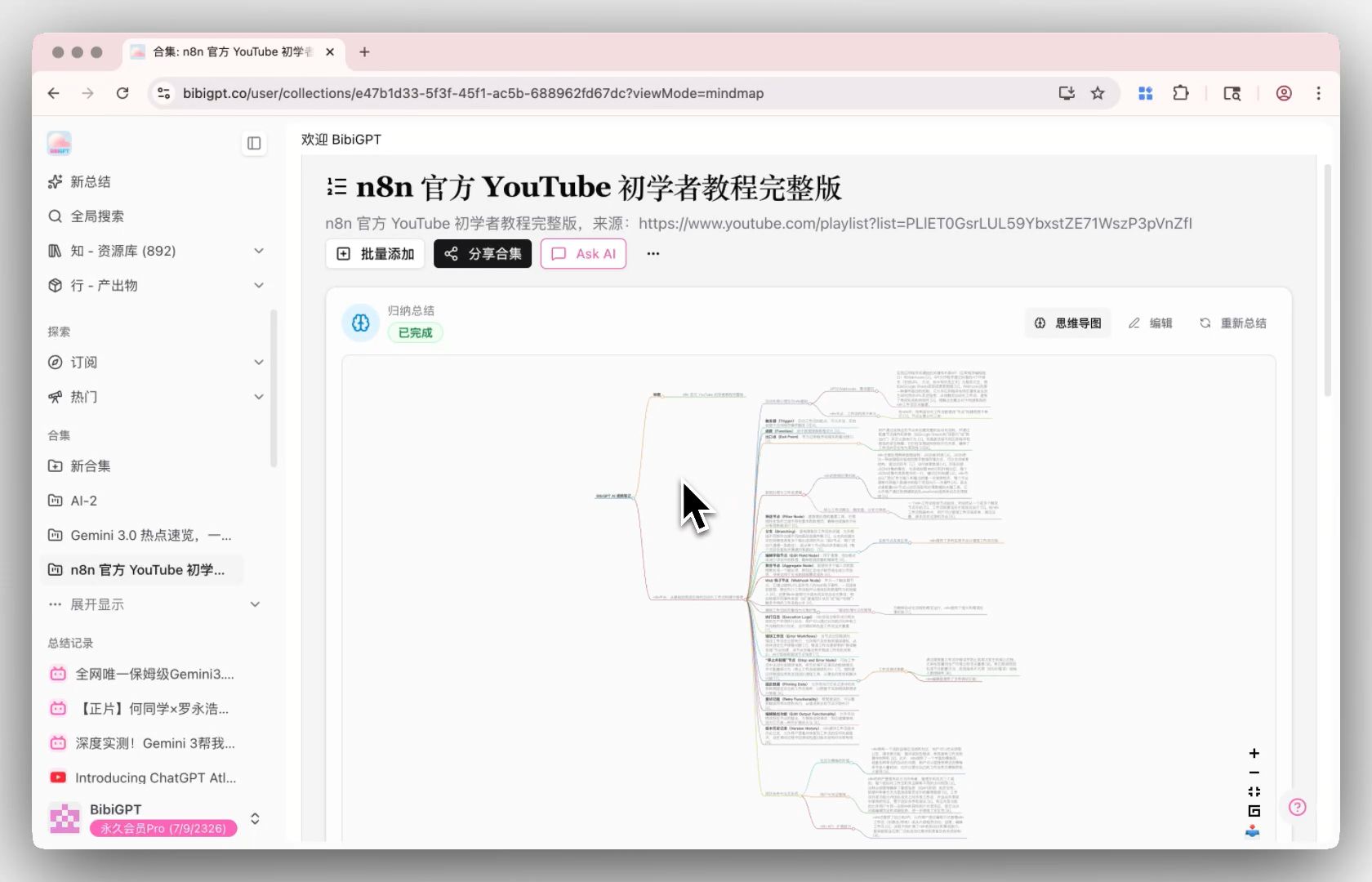 Mind map for organizing competitive signals
Syncing to team collaboration tools matters too. BibiGPT exports to Notion, Obsidian, and other popular note-taking apps for easy team sharing and historical tracking.
Step 5: Establish Continuous Monitoring
One-time analysis solves the "right now" problem, but competitive intelligence's core value comes from consistency. Turn the first four steps into a recurring process:
Daily:
- Check competitor channels for new video uploads
- Send new video URLs to BibiGPT for batch processing
- Scan AI summaries, flag high-priority signals
Weekly:
- Aggregate the week's competitive signals
- Generate competitive weekly report
- Share key findings in team meetings
Monthly/Quarterly:
- Review historical summary data to identify medium-term trends
- Update the competitive source list (add/remove channels)
- Evaluate workflow efficiency, iterate on improvements
BibiGPT's collections and history features let you revisit past analyses anytime without reprocessing.
Real-World Scenario: SaaS Product Manager Monitoring Competitors
Let's walk through the complete workflow with a concrete scenario.
Context: You're a product manager at an AI writing tool company. Your primary competitors include 5 international products (Jasper, Copy.ai, Writesonic, etc.) and 3 domestic products.
Step 1 — Build sources:
- Jasper's official YouTube channel + 2 tech reviewers (Matt Wolfe, AI Jason)
- Copy.ai's official channel + Product Hunt launch videos
- Domestic competitors' official Bilibili accounts + industry KOL channels
- Total: approximately 15 sources
Step 2 — This week's collection:
- Jasper published 1 product update video (18 min) and 1 customer case study (12 min)
- Matt Wolfe released a "Top 10 AI Writing Tools" roundup (45 min)
- Domestic competitors posted 2 feature demos on Bilibili
- Total: 5 videos. Traditional approach: 2 hours of watching. You paste the links into BibiGPT and get all summaries in 5 minutes.
Step 3 — Extract signals: Through AI summaries and follow-up questions, you discover:
- Jasper announced an enterprise API pricing adjustment — a 30% price cut, signaling accelerated B2B acquisition
- Matt Wolfe's roundup rated Jasper and Copy.ai highest for SEO content generation — a potential gap in your product
- A domestic competitor demonstrated multilingual generation capabilities — overlapping with your Q2 roadmap
Step 4 — Generate report: Use BibiGPT to compile summaries from all 5 videos into a weekly competitive report, highlighting three key signals with source links, exported to your team's Notion workspace.
Step 5 — Take action:
- Share Jasper's API pricing move in next week's product meeting; discuss whether to adjust your own B2B pricing
- Add "SEO content generation" to Q2 feature evaluation backlog
- Continue tracking the domestic competitor's multilingual progress
Total time investment: approximately 30 minutes/week, saving over 75% compared to the traditional approach.
Advanced Tips: Maximizing Intelligence Efficiency
Custom Summary Prompts
BibiGPT supports custom AI summary prompts. For competitive intelligence, set up a dedicated prompt:
Summarize this video from a competitive intelligence perspective,
focusing on:
1. Product/feature changes
2. Pricing/business model adjustments
3. Target audience or market direction shifts
4. Comparisons with other competitors
5. Notable strategic signals
This way, every summary directly outputs the dimensions you care about most, eliminating manual reorganization.
Visual Analysis for Screen-Heavy Content
Some competitor product demo videos rely primarily on screen recordings with minimal narration. BibiGPT's visual analysis feature can directly "watch" the video frames, extracting UI design, interaction flows, and feature layouts — something traditional transcription tools cannot do.
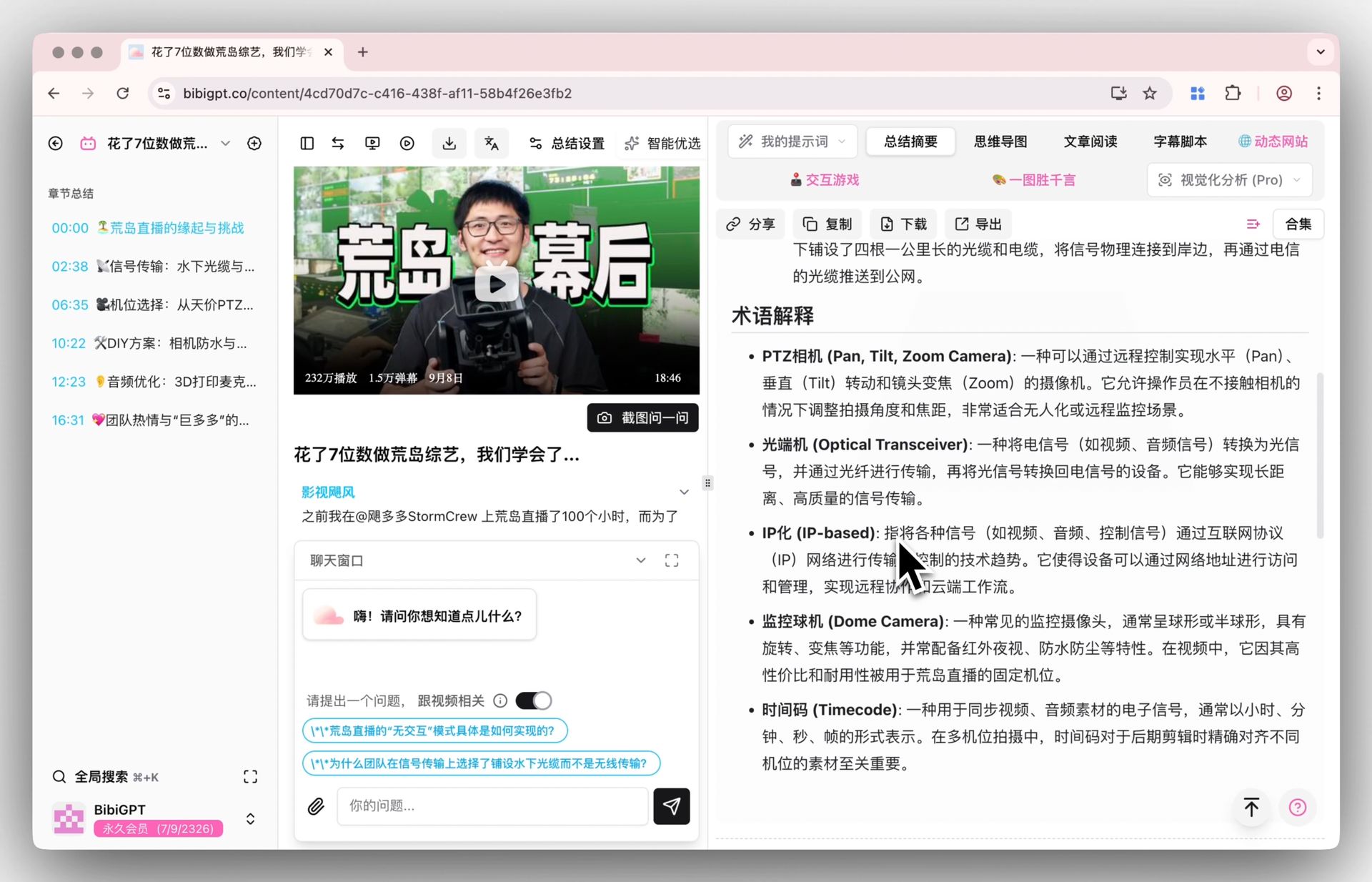 Smart deep summary feature
For more on AI video content analysis techniques, check out our AI viral video content analysis workflow.
Handling Multilingual Competitors
If your competitors operate in overseas markets, their video content may be in English, Japanese, Korean, or other languages. BibiGPT supports multilingual subtitle extraction and cross-language summarization — even if the original video is in English, you can get summaries in Chinese (or vice versa). This is invaluable for cross-border competitive monitoring.
FAQ
Q: Which video platforms does BibiGPT support for competitive monitoring?
BibiGPT supports 30+ major platforms, including YouTube, Bilibili, TikTok, Douyin, Kuaishou, Xiaohongshu, Twitter/X videos, and podcast platforms. For competitive monitoring, the most commonly used are YouTube (international competitors), Bilibili (Chinese market competitors), and podcast platforms (executive interviews).
Q: Are there limits on batch summarization?
Free users can try the basic single-video summary feature. Plus and Pro subscribers get access to batch processing, collections management, custom prompts, and other advanced features suited for ongoing competitive intelligence workflows.
Q: How accurate are AI summaries? Could key information be missed?
BibiGPT uses multiple advanced AI models (including GPT-4o, Claude, Gemini, and others) for summarization, achieving industry-leading accuracy. For critical information, the AI Q&A feature lets you dive deeper into specifics, with every response linked to timestamps for verification. We recommend double-checking key signals before making major decisions.
Q: Can competitive analysis results be shared with my team?
Yes. BibiGPT supports export to Markdown, PDF, and other formats that can be pasted directly into Notion, Lark Docs, Confluence, and other team collaboration tools. Collections can also be shared, enabling seamless team collaboration.
Q: How does BibiGPT compare to traditional competitive intelligence tools like Crayon or Klue?
Traditional competitive intelligence tools primarily monitor text content — news, web pages, social media posts. BibiGPT specializes in video and audio content, which is their blind spot. The best practice is to combine both: traditional tools for text signals, BibiGPT for video signals, creating a comprehensive competitive intelligence system.
Try BibiGPT Now
- 🔗 Try BibiGPT Free
- 📱 Supports 30+ platforms — just paste a link
- 🧠 AI Q&A, mind maps, and article rewriting in one place