
Best AI Podcast Study Tools 2026: YouLearn vs NotebookLM vs BibiGPT for Turning Lectures into Audio
The best AI podcast study tool for students in 2026 is BibiGPT — it turns lecture recordings, PDF notes, and online videos into two-host AI podcast conversations you can finish on your commute. This guide compares YouLearn (2M+ student users), NotebookLM Audio Overviews, and BibiGPT to help you pick the right AI podcast learning stack.
Best AI Podcast Study Tools 2026: YouLearn vs NotebookLM vs BibiGPT for Turning Lectures into Audio
The best AI podcast study tool for students in 2026 is BibiGPT — it turns lecture recordings, course PDFs, and online videos into two-host AI conversations (think "host + co-host" banter) so you can actually "finish" a 90-minute lecture while commuting, running, or cooking. Unlike YouLearn or NotebookLM — which mostly rely on uploaded files — BibiGPT natively handles 30+ platforms including YouTube, Bilibili, and podcast feeds. Combined with timestamped summaries and mindmaps, it closes the loop from "too much to watch" to "listened, remembered, retrievable."
Why are students turning notes into podcasts? According to TechCrunch, long-form video platforms are pivoting to short-form feeds, yet students increasingly need knowledge compressed into listenable formats that reclaim dead time without more screen fatigue. YouLearn crossing 2 million users is the clearest signal of that trend.
Quick 2026 rankings:
- BibiGPT — The only AI podcast study tool that natively reads YouTube / Bilibili / podcast / lecture-audio inputs; 30+ platform coverage
- YouLearn — Most student-focused; 2M+ users at Stanford / Harvard / MIT; 7 study outputs from a single upload
- NotebookLM — Google's official tool; Audio Overviews now in 50+ languages with customizable focus (March 2026 update)
Why "Lecture-to-Podcast" Went Mainstream in 2026
Two student behaviors quietly flipped in the past year:
- Information density anxiety: A 90-minute lecture + a 300-page textbook + 10 YouTube videos your professor dropped in the syllabus — traditional linear reading can't keep up
- Fragmented time: Commute, gym, cooking, walking — 3-4 hours a day that only audio can unlock
AI podcast tools sit exactly on this intersection — compress text and video into 15-20 minute two-host conversations that preserve core ideas while reclaiming dead time. That's why YouLearn crossed 2 million student users so quickly, and why Google rebuilt NotebookLM's Audio Overviews in March 2026.
试试粘贴你的视频链接
支持 YouTube、B站、抖音、小红书等 30+ 平台
The Three Tools Compared
1. BibiGPT — Multi-source + Two-host AI Podcast
BibiGPT is the only AI podcast study tool that natively handles online video URLs + local audio/video files + PDF/notes as three equally valid inputs. Trusted by over 1 million users and over 5 million AI summaries generated, with 30+ mainstream platforms supported.
Core advantages:
- Two-host podcast generation: The AI podcast summary feature turns any video URL or lecture audio into a two-host AI conversation — downloadable MP3, synchronized subtitle scrolling
- 30+ direct URL inputs: That YouTube lecture? That podcast episode? Paste the link — no manual download required
- Timestamped structured summaries: The AI video summary feature produces chapter-based timestamped summaries — hear something you want to review? One click jumps back to that exact moment in the original
- 10+ note-tool integrations: Auto-sync to Notion, Obsidian, Readwise, Logseq — podcast heard, notes filed, review-ready
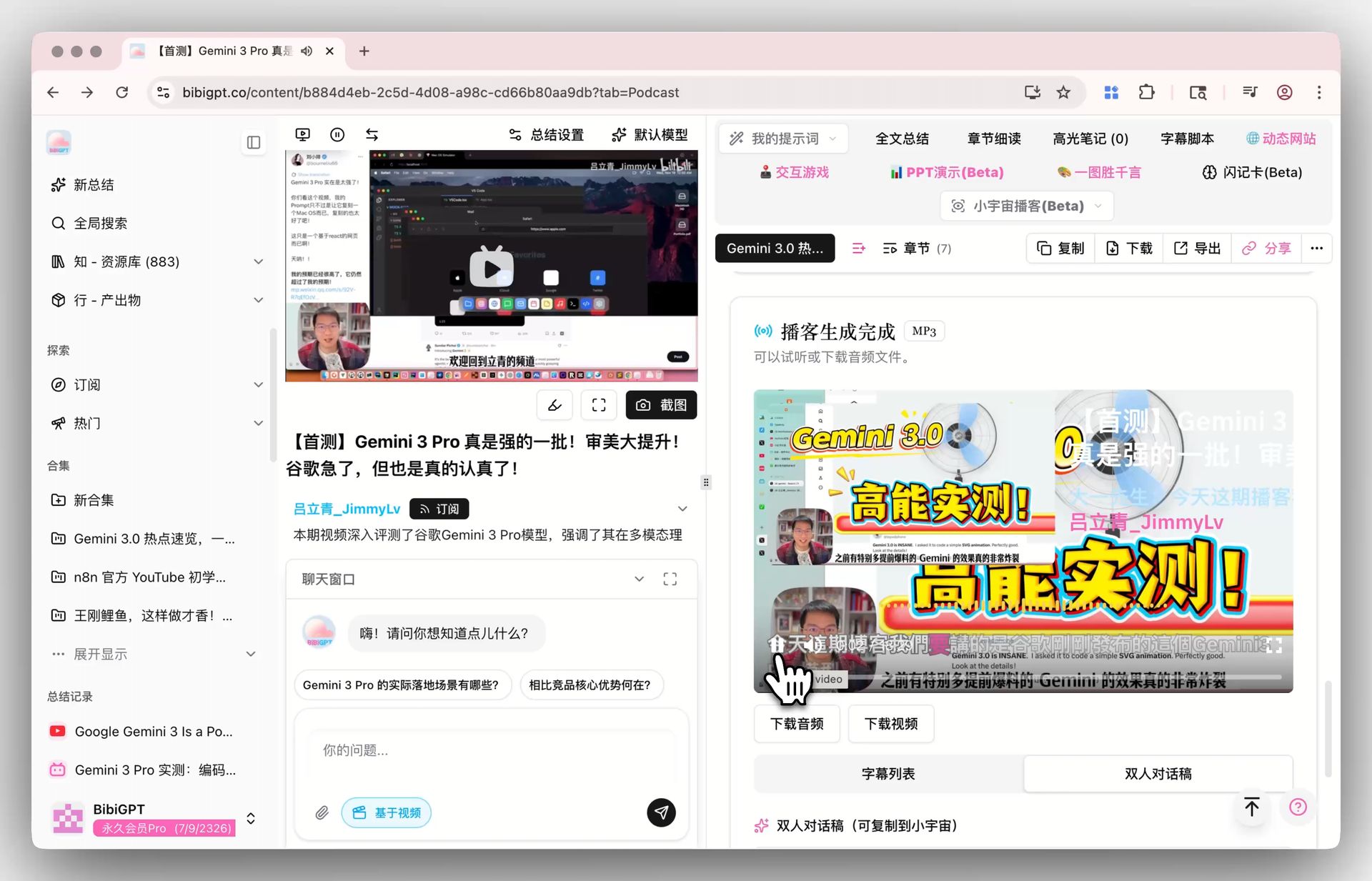 BibiGPT AI podcast generation screenshot
Best for: Undergrads and grad students who juggle class recordings, professor-assigned video links, and textbook PDFs in parallel — plus creators who want to redistribute lectures/interviews as podcasts.
Learning scenario example: Professor lectures for 90 minutes — record it, pipe it into BibiGPT, get a 20-minute two-host podcast to listen to on the walk home, then use the timestamped summary to take structured notes at night. The YouTube supplementary video your professor linked? Same flow. Neither YouLearn nor NotebookLM cover that mixed-source workflow as seamlessly.
2. YouLearn — The Student All-in-One
YouLearn is the fastest-growing AI learning tool among students — 2M+ users at Stanford, Harvard, MIT, and Princeton, Y Combinator-backed and a White House AI in Education Partner.
Core advantages:
- Seven outputs from one upload: Upload a PDF or YouTube video — get notes, flashcards, quizzes, personalized practice tests, AI tutor chat, a podcast (Audio Overview), and a study guide in one shot
- Student-first UX: Default templates and interface are built around exam prep, paper writing, and surviving finals
Limitations:
- Does not read Bilibili / Xiaoyuzhou / Apple Podcast links natively — international students with non-English course resources have to download first
- Podcast is a by-product of the all-in-one bundle; customization and voice selection are limited
- Tight free tier: 3 uploads/day, 5 AI chats/day (YouLearn pricing page)
Best for: Overseas students whose primary resources are English-language textbooks and YouTube open courses.
3. NotebookLM — Google's Power Move: 50+ Language Audio Overviews
NotebookLM is Google's AI notebook tool — Audio Overviews got a major upgrade in March 2026.
Core advantages:
- Customizable Audio Overviews: New pencil icon — tell the AI "focus only on chapter 3", "explain at undergrad level", "use a conversational tone" — March 2026 update
- 50+ languages supported: From Chinese to Portuguese, Audio Overviews now speak your language (Google's official announcement)
- Cinematic Video Overviews: Beyond audio — immersive animated explainers
- EPUB / PPTX import/export: Ebook ingestion, slide deck export
Limitations:
- Still upload-centric — YouTube link handling less seamless than BibiGPT
- No Bilibili / Xiaoyuzhou / Apple Podcasts — a gap for any student working with non-Google-ecosystem sources
- Output = notes + audio — lacks timestamp jumps, mindmaps, and interactive deep-learning formats
Best for: Deep Google Workspace users and research-heavy learners whose primary diet is PDFs and EPUBs.
Feature Comparison
看看 BibiGPT 的 AI 总结效果
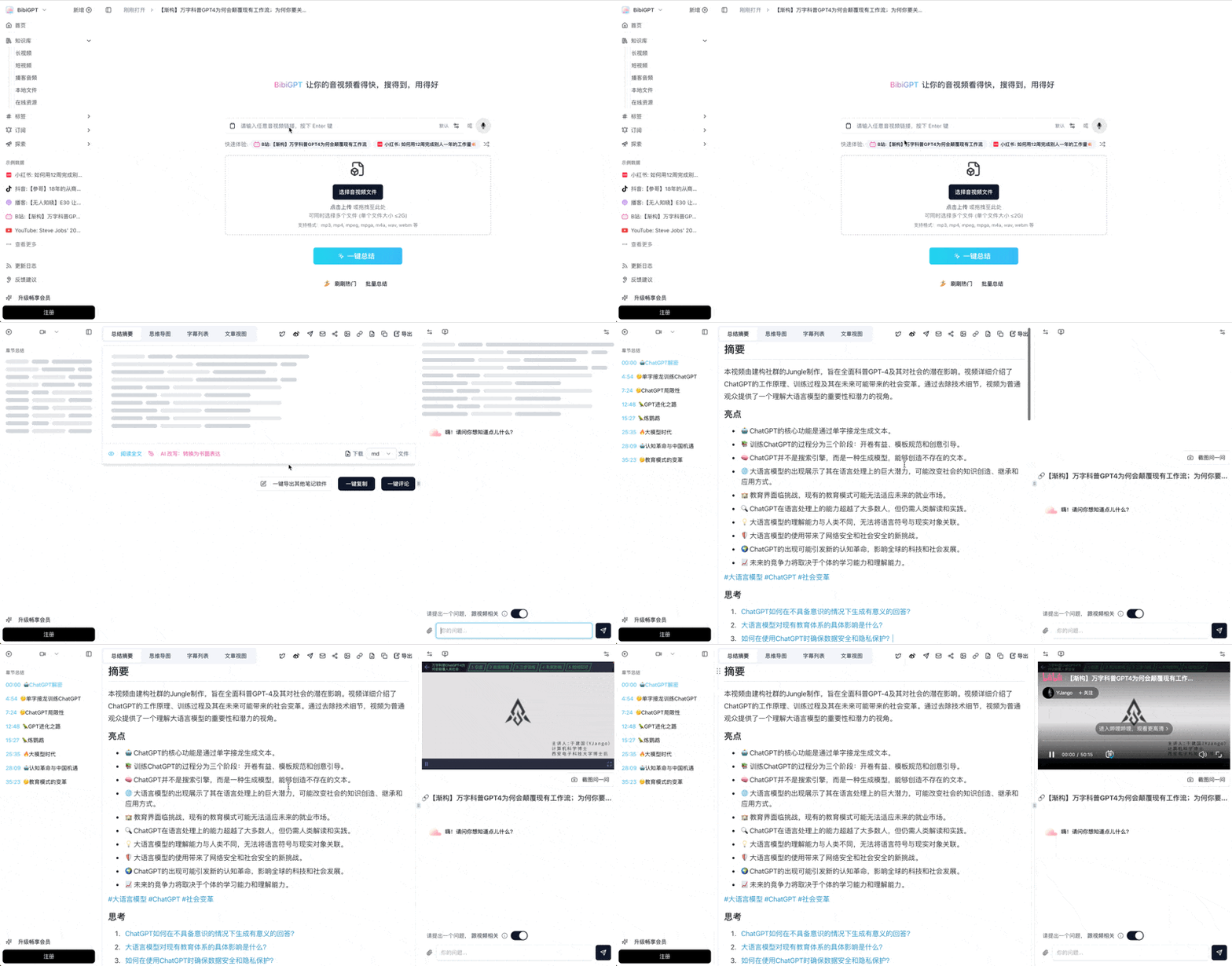
Bilibili: GPT-4 & Workflow Revolution
A deep-dive explainer on how GPT-4 transforms work, covering model internals, training stages, and the societal shift ahead.
| Feature / Tool | BibiGPT | YouLearn | NotebookLM |
|---|---|---|---|
| YouTube URL | Native | Supported | Supported |
| Bilibili / Xiaoyuzhou | Native | No | No |
| Lecture audio upload | Yes | Yes | Yes |
| PDF / EPUB upload | Yes | Yes | Yes (incl. EPUB) |
| Two-host podcast | Yes | Audio Overview | Audio Overviews (50+ lang) |
| Timestamp jumps in podcast | Yes | No | No |
| Mindmap | Yes | No | No |
| Flashcards / Quizzes | Yes | 7-in-1 | No |
| Note-tool sync | 10+ (Notion / Obsidian / Readwise) | Limited | Google Docs |
| Platform coverage | 30+ | PDF / YouTube / Audio | Upload sources |
| Free tier | Daily free quota | 3/day | Free |
Pick the Right Tool by Scenario
Scenario 1: Turn a 90-minute lecture into a 20-minute commute podcast
Recommendation: BibiGPT
Phone-record the lecture → drag into BibiGPT's desktop uploader → generate two-host podcast. Listen on the way home; do structured notes at night using the timestamped summary. NotebookLM can do something similar, but lacks timestamp jumps — when you want to revisit "that moment the prof derived the formula", BibiGPT wins.
Scenario 2: Batch-process 10 YouTube lectures assigned by the professor
Recommendation: BibiGPT (multi-URL batch) or YouLearn (English-only)
BibiGPT supports pasting multiple URLs in the homepage input box — batch summarization launches all at once. If the material is all English lectures and you primarily need flashcards/quiz practice, YouLearn's student-scenario templates will feel smoother.
Scenario 3: Read a textbook while generating a companion podcast
Recommendation: NotebookLM (PDF + EPUB) or BibiGPT
If your primary input is EPUB ebooks or heavy textbook PDFs, NotebookLM added EPUB support in March 2026 — plus the new "focus" customization lets you generate a podcast for a specific chapter. If you mix lecture videos and textbook PDFs, BibiGPT is the better hybrid choice — the 2026 AI podcast summarizer comparison has detailed benchmarks.
Scenario 4: Creators redistributing content as podcasts
Recommendation: BibiGPT
Turn long videos or livestreams into two-host conversations for Spotify, Apple Podcasts, Xiaoyuzhou — BibiGPT's AI podcast summary feature is purpose-built for this. Downloadable MP3, editable subtitle transcripts. The NoteGPT alternatives guide covers parallel text+podcast distribution workflows.
From Listening to Retention: Flashcards + Mindmaps
Just "listening to a podcast" isn't deep learning — retention requires structured review. BibiGPT adds two deep-learning companions:
Flashcards exported to Anki for spaced repetition
The BibiGPT flashcard feature generates interactive Q&A cards from video content — CSV export for Anki imports. The antidote to "I heard it but I don't remember it."
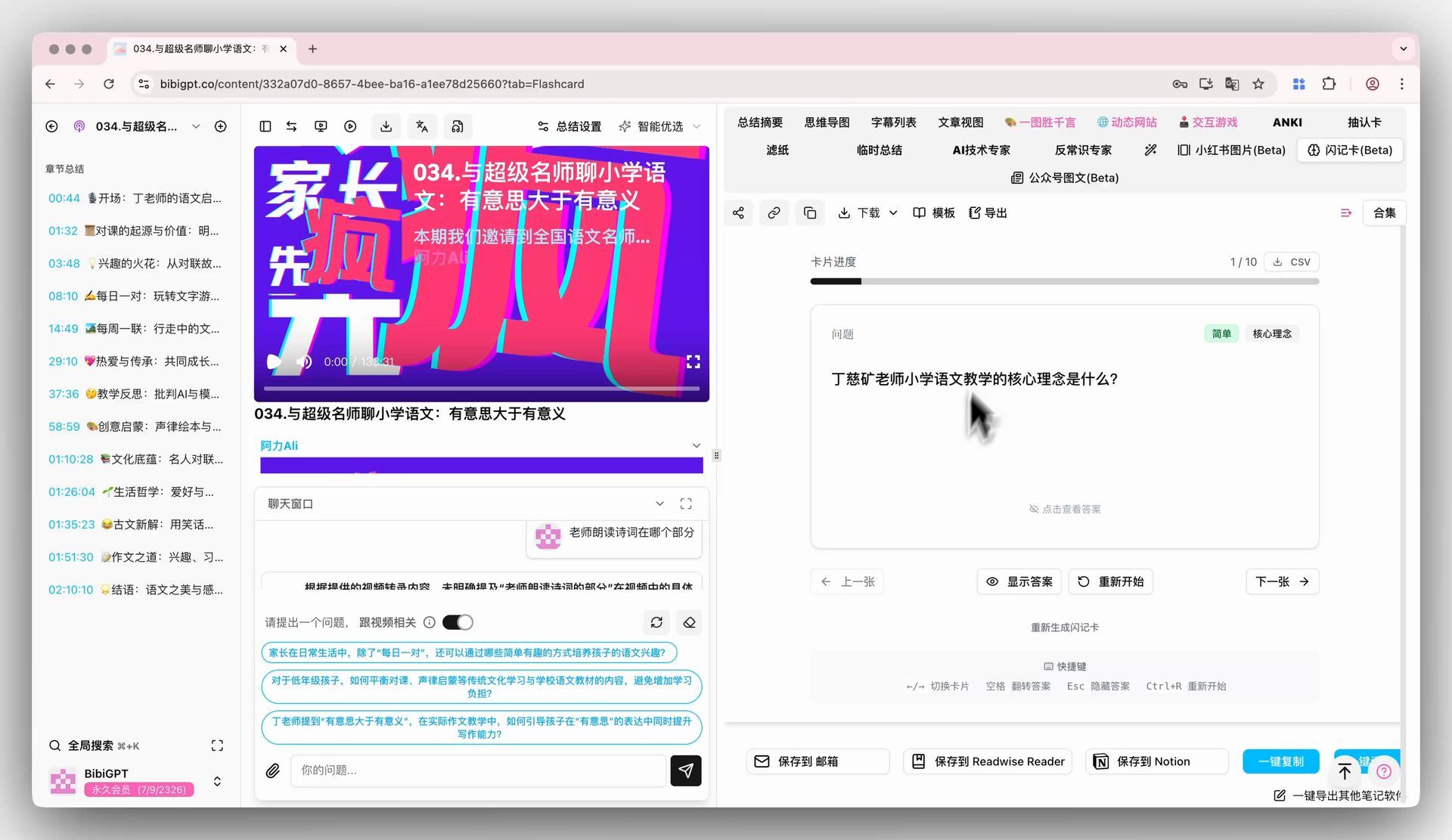 BibiGPT flashcard Q&A interface
Mindmaps for knowledge structure
One-click switch from podcast content to mindmap view (XMind / Markmap format) — scattered audio points reassemble into a cohesive knowledge map. See the BibiGPT 10-platform sync guide for downstream workflows.
FAQ
Q1: How is BibiGPT's podcast different from NotebookLM's Audio Overviews?
A: Two fundamental differences — input sources and learning loop:
- Inputs: BibiGPT reads 30+ platforms natively (YouTube, Bilibili, Xiaoyuzhou, TikTok); NotebookLM is upload-centric
- Learning loop: BibiGPT pairs the podcast with timestamped summaries, mindmaps, flashcards, and Notion/Obsidian sync — a full "listen → revisit → review" loop; NotebookLM focuses on Audio Overviews + notes
- Voices: BibiGPT's Chinese two-host format is purpose-built for Chinese audio content; NotebookLM's Audio Overviews extend to 50+ languages but started English-first
Q2: Student budget is tight — how do I mix the three?
A: A practical cost-efficient stack:
- BibiGPT free tier for Bilibili public courses and Xiaoyuzhou podcasts
- YouLearn free for the 3 most critical English PDF textbooks per day
- NotebookLM free for long-term PDF knowledge-base accumulation + multi-language Audio Overviews
This free trio covers ~80% of a typical undergrad / grad student's learning.
Q3: What if I forget right after listening?
A: Three fixes:
- After listening, generate flashcards in BibiGPT → export to Anki → spaced repetition
- Sync the podcast summary to Notion, revisit weekly
- For key chapters, open the mindmap view — structural memory reinforcement
Q4: Will AI podcasts replace real teachers?
A: Not in the short term. AI podcasts accelerate learning — compressing 10 lectures into 2 hours of "finishable" audio. But deep understanding and critical thinking still need human guidance. Treat AI podcasts as "preview accelerators" and "review compressors", not replacements.
Conclusion
The 2026 AI podcast study space has moved past "can it be built" to "who has the most input sources and the most complete learning loop." YouLearn cornered the student niche with 2M+ users, NotebookLM leverages Google's scale for 50+ languages, and BibiGPT delivers the most complete solution for students juggling mixed audio-video-text resources — 30+ platform coverage + two-host podcast + mindmaps + flashcards in one flow.
Start your AI podcast-powered learning journey now:
- 🌐 Official Website: https://aitodo.co
- 📱 Mobile Download: https://aitodo.co/app
- 💻 Desktop Download: https://aitodo.co/download/desktop
- ✨ Learn More Features: https://aitodo.co/features
BibiGPT Team