
Build Your AI Second Brain from Videos and Podcasts: The 4-Step PKM Method (2026)
Turn YouTube and podcasts into a working second brain. The 4-step Capture-Distill-Connect-Express method, with deep Notion / Obsidian / Readwise integrations via BibiGPT — trusted by 1M+ users.
Build Your AI Second Brain from Videos and Podcasts: The 4-Step PKM Method (2026)
As of 2026-04-28 | Built for Notion / Obsidian / Readwise / Cubox users
TL;DR: The real bottleneck of a Second Brain isn't "how much you save" — it's "how fast you digest." Podcasts, YouTube, lectures, and Bilibili are 90% of the modern knowledge worker's raw material, but classic PKM frameworks (PARA, Zettelkasten) were designed for text. This guide gives the 2026 video-first version: Capture → Distill → Connect → Express, and shows how BibiGPT plugs that pipeline into your existing Notion / Obsidian system.
试试粘贴你的视频链接
支持 YouTube、B站、抖音、小红书等 30+ 平台
Why Classic PKM Breaks in the Video Era
- Text scans fast, video doesn't — you can't "skim" a 1-hour podcast
- Note apps only accept text input — videos and audio are black boxes, unsearchable from the inside
- "Watched once, forgotten by tomorrow" is the default
- Format silos between Notion, Obsidian, and Readwise — no cross-vault search
Methodologies like PARA (Tiago Forte) and Zettelkasten (Niklas Luhmann) answered "how to organize text," but they never answered "how does video enter the system." AI is the patch.
The 4-Step Method at a Glance
| Step | Goal | Output |
|---|---|---|
| 1. Capture | Pull videos / audio into the system | Transcript, link, metadata |
| 2. Distill | Turn raw material into knowledge | Summary, key points, mind map |
| 3. Connect | Wire the knowledge into your second brain | Backlinks, tags, indexes |
| 4. Express | Make knowledge produce output | Articles, slides, flashcards |
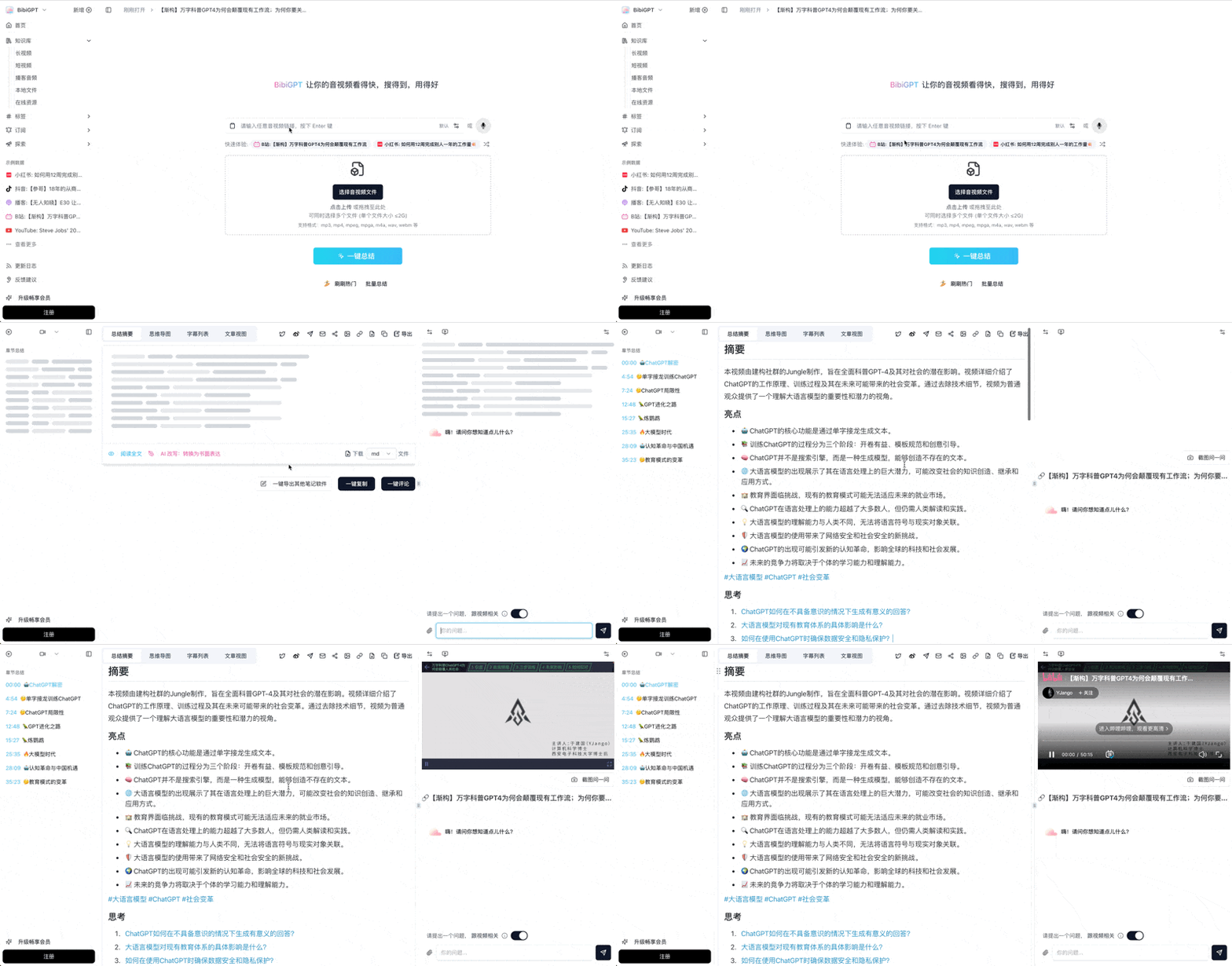
看看 BibiGPT 的 AI 总结效果
Let's build GPT: from scratch, in code, spelled out
Andrej Karpathy walks through building a tiny GPT in PyTorch — tokenizer, attention, transformer block, training loop.
Step 1 — Capture: Turn "watched/listened" into "processable"
1.1 Sources
- YouTube / Bilibili / podcasts → browser extension sends to BibiGPT
- Local lectures / meetings → drag into local video-to-text
- Apple Podcasts / Spotify / Xiaoyuzhou → paste into podcast transcript
- Meeting recordings → see our full meeting workflow
1.2 Be selective
PKM Law #1: More capture is not better capture.
Not every video deserves a place in your second brain. Use PARA's 4 categories: only capture material relevant to a current Project, long-term Area, future Resource, or worth Archiving. Pure entertainment? Watch and let it go.
Step 2 — Distill: Transcripts to consumable knowledge
2.1 Three layers of structured output
BibiGPT outputs three layers by default:
- 30-second summary — decides "should I keep going"
- Section-level highlights — full content in 5-10 minutes
- Full transcript with timestamps — drill in any time
This maps directly onto Tiago Forte's Progressive Summarization — match effort to need.
2.2 Mind maps — the visual skeleton
Video naturally fits mind maps: topic → sub-topic → example. BibiGPT generates them in one click; export to SVG / PNG / Markmap, drop straight into Notion or Obsidian Canvas.
2.3 AI chat — pull, don't read
The best distillation is active questioning, not passive reading. BibiGPT's AI video chat with source tracing lets you ask:
- "What specific number did the guest cite?"
- "Where does the guest disagree with last episode's guest?"
- "If I'm building a SaaS, how does this argument apply?"
Answers come with click-through timestamps. This is the line between "knowledge work" and "knowledge lookup."
Step 3 — Connect: Wire it into your second brain
3.1 Pick your note system
| System | Recommended workflow | Reference |
|---|---|---|
| Notion | Auto-archive each summary as a database row via Notion API | Notion + BibiGPT workflow |
| Obsidian | Export Markdown to vault with auto backlinks | Obsidian + BibiGPT video notes |
| Readwise | Auto-sync highlights | YouTube → Readwise |
| Cubox | Send summary + outline + timestamps via Cubox API | Configure Cubox API in settings |
3.2 Tags and backlinks
PKM Law #2: A standalone note has no value — connections do.
Tag every video note with at least three:
- Topic tag (e.g.,
#AI-Agents#Podcasts#Interviews) - Author / source tag (e.g.,
#Lex-Fridman#Lenny) - Status tag (e.g.,
#to-digest#applied#cited)
Obsidian users add [[]] backlinks so each new video joins your existing graph.
3.3 Index notes
Build a monthly index — one list of every video that month + a one-line summary + jump links. This is the video version of Maps of Content (MOC).
Step 4 — Express: Make knowledge ship
4.1 Output formats
| Output | BibiGPT feature |
|---|---|
| Newsletter / blog | Video-to-article |
| Slides | One-click PPT from summary |
| Anki flashcards | Flashcard export |
| Cross-video synthesis | Collection summary |
| Multi-platform repurposing | Video → article → short-video script |
4.2 Feynman test
PKM Law #3: Knowledge isn't digested until it leaves your head.
Apply the Feynman Technique — re-explain in your own words, find the gaps. BibiGPT's AI chat is a natural Feynman partner: paste your re-explanation and ask, "What did I get wrong?"
See our deep dives: Feynman + Bilibili learning loop and video-learning science system.
4.3 Cross-video synthesis (where compounding lives)
The compounding effect of PKM comes from connecting multiple videos. BibiGPT's collection summary turns 10 episodes on a single topic into one synthesis:
"Compare the 10 AI-Agent videos I watched last month — what are their core arguments, where do they disagree, where are the actionable bets?"
That's PKM's multiplier — single videos have limited value; ten connected videos generate insight no single watch can.
Cross-Walk Against Other Methodologies
| Method | Text-era answer | Video-era patch (via BibiGPT) |
|---|---|---|
| PARA | Files into P/A/R/A | Video notes same buckets + searchable transcripts |
| Zettelkasten | Atomic notes + backlinks | Chapter summaries = atomic notes + timestamp citations |
| Building a Second Brain | CODE: Capture-Organize-Distill-Express | Same four moves with video as raw layer |
| Linking Your Thinking | MOCs | Monthly video-index notes = video MOCs |
| Progressive Summarization | 4 layers of bolding | 30-sec / section / transcript + AI chat |
FAQ
Q1: I already have Notion + Readwise. Where does BibiGPT fit?
A: BibiGPT is your raw + distill layer. Capture, transcript, summary, mind map all happen in BibiGPT; final archive and linkage stay in your Notion / Readwise.
Q2: Do I run all four steps for every video?
A: No — apply PARA filtering. Only run the full pipeline for project-/area-/resource-relevant videos.
Q3: How much does cross-video synthesis cost?
A: Plus / Pro tiers include collection summaries, billed by video count. See pricing.
Q4: How do I handle local podcasts?
A: Use local audio-to-text — drag in. For sensitive content, enable Local Privacy Mode.
Q5: How is this different from Whisper + ChatGPT?
A: Whisper + ChatGPT gives you transcripts and one-shot summaries. They can't do mind maps, source-traced chat, collection synthesis, knowledge-tool integrations, flashcards, or video-to-article. BibiGPT is a PKM pipeline, not a one-trick tool.
Q6: How do I avoid information overload?
A: That's exactly why PKM has selectivity rules. PARA filtering + monthly index notes + cross-video synthesis are the three gates against overload.
Closing: The 2026 Shape of a Second Brain
A Second Brain isn't "store every video you watched." It's "make every watched video participate in some future decision or output." AI compresses "watched → digested → reused" into 10 minutes. BibiGPT's role is simple: make video and audio first-class citizens in your note system.
Start building your video-first second brain:
- Web: https://bibigpt.co
- Desktop: https://bibigpt.co/download/desktop
- Mobile: https://bibigpt.co/app
- Browser extension: https://bibigpt.co/apps/browser
BibiGPT Team