
The 5-Step AI Video Learning System: A Complete Methodology from Consumption to Knowledge Retention
Beyond simple video summarization: a science-backed 5-step framework for effective video learning with BibiGPT. Combine Collection Summary, Deep Summary, Mind Maps, Flashcards, and Anki to turn fragmented videos into long-term knowledge.
The 5-Step AI Video Learning System: A Complete Methodology from Consumption to Knowledge Retention
Have you ever watched hours of educational videos, felt like you learned a lot — only to realize a week later that you can barely remember any of it? Or saved hundreds of videos you never get around to watching? Understood something while watching, but couldn't apply it when it mattered?
This isn't your fault. It's a methodology problem.
Video is a passive medium. If you're just "watching," your brain is in receive mode — not actively building neural connections. Cognitive science research shows that passive video watching retains less than 10% of information after 24 hours.
This article presents a complete 5-Step AI Video Learning System, powered by BibiGPT, to transform passive video consumption into active knowledge internalization.
Why "Watching Videos = Learning" Is an Illusion
Cognitive Load Theory tells us that human working memory has limited capacity. When you're simultaneously processing video visuals, audio, and subtitles, your brain is already running at full capacity — with no bandwidth left for deep processing and memory encoding.
The deeper problem: video lacks active retrieval opportunities.
Active retrieval is the core mechanism of memory consolidation. Simply put: you need to "pull out" knowledge from your brain to strengthen the memory. Input alone isn't enough — you need output actions.
The BibiGPT 5-step system inserts active processing moments at every critical point.
Step 1: Scout — Use 15 Minutes to Decide If It's Worth Your Time
Goal: Build a macro-level understanding of a topic or series before committing significant time.
Tool: BibiGPT Collection Summary
When facing a video series (like a 30-episode Python course) or a batch of related videos, the first step isn't to start from Episode 1. Instead:
- Add the series to a BibiGPT collection
- Click "Summarize Now"
- The system generates an overall knowledge architecture overview + mind map
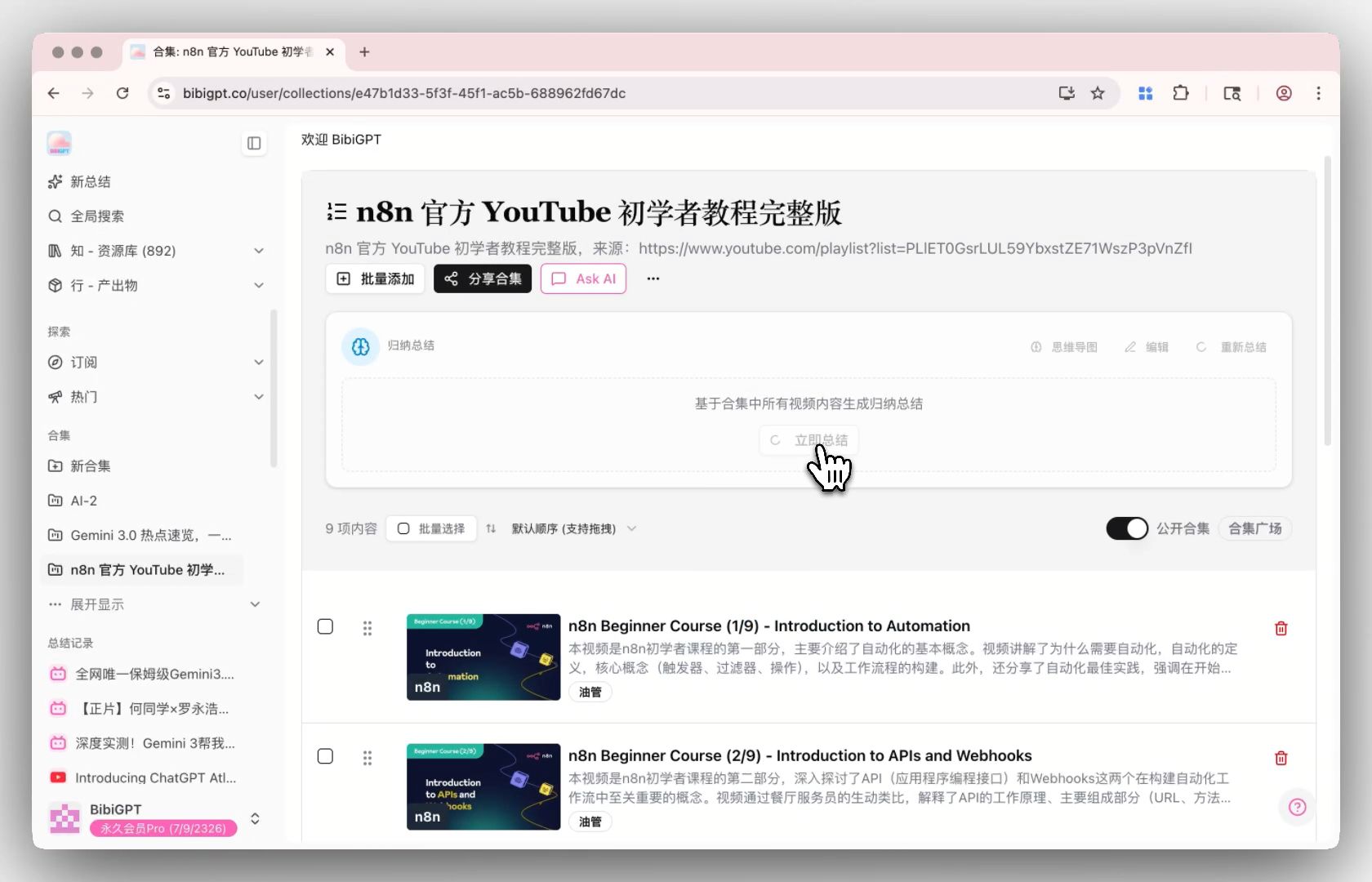 Collection Summary Entry
Through the collection summary, you can answer three critical questions in 15 minutes:
- What are the core knowledge points covered in this series?
- Which parts do I already know (can skip)?
- Which parts do I need most (worth deep reading)?
Cognitive science basis: This corresponds to the "Advance Organizer" strategy — building a framework before learning new content can improve learning efficiency by over 40%.
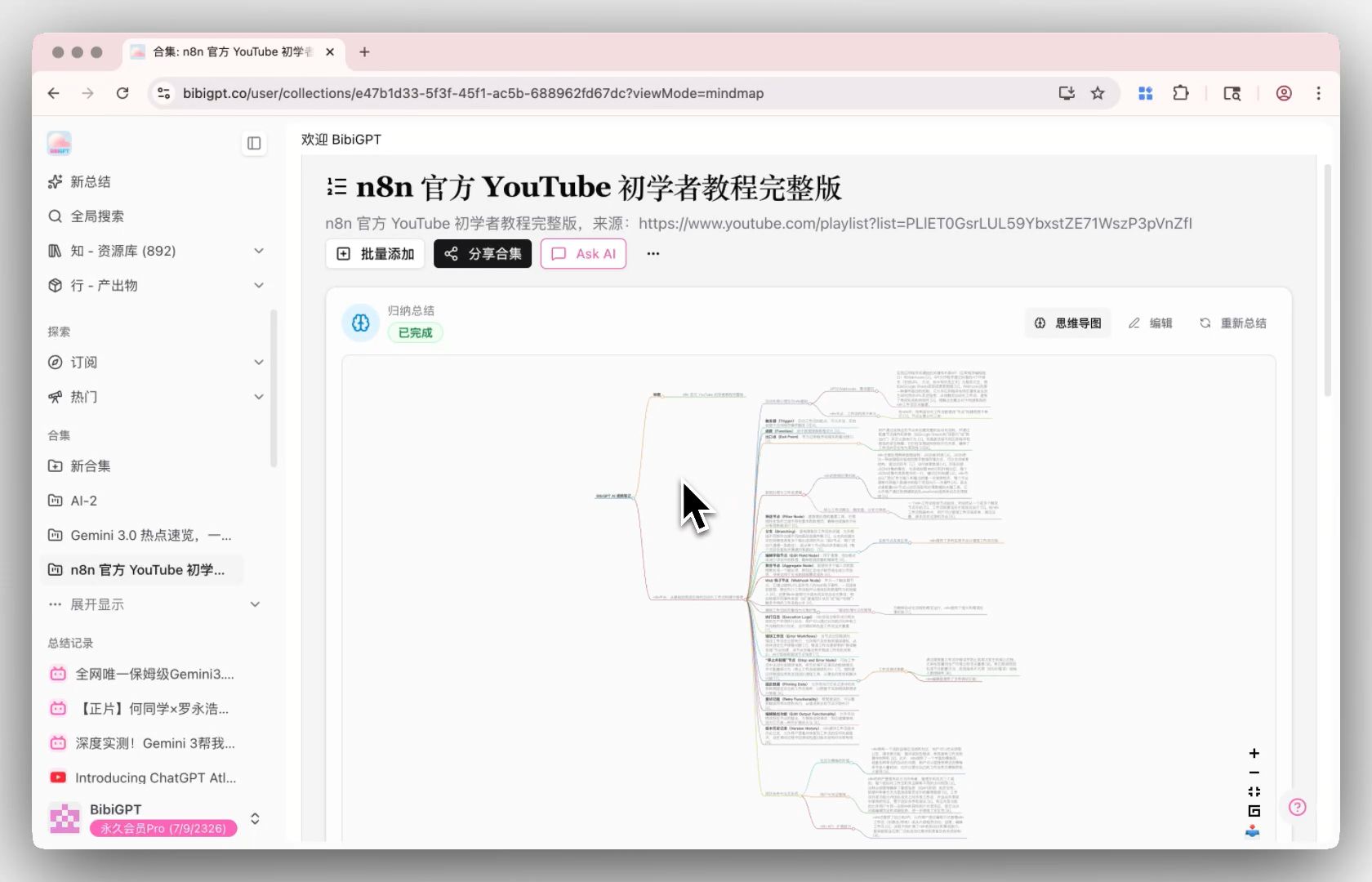 Collection Summary Mind Map
Step 2: Select — Deep Investment Only in What's Worth It
After scouting, you know which episodes or videos deserve deep learning. For those, enter deep processing mode.
Tool: BibiGPT Smart Deep Summary
BibiGPT's deep summary is more than a synopsis — it includes:
- Core Summary: Main arguments and conclusions of the video
- Key Highlights: The 3-5 most important points worth remembering
- Critical Thinking Q&A: Questions to test your depth of understanding
- Key Term Explanations: Plain-English definitions of technical vocabulary
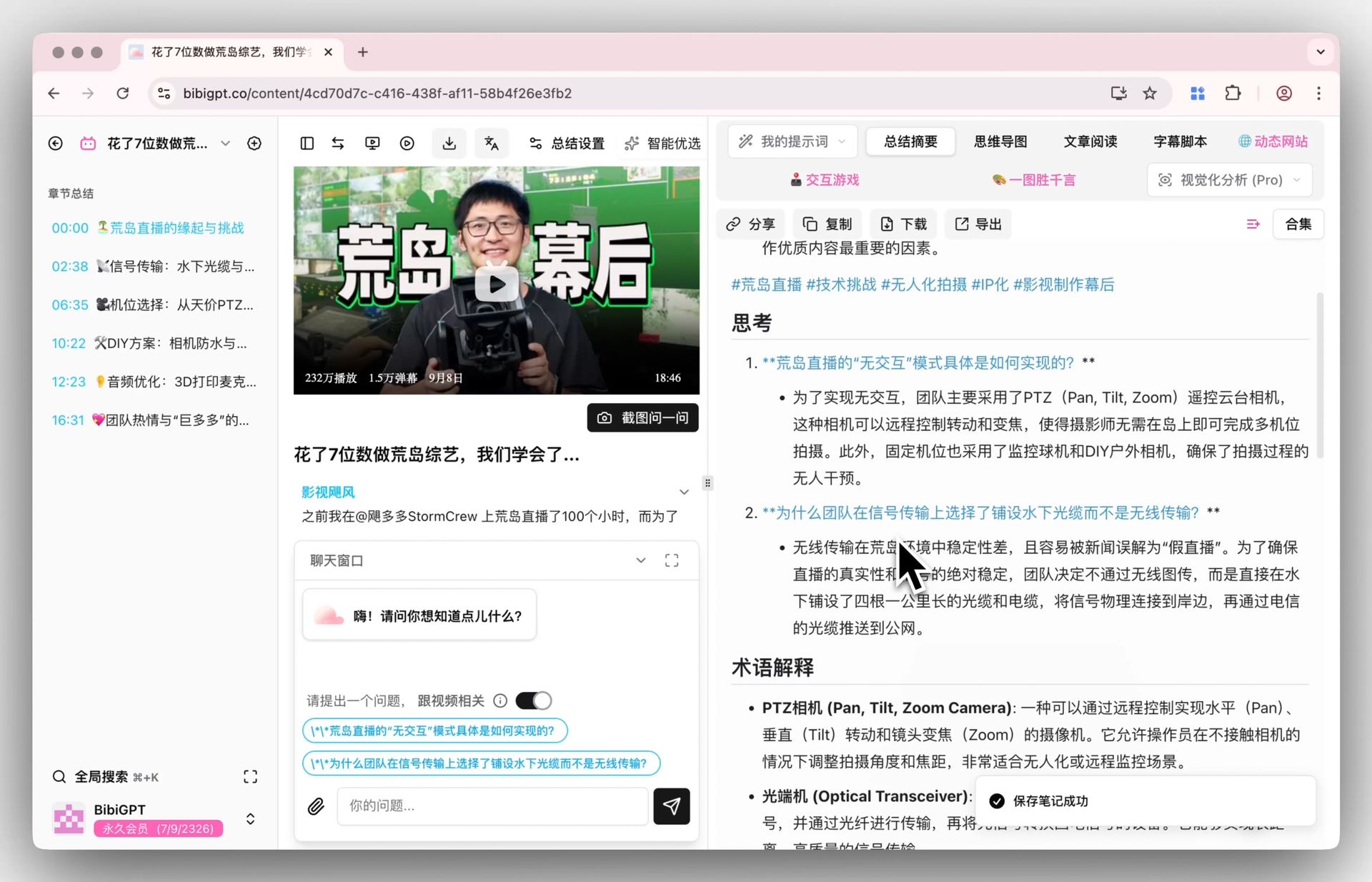 Deep Summary Thinking Questions
Practical tip: After reading the deep summary, close the page and try to answer each critical thinking question in your own words. This is the core practice of the Feynman Technique — if you can't explain it simply, you haven't truly understood it.
For more on the Feynman Technique in video learning: Feynman Learning Method × Active Recall: Complete BibiGPT Video Learning Guide
Step 3: Absorb — Deep Dialogue With Video Content
Goal: Not just receive information, but actively question, extend, and integrate it.
Tool: BibiGPT AI Chat
BibiGPT supports deep Q&A with video content. You can:
- Ask about concepts the video didn't explain clearly
- Request a simpler explanation of a particular section
- Explore connections between the video content and your existing knowledge
- Challenge the video's arguments and ask for alternative perspectives
Question templates (ready to use):
1. The video says [X] — can you explain it with a real-world example?
2. How does [X] relate to [Y] that I learned before?
3. What would happen if the opposite of [X] were true?
4. In what situations does this conclusion break down?
This active questioning approach corresponds to "Elaborative Encoding" in cognitive science — connecting new information to your existing knowledge network can improve memory retention by 3-5 times.
Step 4: Build — Integrate Knowledge With Mind Maps
Goal: Transform fragmented video information into a systematic knowledge structure.
Tool: BibiGPT Inline Mind Map
Knowledge from a single video is isolated. The real value of learning comes from connecting knowledge across different videos to form your own knowledge network.
BibiGPT's mind map feature helps you:
- After each important video → view the BibiGPT-generated mind map
- Manually compare: how does this video's knowledge connect to the previous one?
- Weekly integration: merge mind maps from multiple videos on the same topic into a larger knowledge graph
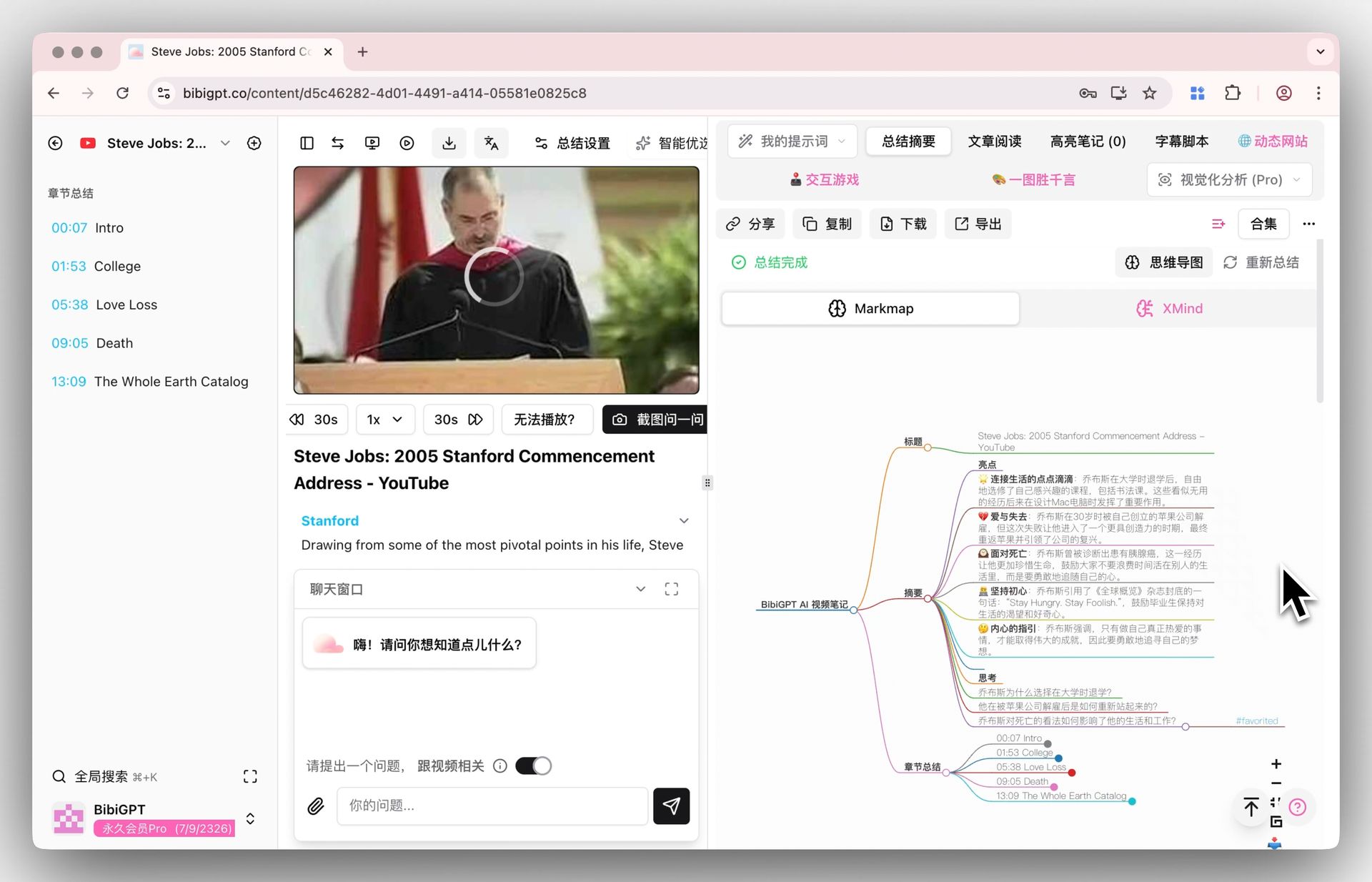 Mind Map Display
Advanced tip: Use the Collection Summary mind map as your master framework, then fill in details from each deep-read video. Your knowledge map becomes increasingly comprehensive and personalized.
Step 5: Internalize — Build Permanent Memory With Spaced Repetition
Goal: Make key knowledge persist in memory for months or years, not just a few days.
Tool: BibiGPT Flashcards + Anki
The Ebbinghaus Forgetting Curve reveals the pattern of memory: without review, you forget 50% within 24 hours, 70% within a week, 90% within a month. Spaced Repetition is the most effective tool against the forgetting curve.
BibiGPT's flashcard feature automatically extracts key knowledge points from video content and generates Q&A cards:
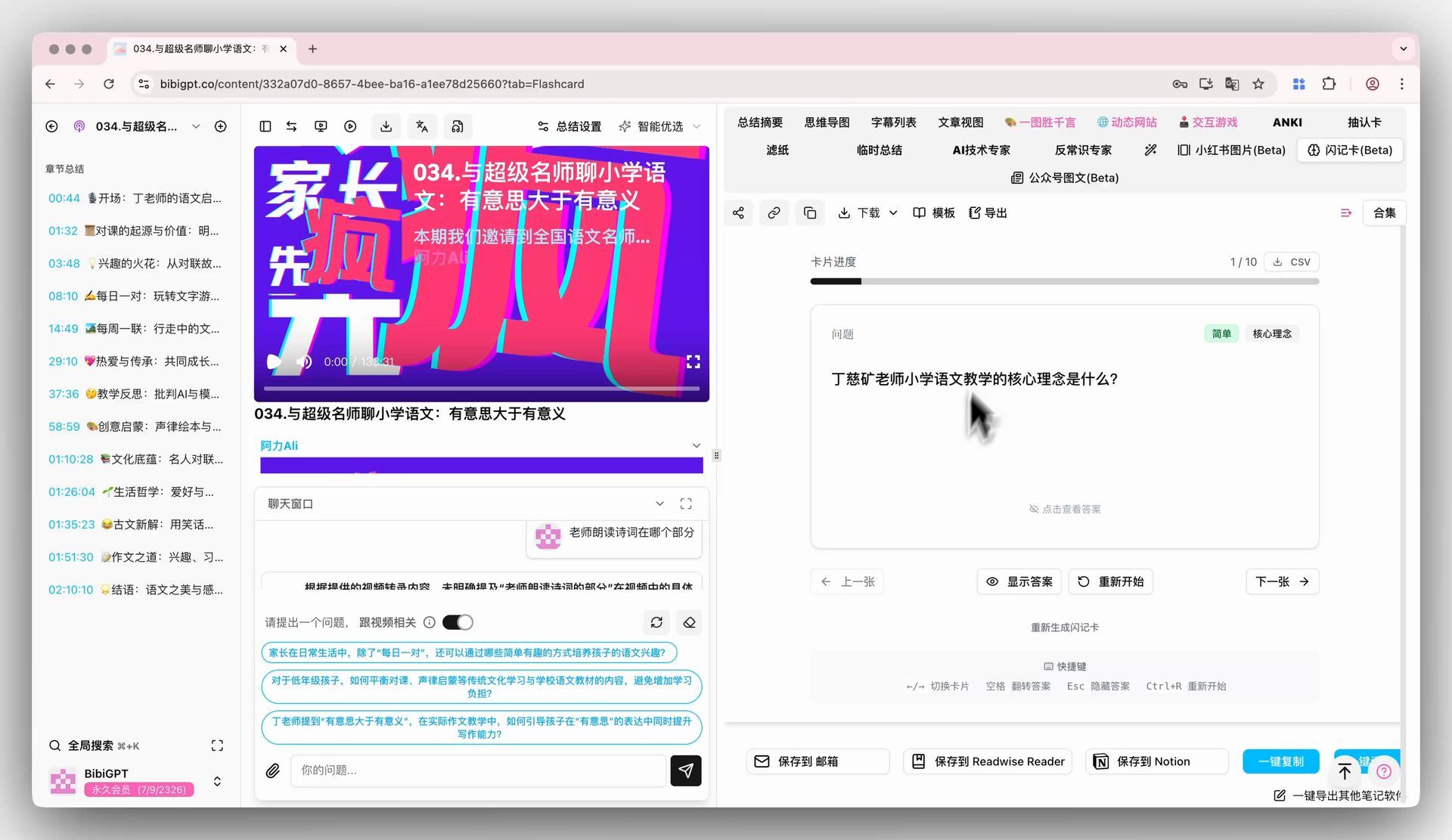 Flashcard Interface
Complete internalization workflow:
Watch important video
    ↓
BibiGPT Deep Summary + Mind Map (Steps 2 & 4)
    ↓
One-click flashcard generation (3-5 minutes)
    ↓
Export CSV → Import into Anki
    ↓
Daily 10-minute Anki spaced repetition
    ↓
Permanent knowledge internalization
For a 10-episode learning series, using this system, just 10 minutes of daily Anki review ensures you still retain over 80% of core content after 3 months.
Time Budget for the 5-Step System
| Step | Tool | Time Investment | Knowledge Value |
|---|---|---|---|
| Scout | Collection Summary | 15 min / series | Build macro framework |
| Select | Deep Summary | 10 min / video | Efficiently identify core content |
| Absorb | AI Chat Q&A | 15 min / video | Active understanding |
| Build | Mind Map | 5 min / video | Knowledge networking |
| Internalize | Flashcards + Anki | 10 min / day | Long-term memory retention |
Compared to the traditional "watch all videos in full" approach (1 hour/episode × 30 episodes = 30 hours), the 5-step system requires about 30-40% of the time investment while achieving 300-500% better knowledge retention.
AI Agent Automation: Let bibigpt-skill Execute the 5-Step System
If you use OpenClaw or Claude Code, you can automate the first steps of the 5-step system:
# Install bibigpt-skill
npx skills add JimmyLv/bibigpt-skill

# Let Agent automatically complete the Scout step
@OpenClaw Add the last 20 videos from [Bilibili channel URL] to a collection and generate a collection summary for me
Related reading: OpenClaw + bibigpt-skill Complete Guide
From Information Consumer to Knowledge Builder
The essence of this 5-step system is reclaiming agency over your own learning.
Instead of creators deciding what you learn and how — you use Scout to decide if it's worth learning, Select to decide what to learn, Absorb to decide how to understand it, Build to decide how to integrate it, and Internalize to decide how to remember it.
BibiGPT is the execution engine for this system. Whether you're learning from YouTube tutorials, Bilibili course series, Xiaohongshu tips, or podcasts, this methodology applies.
Related reading:
- Video Learning Science System + BibiGPT Second Brain Building
- Sora 2 Era: How to Handle the AI Video Explosion with BibiGPT
Start your AI efficient learning journey now:
- 🌐 Official Website: https://aitodo.co
- 📱 Mobile Download: https://aitodo.co/app
- 💻 Desktop Download: https://aitodo.co/download/desktop
- ✨ Learn More Features: https://aitodo.co/features
BibiGPT Team