Bilibili AI Content Surge: Is Your Video Consumption Keeping Up?
Open Bilibili and the homepage is flooded with AI content: AI art tutorials, large model benchmarks, AI coding tools in action, AI-generated music, AI voiceover guides. You click one, spend 20 minutes watching, and walk away with something useful — but there are still 30 unwatched videos in your queue. Pull to refresh, and five more appear.
This isn’t just your experience. In Q1 2026, Bilibili’s AI-related content watch time grew nearly 50% quarter-over-quarter. It’s not that one creator went viral — the entire category is in a production explosion. Creators are using AI to accelerate scripting, editing, voiceovers, and thumbnails. Everyone’s output capacity doubled. Content density on the platform has followed.
The problem: human consumption speed hasn’t scaled. The time you have each day for video is fixed, but the volume of content worth consuming is not what it used to be. This isn’t anxiety — it’s arithmetic. This article tackles a practical question: given Bilibili’s AI content boom, how do you use AI tools to fight the AI content flood and turn your subscriptions into a real knowledge asset?
The Bilibili AI Content Boom: What the Data Actually Means
Bilibili’s Q1 2026 official data shows AI-related content watch time grew close to 50% quarter-over-quarter. The number itself is striking, but what’s behind it matters more.
Supply side: creators’ output velocity just jumped
With AI-assisted creation tools now mainstream, UP creators have shifted from “2-3 videos per month” to “2-3 videos per week” — or faster. Scripting, editing, subtitle generation, thumbnail design: every step now has AI tooling. The marginal cost of creating a video has dropped sharply. The result: subscribe to the same 50 creators in 2026 that you did in 2024, and weekly new content volume is roughly 3x higher.
Platform signal: Bilibili itself launched an AI agent to track updates for you
In 2026, Bilibili upgraded its AI agent monitoring feature — automatically tracking the creators you follow and using AI to generate summaries of new videos, then pushing them to you. This is a platform-level admission: content volume has grown to the point where even Bilibili thinks you need AI to filter it.
AI-generated summaries: extracting key information from lengthy videos
Official context: Bilibili’s data shows AI knowledge content submission volume grew over 200% year-over-year, making it one of the fastest-growing content categories on the platform. See Bilibili’s official platform reports for reference.
The practical rule: When the platform’s content production rate outpaces your consumption speed, you’re already falling behind — tools aren’t optional, they’re necessary.
This isn’t fearmongering. It’s describing something that has already happened: AI-powered content creation has opened up an efficiency gap between producers and consumers. On the consumer side, working without tools means running on foot to keep up with machines.
The Cost of Information Overload: What You’re Missing
Research data suggests the average Bilibili user in China spends over 7 hours per week on the platform. But a heavy user following 50+ creators may be facing 40-60 new videos per week — even at 15 minutes each, that’s 10-15 hours of content. Something has to give.
The more you follow, the harder it is to focus
Your subscription list is a breeding ground for information anxiety. You followed that AI tools creator because they occasionally have good breakdowns. You also follow the finance analyst, the history series, the coding tutorials. Each one “might be useful someday.” The result: your homepage becomes an untopiced knowledge bazaar, and every visit requires energy just to figure out what’s worth watching and what’s padding.
The real cost of information overload isn’t time — it’s attention. Every time you open Bilibili and decide “is this worth watching,” you’re spending cognitive resources that could go toward doing something with what you already know.
What tracking updates without AI assistance actually looks like
Without AI tools, the typical user behavior pattern is:
- Judging by thumbnail and title (high miss rate — good content often has weak titles)
- Jumping to high-comment-density sections to find highlights (loses context, creates fragmented understanding)
- Saving to “watch later” (realistically, never watched again)
- Watching a 40-minute video at 1.5x speed (compresses time but doesn’t reduce cognitive load)
The outcome: you spent time, but the knowledge that actually sticks is low-density.
The most expensive thing isn’t the time you spent — it’s the content you “watched” but never actually absorbed.
Using BibiGPT to Turn Bilibili Subscriptions into a Knowledge Base
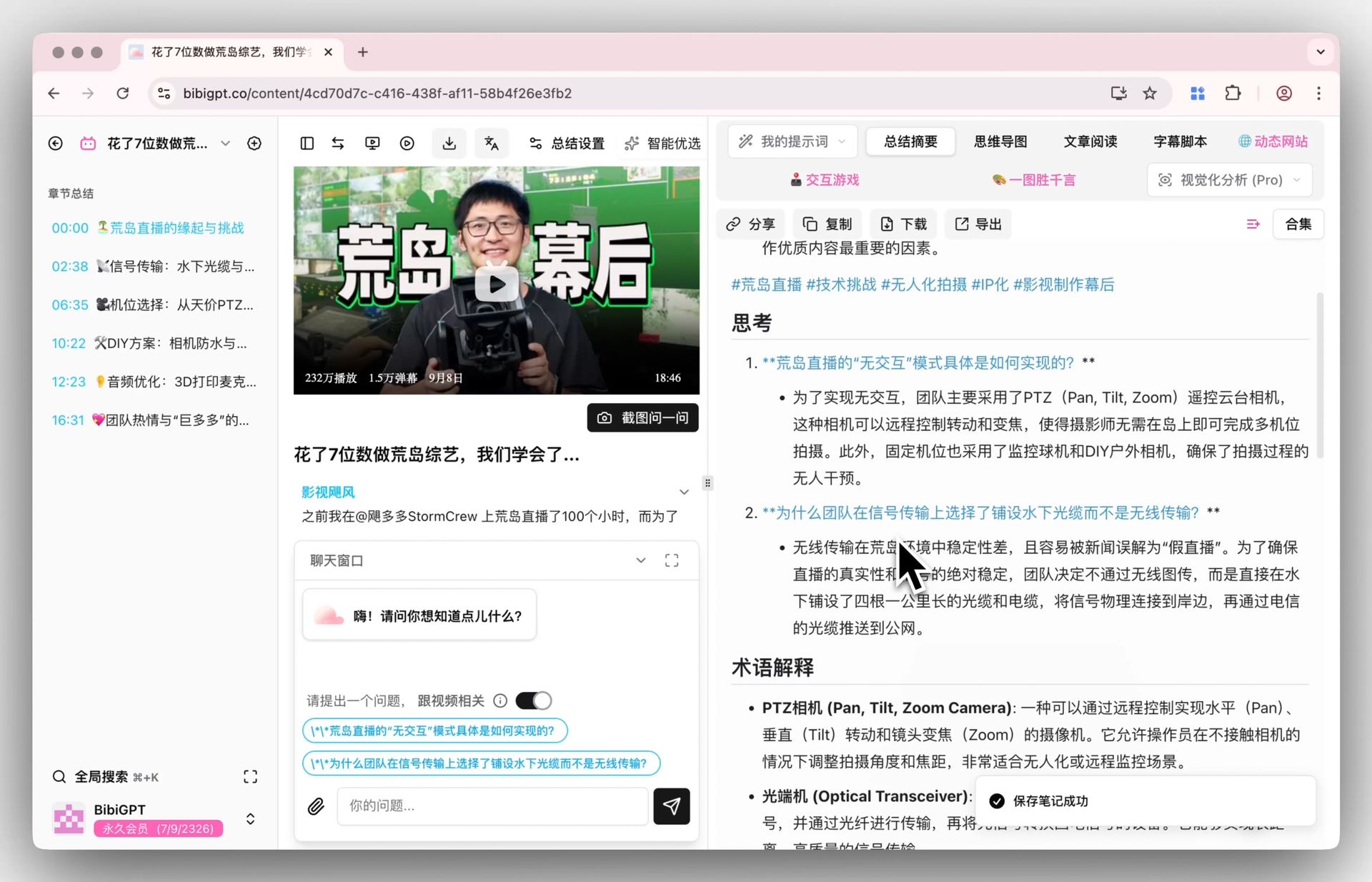
BibiGPT’s core capability: paste a Bilibili video link, extract subtitles, and generate an AI summary. This simple action can systematically change how you relate to Bilibili content.
5-step workflow: from video link to structured knowledge
Step 1: Paste the Bilibili link Open BibiGPT and paste the video URL. Supports standard Bilibili videos, anime with official subtitles, courses, and most content with subtitle tracks.
Step 2: AI generates a structured summary The system automatically extracts subtitles and AI analyzes the full text, generating 3-5 paragraphs of core summary — key arguments, critical data points, actionable takeaways. Done in under 30 seconds. Information density beats anything you’d write by hand.
Step 3: Timestamp navigation to key moments Every point in the summary comes with a video timestamp. Spot something interesting, click the timestamp, jump directly to that segment — no scrubbing through the whole video.
Step 4: AI follow-up questions to deepen understanding If a concept in the summary interests you, ask a follow-up in the AI conversation feature. The AI answers based on this specific video’s content — not generic knowledge, but grounded in what you’re actually processing.
Step 5: Export notes to Notion / Obsidian Your organized summaries and conversation logs can be exported directly into your knowledge management system. Processing time per video drops from 40 minutes to 5 minutes, while the actual knowledge retention goes up.
BibiGPT: paste a link, get a summary, ask follow-ups
Pair this with the AI mind map feature to visualize the knowledge structure of any video — especially useful for learning-heavy or technical content.
Best fit:
- Heavy Bilibili users following 20+ creators with more new content than they can watch
- Professionals using Bilibili as a knowledge source who need to extract value quickly
- Content creators researching competitors to understand angles and information density
- Students processing Bilibili courses and tutorials
Not the best fit:
- Users primarily on Bilibili for entertainment and relaxation, not knowledge retention (you don’t need AI summaries — enjoy the content)
- Non-subtitle content types (pure music videos, live stream replays — summary accuracy is limited)
For a detailed guide to the Bilibili summary feature, see the Bilibili Summary page.
Beyond Tracking Updates: Building an AI Content Radar
Summarizing individual videos is just the first step. The more powerful mode is integrating BibiGPT into your Bilibili subscription management workflow to build an AI content radar.
Workflow design: subscriptions × BibiGPT
Weekly scan: Set a fixed weekly time slot (e.g., 30 minutes on Sunday evening). Batch the week’s new videos from your followed creators into BibiGPT, generate a summary list. Browse summaries, decide which ones are worth a full watch and which ones the summary is enough for.
Thematic archiving: Organize content from different creators by topic (AI tools, finance, tech, etc.), using the export function to build separate knowledge bases. Following multiple creators in the same area lets you compare perspectives horizontally.
Follow-up logging: Develop a habit of asking follow-up questions on interesting content. One good question can extract more value from a video than the video itself, and the follow-up log becomes a record of your thinking process.
Here’s a reference video about the Bilibili AI content ecosystem and how it’s changing the consumption landscape:
Why this workflow works:
Bilibili’s platform AI agent solves “knowing a new video exists.” It doesn’t solve “knowing whether this video is worth 40 minutes of your attention.” BibiGPT’s summaries fill exactly that gap: before you commit to watching, spend 5 minutes with the summary to decide if it deserves your full focus.
This isn’t laziness — it’s attention management. Every high-quality “skip” decision leaves your time for something more worthwhile.
Efficient content consumers aren’t the ones who watch the most — they’re the ones who are clearest about what’s not worth watching.
FAQ: Bilibili’s AI Content Boom and BibiGPT
Q: Bilibili’s AI agent already notifies me of new videos. Why do I need BibiGPT too?
A: Bilibili’s AI agent solves the notification problem — it tells you a creator has uploaded. BibiGPT solves the comprehension problem — it tells you what the video covers, which moments are worth watching closely, and lets you ask follow-up questions. They’re complementary, not competing.
Q: What types of Bilibili content does BibiGPT support?
A: Most Bilibili videos with subtitles, including knowledge, tech, finance, tutorial, and educational content. Anime requires official subtitles. Pure live stream replays and videos without any subtitle track have limited summary accuracy.
Q: How accurate are AI-generated summaries? Will I miss important information?
A: Summary accuracy is strong for content with high knowledge density — technical tutorials, financial analysis, academic lectures. For narrative-heavy or experiential content (documentaries, vlogs), summaries give you the overview but the full experience still requires watching. The recommended use: use summaries to decide “is this worth my time,” and still watch the full video for things that matter to you.
Q: Can I combine summaries from multiple videos into a thematic knowledge base?
A: Yes. Use the export function to send each video’s summary to Notion, Obsidian, or any other tool, then organize by topic manually. BibiGPT currently supports one-click export of summaries and conversation logs; the structural organization happens in your own note-taking system.
Q: How much time can BibiGPT actually save for a heavy Bilibili user?
A: It depends on your use case. If you use summaries for pre-screening (read the summary first, then decide whether to watch), a user following 50 creators can realistically save 3-5 hours per week. If your goal is maximum information density (rapid intake of large content volumes), the savings are even higher — though full viewing experience is traded off.
Ready to use AI to fight the information flood? Try BibiGPT for free — paste the Bilibili link you most want to process today.