
Feynman Learning Method for Bilibili Courses 2026: Turn Long Videos Into Retrievable Memory
Feynman Learning Method for Bilibili Courses 2026: Turn Long Videos Into Retrievable Memory
Table of Contents
- Why “watch and forget” is the default Bilibili-course outcome
- The three stages of the Feynman method: understand → explain → retrieve
- 3-Pass notes: compress a 90-minute course into 9 minutes of focused reading
- Teach it back: the gap between “understood” and “internalized”
- Retrievable memory: still finding this lecture’s core idea one year later
- Three places where NotebookLM Audio Overview falls short for Chinese long-form video
- FAQ
TL;DR: Feynman learning isn’t “watch the lecture, write a note.” Its core is forcing passive consumption to convert into active production. Apply that to a Bilibili long-form course and AI tools play two irreplaceable roles: (1) compressing 90 minutes of video into precisely time-stamped chapter slices (the consumption side gets easier), and (2) forcing you to produce a “teach-back text” for every chapter (the production side gets stricter). BibiGPT is currently the most complete tool for Bilibili long-form video, and combined with the three-stage Feynman loop it can lift retention on a Bilibili course from ~5% to 60%+.
Practical rule: “I watched it = I learned it” is the single biggest learning illusion. The only honest test is “can I explain it to a friend who never watched the lecture, 24 hours later, in my own words?”
Why “watch and forget” is the default Bilibili-course outcome
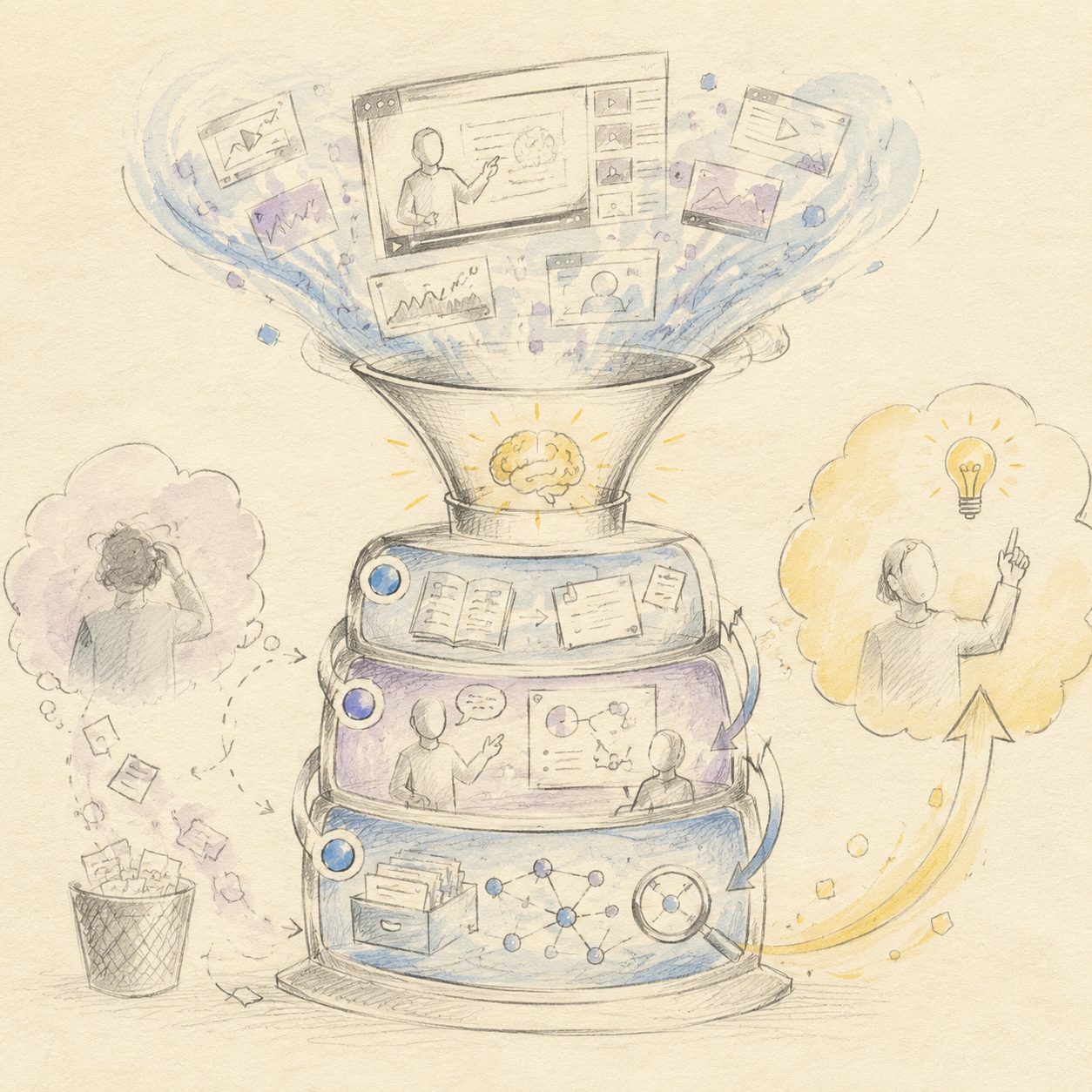
Bilibili is the largest pool of high-quality Chinese-language courses on the internet. In Q1 2026 alone, knowledge-category creators on Bilibili uploaded over 3.2 million hours of new video, covering programming, math, design, business, psychology, languages — almost everything. Free, high-quality, with bullet comments — in theory, the best self-learning gateway for ordinary people.
But classic cognitive science research on the Forgetting Curve (Ebbinghaus) shows that content not actively rehearsed within 24 hours loses 70%+ retention on average. Translation: 10 hours of programming lectures binged on Bilibili leaves you the next day with maybe 30 minutes’ worth of effective recall.
Three structural reasons make Bilibili-style long-form video especially bad for retention:
- Video is linear — you can’t skim, re-read, or jump-compare chapters the way you do with a book
- Bullet comments create emotional noise — entertaining, but they break deep focus; you think you’re learning, but you’re being pulled by the crowd
- No mandatory output step — unlike school courses with exams, watching Bilibili creates no external compulsion to produce; 99% of viewers close the tab and never write anything
Practical rule: Any learning loop without an output step is not learning. Even a 30-second Xiaohongshu note or a 100-word tweet — anything you wrote in your own language — beats “watching one more video” by 10x.
The three stages of the Feynman method: understand → explain → retrieve
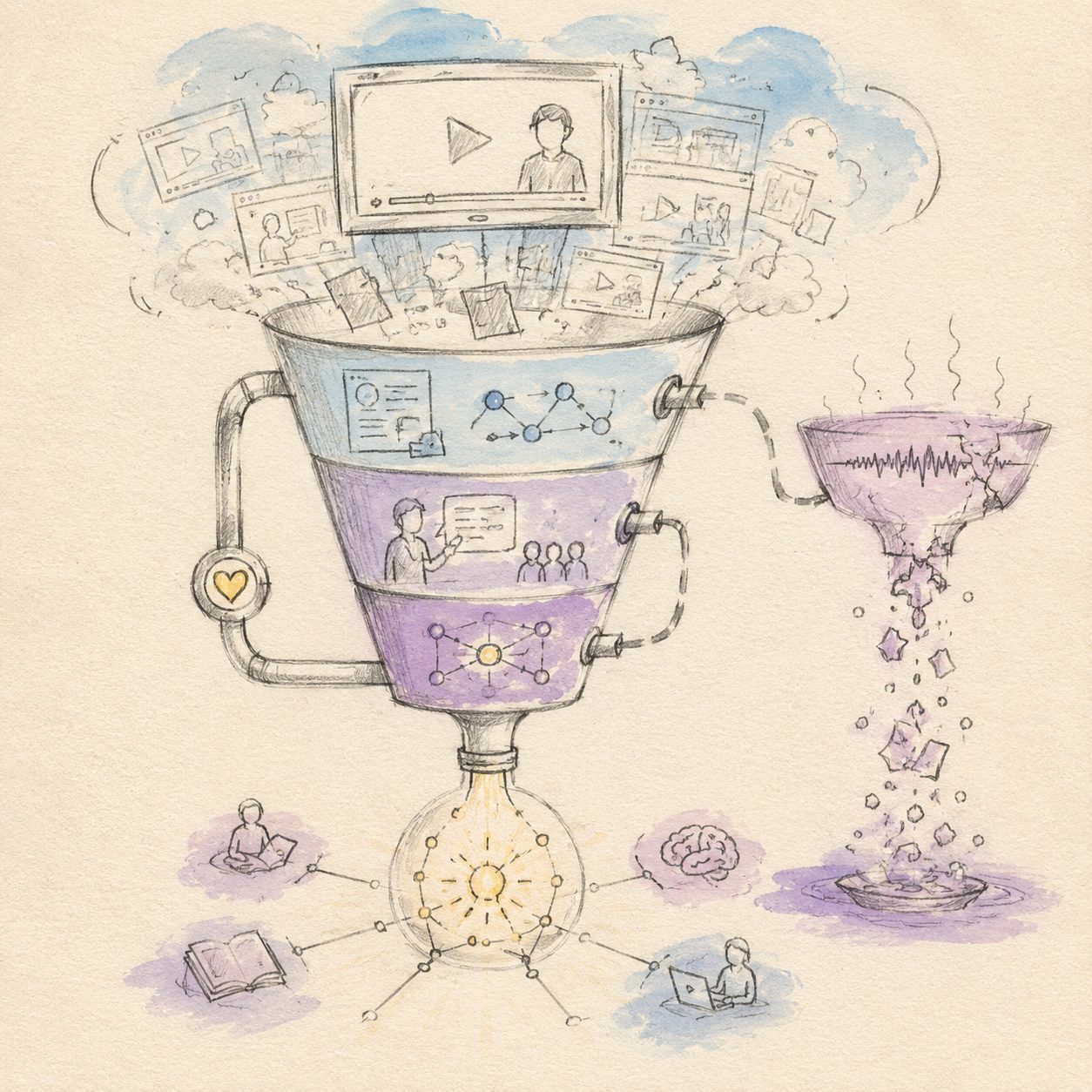
Richard Feynman, Nobel-laureate physicist, was famous for “explaining the most complex concept clearly.” His self-described method gets distilled into four steps:
- Pick a topic — choose what you want to learn
- Explain simply — in plain language, ideally as if teaching a 12-year-old
- Find your gaps — wherever you stall or fudge, go back and re-learn
- Simplify with analogy — translate abstract concepts into everyday metaphors
Applied to Bilibili long-form courses, I simplify it further into a three-stage loop:
- Stage 1 — 3-Pass notes (understand) — use AI to turn 90 minutes of video into 9 minutes of focused reading + 3 core questions
- Stage 2 — Teach-back (explain) — within 24 hours, explain the core questions to a layperson friend in your own words
- Stage 3 — Retrievable memory (retrieve) — archive the notes in Notion or Obsidian using a three-layer “concept → case → quote” structure so you can find them again a year later
3-Pass notes: compress a 90-minute course into 9 minutes of focused reading
The mechanics are three rounds of progressive refinement:
Pass 1 — Paste the Bilibili link, get the structure
Paste any Bilibili course link into bibigpt.co. In 60 seconds you get:
- Full transcript (with timestamps)
- Chapter slicing (typically 6-10 chapters)
- Mind map (3-level hierarchy)
- Quote cards (5-15 quotes)
The goal of this pass is not to “learn” but to “build the panorama” — in 60 seconds, know what the course covers, how it’s split, which chapters are core.
Pass 2 — Selectively deep-read 3 chapters
Don’t deep-read every chapter. Using the Pass-1 chapter titles and mind map, pick the 3 chapters most relevant to your current goal (~25-30 minutes of content).
Open BibiGPT’s Chapter Deep Reading mode for these 3 chapters:
- Read the AI-generated chapter summary (~400-600 words each)
- Click timestamps to jump back into the original video for the critical 30-second segments
- Rewrite the core ideas in your own words into Notion / Obsidian
Pass 3 — Generate 3 core questions
Final step: build “3 exam questions” for the course. Open BibiGPT’s AI chat for the 3 chapters you just deep-read and ask:
- “What’s the most counterintuitive claim in this chapter, and why?”
- “Does the example given here generalize to a different context?”
- “If I have to explain this chapter in three sentences to a friend who never watched it, what would I say?”
Read the AI’s answers next to your own — AI’s answer is the “official answer,” yours is “personal understanding.” The gap between them is what you need to re-learn.
Practical rule: 3-Pass notes don’t aim to “reduce viewing time” but to “convert viewing time into effective learning time.” Same 90 minutes — 3-Pass gets you 3-5x the retention of casual viewing.
Teach it back: the gap between “understood” and “internalized”
The soul of Feynman learning is “teach it to someone else.” If you actually have a layperson friend willing to listen, that’s the ideal practice. In reality most people don’t — so the modern Feynman teach-back has three substitutes:
Option A — Record a 3-minute video for “yourself 30 days from now”
Use your phone to record a 3-minute clip explaining the core ideas to the camera. 30 days later, re-watch the clip. You’ll immediately spot where you fudged — those are exactly the parts you’ve now forgotten.
Option B — Write a 600-word Substack / Xiaohongshu / Twitter post
Convert the 3-Pass notes into a 600-word public post. Even if zero people read it, writing “for strangers” vs. writing “for yourself” is a completely different cognitive load — the former forces you to translate jargon into plain language, which is the essence of Feynman.
Option C — Use an AI as your “pretend-clueless friend”
Open any AI chat tool. Tell it: “Pretend you’re a layperson friend who never watched this course. I’m about to explain it to you. Keep interrupting me with ‘why?’ / ‘give me an example’ / ‘rephrase that.’” This is the most accessible single-player Feynman drill.
Practical rule: “Teaching” isn’t about showing off knowledge — it’s about putting yourself under pressure of being questioned. Being questioned exposes the cognitive gaps you didn’t know you had.
Retrievable memory: still finding this lecture’s core idea one year later
Learning isn’t optimized for 24-hour memory. It’s optimized for “still useful in 1, 3, 10 years.” That requires a retrievable memory system — notes organized so you’ll actually look them up later.
Recommended structure: three layers.
Course topic (e.g. "Data Structures & Algorithms")
├── Concept library (every core concept, 1-2 sentences each)
├── Case library (real-world example per concept, 2-3 sentences each)
└── Quote library (the most-resonant original quote, linked to its BibiGPT timestamp)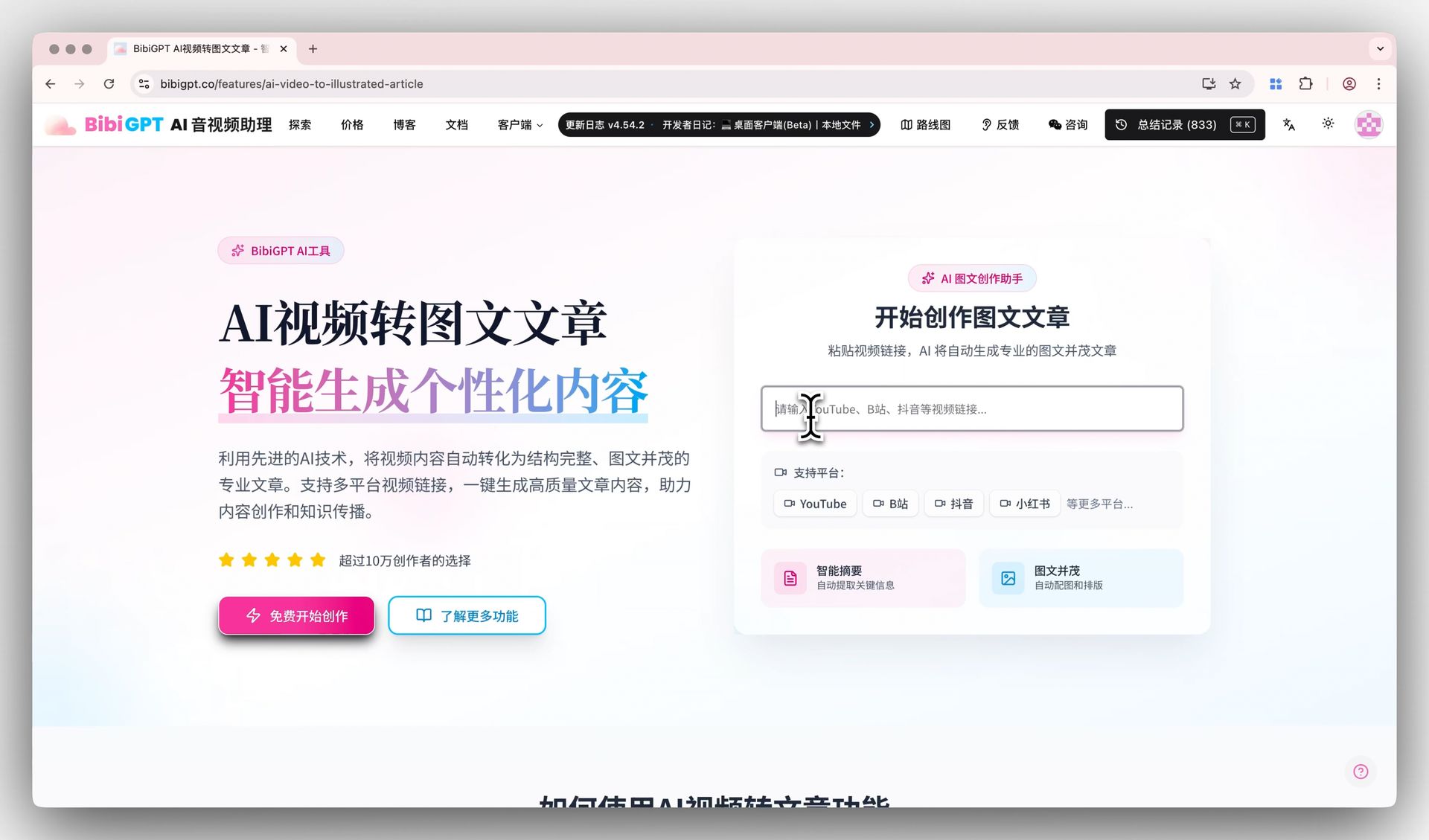
Practically: use BibiGPT’s AI Video to Article to one-click generate a long-form article from the course, then import to Notion / Obsidian. Those notes carry BibiGPT timestamp deeplinks — a year later when you find “that note I wrote about memory fragmentation,” one click jumps back into the original Bilibili video at the exact second.
Three places where NotebookLM Audio Overview falls short for Chinese long-form video
NotebookLM Audio Overview is one of the most-discussed learning tools of the last two years. It generates a two-host podcast from documents you upload — so you can “listen to a long PDF during your commute.” But applied to Chinese-language Bilibili long-form video courses, it has three structural shortcomings:
Shortcoming 1 — NotebookLM cannot ingest Bilibili videos
NotebookLM accepts documents (PDFs, Google Docs, Drive URLs) and recently images. It cannot read Bilibili videos. To use NotebookLM on a Bilibili course you must first extract the video’s transcript into text — and that step itself requires BibiGPT.
Shortcoming 2 — Generated Chinese dialogue still sounds “translated”
NotebookLM is English-first. Chinese support has improved a lot since 2024, but the generated two-host dialogue still has “translation-like” cadence — phrasing, tone, rhythm all less natural than native Chinese podcasts. Compared to BibiGPT’s Chinese chapter summaries (generated by Chinese-native models), the gap is visible.
Shortcoming 3 — Audio Overview is “creation,” not “compression”
NotebookLM Audio Overview is the AI recreating your document as a two-host conversation — what you hear isn’t “a precise compression of the original,” it’s “AI’s re-interpretation of the original.” Great for casual learning. Bad for serious learning — you need the “precise compression of the source,” not an “AI’s re-explanation.”
Practical rule: For serious learning, “compression” is always more trustworthy than “recreation.” BibiGPT chapter summaries are precise compressions of the source video; NotebookLM Audio Overview is AI’s secondary creation based on that source. Different use cases.
FAQ
1. I’m subscribed to 20 Bilibili courses simultaneously. How do I Feynman my way through all of them?
Don’t distribute effort equally. Use BibiGPT’s Collection Summary to run Pass 1 on all 20 (get the structure), then pick 3-5 most-relevant for the full 3-Pass deep-read. For the rest, just read the Pass-1 chapter summary and move on.
2. I’m watching English-language lectures. What language for the teach-back?
Your native language — not English. The point of the teach-back is to translate concepts into your daily idiom. Doing it in a second language adds cognitive load and defeats the gap-detection function of the method.
3. Are bullet comments the enemy of Feynman learning?
Not the enemy, but turn them off for Pass 1. Bullet comments are crowd reactions — great for casual viewing, bad for deep focus. Pass 1: comments off. Pass 2: in BibiGPT’s reading mode (no comments anyway). Pass 3: if you record a teach-back, you can return to Bilibili with comments on to see how others reacted to the same lecture.
4. Does Feynman work for all Bilibili courses?
No. Feynman fits concept-dense courses (programming, math, psychology, business theory, foreign-language grammar). It doesn’t fit demonstration courses (handicraft, painting, cooking, fitness) — those are better served by “watch-and-do,” where secondary production isn’t needed.
5. How does this differ from the Cornell Note-taking method?
Cornell focuses on “page structure” (questions left, notes right, summary bottom). Feynman focuses on “the learning loop” (understand → explain → retrieve). They stack — use a Cornell template as the output format for 3-Pass notes, use Feynman to set the learning cadence. See Cornell Method: from video to publishable article.
Get started: run one complete Feynman loop on any Bilibili course
- Pick a Bilibili course you’ve been wanting to learn but keep procrastinating (e.g. a 30-minute to 2-hour programming/math/language lecture)
- On bibigpt.co, paste the link and complete Pass 1 to get the structure
- Select 3 most-relevant chapters and run Pass 2
- Within 24 hours, record a 3-minute teach-back video or write a 600-word public post
- Archive the notes into Notion / Obsidian using the concept-case-quote three-layer structure
Further reading:
- AI-Powered Feynman Learning Method for Video Knowledge Absorption
- Cornell Method: from raw video to publishable article
- Building knowledge graphs from videos: BibiGPT methodology 2026
—— BibiGPT Team