Spaced Repetition × AI Video Knowledge Management: The BibiGPT Three-Step Method (2026)
Spaced Repetition × AI Video Knowledge Management: The BibiGPT Three-Step Method (2026)
Honest experiment: that “AI engineer survival guide” video you watched a month ago—can you state its three key recommendations right now? Probably not.
That isn’t a personal failing. It’s the brain’s default response to linear video. Information enters short-term memory and is 90%+ forgotten within 24 hours (Roediger & Butler 2011, retrieval-effect research). Without active intervention, the hundreds of videos you watched this year might as well never have happened.
The intervention has a name: spaced repetition. It’s the most validated long-term memory framework in 50 years of cognitive science. The problem? Spaced repetition was designed for static text material—textbooks, flashcards, vocab. How does video content enter this loop? That’s the most underrated value of AI video tools today.
This guide gives a three-step practice: turn any YouTube video, podcast, or local lecture into a spaced-repetition-ready asset. You can copy it today.
Why spaced repetition is uniquely powerful for video knowledge
The core mechanic of spaced repetition: retrigger an item exactly at the moment you’re about to forget it. Each successful retrieval flattens the forgetting curve a little more, eventually consolidating into long-term memory.
Practical rule: Your brain doesn’t store knowledge “during learning.” It stores it during retrieval. Every active recall is a write event.
The bottleneck of classic spaced repetition has always been material cost: turning a book or a video into 20 high-quality flashcards takes 1–2 hours of human distillation. Most people never start because of this friction.
AI video summary changes the math:
- A 45-minute YouTube video → BibiGPT smart deep summary outputs structured highlights in 30 seconds
- Each point already comes with AI-generated thinking questions—essentially card fronts
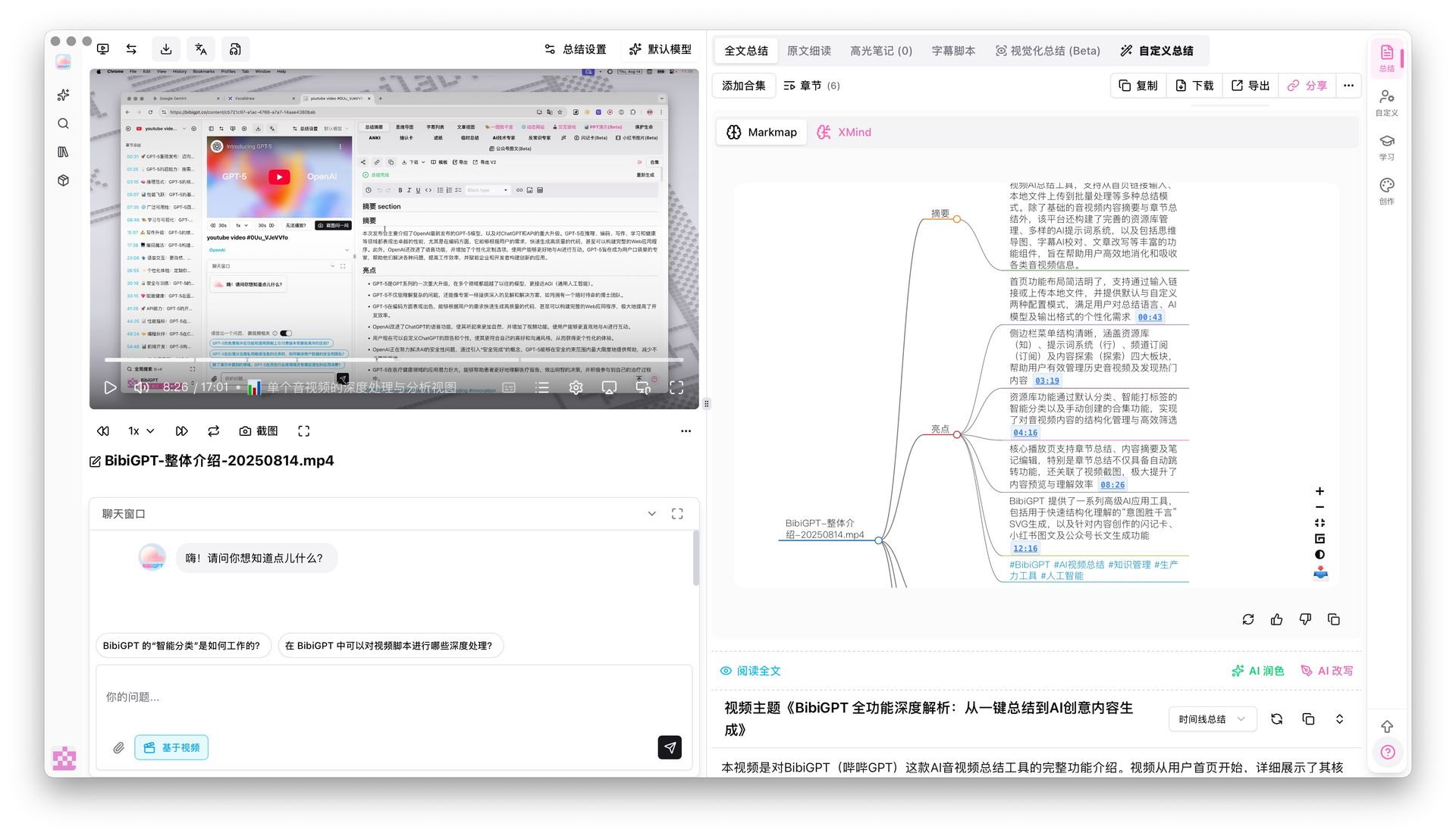
- Mindmap nodes embed clickable timestamps; jumping back to the original moment is free
What used to take 1–2 hours of prep now takes 30 seconds. Once material cost collapses, spaced repetition shifts from “scholar method” to “daily workflow.”
The three-step method: turn a video into a spaced-repetition asset
Three steps. Apply them to any video you actually want to remember. Each step maps to one BibiGPT feature.
Step 1: summarize and select what’s worth keeping (30 seconds)
After watching a video, don’t close the tab immediately. The memory-trigger window is strongest in the first 5 minutes after the video ends.
How:
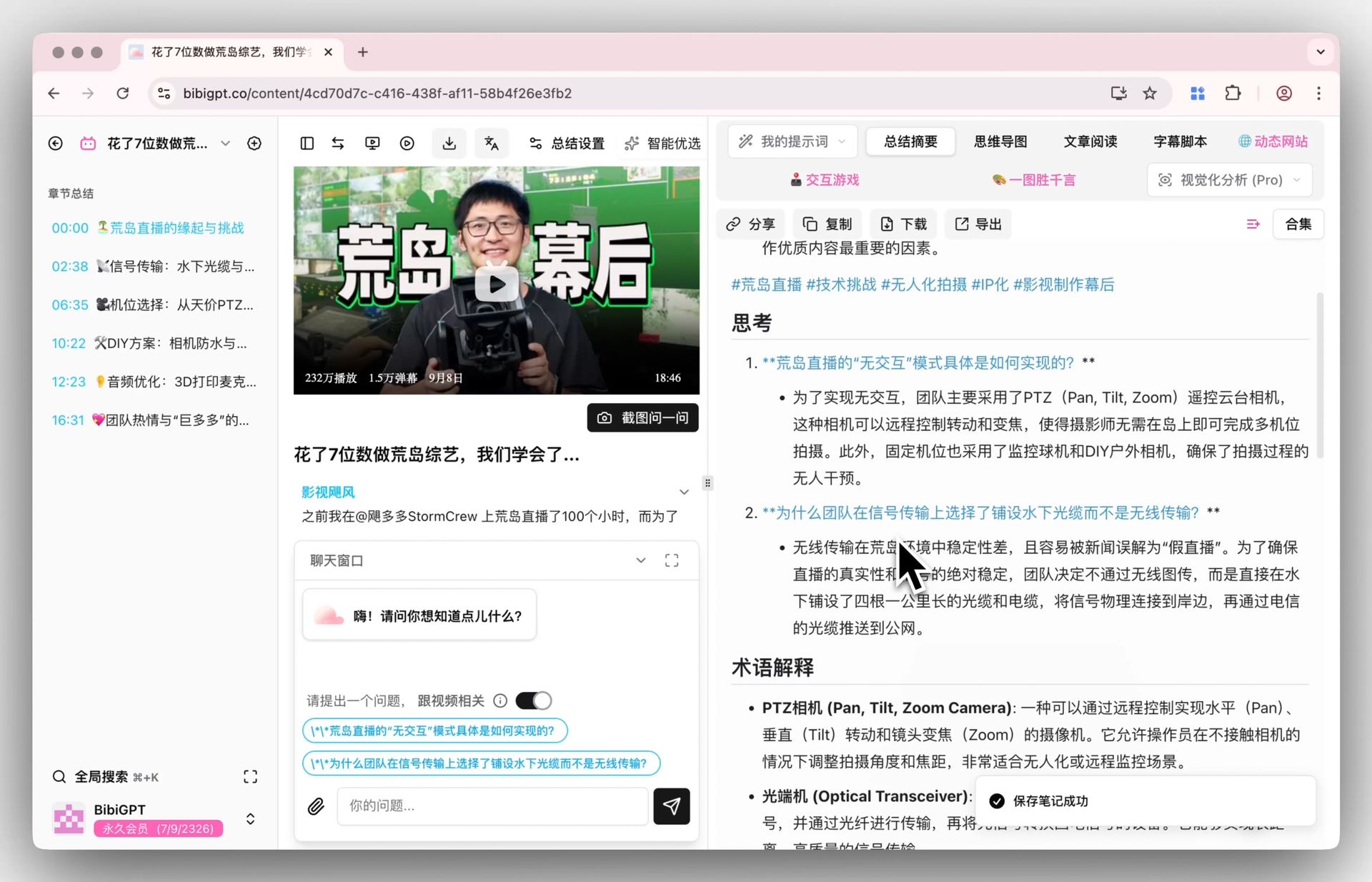
- Paste the YouTube URL into BibiGPT
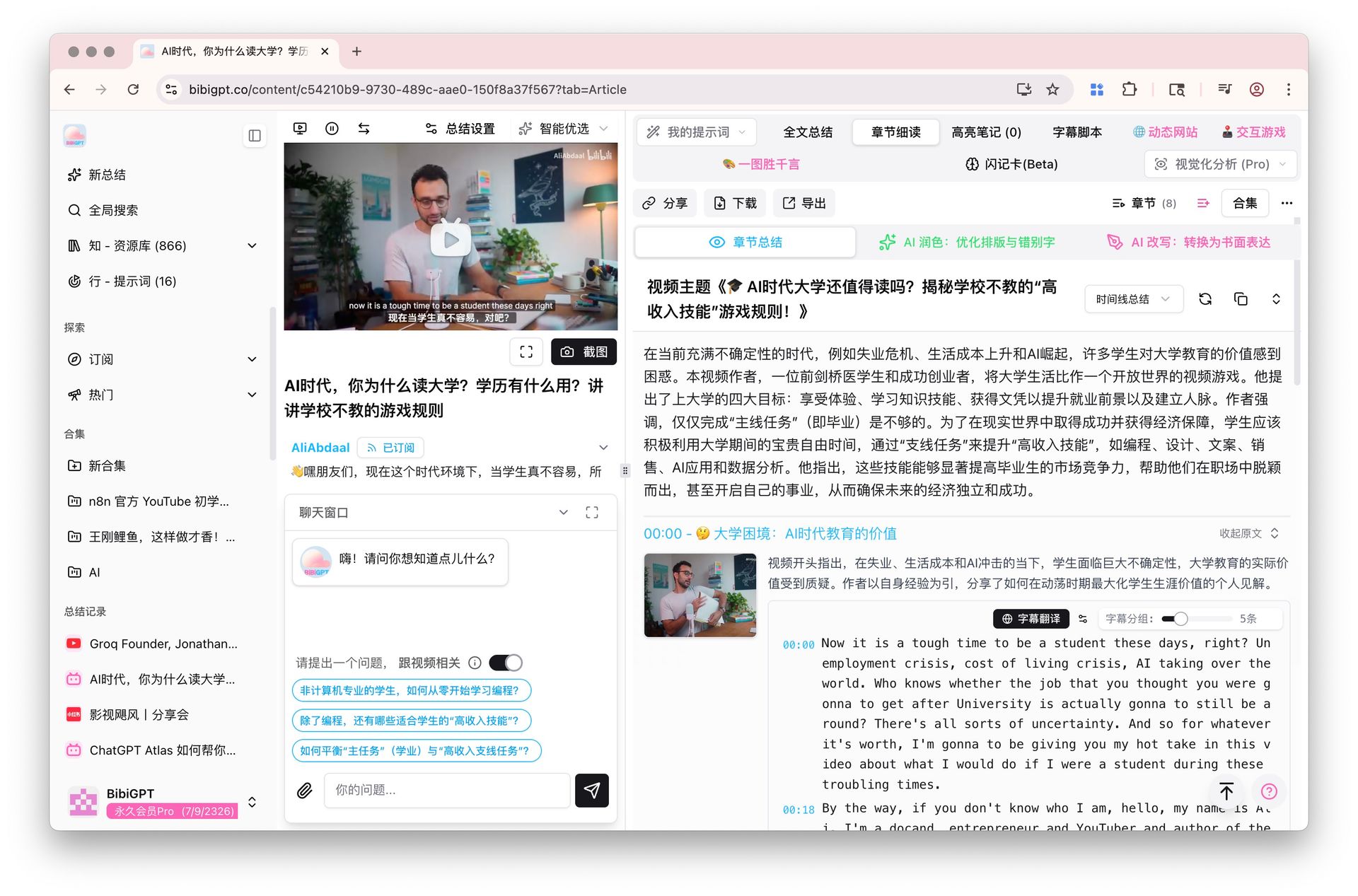
- Switch to the chapter deep reading view
- From the smart summary’s “highlights” and “thinking questions” fields, manually pick the 3–5 items most worth remembering
Why 3–5? Too few and you don’t form a knowledge network; too many and memory strength dilutes. Research shows the optimal new-info load per learning session is 5–7 chunks (Miller 1956, classic cognitive science paper). BibiGPT’s summary fields naturally land in that range.
Practical rule: Don’t try to remember the whole video. Pick 3–5 keepers and burn them in. That beats trying to remember 30 things and keeping zero, by 10x.
Step 2: convert into question–answer pairs (5 minutes)
Spaced repetition cards must be questions, not statements. This is the #1 mistake.
Wrong card:
“BibiGPT supports 30+ platforms.”
Right card:
“How many platforms does BibiGPT support as of 2026? Name two major Chinese-region platforms it covers.”
Turning a statement into a question forces your brain into active retrieval—the core mechanic behind why spaced repetition works.
How:
- Use BibiGPT AI chat to ask, for each selected highlight: “Convert this into a test question that requires active recall to answer”
- The AI returns usable question cards
- Pair each card’s answer with the original video timestamp (the mindmap node automatically carries it)
Practical rule: A good card is a triplet: question — answer — evidence. AI video tools make the “evidence = video timestamp” part free.
Step 3: export to Anki / Mochi / RemNote (2 minutes)
BibiGPT exports flashcards in one click (CSV), or you can copy directly into Mochi, RemNote, or Obsidian’s spaced-repetition plugins.
How:
- Click “export flashcards” in BibiGPT
- Pick CSV or Markdown
- Import into your Anki deck (recommended: one deck per domain—programming / economics / language)
Anki’s spaced-repetition algorithm (optimized SM-2) schedules each card automatically—first review 1 day later, then 3 days, then 7, expanding as you keep getting it right. You only need to open Anki 10 minutes a day; the algorithm handles the rest.
Workflow comparison: manual vs AI-assisted
| Dimension | Traditional manual | BibiGPT + Anki |
|---|---|---|
| Per-video prep time | 30–60 minutes | 5–10 minutes |
| Card quality | Highly depends on individual | AI distillation + human selection, higher floor |
| Evidence source | Hand-written note annotations | Auto-bound video timestamps |
| Question conversion | Manual | AI-assisted |
| Long-term review | Easy to forget to open | Anki algorithm pings daily |
| One-year output | 50–100 cards | 500–1000 cards |
Decision filter: If your one-year deck has fewer than 200 cards, the problem isn’t spaced repetition. It’s material prep. BibiGPT removes exactly that bottleneck.
Case: internalizing 500 video insights in one year
Suppose you watch 10 videos a week (YouTube + podcasts + courses). Following the three-step method:
- 3–5 cards per video → 30–50 cards per week
- 52 weeks → 1500–2600 raw cards
- After spaced-repetition culling (the dull, outdated, redundant ones) → about 500–800 truly internalized knowledge points
What does 500 brain-verified knowledge points actually mean?
According to Buzzsprout’s 2026 content-consumer survey, passive viewers can recall ≤30 specific points per year. Learners using structured notes + spaced repetition recall ≥400—a 13x gap.
That’s the compound interest of spaced repetition + AI video tools.
Further reading:
- Already comfortable with spaced repetition? Pair it with Feynman technique + BibiGPT workflow—spaced repetition makes you remember, Feynman makes you truly understand
- Alternative angle: AI video learning methodology with BibiGPT
Advanced: which videos NOT to card
Not every video deserves cards. Three classes are “watch only, don’t card”:
- Entertainment: vlogs, variety, pure entertainment—wasn’t meant for memory
- News: 3-month-old news is mostly stale—wastes spaced-repetition compute
- Saturation topics: you’ve already watched 3 videos on the same theme—marginal value is near zero
Practical rule: Spaced repetition is a scarce resource. Reserve it for knowledge you’ll use in the next 12 months.
The simplest heuristic: after watching, in 30 seconds answer “will I use this in the next 6 months?” Yes → make a card. No → close the tab, next video.
Common pitfalls
Pitfall 1: “more cards = better”
Wrong. Every card is future review-time debt. 500 high-quality cards beat 5000 low-quality cards. Quality threshold = when you get it wrong, you’re willing to pause 30 seconds and recall it.
Pitfall 2: auto-generate every card with AI
Wrong. AI drafts are high in quality but not personalized. Always do the manual final pick: which lines do you actually want to remember? Which lines did the AI just think were important? Keep only the first set.
Pitfall 3: never update the deck
Wrong. If you miss a card 3+ times, either the question wording is bad or that knowledge no longer fits you. Be willing to delete cards.
Practical rule: You don’t need to remember everything. You need to remember the 5% most useful to you.
Closing: let the algorithm manage your memory
Human attention is finite. Algorithm patience is infinite. Delegate “when should I review what” to Anki’s spaced repetition. Keep “which knowledge is worth remembering” for yourself. That’s the most efficient division of labor for a 2026 knowledge worker.
Open a recent YouTube video, paste it into BibiGPT, and run the three steps. Ten minutes later you’ll have your first spaced-repetition-ready video card—the first deposit in your long-term memory portfolio.
Start your AI efficient learning journey now:
- 🌐 Official Website: https://aitodo.co
- 📱 Mobile Download: https://aitodo.co/app
- 💻 Desktop Download: https://aitodo.co/download/desktop
- ✨ Learn More Features: https://aitodo.co/features
—— BibiGPT Team