
xAI Imagine Video Ships + Sora Shuts Down: Do You Still Need BibiGPT AI Video Summary? 2026
xAI Imagine Video launches inside Grok and hits the top of public leaderboards; OpenAI Sora shuts down. AI video generation is exploding — where does BibiGPT's cross-platform AI video summary fit? 2026 landscape.
xAI Imagine Video Ships + Sora Shuts Down: Do You Still Need BibiGPT AI Video Summary? 2026
Table of Contents
- One-Line Answer
- What Happened This Week In AI Video Generation
- More Generation = More Demand For Summaries
- Cross-Platform AI Video Summary: BibiGPT's Neutral Position
- Three Practical Scenarios
- FAQ
One-Line Answer
With xAI Imagine Video shipping inside Grok subscriptions and OpenAI Sora shutting down, AI video generation goes from "OpenAI dominant" to a multi-player race: Grok, Gemini Veo, Runway, Luma, CapCut Seedance, Kling. The more AI video content gets generated, the more users need a cross-platform summary tool to turn it into searchable, reusable notes and artifacts — which is exactly where BibiGPT sits. The hotter the generation side, the steadier the value of the consumption side.
Try pasting your video link
Supports YouTube, Bilibili, TikTok, Xiaohongshu and 30+ platforms
What Happened This Week In AI Video Generation
Core answer: According to llm-stats.com AI News, xAI Imagine Video launched inside the Grok ecosystem and rapidly topped public video generation leaderboards. In parallel, OpenAI Sora announced a public shutdown, forcing creators to migrate. Combine with Google Gemini Veo 3.1, Kling 3.0, Runway, Luma, and ByteDance Seedance 2.0 — now integrated into CapCut — and you have a genuine multi-model race.
1. xAI Imagine Video: Generation Bundled Into Grok
xAI folded video generation into the Grok subscription. Users stop bouncing between standalone video sites and can now produce short clips inside chat.
2. Sora Shutdown → Creator Migration
Sora's shutdown forces every user who grew up on text-to-video to switch platforms. That accelerates fragmentation — each competitor has its own UI, style, audio, and duration limits.
3. CapCut Plugs In ByteDance Seedance 2.0
CapCut is the dominant global editor; Seedance 2.0 integration means ordinary creators can generate AI assets inside their editing workflow. Expect AI video content to spill further into TikTok, Bilibili, Xiaohongshu, and Douyin as second-hop surfaces.
4. YouTube Shorts Opens Up AI-Generated Creator Likenesses
YouTube has announced that Shorts will support AI-generated creator likenesses alongside the NO FAKES Act stance — "AI generated" is becoming a default capability on major platforms.
More Generation = More Demand For Summaries
Core answer: As generation capability spreads, the volume of AI video content each user sees every day grows, but the average value per clip drops. The need to "quickly judge whether a video is worth watching" becomes more acute. BibiGPT's 30-second structured summary, timestamped transcript, and mind map are purpose-built for this information overload.
1. Content Explosion: Daily Volume Jumps By Orders Of Magnitude
With Grok / Veo / Kling / Seedance live in parallel, public video production steps up sharply. Watching everything is impossible and unnecessary.
2. Signal-To-Noise Drops: AI Content Quality Varies
AI-generated videos range from viral masterpieces to "generated because I could" filler. A generation + summary coordinated workflow is the active strategy to keep your signal high.
3. Neutral Cross-Platform Knowledge Base
No video generation platform wants to help you summarize competitors' videos. BibiGPT, as a neutral third party, accepts YouTube / Bilibili / TikTok / Xiaohongshu / podcast links with timestamped summaries in 30 seconds — that neutral cross-platform vantage point is something generation players cannot replicate.
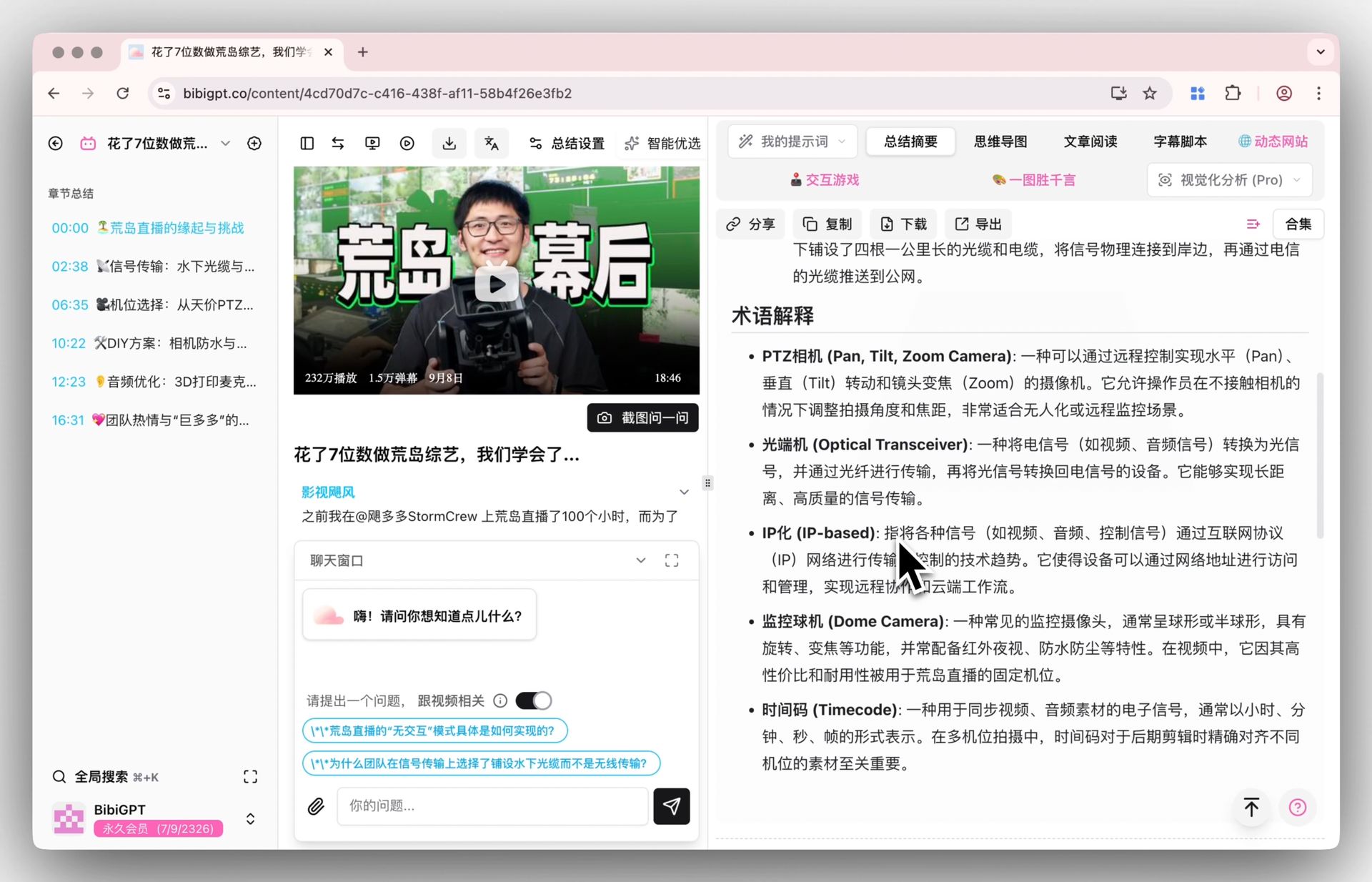 BibiGPT structured glossary output
Cross-Platform AI Video Summary: BibiGPT's Neutral Position
Core answer: BibiGPT doesn't compete in generation. It converts "videos others generate" into "knowledge you can use". Users generate on Grok or Veo, browse AI videos on YouTube / TikTok / Bilibili, and hand every "understand / save / repurpose" step to BibiGPT.
1. 30+ Platforms, One Entry Point
YouTube, Bilibili, Douyin, TikTok, Xiaohongshu, podcasts (Apple Podcasts, Spotify, Xiaoyuzhou), cloud drives (Google Drive, Alibaba Drive, Baidu Cloud, Zoom recordings). Paste any URL, get a summary.
2. Four-Language Output
Different platforms host different languages. BibiGPT outputs summaries in Chinese / English / Japanese / Korean natively, ideal for bilingual creators and cross-market researchers.
3. Creator Output Chain: Articles, Cards, Burn-In Subtitles
Summaries feed further into outputs: video into Chinese public-account articles, Xiaohongshu cards, short-video scripts, or translated subtitles burnt into the video. Generator outputs get digested and remixed in one place.
4. Verifiable Product Facts
BibiGPT supports 30+ platforms, over 5 million AI summaries generated, and is trusted by over 1 million users.
See BibiGPT's AI Summary in Action

Let's build GPT: from scratch, in code, spelled out
Andrej Karpathy walks through building a tiny GPT in PyTorch — tokenizer, attention, transformer block, training loop.
Want to summarize your own videos?
BibiGPT supports YouTube, Bilibili, TikTok and 30+ platforms with one-click AI summaries
Try BibiGPT FreeThree Practical Scenarios
Core answer: Three personas gain the most from a "generation + summary" combo: creators, industry researchers, and students.
Scenario A: Creator Using Grok Imagine + BibiGPT
Generate a 15-second viral asset in Grok Imagine → post to TikTok → use BibiGPT to analyze script structure of competing top clips → feed the structure back to generate the next one. Creation flywheel closed.
Scenario B: Industry Researcher Tracking AI Video Model Launches
3-5 new models drop launch videos on YouTube each week. Use BibiGPT YouTube / Bilibili one-click summary to extract core capabilities, demos, pricing — a weekly brief in 30 minutes.
Scenario C: Students Digesting AI-Generated Explainer Videos
More teachers and edtechs are producing AI-generated explainer content. Students drop those videos into BibiGPT for timestamped notes + flashcards, then use the AI student study workflow for spaced-repetition review.
Related Reading
- NotebookLM 2026 deep dive: NotebookLM × Gemini App Integration vs BibiGPT
- End-to-end student workflow: AI Student Study Workflow MS Study Agent + BibiGPT 2026
- Sora alternatives (updated): Sora Alternatives Roundup 5+
FAQ
Q1: Can I use xAI Imagine Video directly inside my Grok subscription?
A: Yes. xAI Imagine Video launched as part of the Grok ecosystem. Subscribers invoke it inside the chat, and the generated short clips can be exported or shared to social platforms.
Q2: Where should creators migrate after Sora shuts down?
A: Depends on the use case. For short-form viral assets, xAI Imagine Video (inside Grok) or Gemini Veo 3.1 are the strongest picks. For editing-first workflows, CapCut (now with Seedance 2.0) is a natural fit. For academic and enterprise work, Runway or Luma keep leading. Regardless of choice, use BibiGPT to track competitors' videos across platforms to feed your asset pool.
Q3: Will BibiGPT add video generation too?
A: BibiGPT stays on the consumption side: paste link → AI summary → notes / flashcards / articles. Generation is the upstream war; BibiGPT is downstream, serving users who need to turn videos others generate into knowledge they own. Complementary lanes, not competing ones.
Q4: Isn't summarizing lower-quality AI videos a waste?
A: No. BibiGPT's first 30-second structured snapshot helps you decide whether to skip or read deeply. Filtering with BibiGPT saves more time than watching the whole generated clip through.
Q5: Do xAI and Google have their own video summary tools?
A: Grok has no consumer-facing cross-platform video summarizer today. Gemini's video summary is inside NotebookLM with URL sources limited to YouTube. A unified consumption experience across YouTube / Bilibili / TikTok / podcasts is currently most complete via BibiGPT.
Start your AI efficient learning journey now:
- 🌐 Official Website: https://aitodo.co
- 📱 Mobile Download: https://aitodo.co/app
- 💻 Desktop Download: https://aitodo.co/download/desktop
- ✨ Learn More Features: https://aitodo.co/features
BibiGPT Team