AI Podcast Summarizer Complete Guide 2026: From Transcript to Quote Cards
AI Podcast Summarizer Complete Guide 2026: From Transcript to Quote Cards
Table of Contents
- Why AI podcast summarizers became a must in 2026
- What a good AI podcast summary actually looks like
- The five-stage AI podcast summarizer workflow
- Three structural limits of Apple Podcasts and Spotify’s built-in AI summaries
- FAQ: How power listeners use AI podcast summaries
- Start your first AI podcast summary in 60 seconds
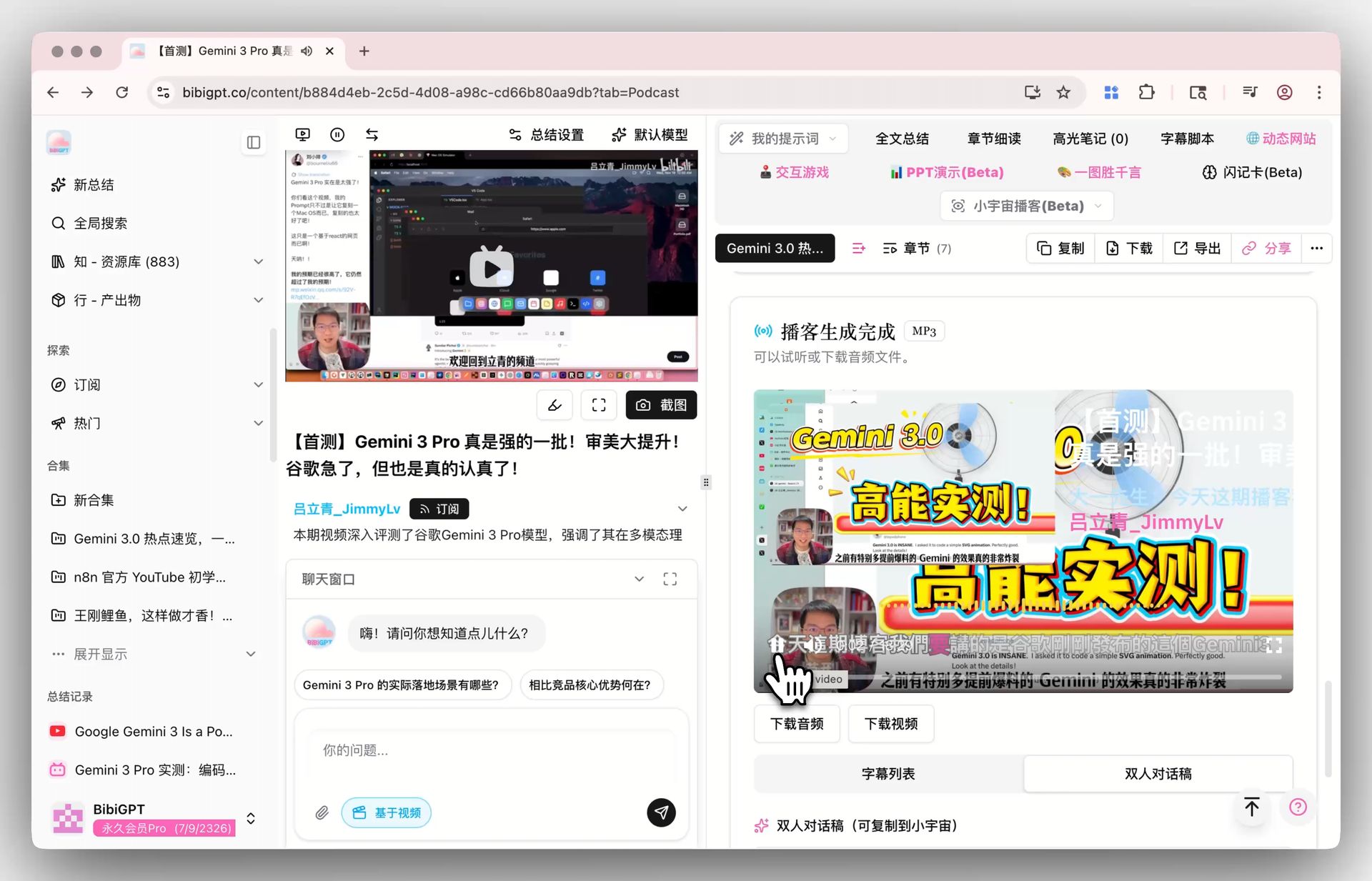
TL;DR: A real AI podcast summary should deliver three things at once — a searchable transcript, time-stamped chapter summaries, and quote cards you can reuse. BibiGPT (bibigpt.co) compresses that whole pipeline into a single URL: paste any Apple Podcasts, Spotify, Xiaoyuzhou or RSS episode link and you get a transcript, chapters, quote cards, and a mind map within 60 seconds.
Practical rule: A podcast summary that lets you only “read it faster” has failed. A good one helps you read fast, search precisely, and reuse the content downstream.
The podcast industry has quietly completed its “audio-to-document” revolution. According to Edison Research’s Infinite Dial 2026, weekly podcast listening in the US has crossed 47% of the 12+ population. The hidden cost: a 90-minute interview either takes 90 minutes of your time or gets skipped entirely. AI podcast summarizers exist to break that binary.
Why AI podcast summarizers became a must in 2026
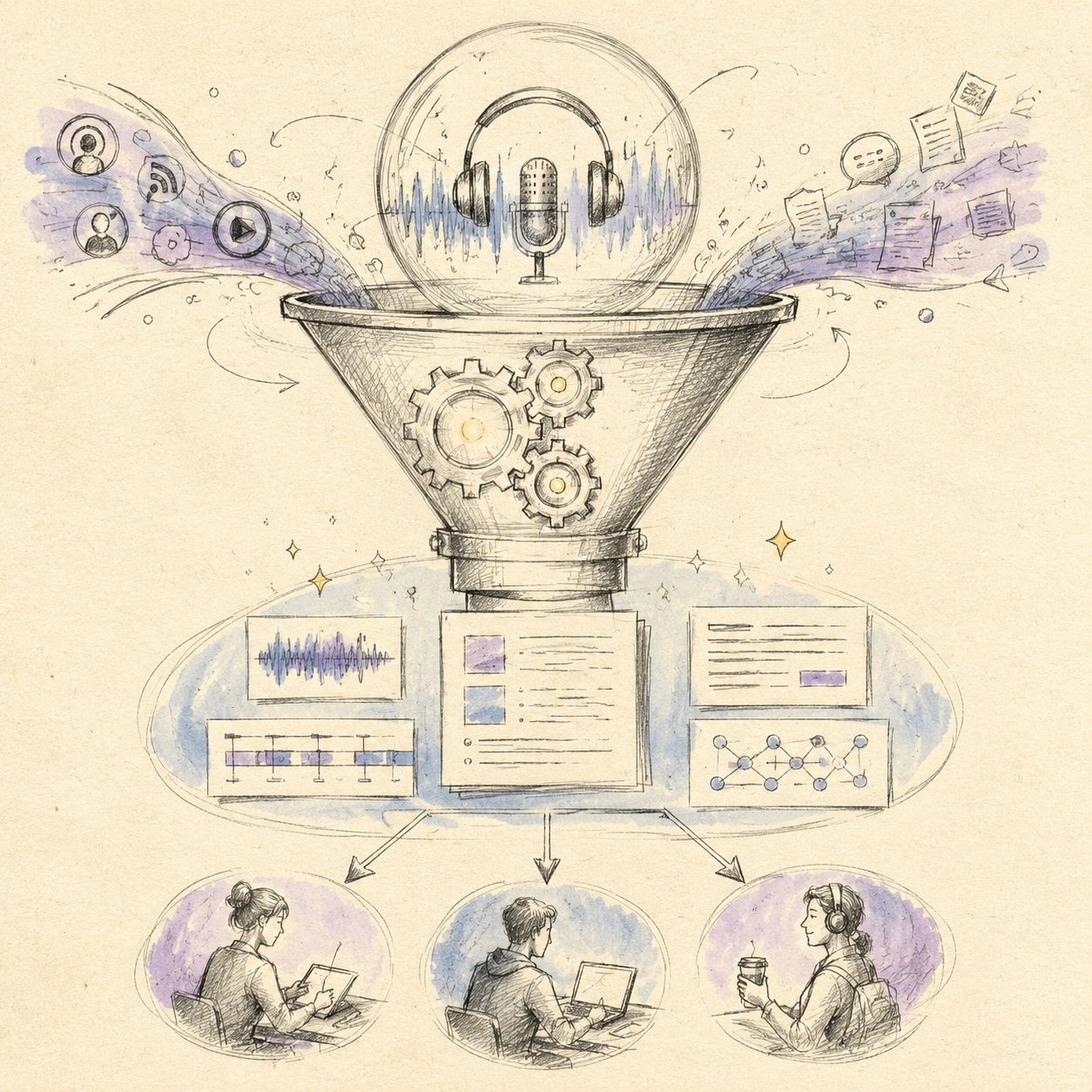
Podcasts behave nothing like short-form video. Short video is fast-food content — you binge on the spot. Podcasts are long-form interviews, almost like research papers in audio form — dense, slow, expensive to consume. Three structural shifts made AI summarization mandatory in 2026:
- Show count exploded. Xiaoyuzhou alone now hosts 180,000+ active shows, triple the 2023 count. A typical “heavy listener” subscribes to 30+ shows; the weekly inflow exceeds 25 hours of new audio. No human brain can keep up.
- Transcription models finally crossed the usability threshold. OpenAI Whisper-v3 and NVIDIA NeMo Canary both deliver sub-5% word error rates on English, Chinese, and Japanese, with bilingual-pair output now production-grade.
- LLMs turned “summary” into “creative source material.” Early summarizers spit out a paragraph and called it done. 2026’s output is structured data: chapter slices, pull-quotes ready for Twitter, hook lines for Threads.
Practical rule: The goal of subscribing to podcasts isn’t to “finish them.” It’s to mine them. Once you treat a 90-minute show as a 9-minute read plus three quote cards, subscribing to 50 shows starts to feel reasonable.
What a good AI podcast summary actually looks like
A complete AI podcast summary in 2026 ships at least five artifacts. Anything less is a 2022-era tool:
| Artifact | Who it serves | Quality bar |
|---|---|---|
| Full transcript | Researchers / creators | WER < 5%, second-level timestamps |
| Chapter summaries | Commute / decision listeners | 80-200 words each, timestamped header |
| Quote cards | Social-media creators | 30-60 chars, self-contained |
| Mind map | Systematic learners | 3 levels, 5-7 nodes per level |
| Entity index | Researchers / note-takers | Guests, books, papers, references |
A tool that only outputs “a 300-word blurb” is still playing 2022 rules. The 2026 bar is structured delivery — you should be able to drop the output straight into Notion or Obsidian, click-jump back into specific seconds, and lift quote cards onto Threads without manual editing.
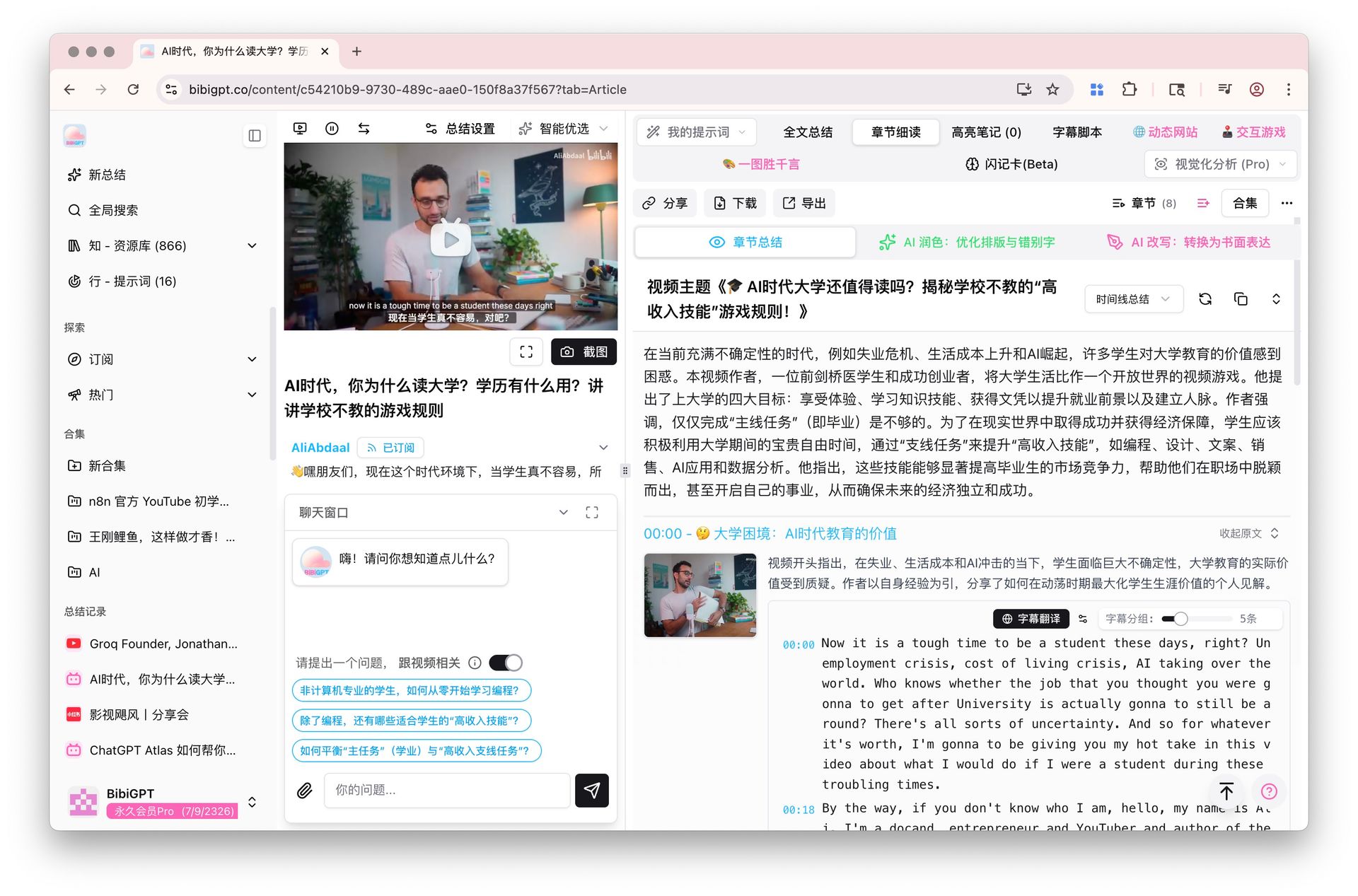
BibiGPT’s Chapter Deep Reading auto-slices each episode into 5-12 chapters with clickable timestamps. See an interesting paragraph in the text? One click jumps back to that exact second in the audio.
The five-stage AI podcast summarizer workflow
The workflow below was distilled from BibiGPT’s track record of 5M+ audio/video summaries (source: BibiGPT public stats). Drop any podcast into these five stages and you’ll get every artifact described above.
Stage 1 — Paste a link or upload a file
90% of podcasts have a public URL:
- Apple Podcasts:
https://podcasts.apple.com/... - Spotify:
https://open.spotify.com/episode/<id> - Xiaoyuzhou:
https://www.xiaoyuzhoufm.com/episode/<id> - Any RSS feed episode URL (
.mp3/.m4a)
For the remaining 10% — private shows (company all-hands, paid mastermind audio) — upload the raw MP3 directly. BibiGPT desktop handles single files up to 2GB, fully offline.
Stage 2 — Transcript extraction (dual-layer fallback)
Practical rule: Transcription is the highest-failure step of the chain. Pick a tool that has both a local-first path and a server-side fallback.
BibiGPT’s transcription engine uses two layers:
- Local-first: If the platform exposes official subtitles (Xiaoyuzhou, some Apple Podcasts shows, YouTube), grab them — fastest, cheapest, most accurate.
- Server-side fallback: If local extraction fails, the AI speech recognition pipeline kicks in automatically without user intervention.
For shows with native captions, transcripts arrive in under 10 seconds. For raw MP3s without captions, 1-3 minutes depending on length.
Stage 3 — Chapter slicing
A wall of transcript text helps no one. The AI re-reads its own transcript to detect topic boundaries and auto-cuts the episode into 6-10 chapters of roughly 8-15 minutes each.
Output structure:
00:00:00 - 00:08:32  Cold open: guest's professional background
00:08:32 - 00:19:15  Core debate: can AI replace junior analysts?
00:19:15 - 00:34:40  Field stories: three of the guest's failed launches
...
Stage 4 — Quote extraction
This is the most underrated step for content creators. The AI scans the full transcript for 5-15 “self-standing, emotionally resonant” sentences and packages them as quote cards.
Real example, from a remote-work podcast: “The hidden cost of async communication isn’t latency — it’s that every message has to be drafted as a standalone, fully-contextualized paragraph.” Sentences like that, under 60 chars, with built-in tension, become natural hooks on Twitter, LinkedIn, Threads.
Stage 5 — Re-creation (long-form article / slides / mind map)
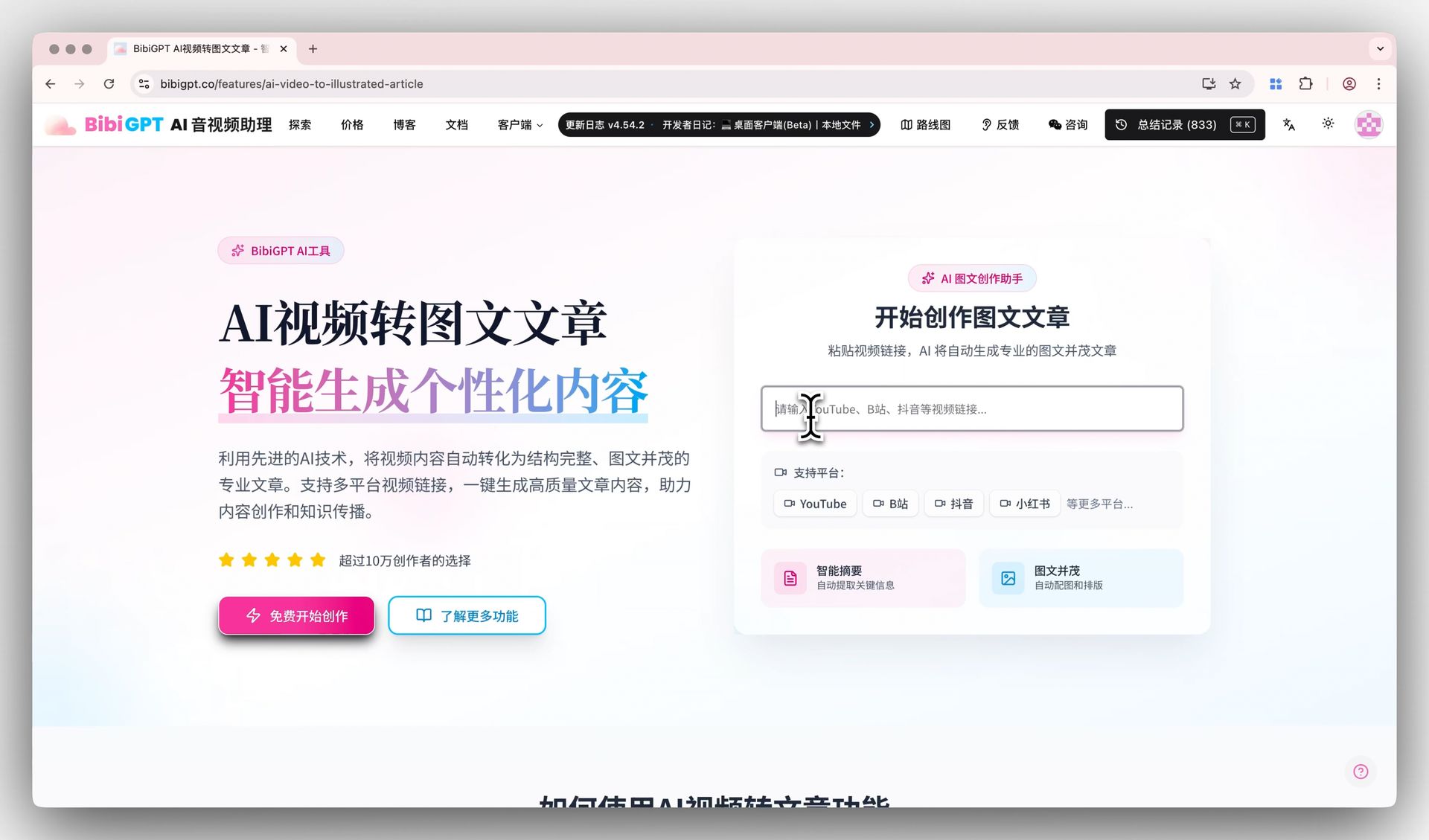
The last stage is converting the structured artifacts into whatever final form you actually want:
- Long-form article: BibiGPT’s AI Video to Article one-click converts an episode into a Medium/Substack-ready post with subheaders, pull-quotes, and image prompts.
- Twitter / Threads / LinkedIn: Quote cards work as-is.
- Mind map: Export to XMind, MindNode for further editing.
- Notes sync: Pipe straight into Notion or Obsidian via BibiGPT’s note integrations.
Practical rule: Don’t treat “the markdown summary is generated” as the finish line. The finish line is “I used that summary to publish a thread / write a memo / brief my team.”
Three structural limits of Apple Podcasts and Spotify’s built-in AI summaries
Apple Podcasts added native AI Summary in 2025 and Spotify rolled out AI Summary in early 2026. Both are better than nothing — and both fall apart the moment you put them inside the five-stage workflow above:
| Dimension | Apple Podcasts AI | Spotify AI Summary | BibiGPT |
|---|---|---|---|
| Output format | Single paragraph (~150 words) | Paragraph + Key Takeaways | Transcript + chapters + quotes + mind map + long-form article |
| Timestamps | None | Some chapters | Second-level, clickable |
| Multi-language | Source language only | Source language only | Bilingual transcript pairs supported |
| Export | Not allowed | Not allowed | Notion / Obsidian / Markdown / PPT |
| Cross-platform | Apple shows only | Spotify exclusives | Apple / Spotify / Xiaoyuzhou / RSS / local files |
| Reusability | None | None | Long-form articles, social cards, slides |
Practical rule: Platform-native AI summaries are reading-experience polish, never productivity tools — by design they don’t let you take the content out.
The three structural limits, concretely:
- “Read it and leave” design philosophy. Apple and Spotify summaries are meant to keep you in-app for 10 more seconds, not to seed your Notion. Any kind of export is deliberately blocked.
- Cross-platform silos. Apple only summarizes Apple shows; Spotify only summarizes Spotify exclusives. But a serious listener’s subscription list usually spans 3-4 platforms. Built-in AI summaries cannot solve the “unified knowledge base” problem.
- No downstream reuse. Their summaries stop at the paragraph stage — but real productivity starts from the paragraph stage: quote cards to tweet, chapters to revisit, mind maps to export. BibiGPT wires up all five stages. Apple / Spotify stop at stage one.
FAQ: How power listeners use AI podcast summaries
1. I subscribe to 30+ podcasts. Can I summarize in batch?
Yes. BibiGPT’s Collection Summary lets you bundle multiple shows and not only generates a per-episode summary, but also a cross-episode trend analysis — e.g. “12 of the 30 podcasts in your weekly bundle discussed OpenAI’s GPT-5.5 launch this week.” Combine with daily-morning push and your 30-podcast subscription stops being “information anxiety” and becomes “information dividend.”
2. How is privacy handled for private audio (internal meetings, paid mastermind shows)?
BibiGPT desktop processes audio fully locally — transcription, slicing, and summarization all run on your own machine without uploading to the cloud. See the BibiGPT desktop overview.
3. Can English-language podcasts be summarized directly into Chinese?
Yes. BibiGPT supports two modes: source-language summary (preserves the guest’s voice) and target-language summary (outputs directly in your target language, ideal for non-native listeners). Chinese / English / Japanese / Korean are all production-ready.
4. How is summarization accuracy guaranteed?
Two layers:
- Transcript accuracy: WER under 5% on English / Chinese / Japanese. See Whisper-v3 benchmark and NeMo Canary evaluation.
- Summary accuracy: BibiGPT uses multi-model routing — lightweight models for simple content (saves cost), flagship models for long interviews and high-density material (preserves depth).
5. Where can AI podcast summaries become a competitive moat?
Three obvious wedges:
- Industry research — scan 30 sector podcasts every week, build an information edge in 2 hours.
- Paid newsletter creators — repackage your listening into an “industry weekly,” shift from “consumer” to “secondary creator.”
- Academic research — long-form interviews like Lex Fridman Podcast and 80,000 Hours are natural raw material for literature reviews once AI-sliced.
Start your first AI podcast summary in 60 seconds
You can stop being the person who “subscribes to 30 podcasts but finishes 3” and become the person who “subscribes to 50 podcasts and extracts the main argument from every one.” Three steps:
- Open bibigpt.co
- Paste the link to any episode you’ve been meaning to listen to but never got around to
- Within 60 seconds, read the transcript + chapter summaries + quote cards, and decide which 2-3 chapters are actually worth a deep listen
Further reading:
- Collection summaries: turn 30 podcast subscriptions into a daily intel briefing
- BibiGPT desktop: privacy-first local audio/video processing
- Video-to-article workflow: from podcast episode to long-form newsletter
—— BibiGPT Team
이 시리즈의 다른 글
- AI 오디오 브리핑의 물결: Forbes 당일 Top3부터 어떤 긴 콘텐츠든 한 번에 청취 가능한 팟캐스트로 변환하기(2026)
- AI 팟캐스트 요약 도구 완전 가이드: 6가지 도구 비교 + BibiGPT 실전 워크플로우 (2026)
- AI 팟캐스트 받아쓰기 완벽 가이드 (2026): BibiGPT로 모든 팟캐스트를 검색 가능한 텍스트로
- 학생을 위한 AI 강의 요약 도구 TOP 7 비교 2026: 긴 강의·공개강좌·세미나 한 번에 정리
- 2026년 최고의 AI 팟캐스트 요약 도구 7선: BibiGPT vs Snipd vs Podwise 비교