OpenClaw + bibigpt-skill Complete Guide (2026, May Update): Collection Summary, Flashcards & Advanced Workflows for Bilibili/YouTube AI Summarization
OpenClaw + bibigpt-skill Complete Guide: Collection Summary, Flashcards & Advanced Workflows for Bilibili/YouTube AI Summarization
Short answer: OpenClaw (nicknamed “the crayfish”) is an open-source AI agent framework — think of it as an orchestrator that lets an AI call real tools to get work done. It’s strong at YouTube and English-language tasks, but its native summarize command can’t read Chinese video platforms (Bilibili, Xiaohongshu, Douyin) at all. bibigpt-skill is the official extension that gives OpenClaw the ability to “understand” those videos — installed with a single command. This guide walks through what OpenClaw is, how to install bibigpt-skill, and the full workflow for auto-summarizing Bilibili videos, building collection mind maps, and reading videos chapter by chapter.
OpenClaw has taken the world by storm — 180K+ GitHub Stars, viral in 10 days, and “raising your crayfish” became a new geek-culture meme. It gives AI agents real-world hands: sending emails, managing calendars, operating files. But for Chinese-speaking users there’s one very real gap: its native summarize command simply can’t process Bilibili, Xiaohongshu, or Douyin videos.
The bibigpt-skill Agent Skill is the answer to that gap — and goes far beyond it. This guide covers everything: from basic installation to advanced workflows, from structured output to collection summaries, flashcards, and Anki integration.
Update — May 7, 2026: ① bibigpt-skill is fully compatible with the latest OpenClaw v2026.04 series; the install command remains identical. ② With YouTube’s Ask YouTube AI search now in testing, the recommended pattern is: use Ask YouTube for topic discovery, then OpenClaw + bibigpt-skill for deep video digestion (especially for Chinese platforms). Related reads: GTD × AI Video Learning | YouTube to Mind Map AI Tools.
Part 1: Installing bibigpt-skill — The Agent-Native Way
Method 1: Let AI Install It
Tell your OpenClaw or Claude Code directly:
@OpenClaw Please read and install https://github.com/JimmyLv/bibigpt-skillClaude Code reads the README and executes all setup steps automatically. No manual intervention required.
Method 2: CLI Installation
npx skills add JimmyLv/bibigpt-skillThen in OpenClaw / Claude Code:
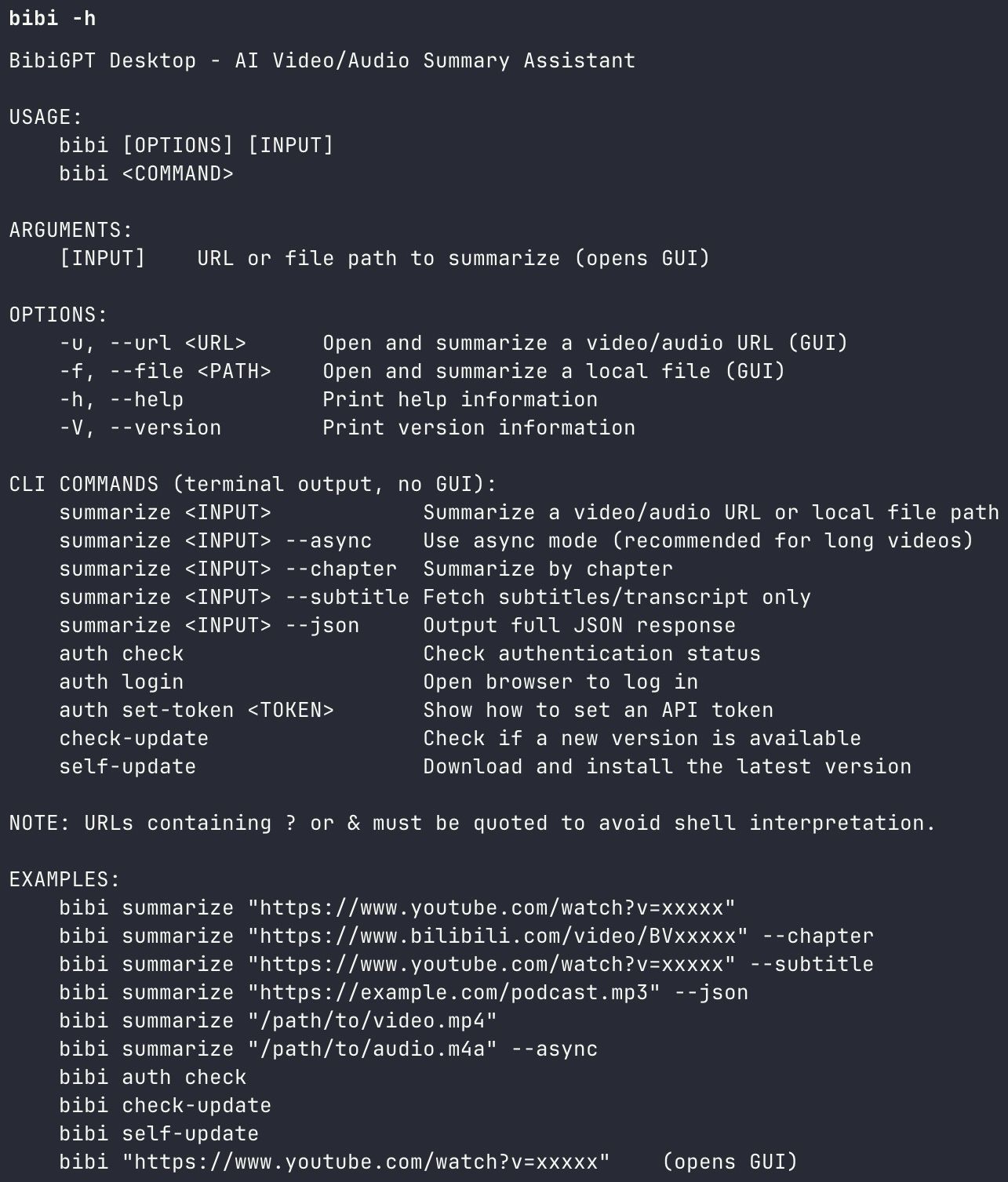
@OpenClaw Use the bibi skill to summarize https://www.bilibili.com/video/BV1Sk4y1x7r2
Supported platforms: Bilibili ✅ · Xiaohongshu ✅ · Douyin ✅ · YouTube ✅ · Podcasts ✅ · Local media files ✅
Full installation guide and API configuration: aitodo.co/user/integration
Part 2: Structured Output — Make Agent Workflows Programmable
Regular summary tools give you a wall of text. bibigpt-skill gives you programmable structured data that integrates natively into OpenClaw’s task pipelines:
| Flag | Output Format | Best Agent Use Case |
|---|---|---|
| Default | Markdown summary | Reading, conversation output |
--chapter | Chapter-by-chapter breakdown | Course knowledge mapping |
--json | Machine-readable JSON | Batch processing, databases, reports |
--subtitle | Full subtitle text | Precise quotes, secondary AI processing |
Real workflow example:
You: Batch-process this 50-episode Python course, output --json for each, save to Notion
OpenClaw: [calls bibi --json in parallel for each episode]
          [parses JSON, formats and saves to Notion API]
For developer users, --json turns bibigpt-skill into a native data source for agent workflows — not just human-readable summaries.
Part 3: Collection Summary × OpenClaw — Master an Entire Course in Hours
This is the most powerful combination of bibigpt-skill and BibiGPT’s advanced features: Collection Summary.
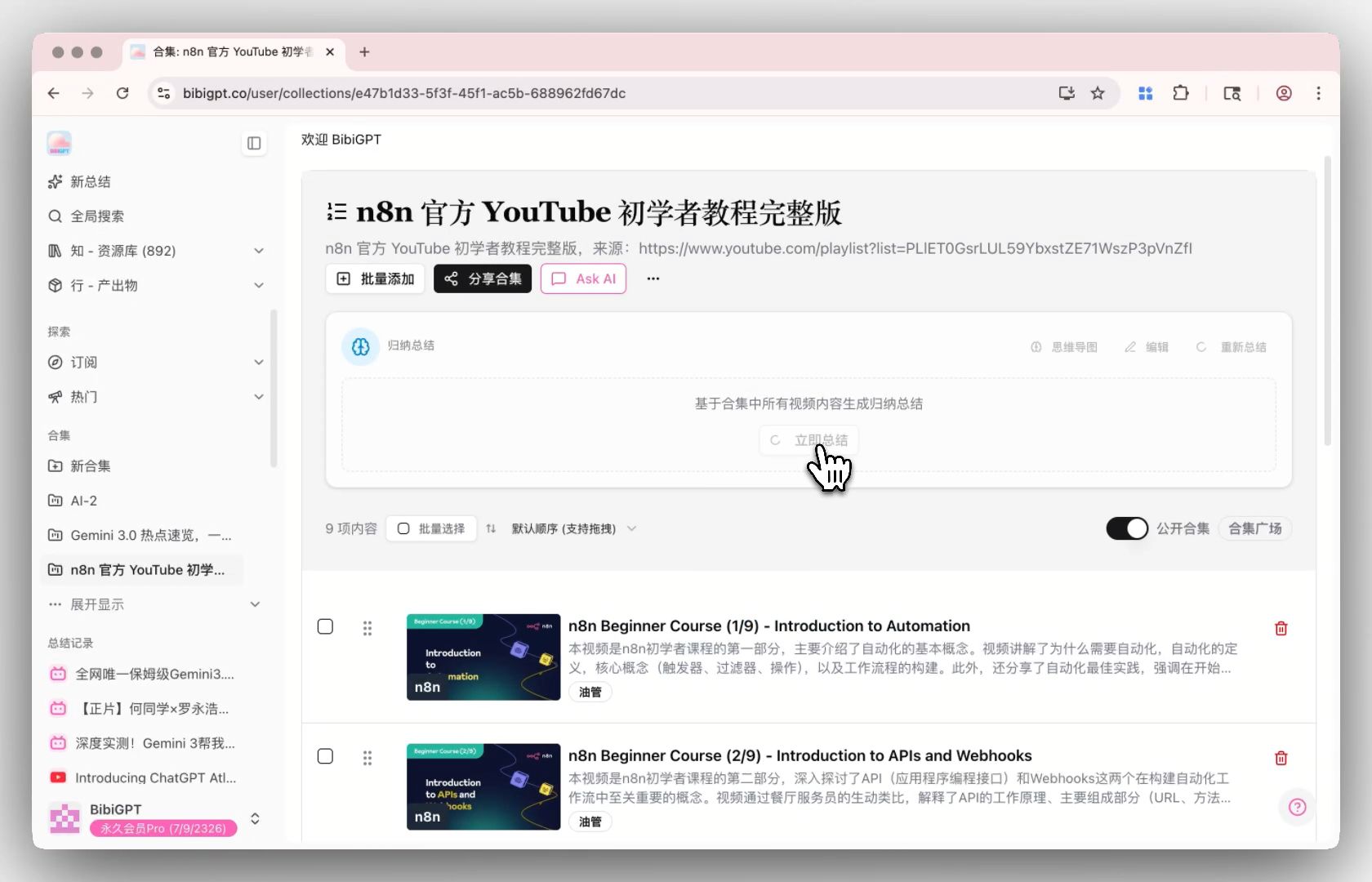
Once you’ve added a creator’s series (e.g., 30-episode Java course) to a BibiGPT collection, click “Summarize Now” and the system:
- Analyzes all videos in the collection (not individual episodes)
- Generates a structured knowledge system overview for the entire series
- Outputs an interactive mind map (expandable/collapsible nodes)
- Every reference point links back to the original video timestamp
Full OpenClaw × Collection Summary workflow:
Step 1: Targeted collection
You: Add the first 30 episodes of this Java tutorial to my "Java Learning" collection
OpenClaw: [calls bibi for each episode sequentially]
          ✅ Episodes 1-30 complete

Step 2: Generate holistic knowledge system
You: Generate a summary for the "Java Learning" collection
BibiGPT: Analyzing 30 episodes...
         ✅ Structured knowledge map generated
         ✅ Mind map with 23 core themes
         ✅ High-frequency concept extraction
         ✅ Every point links to source video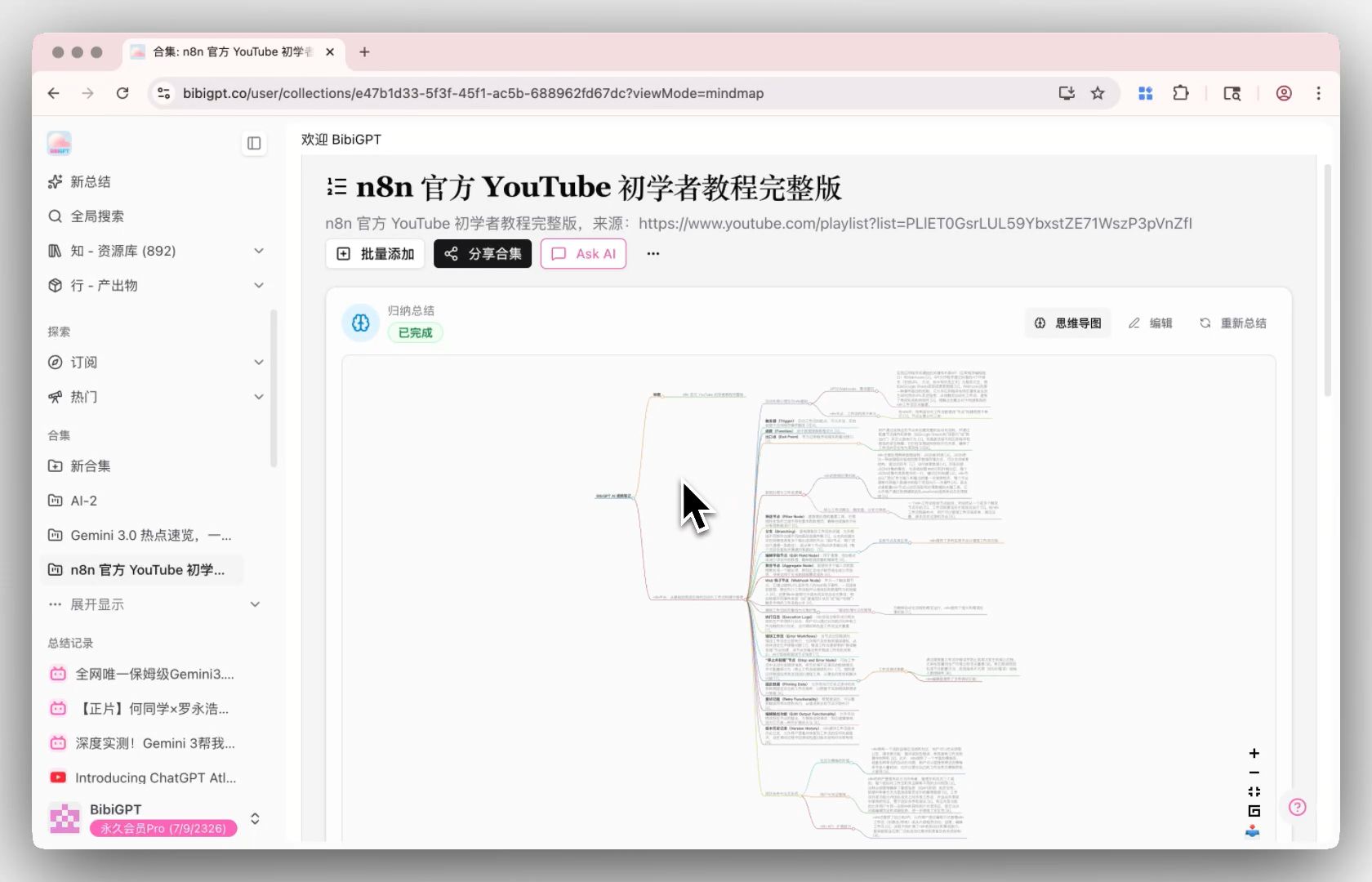
What used to require 25+ hours of course preview now takes: 2 hours reading the structured summary + focused review of key episodes.
Part 4: Flashcard + Anki Integration — Auto-Generate Memory Cards
BibiGPT’s Flashcard feature automatically generates question-answer cards from video content and exports them as CSV for direct import into Anki.
Combined with OpenClaw, you get a fully automated “watch video → generate flashcards → import to Anki” pipeline:
You: Summarize this English listening video and generate Anki flashcards
OpenClaw: [calls bibi to summarize video]
          [triggers BibiGPT flashcard generation]
          [exports CSV]
          ✅ Generated 18 memory cards, ready to import to Anki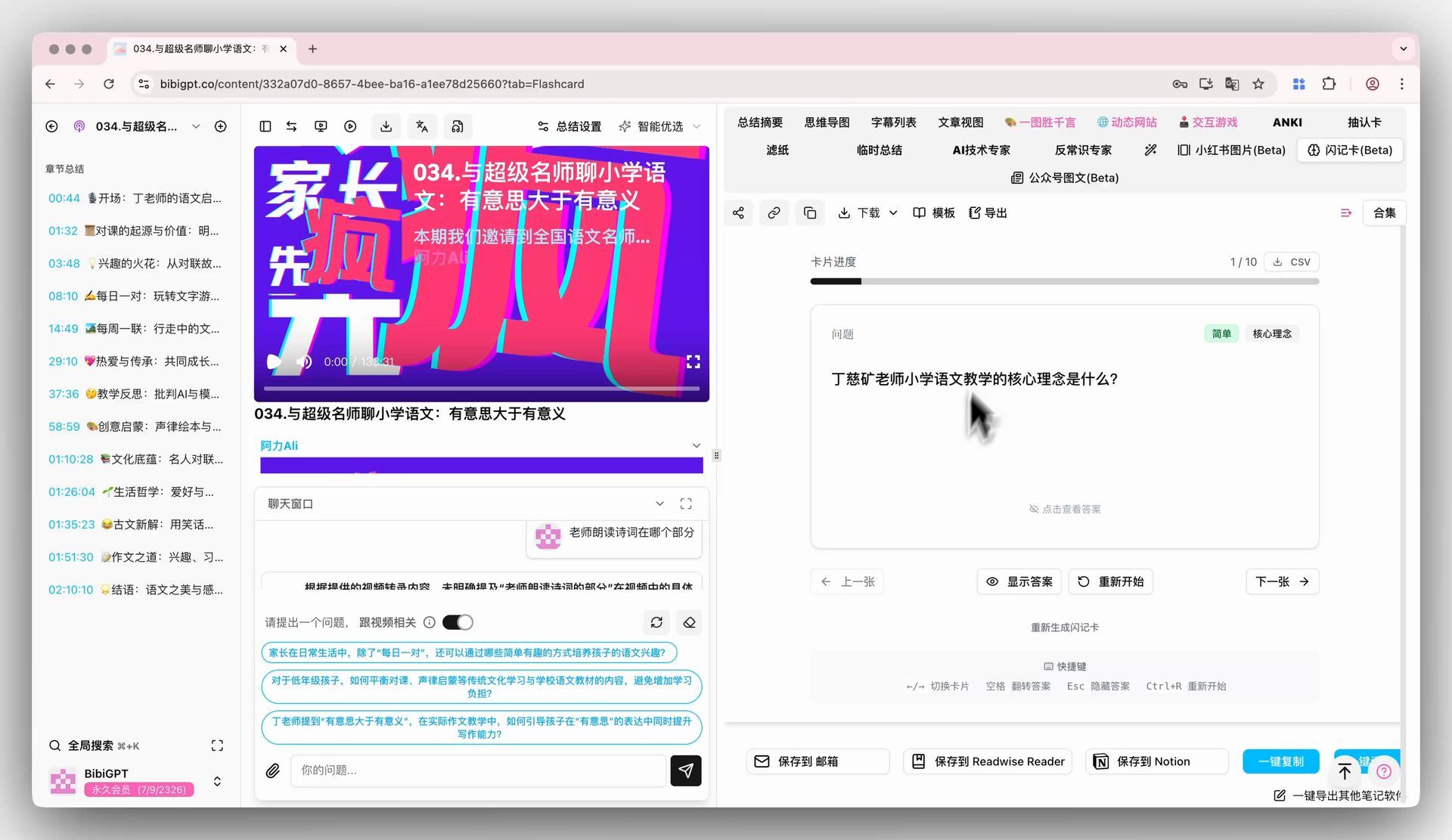
For language learners and exam prep, this workflow is a multiplier on AI learning efficiency. For more active recall techniques with BibiGPT, see: Active Recall AI Video Learning Method: Reshape Your Study Efficiency with BibiGPT.
Part 5: Three Advanced OpenClaw Workflow Paths
Path 1: Developer Daily — On-Demand Summaries
The lightest use case. In any Claude Code or OpenClaw conversation:
Summarize this Bilibili tech video: https://www.bilibili.com/video/BV1xxxStructured summary in 30 seconds. Your coding flow stays uninterrupted.
Path 2: Spawn Mode — Parallel Batch Research
OpenClaw supports spawning parallel subprocesses:
You: Process these 10 videos in parallel, each with --json output
OpenClaw: [spawns 10 subprocesses, calls bibi concurrently]
          [waits for all to complete, merges results]
          [generates comprehensive research report]
10 videos, 10 parallel processes: from “10 × 30 seconds” to “~30 seconds.”
Path 3: Heartbeat Tasks — Fully Automated Information Digest
Set up a timed heartbeat for hands-free content digestion:
Every morning at 7:30, auto-summarize new videos added to my "AI Frontier"
collection in the last 24 hours. Format: 3 key points + priority recommendation.
Send to my Slack/Telegram.
Completely autonomous information pipeline. Every morning you get AI-processed insights — not an unread video list.
For deep-dive on the Bilibili-specific workflows, see: OpenClaw Can’t Summarize Bilibili? bibigpt-skill Collection Summary Fixes That.
Part 6: Four Feature Upgrades at a Glance
Windows winget Installation
winget install BibiGPTmacOS users: Homebrew still available:
brew install --cask jimmylv/bibigpt/bibigpt
Siyuan Notes Integration Overhaul
AI-generated video summaries, outlines, and subtitles now sync directly to your Siyuan Notes library. Configure at: aitodo.co/user/accounts?tab=siyuan
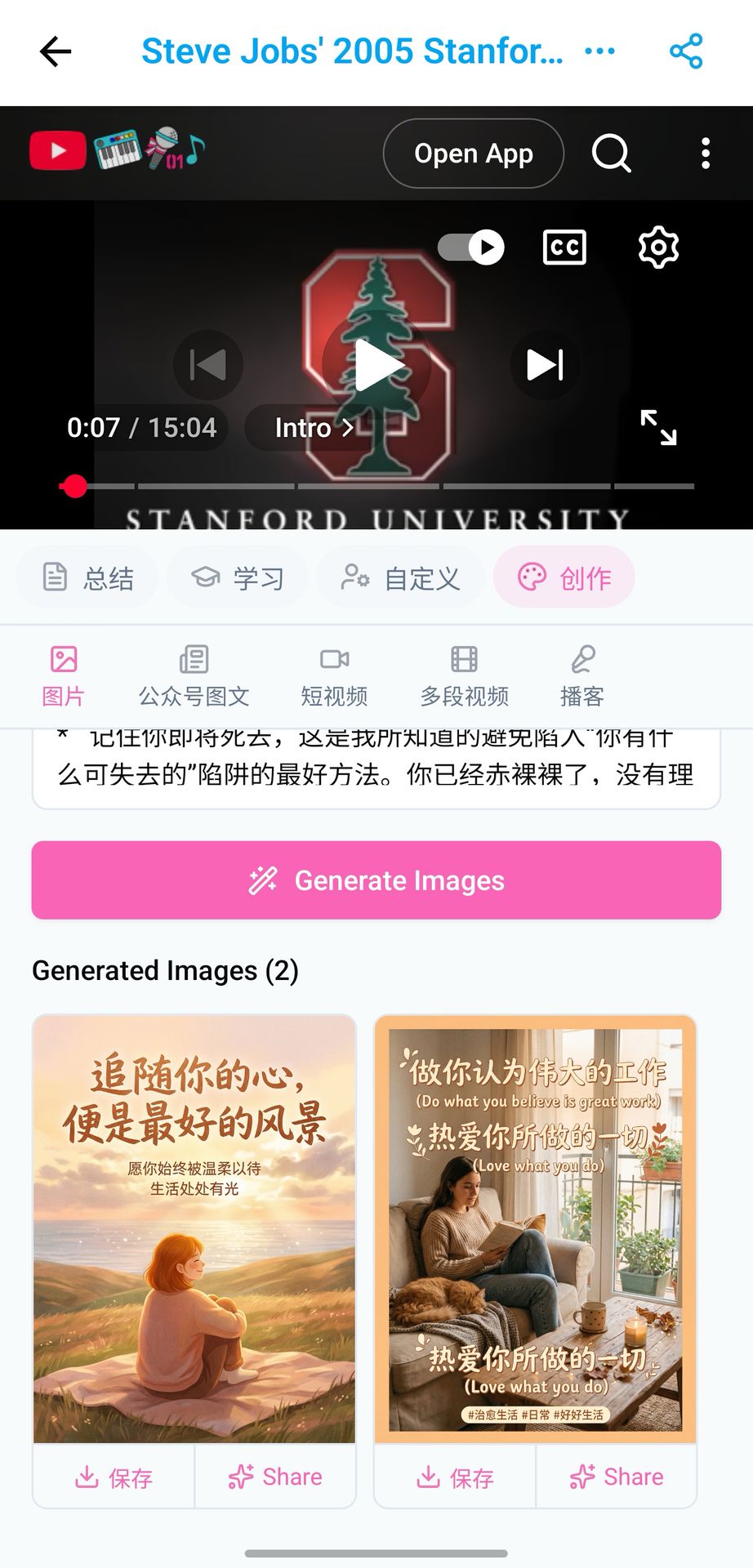
Mobile Image Creation
Generate AI images from video content directly on mobile in the “Create” tab. Multiple AI art styles, multi-image batch generation, instant save to album or share.
Part 7: Full Capability Comparison
| Capability | OpenClaw Native | bibigpt-skill + BibiGPT |
|---|---|---|
| YouTube summaries | ✅ | ✅ More accurate (6 years optimized) |
| Bilibili summaries | ❌ | ✅ 3 subtitle sources, >98% success rate |
| Xiaohongshu summaries | ❌ | ✅ Full support |
| Douyin summaries | ❌ | ✅ Full support |
| Podcast summaries | ❌ | ✅ Audio transcription |
| Collection mind map summary | ❌ | ✅ Cross-video knowledge system |
| Flashcards / Anki export | ❌ | ✅ One-click CSV export |
| Structured JSON output | ❌ | ✅ Agent-programmable |
| Siyuan Notes / Notion sync | ❌ | ✅ Native integration |
Frequently Asked Questions
How is bibigpt-skill different from OpenClaw’s built-in summarize?
OpenClaw’s native summarize is mainly optimized for English YouTube content and has limited support for Chinese platforms like Bilibili, Xiaohongshu, and Douyin. bibigpt-skill is purpose-built for these platforms — it uses a triple subtitle pipeline (official captions + AI transcription + hard-subtitle recognition) and reaches a >98% success rate on Bilibili, plus advanced features like deep summaries, chapter reading, and collection mind maps.
Do I need a BibiGPT account, and how many calls do I get per day?
Yes, a BibiGPT account is required. Free users get 3 calls per day, Plus members 50 per day, and Pro members 100 per day. After installing, grab your API token from BibiGPT settings and add it to the bibigpt-skill config — see aitodo.co/user/integration.
How many episodes can a collection summary handle at once?
Collection summary builds a cross-video knowledge map for up to 100 episodes; in practice we recommend 50 or fewer per run for the best results. OpenClaw’s spawn mode can process multiple videos in parallel to cut waiting time dramatically.
How does chapter reading decide where to split a video?
BibiGPT uses semantic segmentation — it splits chapters by topic shifts rather than fixed time intervals. Each chapter gets its own summary and a precise timestamp, and you can ask follow-up questions on a single chapter. It’s ideal for technical videos or courses longer than 30 minutes.
Which note-taking tools can bibigpt-skill export to?
Today it supports Notion, Obsidian, Siyuan Notes, and Readwise, plus Markdown/PDF export. With the --json flag you get structured data you can wire into any note tool that has an API.
I’ve never used Claude Code or OpenClaw — can I still use this?
Absolutely. If you don’t use an agent CLI at all, just paste a video link on the BibiGPT website — every bibigpt-skill capability is a CLI wrapper around features the BibiGPT site already has. bibigpt-skill is for developers who want to wire BibiGPT into their agent workflows.
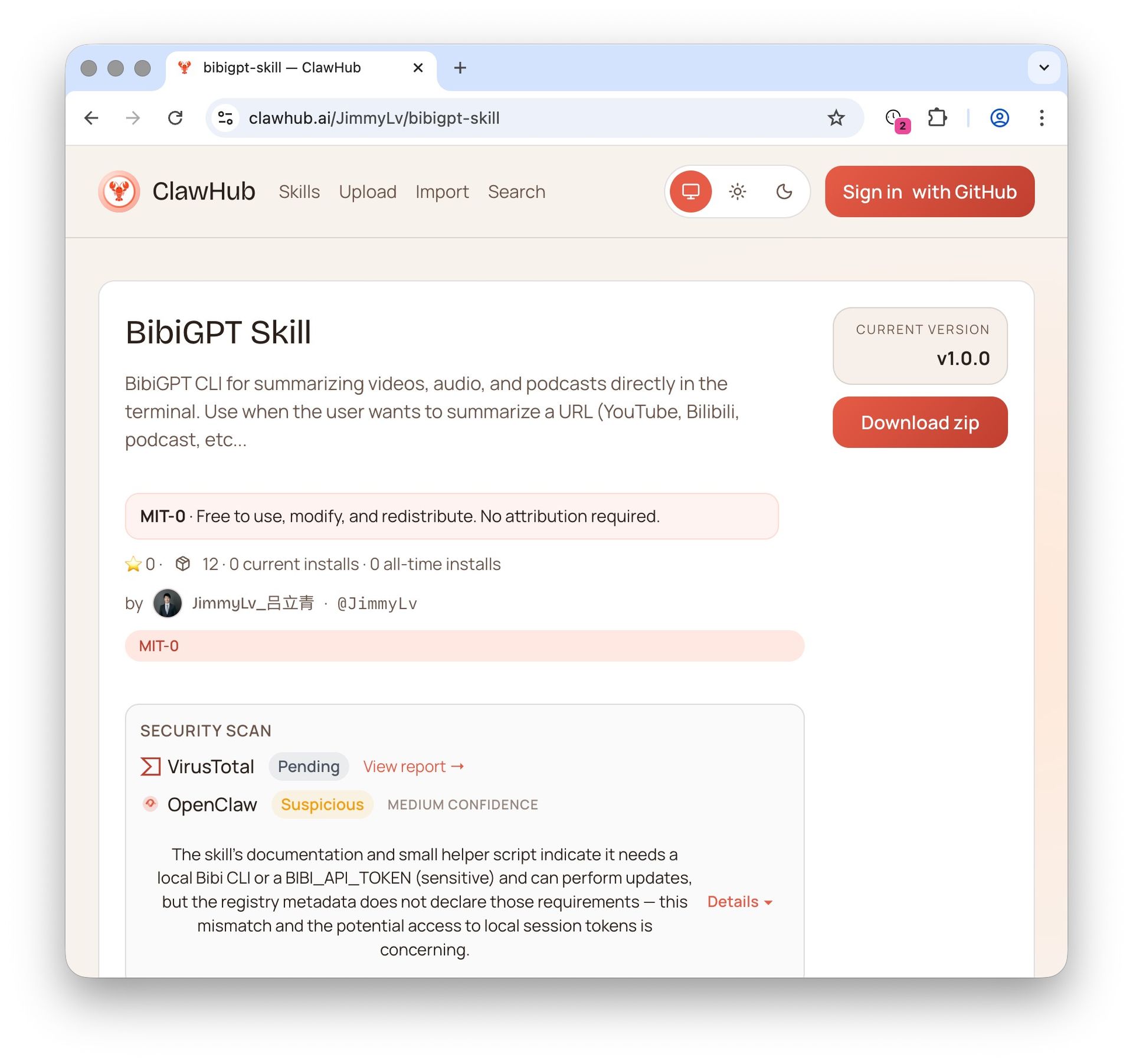
bibigpt-skill resources:
Always shipping. Thank you for being with us 🙏
Visit BibiGPT today and start your AI-powered video workflow:
- 🌐 Website: https://bibigpt.co/en/desktop?utm_source=growth-pages&utm_medium=blog-inline-cta&utm_campaign=20260309-bibigpt-openclaw-agent-skill-update
- 📱 Mobile: https://aitodo.co/app
- 💻 Desktop: https://aitodo.co/download/desktop
- ✨ All features: https://aitodo.co/features
BibiGPT Team