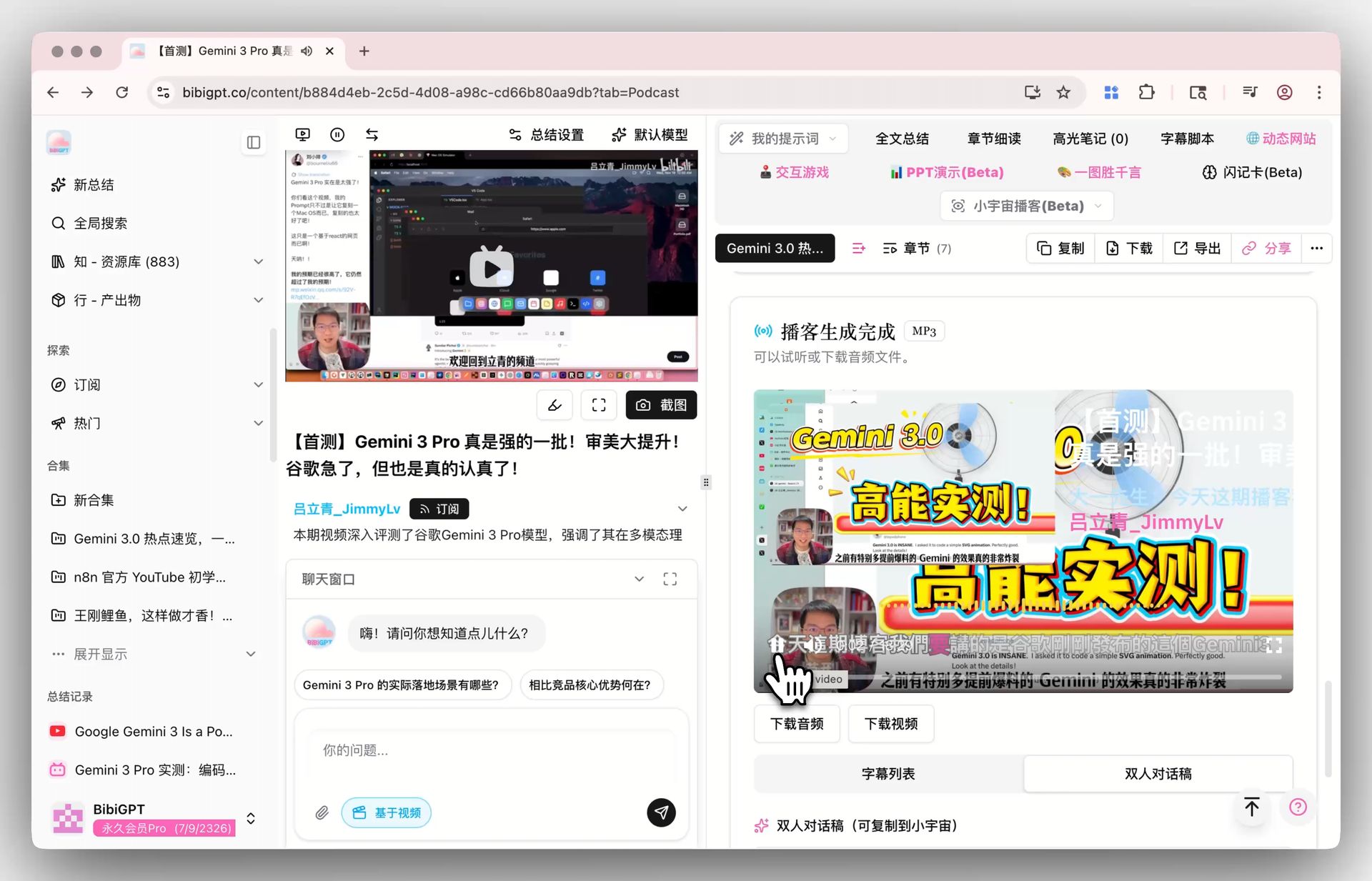
Granola vs BibiGPT: Meeting Notes or Multi-Platform Video Summary — Which One Do You Actually Need? (2026 Review)
Granola vs BibiGPT: Meeting Notes or Multi-Platform Video Summary — Which One Do You Actually Need? (2026 Review)
TL;DR: Granola is the AI meeting notes darling for enterprise scenarios — background-listens to Zoom/Meet/Teams, syncs to Notion/Slack, perfect for English-speaking workplace users doing meeting recap. BibiGPT is the all-in-one multi-platform video/audio summarizer — Bilibili, YouTube, Xiaohongshu, TikTok, podcasts on 30+ platforms in 4 languages — built for content creators, learners, and information workers. The two products barely overlap in user scenarios. Pick based on whether 90% of your time is “meeting” or “consuming content.”
Starting in 2026, Granola became near-default in Western startup circles. The “silently listens during your meeting, gives you a polished note when it ends” experience is genuinely good. But Chinese-speaking users searching “Granola” usually ask: “Is this the same product as BibiGPT? Which should I pick?”
Answer: They solve different problems and barely substitute for each other. Here’s the honest boundary line.
TL;DR: Scenario-to-tool matrix
| Scenario | Pick | Why |
|---|---|---|
| Zoom / Google Meet / Teams meeting notes | Granola | Auto-listen, speaker ID, Notion/Slack sync |
| Bilibili / YouTube / Xiaohongshu / TikTok video summary | BibiGPT | Granola supports zero video platforms |
| Podcasts (Apple/Spotify/Xiaoyuzhou) summary | BibiGPT | Granola is realtime-listen only, doesn’t process podcast URLs |
| Bulk meeting recording transcription | Either works | Granola = better UX, BibiGPT = better multilingual + export |
| Course videos / learning notes | BibiGPT | Mind map + timestamp jump + AI Q&A |
| Content creator topic research | BibiGPT | Multi-platform aggregation + one-click export |
| Chinese / Japanese / Korean users | BibiGPT | Granola Chinese support is shallow |
| Team / enterprise meeting management | Granola | Enterprise SSO, RBAC, compliance |
1. What is Granola? Why did it explode in 2026?
Granola is a desktop AI meeting notes app, founded in 2024 by Chris Pedregal (former Socratic founder). Core scenario:
- You’re in a Zoom / Google Meet / Microsoft Teams meeting
- Granola listens to your desktop audio in the background
- 30 seconds after the meeting ends, AI gives you a titled note with key points and Action Items
- Auto-sync to Notion / Slack / email
Why it exploded in 2026:
- Y Combinator backing + startup-circle word-of-mouth — every Silicon Valley founder uses it
- Background-first UX — no need to invite a meeting bot, the desktop app listens automatically
- Deep Notion integration — notes with Action Items go straight into Notion, no manual cleanup
Granola’s hard boundary: It only handles realtime meeting audio. It doesn’t accept video URLs, doesn’t process podcast links, doesn’t aggregate cross-platform content. That’s its hit direction — and its ceiling.
2. What is BibiGPT? Why is it a different species?
BibiGPT is a multi-platform audio/video content summarizer. Core scenario:
- You see a video/podcast on Bilibili, YouTube, Xiaohongshu, TikTok, Apple Podcasts, Spotify, Xiaoyuzhou — any platform
- Copy the link, paste into BibiGPT
- 30 seconds to 3 minutes — AI returns a structured summary + mind map + timestamped chapters
- One-click export to Notion / Obsidian / Lark / WeChat draft
- AI follow-up Q&A, cross-episode comparison, multi-model routing
BibiGPT’s hard boundary: It works from “content with a URL.” It doesn’t directly listen to local realtime meeting audio. You can upload meeting recording files for summary, but it’s not the core scenario.
3. 6-dimension deep comparison
3.1 Platform coverage
| Dimension | Granola | BibiGPT |
|---|---|---|
| Realtime Zoom / Meet / Teams | ✅ Core | ❌ Not supported |
| Uploaded meeting recordings | ✅ | ✅ |
| YouTube videos | ❌ | ✅ |
| Bilibili / Xiaohongshu / TikTok / Kuaishou | ❌ | ✅ |
| Apple Podcasts / Spotify / Xiaoyuzhou | ❌ | ✅ |
| Podcast RSS subscription | ❌ | ✅ |
| 30+ Chinese platforms | ❌ | ✅ |
Verdict: Granola supports 1 platform (realtime meetings), BibiGPT supports 30+ platforms (audio/video content).
3.2 Note output capabilities
| Output form | Granola | BibiGPT |
|---|---|---|
| Action Items list | ✅ Strength | ⚠️ Available but not primary |
| Structured summary | ✅ | ✅ |
| Mind map | ❌ | ✅ |
| Timestamped chapters | ❌ (no video concept) | ✅ |
| AI follow-up Q&A | ⚠️ Basic | ✅ Strength |
| One-click export to WeChat / Xiaohongshu / video script | ❌ | ✅ |
Verdict: Granola wins on meeting Action Items polish; BibiGPT wins on content-consumption multi-form output.
3.3 Multilingual
| Language | Granola | BibiGPT |
|---|---|---|
| English | ✅ Top priority | ✅ |
| Chinese (Simplified) | ⚠️ Basic | ✅ Top priority |
| Chinese (Traditional) | ⚠️ Basic | ✅ |
| Japanese | ⚠️ Basic | ✅ |
| Korean | ⚠️ Basic | ✅ |
Verdict: English users slightly prefer Granola; CJK users clearly prefer BibiGPT.
3.4 Integrations + export
| Integration | Granola | BibiGPT |
|---|---|---|
| Notion | ✅ Deep | ✅ |
| Obsidian | ⚠️ Markdown export | ✅ |
| Slack | ✅ Native | ⚠️ |
| Lark / Feishu | ❌ | ✅ |
| WeChat Public Account drafts | ❌ | ✅ |
| Team / RBAC | ✅ Enterprise | ⚠️ |
Verdict: English workplace = Granola depth. Chinese creator = BibiGPT depth.
3.5 Pricing
| Dimension | Granola | BibiGPT |
|---|---|---|
| Free tier | 25 meetings/month | Daily quota (1-2 videos/podcasts) |
| Personal | $18/month | $5-15/month (Plus / Pro) |
| Team | $14/month/seat | $30-50/month |
| Student discount | None | Sometimes |
Verdict: BibiGPT is friendlier on price, especially for individual creators and students.
3.6 Privacy + compliance
| Dimension | Granola | BibiGPT |
|---|---|---|
| Data processing region | US (Anthropic models) | China + global dual deployment |
| Don’t train on my data | ✅ Default | ✅ Default |
| Enterprise SSO / SOC 2 | ✅ | ⚠️ Some enterprise plans |
| Mainland China access stability | ⚠️ Network-dependent | ✅ |
Verdict: Cross-border enterprise = Granola compliance more mature. Mainland China individuals/SMBs = BibiGPT more stable.
4. When to pick Granola
If all three are true:
- Main work scenario is English meetings (Zoom / Google Meet / Teams)
- Your team / company is already on Notion or Slack
- You have ≥ 5 meetings per week needing notes
Subscribe to Granola, don’t bother with BibiGPT.
5. When to pick BibiGPT
If any of the following are true:
- You frequently summarize YouTube / Bilibili / Xiaohongshu / TikTok videos (learning, research, topic ideation)
- You subscribe to multiple podcasts and need to consume content fast
- Chinese / Japanese / Korean is your primary working language
- You’re a content creator turning audio/video into articles
- You’re a student or researcher turning course videos into reusable notes
BibiGPT is the right tool. Try BibiGPT free.
6. Can I use both?
Yes, and they’re complementary:
- Workday meetings → Granola listens silently → meeting notes
- Off-hours / weekend learning + content consumption → BibiGPT for YouTube, podcasts, Xiaohongshu videos
Two tools, two domains, no conflict. But if you must pick one:
- 90% of time in meetings → Granola
- 90% of time consuming/creating content → BibiGPT
FAQ
Q1: Can Granola process YouTube videos?
No. Granola is built for realtime meeting audio listening — there’s no URL input, no in-product video/podcast parser.
Q2: Can BibiGPT listen to my Zoom meeting?
Not directly to desktop audio. But you can export the Zoom recording and upload it to BibiGPT for summary.
Q3: Which uses a better AI model?
Granola uses Anthropic Claude. BibiGPT uses multi-model routing (GPT / Claude / Gemini / Gemma 4). Model layer differences are small — what matters is “scenario-tuned prompts + UX.”
Q4: Is Granola’s Chinese experience really weaker?
Not awful, but visibly behind English. Chinese formatting style (Xiaohongshu / WeChat Official Account flavor), punctuation, and structural conventions are noticeably better in BibiGPT.
Q5: I’m a founder doing both meetings and podcasts — what do I do?
Use both. Granola for meetings ($18/month) + BibiGPT for podcasts/industry videos ($5-15/month). Combined $23-33/month covers ~95% of your information consumption.
Closing: pick by scenario, not by feature checklist
Granola and BibiGPT are not competitors — they solve adjacent but fundamentally different problems.
Granola strengths: realtime meetings, Action Items, enterprise team scenarios BibiGPT strengths: multi-platform content, mind maps, individual creators
Don’t judge either tool by “why doesn’t X have Y feature?” — they were never trying to.
Further reading:
- BibiGPT vs Otter.ai Meeting Comparison
- Fathom vs BibiGPT: Meeting and Video AI
- AI Podcast Summarizer Comprehensive Guide
- China AI Meeting Transcription Tools Comparison
Authoritative sources:
BibiGPT Team