Exam-Season Lecture Recording Review Method: Compress a Semester into a Week with Active Recall + AI Summaries (2026 Study-Abroad Playbook)
Exam-Season Lecture Recording Review Method: Compress a Semester into a Week with Active Recall + AI Summaries (2026 Study-Abroad Playbook)
Quick answer: To catch up on a semester of lecture recordings before finals, the fastest path isn’t pulling all-nighters replaying every session — it’s a three-part combo of active recall + spaced repetition + AI summaries. Compress each class into key points and timestamps first, use active recall to check whether you actually understand, and only rewatch the parts where you got stuck. Paste your Zoom lecture recording or Coursera video link into BibiGPT and try it, get structured notes in a minute — the most efficient starting point for exam season in 2026.
1. Why “replaying every session” is the biggest time sink of exam season
Almost every international student has hit the same trap during exam season: a backlog of a dozen lecture recordings, then starting to replay them one by one from the top the week before finals. One class is 90 minutes, 12 weeks is 18 hours of pure playback — before you count the time you zone out and rewind.
The problem isn’t that you’re not trying hard enough; it’s the method. Passive review is widely recognized as the least efficient way to study: you assume “listened once = learned,” but your brain has only grown familiar with the content, not actually retrieved and consolidated it.
Practical rule: The effectiveness of review depends not on how long you watched, but on how much you actively recalled. Replay is input; recall is learning.
Cognitive science has a repeatedly validated finding: active recall and spaced repetition far outperform passive rereading. A frequently cited controlled study shows students who did retrieval practice had significantly higher retention a week later than the rereading group. In other words, instead of listening to the recording again, force yourself to “recall it” first.
2. The core method: active recall + spaced repetition + AI summaries
The key to this playbook is stringing three validated learning principles into one executable pipeline.
Active recall: close the recording, force yourself to restate
After getting through one class’s key points, don’t rush to the next. Close your notes and restate the class’s core conclusions in your own words — what you can restate, you truly know; what you get stuck on is exactly what you should rewatch. This step turns “I think I know it” into “I actually know it.”
Spaced repetition: schedule rewatches along the forgetting curve
Don’t cram one class’s review into a single moment. After your first pass, do another active recall the next day, then another three days later. Each time, only rewatch the parts you got stuck on last time. The core of spaced repetition is retrieving again right when you’re “about to forget” — that’s when it sticks best.
AI summaries: turn 18 hours of recordings into searchable key points
The first two steps assume you have “material that’s fast to review.” That’s exactly the value of AI summaries — compress each recording into timestamped key points first, so you have something to “actively recall” and “space out,” instead of starting from the 90-minute original every time.
The demo below directly shows “how a video gets compressed into a TL;DR + key points + timestamps”:
Summarize any video in seconds
Pick a sample below to see the AI summary — TL;DR, key points, and jump-to timestamps.
TL;DR: Karpathy builds a GPT-style language model from scratch in code, explaining every piece — from a tiny character-level model up to the full Transformer.
Key points
- Start with a bigram model, then add self-attention so tokens can "talk" to each other
- A Transformer block = multi-head attention + feed-forward + residual connections + layer norm
- Training is just predicting the next token; scale and data do the rest
- The same architecture behind nanoGPT is what scales up to ChatGPT
Jump to
- 00:07 Why build GPT from scratch
- 08:23 Self-attention, intuitively
- 1:00:00 Assembling the Transformer block
- 1:35:00 From nanoGPT to ChatGPT
Demo: BibiGPT compresses a lecture recording into structured key points
Practical rule: Without structured key points, active recall has nowhere to start. Get “searchable review material” first, then the method can run.
3. The 5-step routine: compress a semester into a week
This flow turns the method above into concrete daily actions. First watch an explainer video, then follow along:
The video below explains, from a learning-science angle, why active recall beats rereading — a solid backing for the method:
Video source: YouTube · study method explainer
The steps:
- Batch out the key points: paste all this week’s backlogged lecture recording links into BibiGPT one by one, and get each class’s structured summary and key timestamps.
- First active recall pass: after reading each class’s points, close them and restate the core conclusions in your own words. Flag the points you can’t restate.
- Targeted rewatch: only rewatch the flagged stuck points — click the timestamp in the points to jump straight there, no need to replay from the start.
- Spaced repetition schedule: lay out three rounds of active recall across “Day 1 / Day 3 / Day 5,” each round only checking last round’s stuck points.
- One pre-exam speed pass: the day before the exam, only review your own “stuck-points list” and do a final active recall.
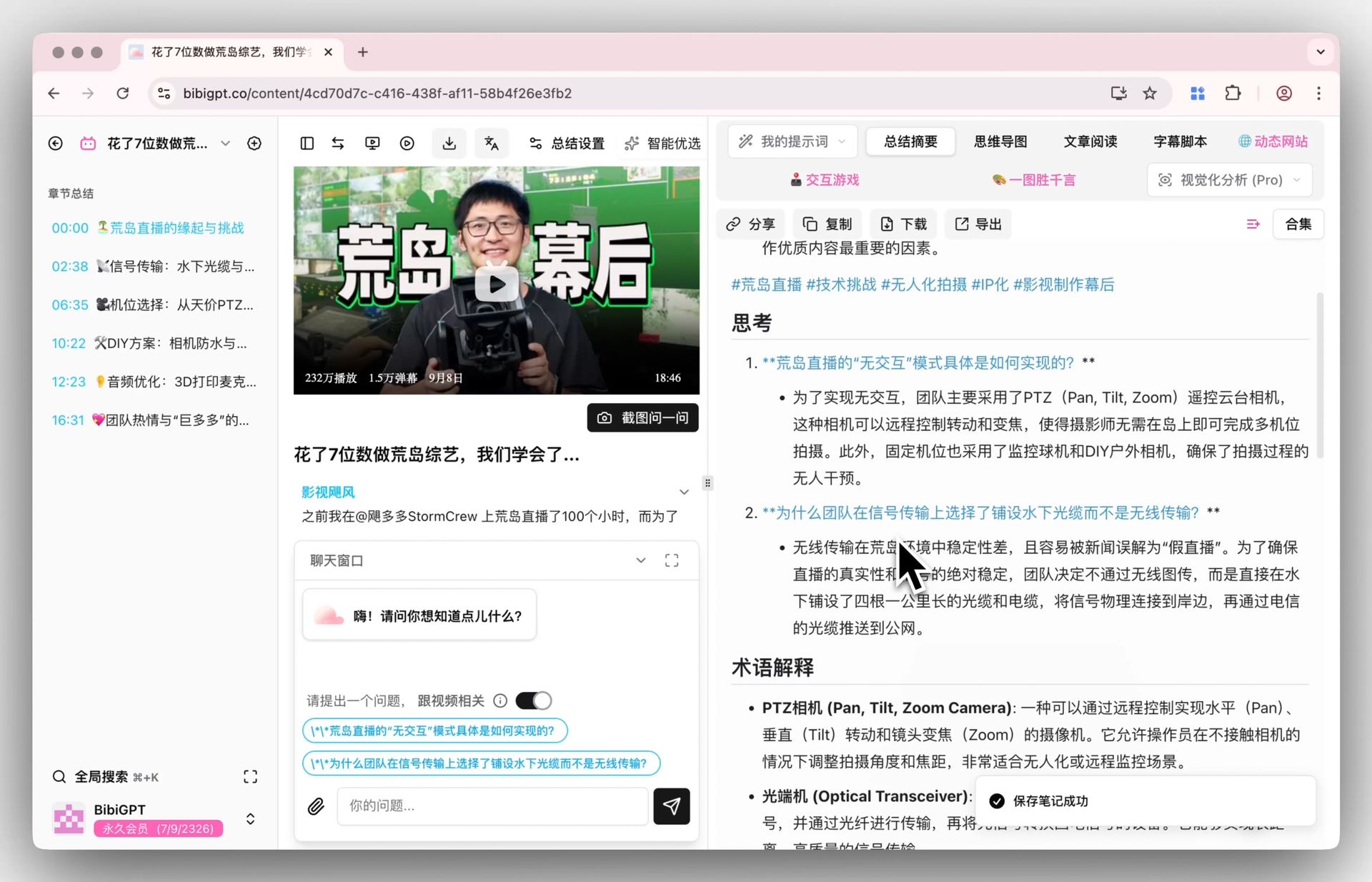
The image below is BibiGPT’s deep-summary view, which lets you spot each class’s core question at a glance and know where to start recalling:
Screenshot: BibiGPT · smart deep summary feature demo
Run the whole flow and 18 hours of pure playback gets compressed into “read the points + targeted rewatch of stuck spots” — the only thing that actually takes time is the small part you don’t understand. To use this method on your own recordings, just paste a lecture recording to generate review notes.
4. By-country exam-season comparison: how tight is your review window
Different countries have different exam-season pressure points, and the method’s emphasis should adjust accordingly.
US undergraduates
F1 required-course recordings pile up the week before midterms, often forcing you to get through 12 weeks of content in 7 days. The active recall step matters most for you — too little time to replay session by session, you can only rely on “recall first, then targeted patch.”
UK master’s students
PgDip seminar recordings have incomplete materials and tutors with hard-to-follow accents. Turn seminar recordings into key points first, and during active recall focus on checking whether you can restate the “claim + evidence” chain.
Australian undergrad/postgrad
Final exams cluster together, plus timezone gaps make live lectures hard to follow. Compress lecture recordings into points first, and in your spaced repetition schedule give time to the concepts you genuinely don’t understand, not an even split.
Canadian students
Co-op work clashes with online classes, so review only fits in fragments. This method is naturally suited to fragmentation — active recall takes only minutes each time, and spaced repetition only checks stuck points, requiring no large blocks of time.
| Country | Exam-season pain point | Method emphasis |
|---|---|---|
| US | 12 weeks of content the week before midterms | Heavy active recall, almost no replay |
| UK | Hard-to-follow seminar recordings | Check the claim-evidence chain |
| Australia | Clustered finals + timezone gaps | Speed-compress points + targeted spacing |
| Canada | Co-op clashes, fragmented time | Fragmented active recall |
Practical rule: The tighter the time, the more you should shift review weight from “replay” to “recall.” Replay is a luxury; recall is a necessity.
5. FAQ
Q1: Active recall sounds tiring — is it really faster than rewatching?
Yes. Rewatching one class takes 90 minutes; active recall takes only minutes — and it tells you directly “where you didn’t understand,” letting you spend your precious rewatch time where it counts. Overall it saves time.
Q2: Will AI summaries miss key points and leave my review incomplete?
AI summaries are an “index,” not a “replacement.” They help you quickly locate each class’s core structure and timestamps; the parts you’re genuinely unsure about, you still rewatch the original to confirm — and active recall is exactly what surfaces those points.
Q3: Which platforms’ recordings work with this method?
Zoom lecture recordings, Coursera, edX, Udemy, Khan Academy, YouTube open courses, Bilibili study-section videos, and academic podcasts all work. As long as you can get a link or file, you can compress it into points first.
Q4: Exam season is so tight — how long does this flow take to set up?
The first run takes a dozen minutes or so to learn the flow; after that, “points out + one active recall round” per class is usually quick. A small upfront investment buys review efficiency for the whole exam season.
Q5: Do I have to make review cards by hand?
No need to build from scratch. Get structured key points from the AI summary first, then during active recall just note the stuck points into a single “stuck-points list” — that’s your most minimal review card.
6. Try it now: compress this week’s recordings into key points first
What’s scarcest in exam season isn’t effort, it’s time. Passive replay spends time on content you already know; active recall + AI summaries concentrate time on what you genuinely don’t — that’s the whole secret of “compressing a semester into a week.”
A minimal flow you can start today:
- Paste this week’s backlogged recordings into BibiGPT and batch out the points.
- After each class, close it, restate it in your own words, and flag the stuck points.
- Only rewatch the stuck points, doing three rounds of active recall on Day 1/3/5.
Models are no longer scarce; what’s scarce is the speed to understand, retain, and recall a semester of lectures on demand.
Paste your Zoom lecture recording or Coursera video to generate review notes and get structured notes and key timestamps in a minute — for exam season 2026, the most efficient review starts here.
BibiGPT Team