YouTLDR vs BibiGPT: The 2026 YouTube AI Summary Tool Showdown
YouTLDR vs BibiGPT: The 2026 YouTube AI Summary Tool Showdown
Quick answer: YouTLDR is a lightweight, YouTube-only “TL;DR” reader. BibiGPT is a full-stack audio-video knowledge tool covering 30+ platforms with deep summaries, subtitle translation, batch processing, and video-to-article. If 95% of your time lives on YouTube and you only need a 30-second TL;DR, YouTLDR is enough. If you cross platforms (Bilibili, podcasts, TikTok), need mind maps, subtitle translation, video-to-article, or batch workflows, BibiGPT is the inevitable choice. This article runs the head-to-head across five core dimensions.
1. Two tools, two different positioning bets
YouTLDR and BibiGPT often get compared, but they solve different layers of the problem:
- YouTLDR: single platform (YouTube) → text summary, positioned as “fast preview.”
- BibiGPT: multi-platform audio-video → deep knowledge assets, positioned as “learning + creation productivity.”
Practical rule: Before picking a tool, ask: “Am I using this to avoid watching the video, or to better digest the video?” The former → YouTLDR. The latter → BibiGPT.
The two needs aren’t mutually exclusive, but the design tradeoffs are completely different — one optimizes for “scan 100 headlines,” the other for “actually understand 100 ideas.”
2. Five-dimension head-to-head
The table below reflects publicly documented capabilities and our hands-on tests in May 2026:
| Dimension | YouTLDR | BibiGPT |
|---|---|---|
| Platform coverage | YouTube-focused | 30+ platforms (YouTube, Bilibili, Xiaoyuzhou, TikTok, Apple Podcasts, Spotify, local files) |
| Summary depth | Short summary / chapter bullets | Smart deep summary (core, highlights, thinking questions, glossary) |
| Subtitles | Native subtitles only | Multi-language translation, SRT sync export, bilingual side-by-side |
| Batch processing | Mostly single-video | Collection summary, bulk export, batch translation |
| Video-to-article / multimodal | Not supported | AI video-to-article + mind map + smart screenshot extraction |
Practical rule: YouTLDR is a “speed-reading add-on.” BibiGPT is a “content productivity platform.” They overlap on “glance at a YouTube video,” diverge entirely on “turn a video into a reusable knowledge asset.”
3. Where YouTLDR shines
To be fair, YouTLDR excels in these scenarios:
- YouTube power-user filtering — skim 30 videos a day, decide in 30 seconds which one to watch in full.
- Lightweight, no extra account — most YouTLDR-style tools ship as browser extensions, zero friction.
- Native English speakers — YouTLDR is built around the English YouTube ecosystem.
Boundaries:
- No support for Bilibili / podcast platforms / TikTok / local files.
- Summary depth is shallow — fine for TL;DR, weak for deep learning.
- No translation (depends on your English fluency).
- No batch or multimodal output (no video-to-article, no mind maps).
If your workflow falls outside these limits, YouTLDR runs out — that’s where BibiGPT takes over.
4. Where BibiGPT pulls ahead
4.1 Cross-platform audio-video research
Native support for 30+ platforms. Trusted by 1M+ users, 5M+ AI summaries generated. Bilibili courses, Xiaoyuzhou podcasts, TikTok/Douyin short videos, local mp4 — paste or upload, both work.
4.2 Deep summaries (thinking questions + glossary)
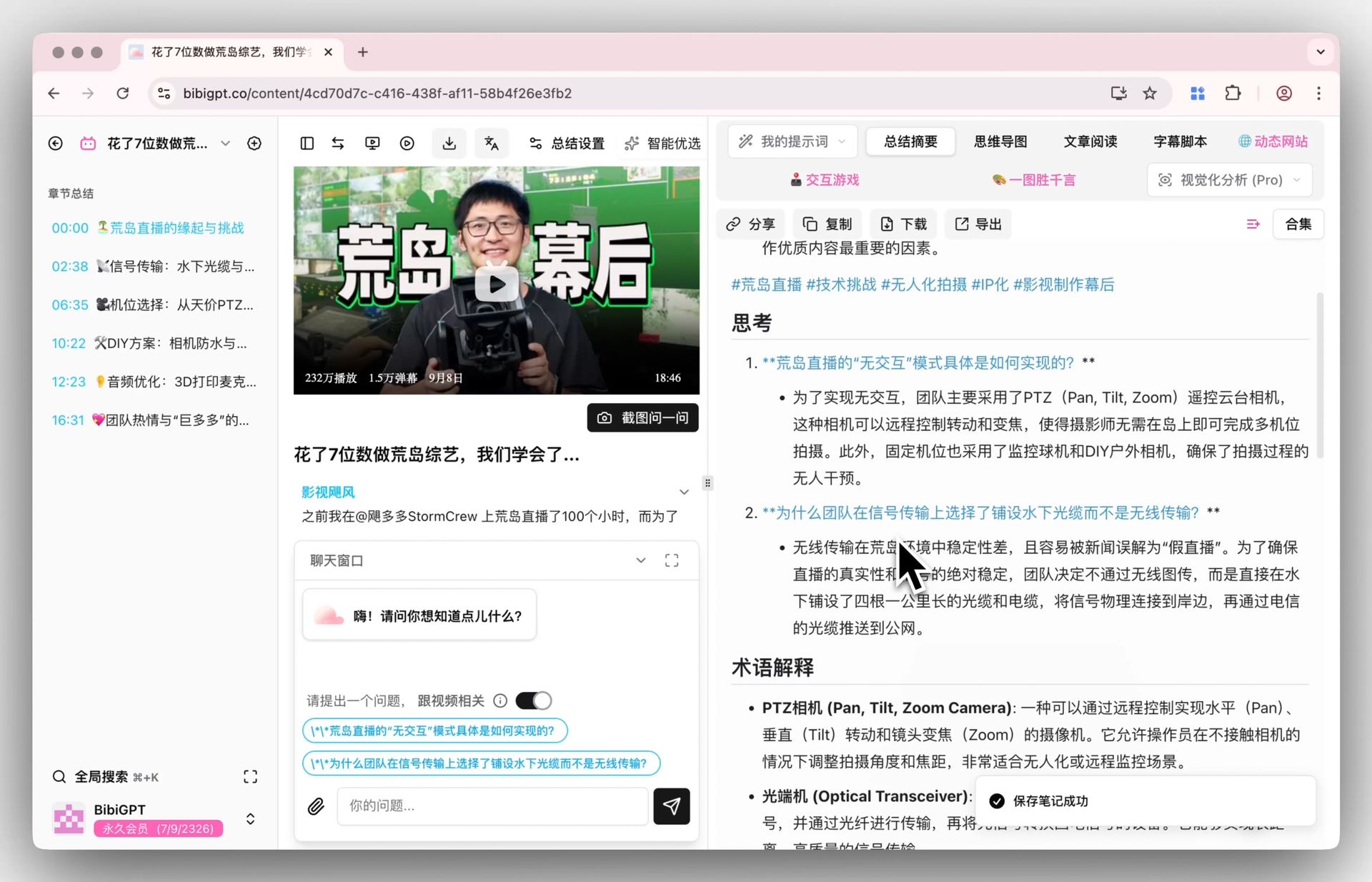
BibiGPT smart deep summary ships a structured default: core summary, key highlights, thinking questions, glossary.
YouTLDR’s short summary is “glance bait.” BibiGPT’s deep summary is “actually learn something.” For research, knowledge management, or content creation, the depth difference matters.
4.3 Subtitle translation and multilingual support
Auto-translate on upload lets you set the target language pre-upload — bilingual subtitles + translated summary come out automatically.
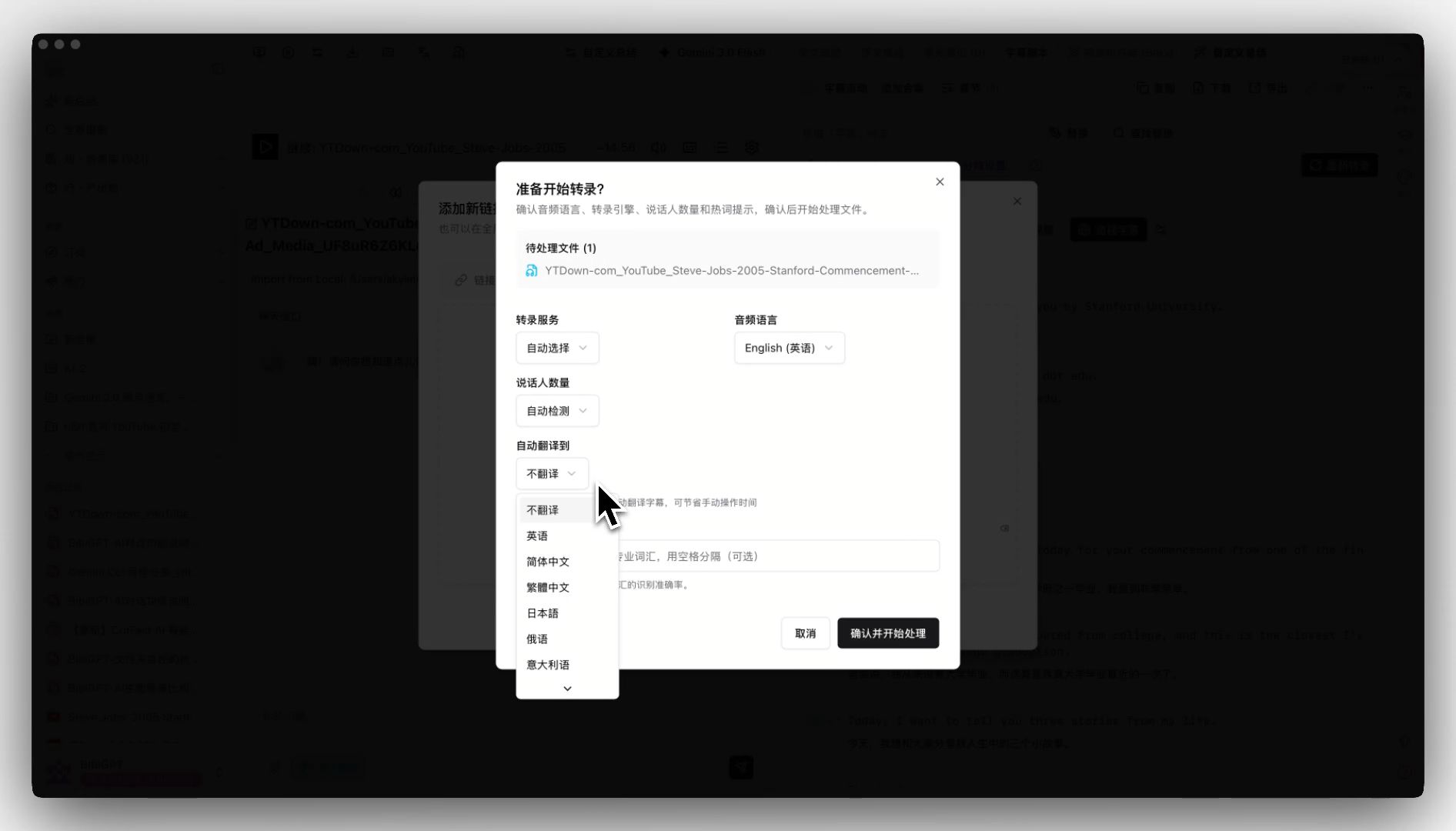
YouTLDR assumes English fluency. BibiGPT lets Chinese / Japanese / Korean speakers digest English YouTube directly — and vice versa.
4.4 Video-to-article (creator superpower)
AI video-to-article converts a video into a richly illustrated article with smart screenshots, chapters, and Markdown / HTML / PDF export.
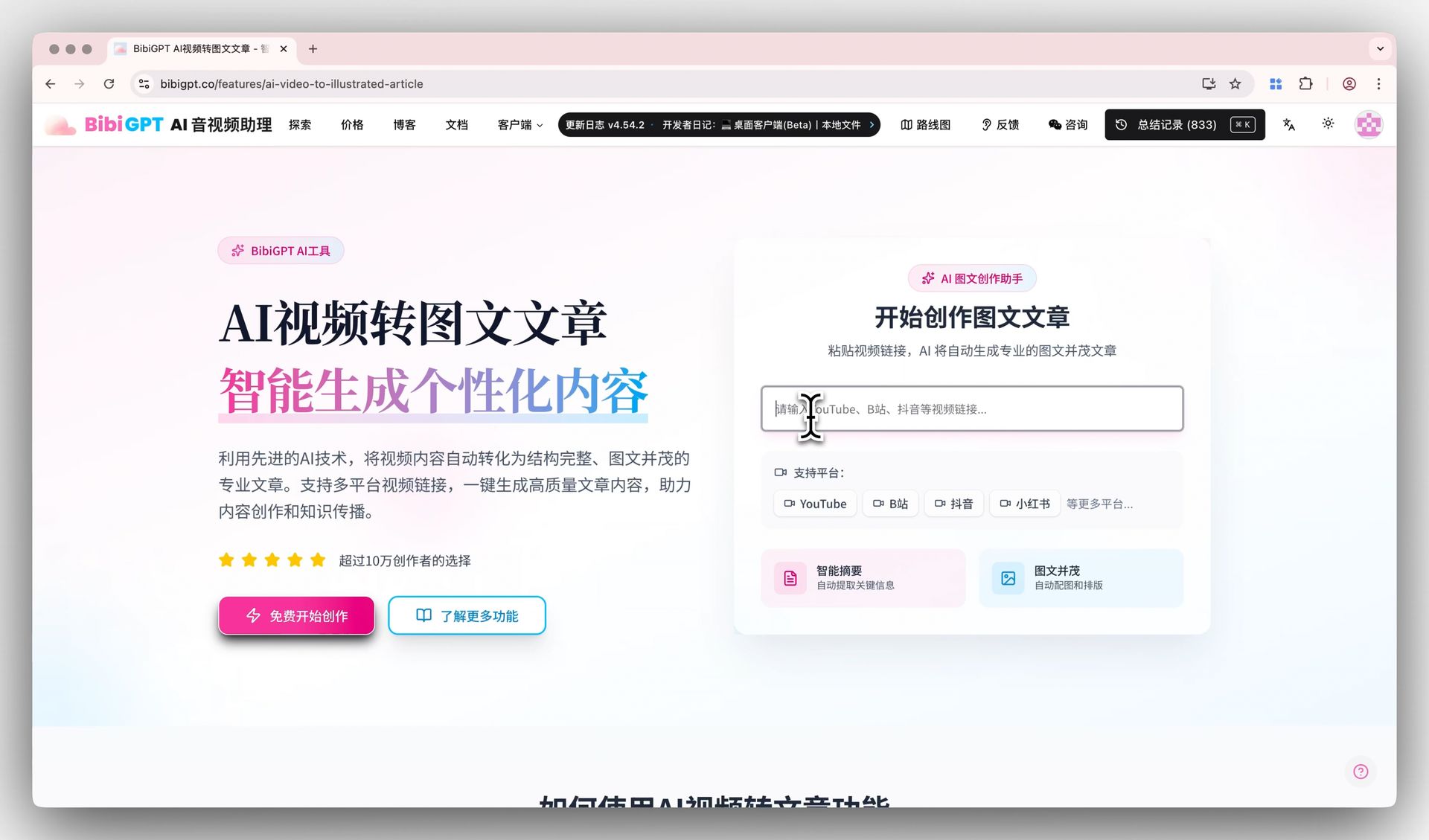
YouTLDR gives you “a text summary.” BibiGPT gives you “a publishable illustrated article.” Different planet.
4.5 Batch and collections
Bulk export video summaries + collection AI chat: process dozens of videos at once, run shared custom prompts across the whole collection. Core need for researchers, creators, and enterprise API users.
5. Six real scenarios — which one to pick
| Scenario | Pick | Why |
|---|---|---|
| I only scan YouTube to filter 30 videos a day | YouTLDR | Lightweight, zero friction |
| Academic research across 50 related videos | BibiGPT | Deep summary, batch, collection chat |
| Non-English speaker digesting English YouTube | BibiGPT | Subtitle translation, bilingual side-by-side |
| Creator turning videos into illustrated articles | BibiGPT | AI video-to-article + multimodal export |
| Cross-platform (YouTube + Bilibili + podcasts) | BibiGPT | 30+ platforms native |
| Enterprise batch via API | BibiGPT | Pro / API both support batch |
Practical rule: YouTLDR solves “filter.” BibiGPT solves “digest + create.” The former is a consumer tool. The latter is a productivity tool.
6. FAQ
6.1 Can I use both?
Yes. Use YouTLDR as a browser-based fast filter; when a video earns deeper attention, run it through BibiGPT for the full summary. Zero conflict.
6.2 Is BibiGPT slower than YouTLDR on YouTube?
BibiGPT’s deep summary adds 30-60 seconds compared to a pure TL;DR tool because of extra output dimensions — still 10x faster than watching the video. If you want fast TL;DR only, use BibiGPT’s custom prompt summary to enforce short-mode output.
6.3 Is YouTLDR free?
Most YouTLDR-style tools offer a free quota with paid upgrades. BibiGPT similarly offers a free tier + Pro subscription + pay-as-you-go. See BibiGPT pricing.
6.4 Which is better for academics?
BibiGPT, clearly. Collection AI chat supports cross-video questioning; SRT subtitle sync export enables timestamp-precise citations; video-to-article ships publishable research notes.
6.5 Data privacy comparison?
Both ship their own privacy policies. BibiGPT has specific compliance designs for the Chinese market, and Pro users can route through stricter privacy paths. See BibiGPT privacy policy.
7. Verdict
If you’re choosing between “fast YouTube filter” and “deep audio-video learning”:
- Filter only, no deeper work → YouTLDR is enough.
- Want depth, cross-platform, or production output → BibiGPT is the 2026 default.
Try BibiGPT smart deep summary free →
References: Anthropic multimodal research, Google AI Research.
BibiGPT Team