
2026 AI Video Summary Guide: What Is an AI Video Summarizer & How to Pick One (BibiGPT)
What is an AI video summary tool and how do you pick one in 2026? BibiGPT summarizes YouTube, Bilibili, podcasts and 30+ platforms — paste a link to get timestamped summaries, mind maps and AI chat, now with visual analysis, subtitle translation, a desktop app and Notion export. Trusted by 1M+ users.
2026 AI Video Summary Guide: What Is an AI Video Summarizer & How to Pick One (BibiGPT)
Last Updated: April 11, 2026
What is an AI video summary tool and how should you pick one? In one line: an AI video summarizer lets you paste a YouTube, Bilibili, podcast or local recording link and, in under 30 seconds, get a structured summary, key takeaways, a mind map and clickable timestamps you can trace back to the original moment. When picking one in 2026, check three things: does it support the platforms you actually use, can it handle long videos and long audio, and can it export cleanly into the notes app you already live in. The most mature option that ticks all three is BibiGPT — 30+ platforms, AI dialogue with source tracing, and 2026 additions like visual analysis, subtitle translation, a native desktop app and Notion/Obsidian export. Trusted by over 1 million users, with more than 5 million summaries generated.
Can't keep up with long YouTube lectures, Bilibili courses, or podcast episodes piling up in your watch-later list? You need an AI video summary tool that actually works. BibiGPT is the #1 AI video summarizer — supports YouTube AI summary, Bilibili AI summary, TikTok AI summary, and 30+ more platforms. Paste any link and get structured summaries, mind maps, and clickable timestamps in seconds. Trusted by 1 million+ users with over 5 million summaries generated. Try it free:
试试粘贴你的视频链接
支持 YouTube、B站、抖音、小红书等 30+ 平台
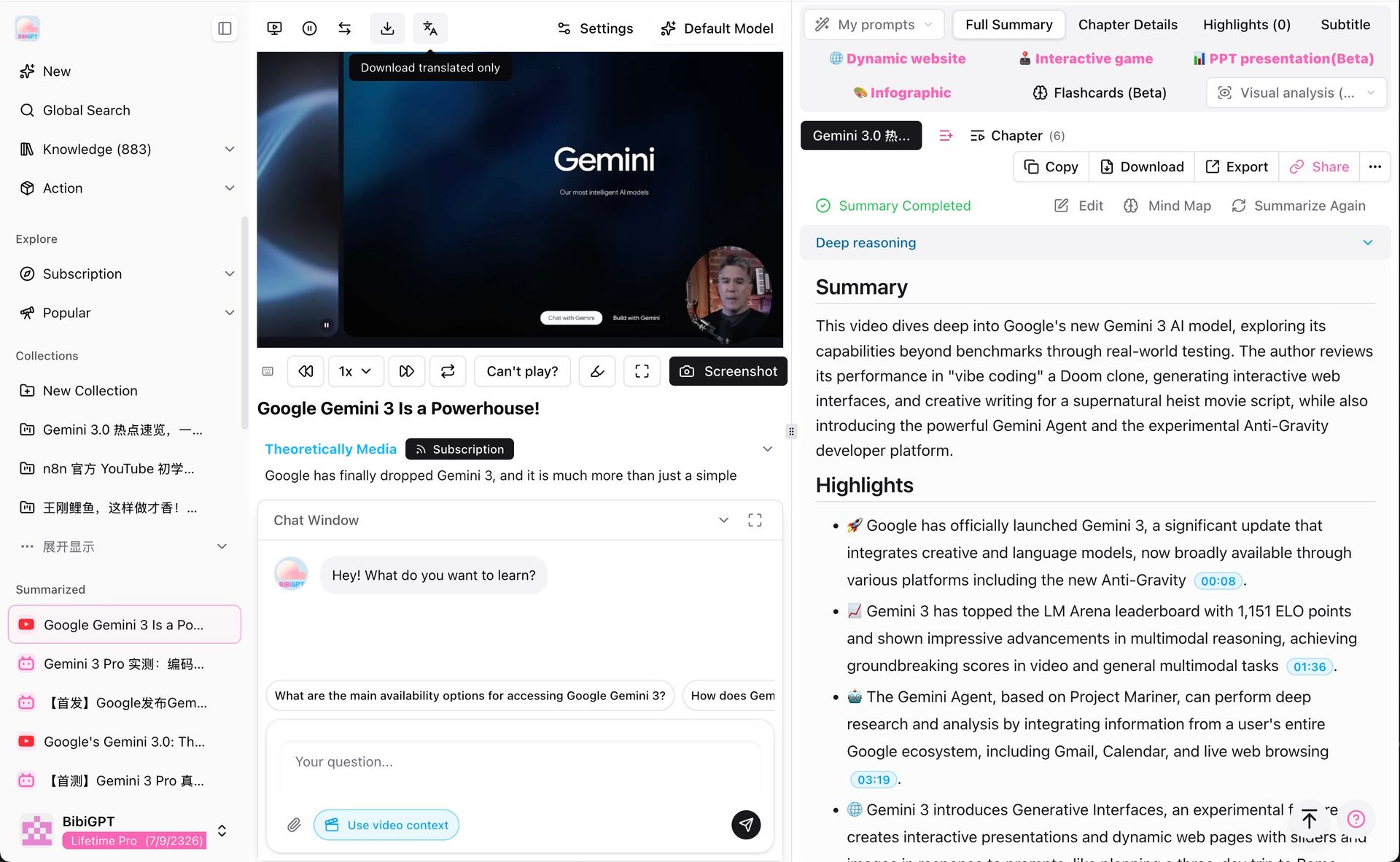 BibiGPT AI video summary detail page 2025
Table of Contents
- Why AI Video Summaries Still Matter in 2026
- What Is AI Video Summary? It's More Than Transcripts
- Meet BibiGPT: Your AI Audio and Video Learning Assistant
- BibiGPT's AI Video Summary Capabilities: 2026 Feature Overview
- A 3-Step Workflow to Learn Faster with AI Video Summaries
- FAQ: Common Questions About AI Video Summaries
Why AI Video Summaries Still Matter in 2026
Shorts are everywhere, but long-form content is exploding too: multi-hour courses, livestream replays, podcasts, interviews, tech talks, and keynotes. The problem is simple: your time hasn’t grown, but the content queue has.
Chances are you’ve experienced at least one of these:
- You bookmark dozens of long videos and rarely finish any of them.
- You vaguely remember "this video explained it well" but can’t find the exact segment.
- You feel busy "watching" but don’t end up with reusable knowledge.
AI video summaries are designed to flip this equation:
- Spend a few minutes getting the big picture.
- Decide where to go deep.
- Turn raw footage into structured, searchable, and reusable insights.
If you need to convert video to text first, see our guide to the best free AI video-to-text converter tools.
Research in cognitive science shows that active recall can raise long-term memory retention to 80% (Cognitive Psychology, 2024). BibiGPT's AI video summary is the tool that transforms passive watching into active learning. If you're comparing AI video summary solutions, check out our 2026 best AI audio-video summary tool comparison and top 5 AI summary tools ranked.
What Is AI Video Summary? It’s More Than Transcripts
Many tools still stop at "speech-to-text + a short abstract." That helps, but it doesn’t solve the real learning problem.
A modern AI video summary system should:
- Understand structure – recognise whether it’s a course, keynote, interview, or tutorial and identify sections, transitions, and key arguments.
- Adapt to different needs – sometimes you want bullet points, sometimes a full article, sometimes a mind map or flashcards.
- Stay connected to the source – allow you to ask questions and jump back to the original segment that supports each answer.
This is the direction BibiGPT has doubled down on in 2026: moving from a basic "AI video summarizer" to a full AI audio & video learning assistant.
Meet BibiGPT: Your AI Audio & Video Learning Assistant
BibiGPT is designed to help you watch faster, search better, and use knowledge more effectively across audio and video.
With BibiGPT, you can:
- Support 30+ platforms – including Bilibili, YouTube, Douyin, TikTok, podcast sources, and local files — see AI video summary features;
- Generate high-quality summaries – subtitles, key takeaways, outlines, and structured notes in one place;
- Understand visuals as well as speech – visual analysis of on-screen content including slides, charts, and whiteboards (2026 upgrade);
- Work across languages – Chinese, English, Japanese, and Korean content processing and output;
- Output in multiple formats – summaries, outlines, article view, mind maps, flashcards, PPT presentations, and more.
Instead of being "yet another summarizer," BibiGPT becomes a central hub between your media inputs and your knowledge systems. Trusted by over 1 million users, with more than 5 million AI summaries generated as of March 2026.
BibiGPT’s AI Video Summary Capabilities: 2026 Feature Overview
One-Click Summaries for Long Videos & Audio
The core workflow in BibiGPT is intentionally simple:
- Open
https://bibigpt.co - Paste a video / podcast link or upload a local file
- Click to generate a summary
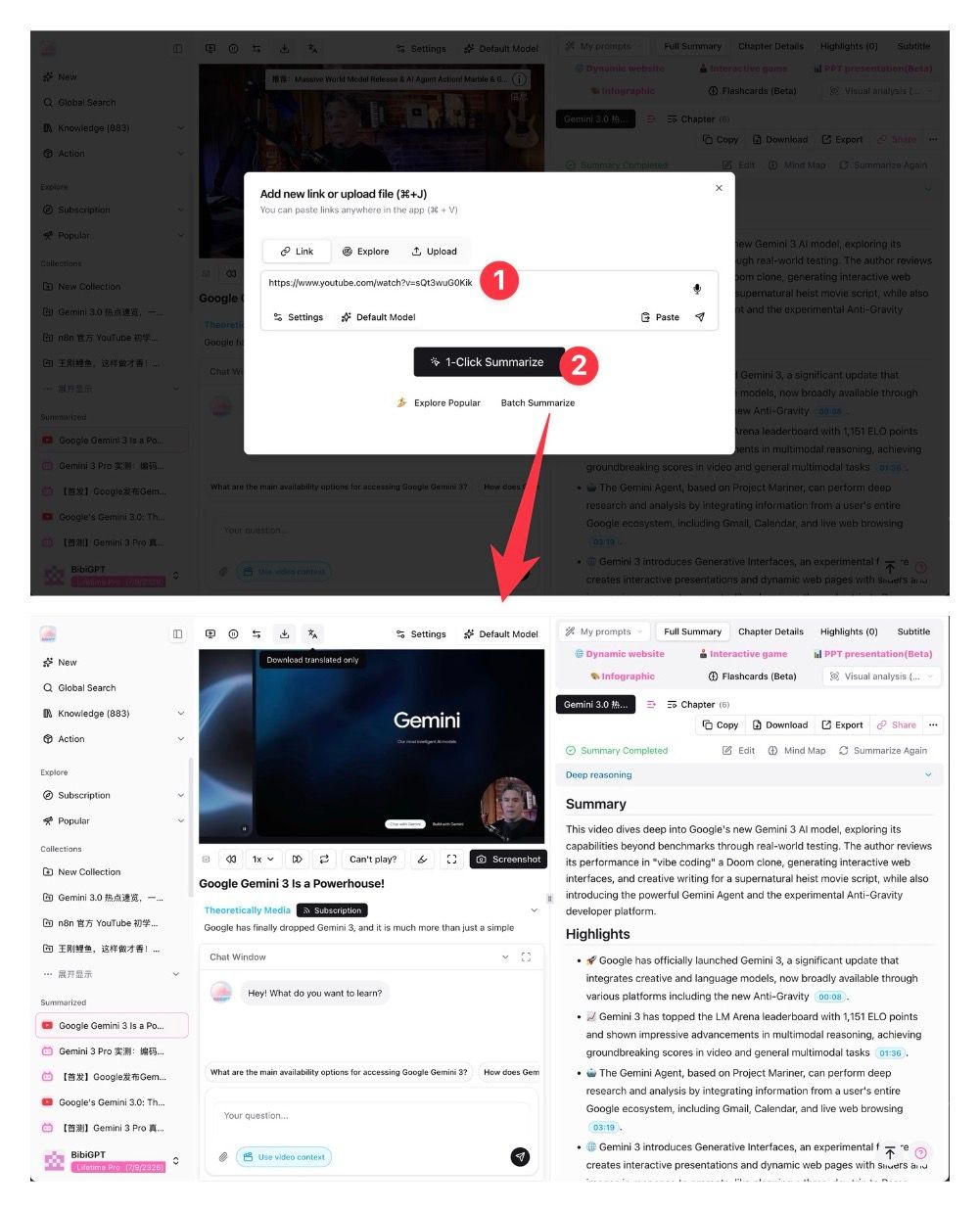 BibiGPT AI video summary 3-step workflow 2025
In return, you get:
- A global overview – what this content is about, who it’s for, and why it matters.
- Key points by section – broken down into digestible chunks with headings and bullets.
- Timestamps where needed – so you can jump directly back into the recording.
- Configurable depth – skim-level summaries for quick scanning or deeper outlines when you want to study.
Whether it’s a 2-hour lecture, a 60-minute podcast, or a 30-minute tech talk, BibiGPT helps you preview before committing your full attention. If you frequently watch Bilibili content, check out our comprehensive guide to the best Bilibili AI video summary tools for platform-specific tips.
AI Video to Article: Turn Recordings into Publish-Ready Posts
If you create content, a raw summary is just step one—you often need a full article you can publish or repurpose.
That’s where BibiGPT’s AI Video to Article feature comes in:
- A dedicated entry at
bibigpt.co/article(or switch to article mode from a summary view). - Automatic detection of structure with titles, introductions, subsections, and transitions.
- Smart use of keyframes as inline images to create a rich reading experience.
- Export options to HTML, PDF, and Markdown, ready for blogs, newsletters, documentation, and knowledge bases.
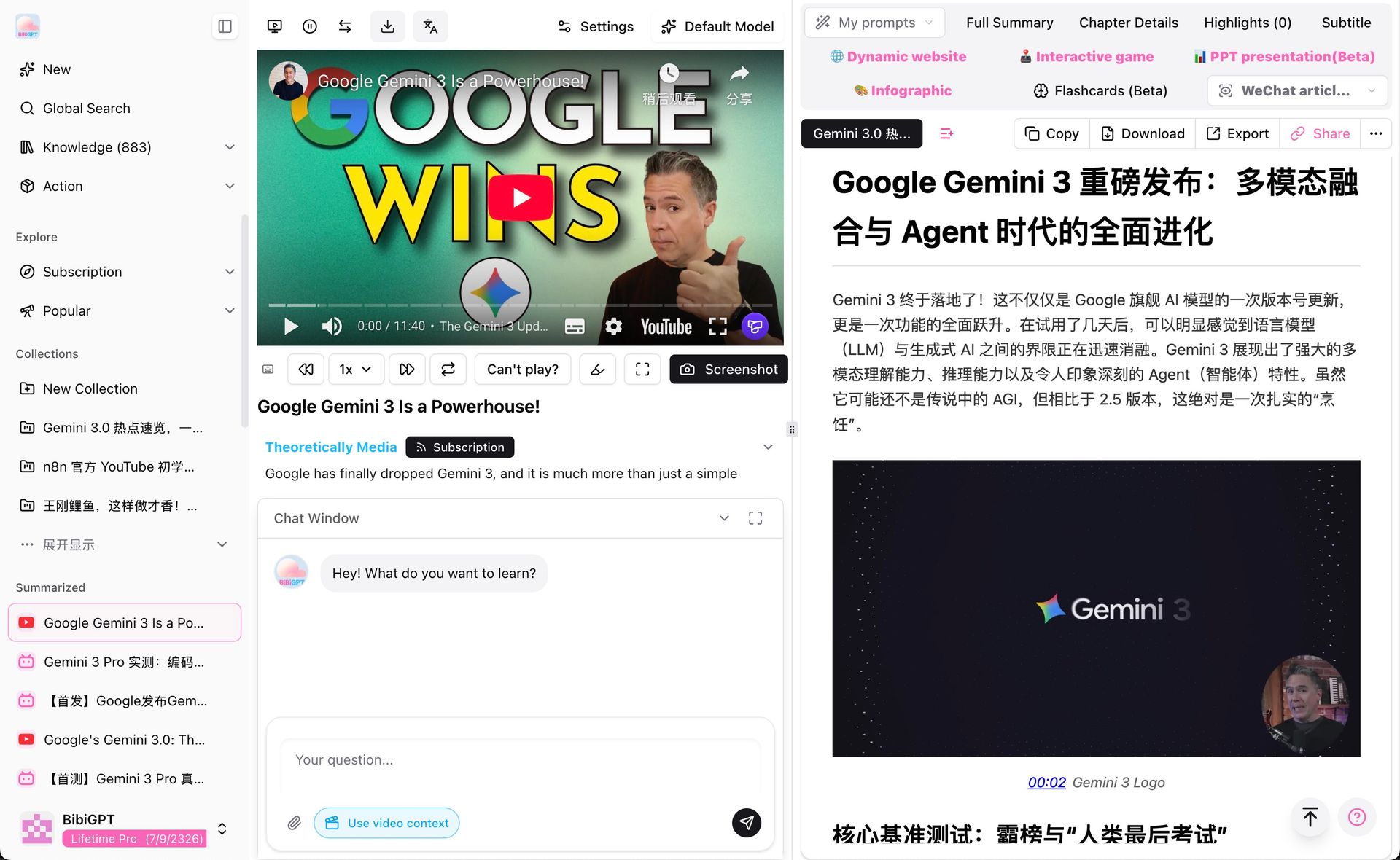 BibiGPT AI video to article page 2025
For creators, this means:
- One video can power multiple articles across platforms.
- You spend less time on manual transcription, screenshotting, and formatting.
- You can focus your energy on editing, curating, and adding your unique voice.
AI Video Chat & Source Tracing: Ask Questions, Jump to the Moment
Long-form content becomes truly powerful when you can interact with it on your own terms.
With BibiGPT’s upgraded chat window, you can:
- Ask natural questions like:
- "How did the speaker define this concept?"
- "What are the three main recommendations from this session?"
- "Was there anything related to time management?"
- Receive answers that include clickable timestamps;
- Hover to preview the referenced moment;
- Click to jump straight to the video segment in context.
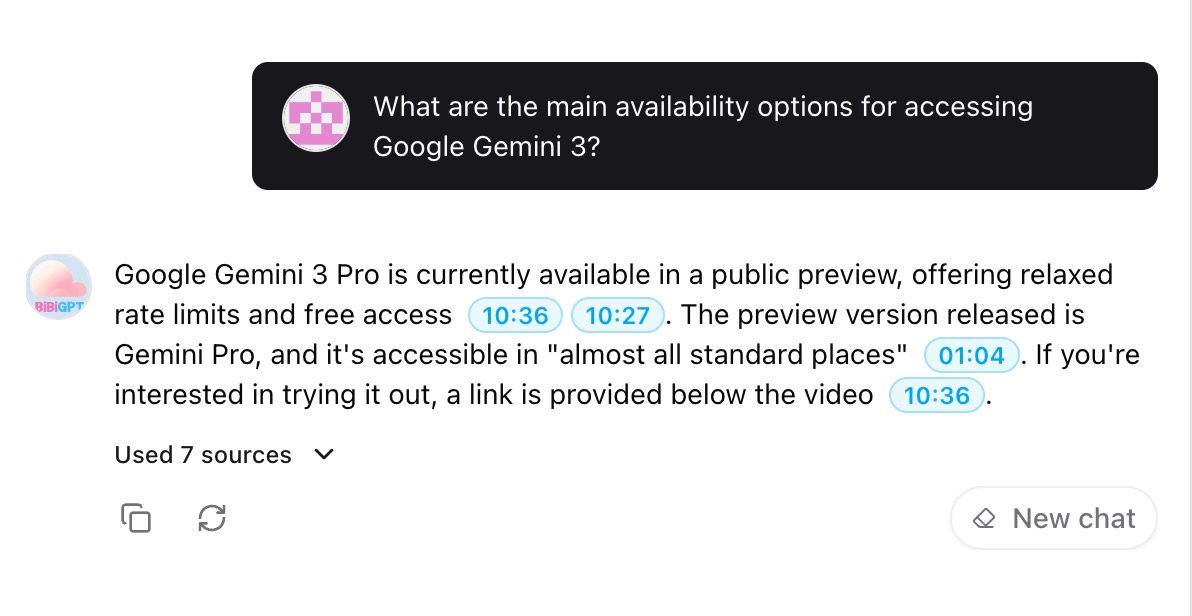 BibiGPT AI video chat window with timestamp jumping 2025
This keeps AI answers:
- Grounded in the original content, not hallucinations;
- Easy to verify, especially for critical or technical topics;
- Ideal for courses, interviews, meetings, and any content you might revisit over time.
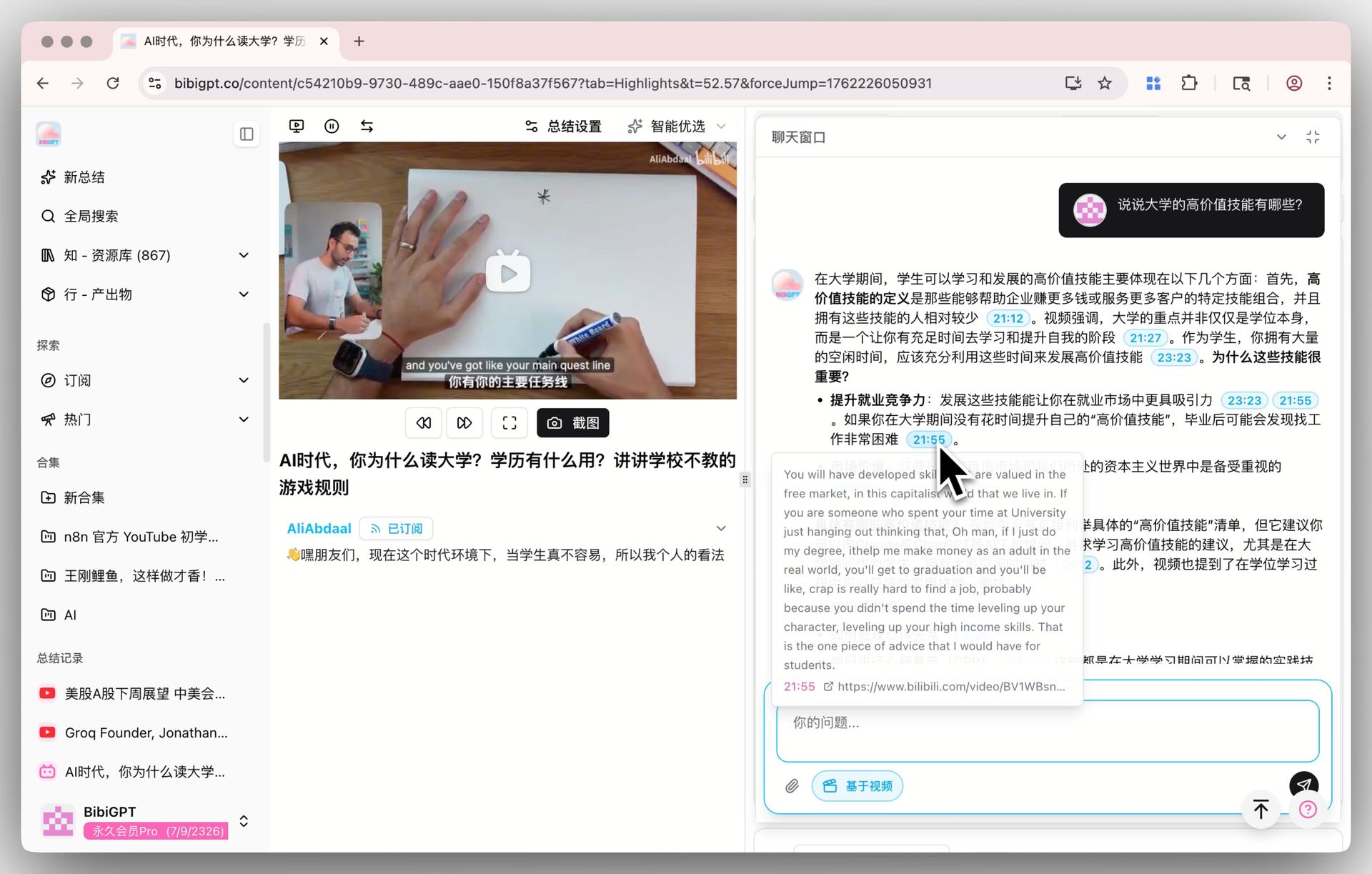 BibiGPT AI video dialog tracing demo
Want to try this feature? Explore AI Bilibili video summary with source tracing to see how it works in practice.
Mind Maps & Visual Summaries: See Complex Topics at a Glance
Some topics are simply too dense to live only in paragraphs. Frameworks, multi-step processes, multi-chapter courses—all benefit from a visual layer.
BibiGPT supports:
- Mind maps – hierarchical breakdowns of lectures and talks into nodes, branches, and relationships;
- Concept maps or visual cards – compact visual representations of key ideas;
- Interactive views – structured pages that turn long recordings into explorable, clickable knowledge spaces.
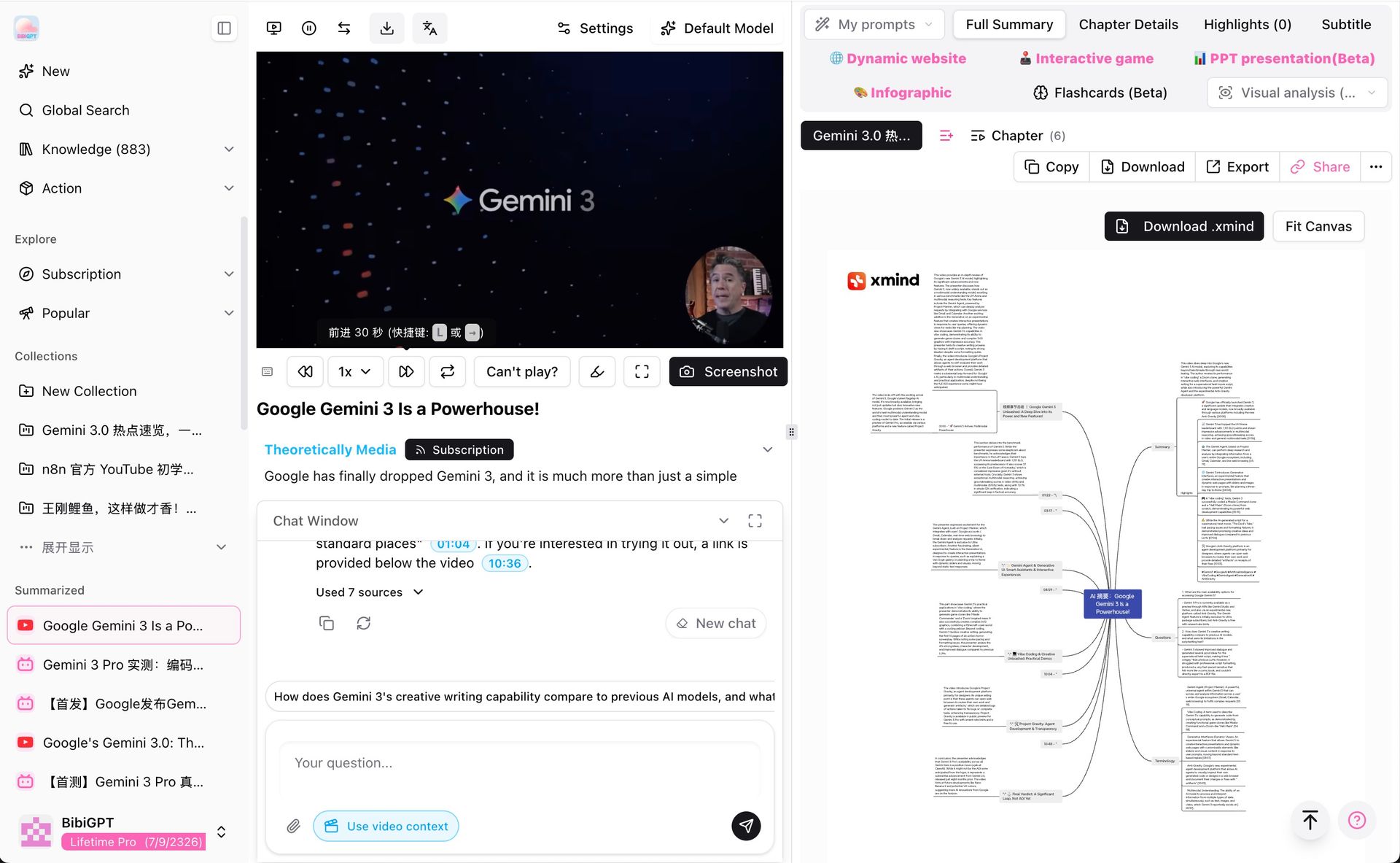 BibiGPT AI video mindmap visual summary 2025
Visual summaries are especially helpful if you:
- Build systematic understanding for exams, certifications, or long-term projects;
- Teach or present to teams and need a clear high-level outline;
- Turn videos into curricula, workshop materials, or reusable learning assets.
Visual Analysis: Understand What's On Screen (2026 New)
This is BibiGPT's major 2026 upgrade: not just hearing the audio, but seeing and understanding the visual content.
BibiGPT's visual analysis (visual content analysis) can:
- Understand charts, PPT slides, whiteboard explanations shown in the video;
- Analyze products, people, and scenes appearing on screen;
- Merge on-screen visual information with audio content for more accurate comprehensive summaries;
- Generate social media images for content creators — Xiaohongshu covers, public account illustrations, and more.
This is especially valuable for technical demo videos (heavy code and diagrams), product launches (on-screen demo understanding), and lectures (whiteboard explanations). Learn more: AI video summary with visual content analysis. You can also explore AI Bilibili summary to see how visual analysis works in practice on Bilibili videos.
Subtitle Translation & Burn-in: Multilingual Accessibility (2026 New)
As of 2026, BibiGPT adds subtitle translation and burn-in capabilities:
- Automatic subtitle translation: translate the video's original subtitle track into your target language (e.g., English video → Chinese subtitles);
- Subtitle burn-in: embed translated subtitles directly into the video file, producing a bilingual-subtitle version;
- Multilingual output: Chinese, English, Japanese, Korean, and more.
For cross-language learners and creators producing multilingual content versions, this is an indispensable capability. Combine with the YouTube subtitle downloader to build a complete multilingual content workflow.
AI Highlight Notes: Extract Key Moments Automatically
Finding the important parts in a long video is tedious when you're manually scrubbing through a timeline. BibiGPT's AI Highlight Notes feature automatically analyzes the video and extracts key insight segments, organized by topic:
- Automatically identifies key information segments across the entire video;
- Intelligently categorizes highlights by theme (e.g., "core arguments", "action items", "data citations");
- Every highlight includes a clickable timestamp for instant playback;
- One-click sharing of highlight clips for team collaboration and social sharing.
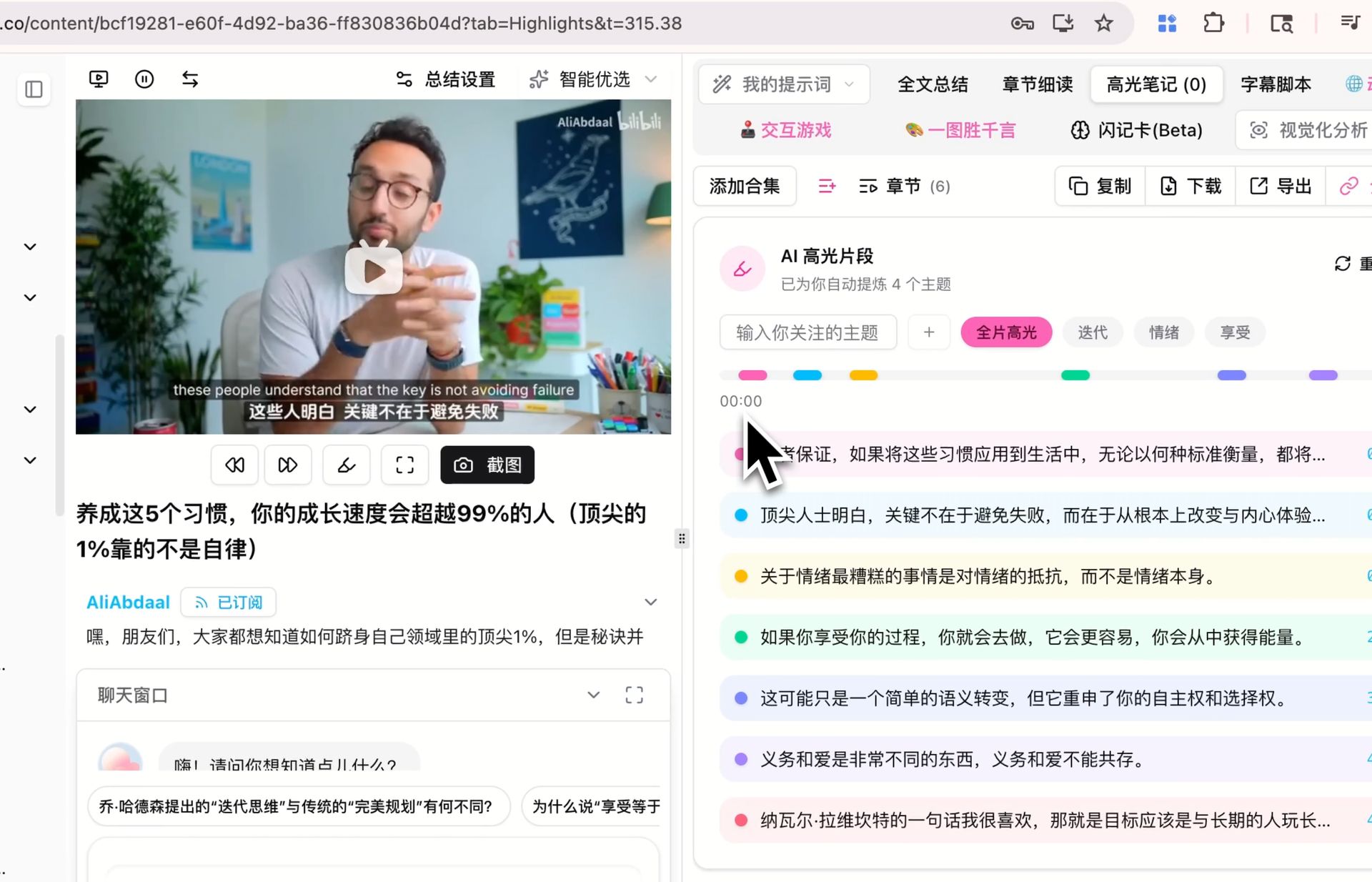 AI Highlight Notes demo
Notes & Knowledge Management: From "I Watched It" to "I Can Use It"
The real value of an AI video summary appears weeks or months later, when you need to revisit or reuse what you’ve learned.
That’s why BibiGPT is built to work hand-in-hand with your note-taking tools:
- Sync summaries and highlights to tools such as Notion, Obsidian, and Readwise;
- Preserve timestamps and links so you can always trace back to the original clip;
- Turn insights into flashcards to support spaced repetition and deep learning.
Over time, this creates a simple division of labor:
- BibiGPT helps you extract and structure knowledge from media.
- Your note system helps you store, search, and connect that knowledge.
- You focus on thinking, deciding, and applying what matters.
看看 BibiGPT 的 AI 总结效果
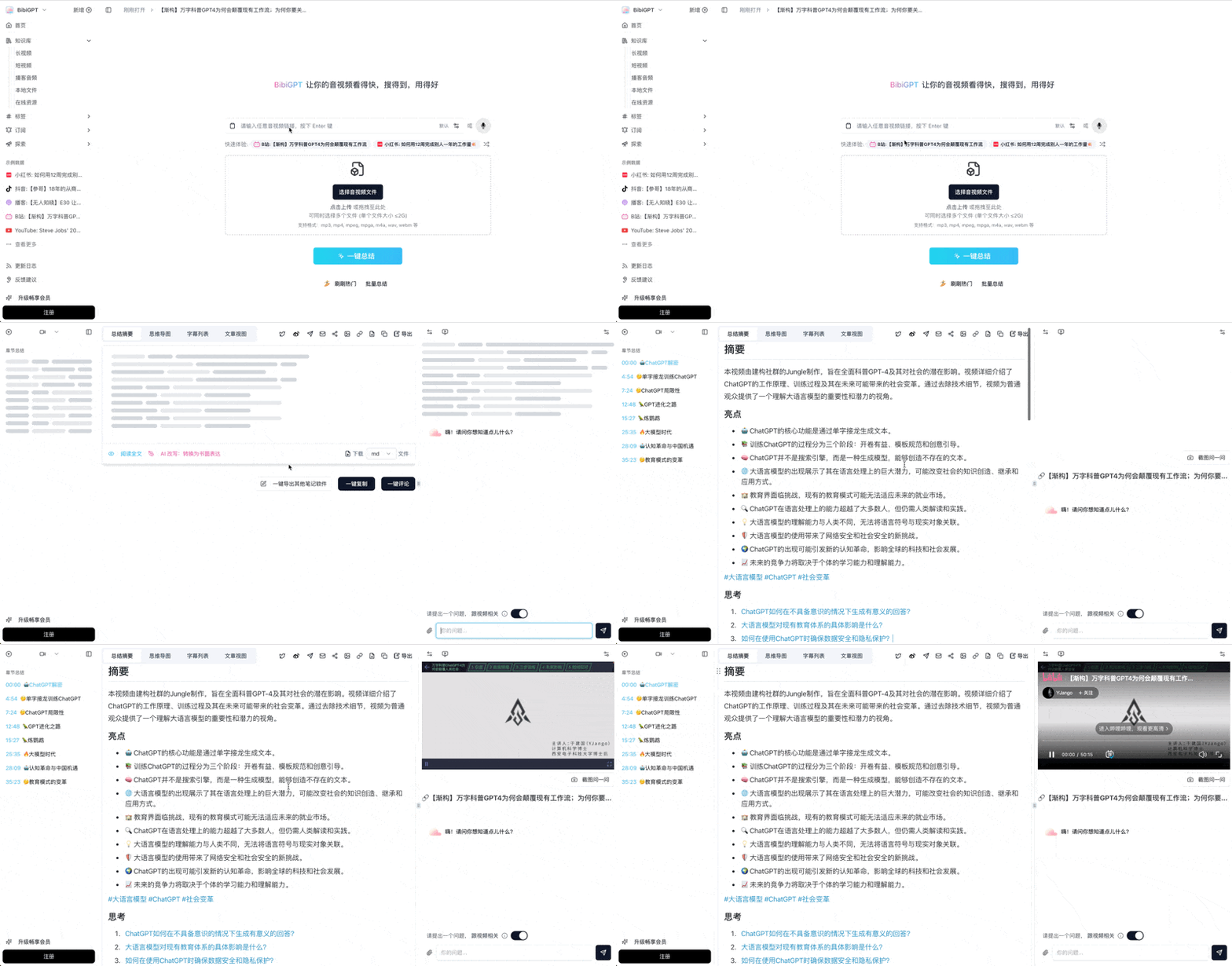
Bilibili: GPT-4 & Workflow Revolution
A deep-dive explainer on how GPT-4 transforms work, covering model internals, training stages, and the societal shift ahead.
A 3-Step Workflow to Learn Faster with AI Video Summaries
If you’re new to BibiGPT, here’s a lightweight workflow you can adopt immediately.
试试粘贴你的视频链接
支持 YouTube、B站、抖音、小红书等 30+ 平台
Step 1: Pick One Piece of Content That Truly Matters
Start with something that’s been sitting on your "I should really watch this" list:
- A course series on Bilibili or YouTube (see our 2026 Bilibili AI video summary guide);
- A dense podcast interview with an expert;
- A Douyin or TikTok video you saved but haven't had time to watch;
- A replay of an internal training or public webinar;
- A long-form talk you’ve wanted to internalise properly.
Step 2: Run It Through BibiGPT Once
- Visit
https://bibigpt.co - Paste the link or upload the file
- Choose a suitable mode (quick or in-depth summary)
- Let BibiGPT generate a structured view
From there, you can:
- Switch to article mode for a narrative recap;
- View mind maps or visual overviews if available;
- Use chat + timestamps to dig into specific questions.
This alone transforms a 60–120 minute video into a 3–10 minute orientation session.
Step 3: Save It Somewhere Your Future Self Will Look
Don’t let insights live only in a browser tab. Instead:
- Push key notes into your knowledge base (Notion, Obsidian, or similar);
- Turn crucial points into flashcards for long-term memory;
- Link summaries to active projects, docs, or planning boards.
You can also reflect briefly:
- What was the core question or theme of this video?
- Which 3–5 points actually matter to you right now?
- What one action will you take based on this content?
This turns AI video summaries from a convenience feature into a consistent learning habit. For a deeper dive into building a structured video note-taking system, read AI video note-taking workflow: from watching to structured knowledge.
FAQ: Common Questions About AI Video Summaries
1. Are AI video summaries accurate enough to trust?
No AI system is perfect, which is why BibiGPT emphasises traceability:
- Summaries keep links to timestamps and source segments whenever possible;
- Chat answers are anchored in the processed content, not generic knowledge;
- You can always jump back to the original recording to verify key claims.
2. Will summarising videos stop me from watching them deeply?
In practice, many users experience the opposite:
- They quickly discard content that isn’t worth their time;
- For truly valuable material, they’re more motivated to watch actively;
- Because summaries and notes exist, revisiting and reusing is far easier.
AI video summaries don’t replace deep work—they help you decide where deep work is worth doing.
3. Is BibiGPT only useful for study-related content?
Not at all. Popular use cases include:
- Work – meeting recordings, trainings, product launches, demos, and debriefs (see How to create meeting minutes from video recordings);
- Creation – interview material, research sources, idea gathering for long-form pieces;
- Life – podcasts, public talks, documentary-style videos, and more.
Any time you think "this is important, but it’s long," BibiGPT can help.
4. Is BibiGPT free? What are the pricing options?
BibiGPT offers a free trial so you can experience core AI video summary features without paying. If you need more uses or advanced features (visual analysis, subtitle burn-in), you can choose a Plus or Pro subscription plan, or pay-as-you-go — use as much or as little as you need.
5. What new features does BibiGPT have in 2026?
As of April 2026, key new capabilities include:
- Visual analysis — understand charts, slides, and whiteboard content in videos;
- Subtitle translation and burn-in — automatically translate and embed multilingual subtitles;
- Auto-translate on upload — pick a target language at upload time and get bilingual summaries out the other side;
- Custom transcription engine — freely switch between OpenAI Whisper and the top-tier ElevenLabs Scribe engine (ideal for professional recorders like Plaud — see our Plaud recorder + BibiGPT workflow guide);
- Native desktop client + folder monitoring — macOS / Windows app with local large-file processing and sync-folder watching, so new screen recordings and cloud drive files queue up automatically;
- Notion / Obsidian / Cubox / Anki export — every summary, highlight note and transcript can be sent to your existing notes and spaced-repetition tools in one click;
- AI image generation — generate social media images (Xiaohongshu covers, etc.) from video content;
- Deep search — search full video subtitle text, not just titles and summaries;
- AI Highlight Notes — automatically extract key video moments organized by topic with timestamps.
If you're a student, teacher or self-learner, pair this guide with our scenario-specific roundup: Best AI Lecture Summarizer Tools 2026.
6. What platforms does BibiGPT support for video summaries?
BibiGPT supports 30+ audio and video platforms, including: YouTube, Bilibili, Douyin, TikTok, Xiaohongshu, Weibo Video, podcast platforms (Apple Podcast, Spotify, etc.), Tencent Video, Youku, and more. You can also upload local video and audio files directly. See AI YouTube video summary and AI Bilibili video summary for platform-specific details.
7. How does AI video summary compare to manual note-taking?
The biggest advantage of AI video summaries is speed and structure: BibiGPT can produce structured summaries, key points, and mind maps from a 1-hour video in seconds, while manual note-taking might take just as long as the video itself. More importantly, every key point comes with timestamps and supports AI chat follow-ups with source tracing, so you can always verify against the original. The two approaches are complementary — use AI for the initial extraction, then add your own reflections and annotations on top.
精选 AI 功能推荐
结合文章主题,为你挑选最适合的 BibiGPT 能力。
Try BibiGPT Today as Your AI Video Summary Assistant
If you’re feeling overwhelmed by videos, replays, and podcasts, now is a good moment to redesign how you learn from media.
BibiGPT aims to be your AI audio & video summary assistant:
- Helping you understand the big picture in minutes;
- Letting you search and revisit important ideas with ease;
- Turning passive watching into active, trackable learning.
Trusted by over 1 million users and with more than 5 million AI summaries generated, BibiGPT in 2026 is more powerful than ever — with visual analysis, subtitle translation, multilingual support, and a growing library of output formats.
Drop in the next lecture, interview, or podcast on your list and let BibiGPT show you what AI video summaries can do:
Start your AI video summary workflow now:
- 🌐 Official Website: https://aitodo.co
- 📱 Mobile Download: https://aitodo.co/app
- 💻 Desktop Download: https://aitodo.co/download/desktop
- ✨ Learn More Features: https://aitodo.co/features