
Bayt Podcast Translation vs BibiGPT: Which Podcast AI Tool Is Right for You?
Bayt translates foreign-language podcasts into Chinese audio with realistic voices. BibiGPT summarizes podcasts across 30+ platforms with AI transcription, mindmaps, and chat. This in-depth comparison helps you choose the right podcast tool.
Bayt Podcast Translation vs BibiGPT: Which Podcast AI Tool Is Right for You?
Have you ever hit play on a foreign-language podcast, understood the keywords, but completely lost the thread of the argument? Studies suggest that non-native listeners retain less than 40% of full content when listening to podcasts in a second language. Two AI tools tackle this problem from opposite angles: Bayt translates podcast audio into Chinese speech, so you can literally hear the content in your language; BibiGPT uses advanced AI to extract transcripts, generate summaries, mindmaps, and enable follow-up chat, letting you grasp a one-hour podcast in 30 seconds.
Quick Answer: Bayt specializes in podcast audio translation to Chinese, positioning itself as an "immersive translation for podcasts." BibiGPT provides comprehensive podcast summarization, transcription, mindmaps, and AI chat across 30+ platforms. One helps you "hear" the content; the other helps you "understand" it deeply.
Table of Contents
- What Is Bayt? Immersive Translation for Podcasts
- BibiGPT Podcast Capabilities Overview
- Feature Comparison: Bayt vs BibiGPT
- Which One Is Right for You? Scenario Guide
- BibiGPT Podcast Tutorial: Step by Step
- Frequently Asked Questions (FAQ)
- Conclusion
What Is Bayt? Immersive Translation for Podcasts
Bayt is an iOS podcast translation app developed by indie developer Wenshuo Cai (baytfm.com). Its tagline is "immersive translation for podcasts," and its core mission is straightforward: take any foreign-language podcast and translate it into Chinese audio using realistic AI voice synthesis.
试试粘贴你的视频链接
支持 YouTube、B站、抖音、小红书等 30+ 平台
Here is what Bayt offers:
- Multi-language podcast translation to Chinese audio: Supports English, Japanese, Korean, and other languages translated into natural-sounding Chinese speech
- Speaker identification: Automatically distinguishes between different speakers, preserving the multi-voice dialogue feel after translation
- Bilingual subtitles: Displays both Chinese and original-language subtitles simultaneously for study-oriented listeners
- Realistic voice synthesis: The translated Chinese audio uses high-quality TTS (text-to-speech) for a natural listening experience
Bayt launched on the App Store in July 2025 and was last updated in November 2025. It holds a 5.00 rating but with only 8 ratings total — indicating a very small user base at an early stage.
The value proposition is clear: if your primary need is to convert foreign-language podcasts into Chinese audio, Bayt provides a direct solution for that specific use case.
BibiGPT Podcast Capabilities Overview
BibiGPT approaches podcasts as part of its broader 30+ platform AI audio-video assistant capability. Unlike Bayt's "translate and listen" approach, BibiGPT's core logic is extracting knowledge from audio-video content — whether it is a podcast, YouTube video, Bilibili clip, or local file, the same unified workflow applies.
Here is what BibiGPT brings to podcast processing:
AI-Powered Summarization
Paste a podcast link, and within 30 seconds you get a structured summary including core arguments, key evidence, and timeline markers. Supports Chinese, English, Japanese, and Korean output. Over 1 million users have generated more than 5 million AI summaries to date.
Full Transcript and Subtitles
Automatically transcribes podcast audio into a complete text transcript, exportable in SRT, TXT, and other formats. Learn more about AI local file speech-to-text.
Mind Maps
One-click generation of interactive mind maps from podcast content, visually mapping the knowledge structure and logical relationships.
AI Chat Follow-Up
Summary not enough? Ask specific questions about the podcast content and get AI answers grounded in the original material. For example: "What are the three core strategies discussed in this episode?"
30+ Platform Coverage
Not just podcasts. BibiGPT supports YouTube, Bilibili, Douyin, TikTok, Xiaohongshu, Ximalaya, and 30+ other platforms, plus local audio/video file uploads. One tool for all your content sources.
Multi-Device Access
Browser extension, desktop app (macOS/Windows), and mobile app (iOS/Android) — process podcast content anytime, anywhere.
Explore BibiGPT's full AI podcast summary feature set.
AI 字幕提取预览
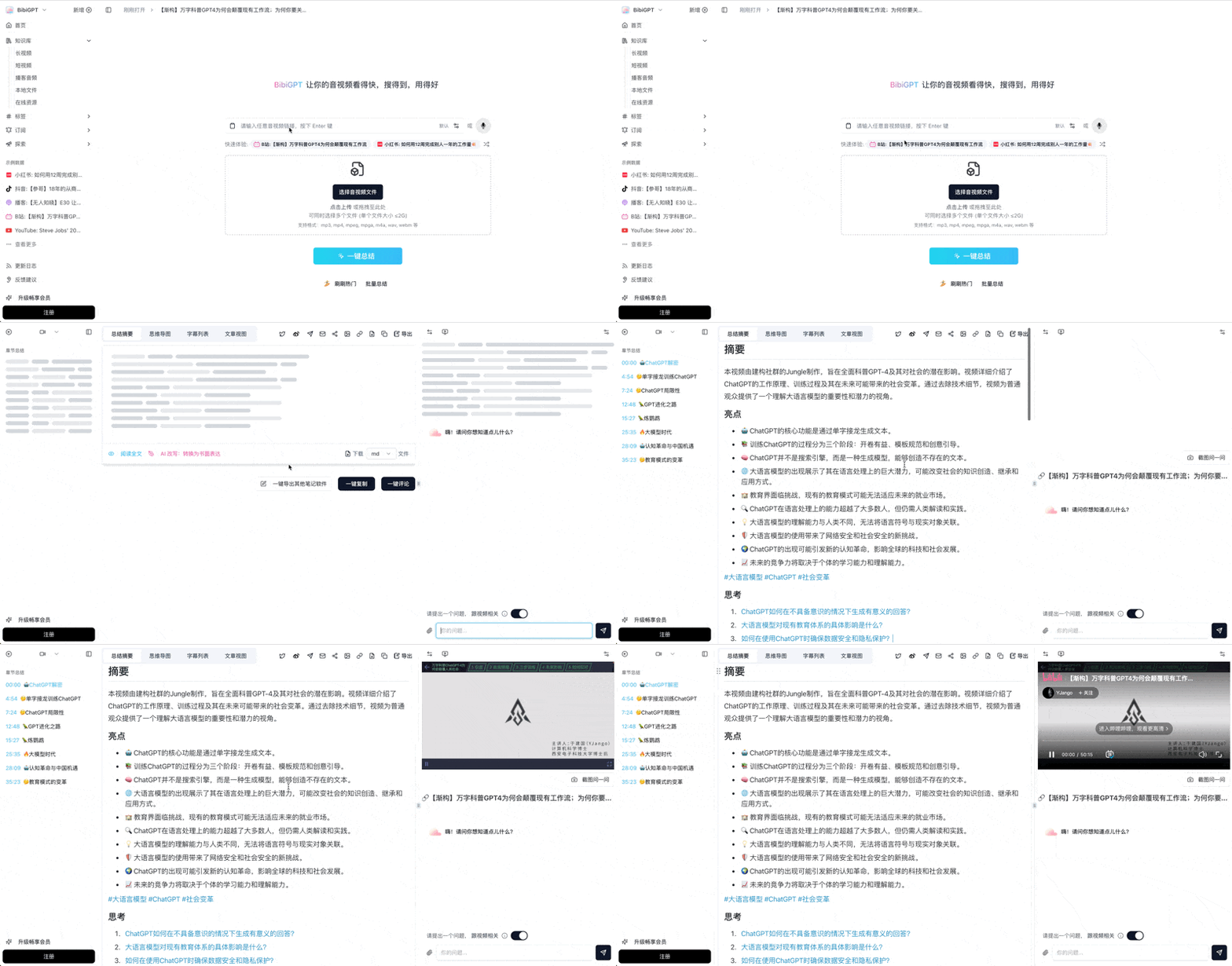
Bilibili: GPT-4 & Workflow Revolution
A deep-dive explainer on how GPT-4 transforms work, covering model internals, training stages, and the societal shift ahead.
Feature Comparison: Bayt vs BibiGPT
| Feature | Bayt | BibiGPT |
|---|---|---|
| Core positioning | Podcast audio translation | Multi-platform AI audio-video assistant |
| Podcast translation to Chinese audio | Yes (core feature) | No (offers subtitle translation) |
| AI content summary | No | Yes (30-second structured summary) |
| Full transcription | Partial (bilingual subtitles) | Yes (full transcript + multi-format export) |
| Mind maps | No | Yes |
| AI chat follow-up | No | Yes |
| Speaker identification | Yes | Yes |
| Platforms supported | Podcast platforms only | 30+ (podcasts, YouTube, Bilibili, etc.) |
| Local file support | No | Yes (MP3, MP4, etc.) |
| Article rewrite | No | Yes |
| Visual analysis | No | Yes |
| Browser extension | No | Yes |
| Desktop app | No | Yes (macOS/Windows) |
| Mobile app | Yes (iOS only) | Yes (iOS/Android) |
| User base | Small (8 ratings) | 1M+ users |
| Multi-language output | Chinese audio | zh/en/ja/ko text |
For a broader landscape of podcast AI tools, see Best AI Podcast Transcription Tools 2026 and Best AI Podcast Summarizer Tools 2026.
Which One Is Right for You? Scenario Guide
Choose Bayt if you:
- Primarily want to "hear" foreign podcasts in Chinese — you prefer audio consumption over reading text summaries
- Mainly listen to English-language podcasts during commutes or workouts and want a passive listening experience in Chinese
- Are comfortable using an early-stage niche tool (small user base means limited community support and slower feature iteration)
- Use iOS exclusively
Choose BibiGPT if you:
- Want to extract key insights fast — grasp an hour-long podcast in 30 seconds through AI summaries
- Consume content across multiple platforms (YouTube, Bilibili, podcasts, TikTok, Xiaohongshu, etc.)
- Need deep analysis capabilities: mind maps, AI chat follow-up, article rewrite
- Have knowledge management needs — syncing podcast notes to Notion, Obsidian, or similar tools
- Create content and need to repurpose podcast material into articles, videos, or social posts
- Use Android, Windows, or the web (Bayt is iOS-only)
Recommendation for most users: If your knowledge intake spans podcasts, videos, and articles across platforms, BibiGPT's comprehensive toolset delivers a significantly higher return on your time investment. If you have a very specific need to listen to translated Chinese versions of foreign podcasts, Bayt is a solid niche solution.
Also see OpenAI Audio API vs BibiGPT for more AI audio processing comparisons.
BibiGPT Podcast Tutorial: Step by Step
Processing a podcast with BibiGPT takes just three steps:
Step 1: Get the Podcast Link
Copy the episode link from your preferred podcast platform — Apple Podcasts, Spotify, Ximalaya, Google Podcasts, or any supported source.
Step 2: Paste and Summarize
Open BibiGPT (web, desktop, or mobile app) and paste the link. The AI engine processes the content within 30 seconds:
- Automatically extracts audio and transcribes it into a full text transcript
- Generates a structured content summary (core arguments, key evidence, timeline markers)
- Optionally generates an interactive mind map
Step 3: Go Deeper
- AI chat follow-up: Ask specific questions about the podcast content and receive answers grounded in the original transcript
- Export notes: One-click sync to Notion, Obsidian, or export as Markdown and PDF
- Content creation: Use the article rewrite feature to transform podcast highlights into blog posts, social media content, or newsletters
The entire workflow takes under a minute, turning every podcast episode into a reusable knowledge asset.
Frequently Asked Questions (FAQ)
Q1: Can I use Bayt and BibiGPT together?
Yes. They solve different problems — Bayt addresses the "hearing comprehension" problem by translating audio into Chinese speech, while BibiGPT addresses the "knowledge extraction" problem by summarizing, transcribing, and enabling interactive analysis. Using both together covers the full spectrum from passive listening to active knowledge work.
Q2: What podcast platforms does BibiGPT support?
BibiGPT supports 30+ mainstream platforms including Apple Podcasts, Spotify, Google Podcasts, Ximalaya, and Xiaoyuzhou for podcasts. It also supports YouTube, Bilibili, TikTok, Douyin, Xiaohongshu, and more. You can also upload local audio files (MP3, M4A, etc.) directly.
Q3: How good is Bayt's translation quality?
Bayt uses AI voice synthesis to convert translated content into Chinese audio with speaker identification to preserve multi-voice conversations. However, as with any machine translation plus TTS pipeline, accuracy may suffer with domain-specific terminology or highly nuanced discussions. Its 5.00 App Store rating is based on only 8 ratings, so the sample size is very small.
Q4: How accurate are BibiGPT's podcast summaries?
BibiGPT uses advanced AI technology for speech recognition and intelligent summarization. For most podcast formats — interviews, knowledge sharing, news commentary — summary accuracy is high. Results include timeline markers so you can jump to the original audio for verification. Over 1 million users and 5 million+ summaries have validated this capability at scale.
Q5: Which tool offers better value for money?
Bayt is a niche iOS-only app with a very small user base, so long-term service stability and iteration speed are uncertain. BibiGPT has served over 1 million users with 5 million+ AI summaries generated, offers a free trial tier, and has paid plans covering individual users through enterprise API customers — its reliability is battle-tested at scale.
Q6: Can BibiGPT translate podcast audio into spoken Chinese?
BibiGPT currently offers subtitle and text translation (supporting zh/en/ja/ko output) but does not generate translated audio with voice synthesis. If your core need is specifically to "listen to foreign podcasts in Chinese," that is genuinely Bayt's differentiator. BibiGPT's strength lies in more comprehensive content understanding and knowledge extraction.
Conclusion
Bayt and BibiGPT represent two distinct philosophies for consuming foreign-language podcasts. Bayt lets you "hear a Chinese version of a foreign podcast." BibiGPT lets you "grasp the essence of an hour-long podcast in 30 seconds." One prioritizes immersive audio experience; the other prioritizes efficiency and deep analysis.
For most users who need to efficiently process multi-platform content, manage knowledge, and create derivative content, BibiGPT's comprehensive capabilities deliver a higher return on investment. Try BibiGPT's podcast AI features today and turn every episode into a lasting knowledge asset.
Start your AI efficient learning journey now:
- 🌐 Official Website: https://aitodo.co
- 📱 Mobile Download: https://aitodo.co/app
- 💻 Desktop Download: https://aitodo.co/download/desktop
- ✨ Learn More Features: https://aitodo.co/features