
NotebookLM vs BibiGPT 2026: Which AI Video Summary Tool Is Better?
A comprehensive 2026 comparison of NotebookLM and BibiGPT across 7 dimensions: platform coverage, Chinese support, podcast summarization, AI chat, export options, pricing, and mobile apps. Find out which AI video summary tool fits your needs.
NotebookLM vs BibiGPT 2026: Which AI Video Summary Tool Is Better?
Table of Contents
- Quick Verdict
- What's New in NotebookLM 2026?
- BibiGPT Core Advantages — Why It's the Best NotebookLM Alternative
- 7-Dimension Detailed Comparison
- Real-World Scenario Comparison — Which One Suits You?
- FAQ
- Conclusion
Quick Verdict
Bottom line: If you primarily work with English content, only use YouTube and Google Drive, and want a free tool, NotebookLM is a solid choice. But if you need multi-platform video summarization covering YouTube, Bilibili, TikTok, Douyin, podcasts, and more — BibiGPT is the more comprehensive AI video summary tool in 2026.
NotebookLM vs BibiGPT at a glance:
- Platform coverage: BibiGPT supports 30+ platforms (YouTube, Bilibili, Douyin, TikTok, Xiaohongshu, podcasts, etc.) vs. NotebookLM's 3 (YouTube, Google Drive, web links)
- Chinese support: BibiGPT is deeply optimized for Chinese ASR and summarization; NotebookLM is English-first
- AI chat: BibiGPT offers video-grounded Q&A with timestamp tracing; NotebookLM's Interactive Audio Mode converts documents into podcast-style audio
- Pricing: NotebookLM is free; BibiGPT has a free tier plus Plus/Pro subscriptions
- Trusted by over 1 million users with over 5 million AI summaries generated
试试粘贴你的视频链接
支持 YouTube、B站、抖音、小红书等 30+ 平台
What's New in NotebookLM 2026?
Short answer: NotebookLM shipped three major upgrades in 2026 — a 1M token context window, Interactive Audio Mode, and Custom Personas. These make it a much stronger research assistant, but the improvements are centered on documents and English-language workflows.
1M Token Context Window
Powered by Gemini 2.5, NotebookLM now handles up to 1 million tokens of context. This means you can upload dozens of research papers or lengthy reports and analyze them simultaneously. For academic researchers juggling multiple sources, this is a game-changer.
However, a larger context window doesn't translate into better audio/video understanding. If your goal is to summarize a Bilibili creator's 2-hour lecture or a Chinese podcast episode, NotebookLM still can't process those sources directly.
Interactive Audio Mode
NotebookLM's headline feature converts your uploaded documents into a "podcast-style" conversation between two AI hosts. The 2026 upgrade lets you interrupt and ask questions during playback, creating a genuinely interactive listening experience.
This is excellent for auditory learners who want to review materials during commutes. But notice the direction: NotebookLM turns text into audio. BibiGPT goes the opposite way — turning audio and video into structured text and knowledge artifacts. They solve fundamentally different problems.
Custom Personas
You can now assign custom personas to Audio Overview hosts — for example, having them discuss your materials as industry analysts or academic reviewers. This adds a layer of perspective that's useful for deep research.
BibiGPT Core Advantages — Why It's the Best NotebookLM Alternative
Short answer: BibiGPT leads NotebookLM in platform coverage (30+ vs. 3), Chinese-language support, and native audio/video processing — making it the go-to choice for anyone searching for a "NotebookLM alternative."
30+ Platform Coverage — No More "Unsupported"
This is the fundamental differentiator. NotebookLM supports only YouTube videos, Google Drive uploads, and web links. BibiGPT supports 30+ mainstream platforms:
- Global: YouTube, TikTok, Twitter Spaces, and more
- China: Bilibili, Douyin, Xiaohongshu, WeChat Channels
- Podcasts: Apple Podcast, Spotify, Xiaoyuzhou, and 9 podcast platforms total
- Local files: Upload your own audio/video files
If you're searching for a "NotebookLM alternative," it's likely because NotebookLM doesn't support the platform you need. BibiGPT was built to solve exactly this problem.
Audio/Video-Native Architecture
NotebookLM's core is built around documents: upload docs → AI analyzes → generate summaries/audio. Video is an add-on.
BibiGPT was designed for audio/video from day one:
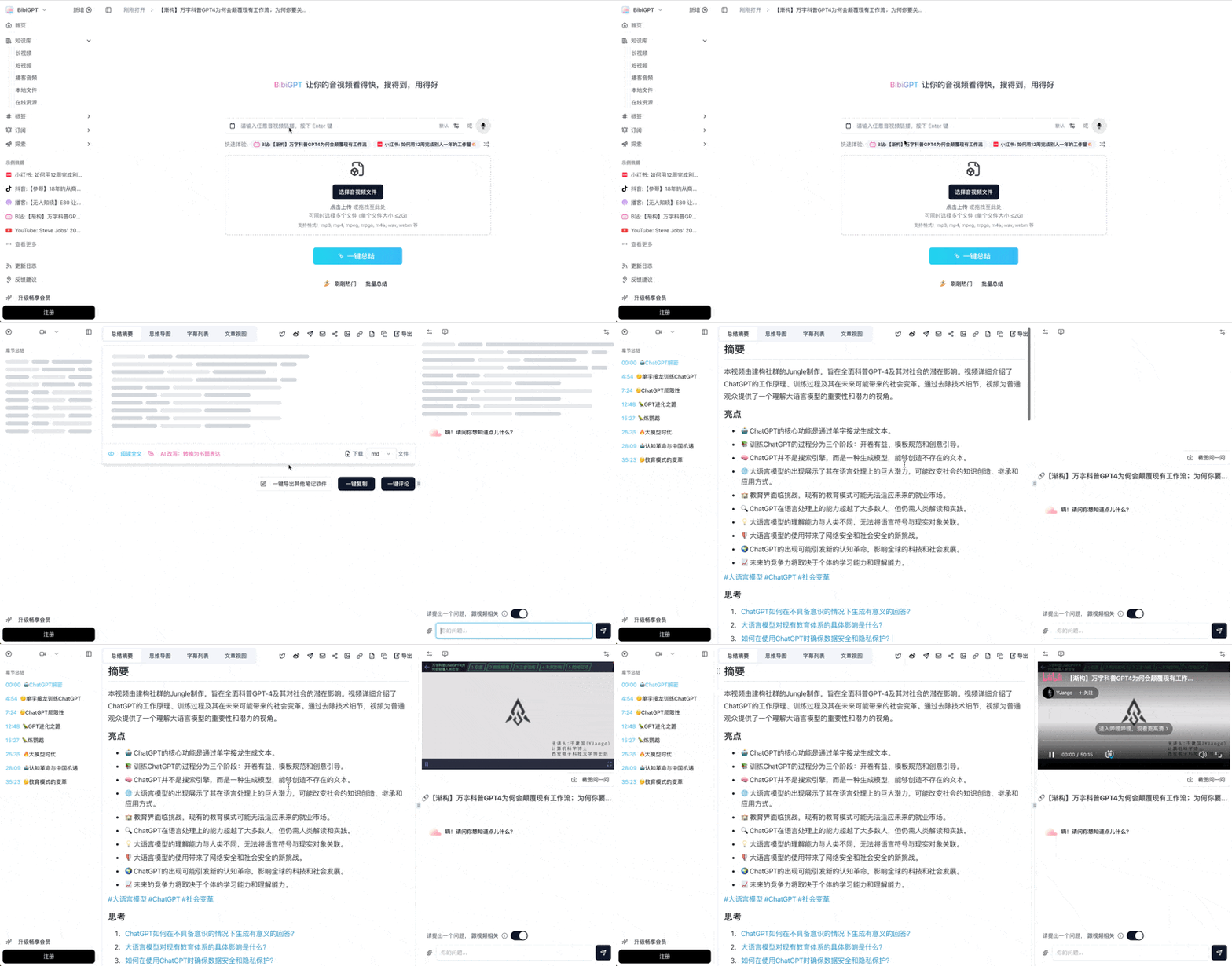
- Side-by-side video and transcript view — click any line to jump to the exact timestamp
- AI video chat traces answers back to specific seconds in the video, not just text
- Mind maps, flash cards, and other knowledge artifacts for different learning styles
- Subtitle extraction with multi-language download support
Deep Chinese Language Optimization
BibiGPT has a natural advantage in Chinese-language scenarios:
- Automatic Chinese ASR (speech recognition) for audio/video content
- AI summaries deeply optimized for Chinese linguistic patterns
- Multilingual UI (Chinese, English, Japanese, Korean)
- Deep integration with Chinese platforms (Bilibili, Douyin, Xiaohongshu, Xiaoyuzhou)
While NotebookLM accepts Chinese document uploads, its design and optimization are English-first. The Chinese audio/video experience is noticeably weaker compared to BibiGPT.
7-Dimension Detailed Comparison
Short answer: The table below breaks down the key differences across 7 critical dimensions to help you make an informed decision.
| Dimension | NotebookLM | BibiGPT | Winner |
|---|---|---|---|
| Platform support | 3 (YouTube, Google Drive, web links) | 30+ (YouTube, Bilibili, Douyin, TikTok, Xiaohongshu, podcasts, etc.) | BibiGPT |
| Chinese support | Basic Chinese, English-optimized | Deep Chinese optimization with native ASR and platform integration | BibiGPT |
| AI chat | Interactive Audio Mode (docs → audio conversation) | AI video chat (question videos, trace to timestamps) | Tie |
| Podcast support | No native support; requires manual audio upload | 9 podcast platforms via paste-a-link (Xiaoyuzhou, Apple Podcast, etc.) | BibiGPT |
| Export options | Text summaries, audio export | Markdown, mind maps, flash cards, article rewrite, subtitle files | BibiGPT |
| Pricing | Free | Free tier + Plus/Pro subscriptions | NotebookLM |
| Mobile | Web-responsive | Native iOS/Android apps + browser extension + desktop client | BibiGPT |
Summary: NotebookLM wins on pricing and Gemini 2.5's powerful document analysis. BibiGPT wins on audio/video platform coverage, Chinese optimization, and a full product suite across devices. Your choice depends on your primary use case.
看看 BibiGPT 的 AI 总结效果
Let's build GPT: from scratch, in code, spelled out
Andrej Karpathy walks through building a tiny GPT in PyTorch — tokenizer, attention, transformer block, training loop.
Real-World Scenario Comparison — Which One Suits You?
Short answer: Students benefit from NotebookLM's free research capabilities. Working professionals and content creators are better served by BibiGPT's multi-platform coverage and knowledge artifact generation.
Scenario 1: Students — Research and Course Learning
Choose NotebookLM if:
- Budget is a constraint — it's completely free
- You need to analyze multiple academic papers simultaneously (1M token context)
- Interactive Audio Mode helps you review materials during commutes
Choose BibiGPT if:
- You watch educational content on Bilibili or Chinese platforms
- You want to convert video lectures into mind maps or flash cards
- You need to process Chinese academic talks or podcasts
Recommendation: For English YouTube tutorials and PDF papers, NotebookLM is sufficient. If you also follow Chinese knowledge platforms, BibiGPT is the better pick.
Scenario 2: Professionals — Meeting Notes and Industry Research
Choose BibiGPT if:
- You need to upload meeting recordings and generate instant summaries
- You watch industry conference replays on both Bilibili and YouTube
- AI chat helps you drill deeper into meeting content
- Markdown export syncs directly to Notion or Obsidian
Choose NotebookLM if:
- You need to cross-analyze multiple industry reports (PDFs)
- Custom Personas provide industry-specific perspectives on materials
Recommendation: Professionals typically deal with diverse content sources (video replays, podcasts, documents). BibiGPT's multi-platform coverage provides a clear advantage.
Scenario 3: Content Creators — Topic Research and Production
Choose BibiGPT if:
- You need to batch-analyze competitor videos for viral patterns
- You want to transform long videos into articles, social posts, and other repurposed content
- The free video summarizer lets you explore with zero cost
- You work with Douyin, TikTok, and Xiaohongshu — platforms creators use daily
Choose NotebookLM if:
- You need deep multi-document research on a specific topic
- Audio Overview can inspire podcast content creation
Recommendation: Content creators almost always need multi-platform support, making BibiGPT the clear winner in this scenario.
FAQ
Is NotebookLM free? What about BibiGPT?
NotebookLM is currently completely free, backed by Google. BibiGPT offers a free tier for trial use, with advanced features available through Plus or Pro subscription plans. Both let you experience core functionality before committing.
Can NotebookLM summarize Bilibili videos?
No. NotebookLM currently only supports YouTube videos, Google Drive uploads, and web links. Videos from Bilibili, Douyin, Xiaohongshu, TikTok, and similar platforms require third-party tools like BibiGPT.
What's the difference between BibiGPT's AI chat and NotebookLM's Interactive Audio Mode?
They solve different problems. BibiGPT's AI chat lets you ask questions based on video content, with answers traced to specific timestamps for quick reference. NotebookLM's Interactive Audio Mode converts documents into a two-host podcast-style conversation that you can interrupt with questions — ideal for auditory learning during commutes.
Can I use NotebookLM and BibiGPT together?
Absolutely — many users already do. An efficient workflow: use BibiGPT to process audio/video content (Bilibili courses, YouTube tutorials, podcasts), generate structured summaries, then import those summaries into NotebookLM for cross-document analysis. The combination covers the full knowledge workflow from audio/video to documents.
What platforms does BibiGPT support?
BibiGPT supports 30+ mainstream audio and video platforms, including YouTube, Bilibili, Douyin, TikTok, Xiaohongshu, WeChat Channels, Twitter Spaces, Xiaoyuzhou, Apple Podcast, Spotify, Google Podcast, Himalaya, and more. Local audio/video file uploads are also supported. See the full list at aitodo.co.
Conclusion
NotebookLM and BibiGPT are both excellent AI knowledge tools in 2026, but they have fundamentally different design philosophies. NotebookLM is a document-centric research assistant powered by Gemini 2.5's deep understanding. BibiGPT is an audio/video-native knowledge assistant with 30+ platform coverage, deep Chinese optimization, and apps across every device.
If your core need is multi-platform audio/video summarization — especially for Chinese-language content — BibiGPT is the better choice.
Try BibiGPT now: aitodo.co — Paste any audio/video link and get an AI summary instantly.