
Sora 2 Video API Makes Video Creation Nearly Free — How BibiGPT AI Video Summarizer Handles the Content Flood (2026)
OpenAI's Sora 2 Video API is now live, making AI video generation nearly free. As video content explodes, BibiGPT AI video summarizer helps you extract knowledge from any video in 30 seconds with Agent skills, AI video chat, collection summaries, and flashcards.
Sora 2 Video API Makes Video Creation Nearly Free — How BibiGPT AI Video Summarizer Handles the Content Flood (2026)
On March 12, 2026, OpenAI officially launched the Sora 2 Video API for all developers — anyone can now generate, edit, and batch-manage professional-grade videos with just a few lines of code. When creating a video costs virtually nothing, the amount of video content you need to process will grow exponentially. BibiGPT, as an all-platform AI video summarizer, converts any video into structured notes in 30 seconds — making it an essential tool for the AI video explosion era.
What Does the Sora 2 Video API Do? Why Video Creation Barriers Just Disappeared
Core answer: The Sora 2 Video API offers text-to-video generation, video extension, and batch production capabilities at just $0.10 per second, bringing both technical and cost barriers to video creation to historic lows.
As reported by TechCrunch on March 12, 2026, the Video API is now open to all developers. Here is what it enables:
- Text-to-Video: Generate HD videos from text descriptions, supporting 720P and 1080P
- Video Extension and Editing: Extend, modify, and restyle existing videos programmatically
- Batch Production: Developers can make concurrent API calls for industrial-scale content output
- Ultra-Low Cost: Standard tier at $0.10/second — a 10-second video costs under $1
Previously, producing professional video required cameras, editing software, and skilled personnel. Now a single developer can achieve the same with a few lines of code. A 10-person content team that produced 3 videos per week can now output 30 or more.
This is not just an API launch — it is the watershed moment for AI video content production.
The Video Content Explosion: An Unavoidable Information Tsunami
Core answer: YouTube already receives over 500 hours of video uploads every minute (YouTube official data, 2026). The proliferation of AI video generation tools will push this number even higher, creating unprecedented information overload for content consumers.
Video content explosion is not new, but the industrialization of AI video generation is pushing the problem to an entirely new scale:
- Creator Output Doubles: AI-assisted production cuts video creation cycles from days to hours, dramatically increasing upload frequency
- AI-Native Content Floods In: Businesses and individual developers batch-generate tutorials, product demos, and news briefings via API
- Multi-Platform Simultaneous Growth: YouTube, Bilibili, TikTok, podcasts — content velocity is accelerating across every platform
"My AI learning subscriptions went from 1 video per week to 3 per day, but I still only have 1 hour of commute time."
Existing tools like NotebookLM primarily handle documents and have very limited video coverage. What you need is a purpose-built AI video summarizer — and that is exactly what BibiGPT was designed to be.
How BibiGPT Helps You Extract Knowledge from the Video Flood
Core answer: BibiGPT provides four core capabilities — bibigpt-skill (Agent automated summarization), AI video chat (timestamped source tracing Q&A), collection summaries (one-click series knowledge overview), and flashcards (video-to-Anki knowledge internalization) — creating a complete pipeline from video consumption to knowledge retention.
BibiGPT has saved over 5 million users an average of 28 minutes per video session (as of March 2026). In the video flood triggered by Sora 2, these four features keep you ahead:
bibigpt-skill: Let AI Agents Auto-Summarize Videos
When video content grows at API speed, your consumption capacity needs automation too. BibiGPT Agent Skill lets your AI Agent (whether OpenClaw, Claude Code, or other platforms) directly invoke BibiGPT's summarization power:
- One Command Summary: Agents use the
bibiCLI tool to automatically complete video summaries - All-Platform Coverage: YouTube, Bilibili, TikTok, podcasts — Agents can batch-process everything
- Zero Manual Intervention: Once configured, the Agent automatically digests new content and generates structured notes
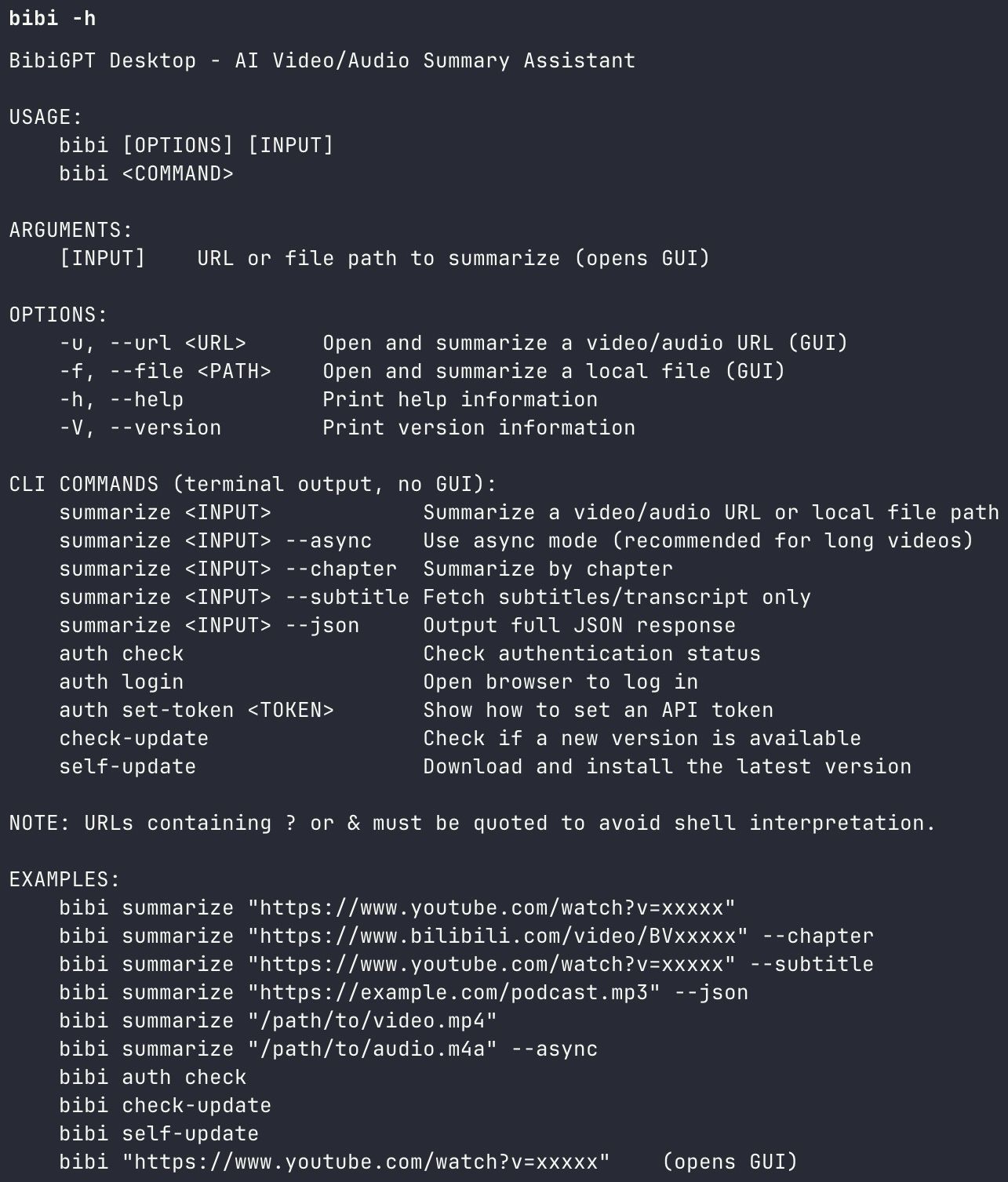 BibiGPT Agent Skill CLI
Want to learn how to automate your video learning workflow with AI Agents? Read our OpenClaw + BibiGPT Agent Skill practical guide.
AI Video Chat with Source Tracing: Talk to Your Videos
After watching a 30-minute tutorial, you might have 10 specific questions. AI Video Chat lets you ask questions directly to the video:
- Timestamped Answers: Every answer includes clickable timestamps — hover to preview the source text
- Traceable Sources: View all video source segments the AI referenced, ensuring accuracy
- Smart Question Suggestions: AI automatically recommends 3 deep-dive questions related to the video
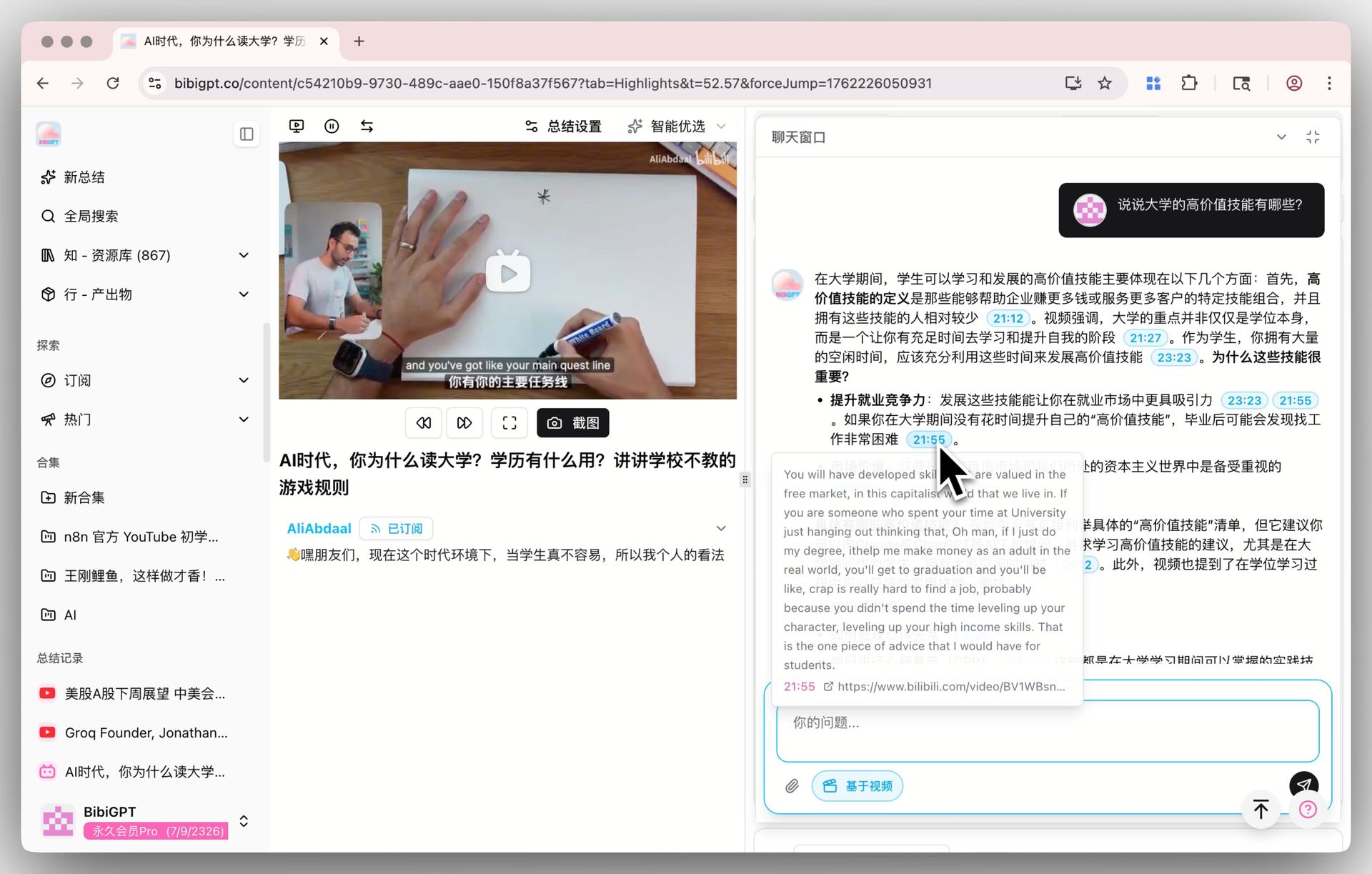 AI Video Chat Source Tracing Demo
No more scrubbing through the timeline — just ask the video directly.
Collection Summary: Master an Entire Series at a Glance
When a topic spans a dozen videos (like an AI course or tutorial series), you need a global perspective, not individual summaries:
- One-Click Collection Summary: Generate a structured overview based on all videos in a collection
- Clickable Citation Backtracking: Each summary point links precisely to its source video
- Mind Map Visualization: Generate detailed mind maps that connect the knowledge threads across the series
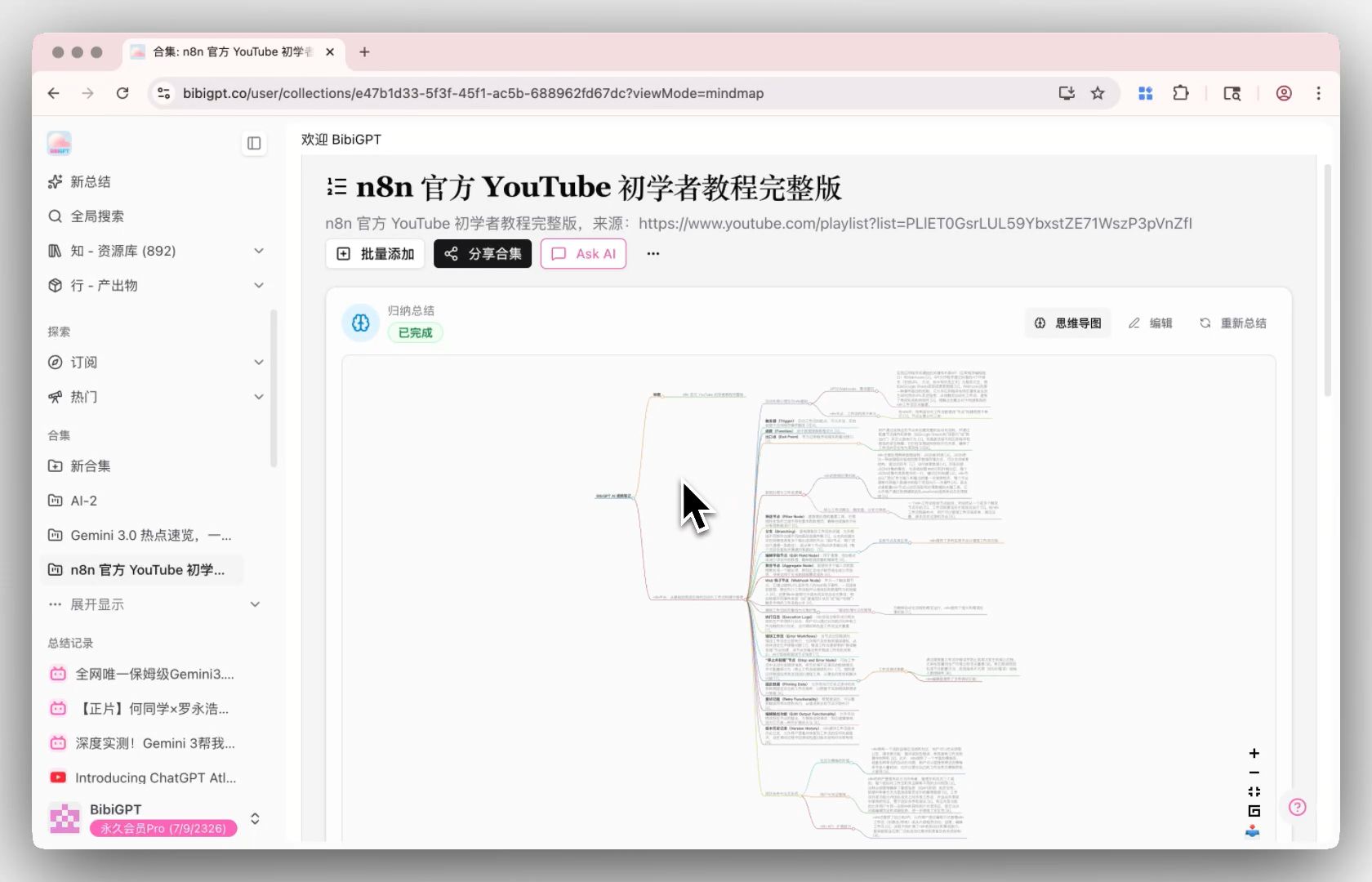 Collection Summary Mind Map
This feature is particularly valuable when AI-generated tutorial series start appearing in bulk — the video collection AI summary feature helps you grasp the full picture in minutes.
Flashcards: From Video to Anki — True Knowledge Internalization
Watching a video is step one; actually retaining the knowledge is what matters. Flashcards turn video knowledge into reviewable Q&A cards:
- Auto-Generated Q&A Cards: Automatically extract core knowledge points from video content
- In-App Interactive Review: Flip cards, use keyboard shortcuts, annotate difficulty and concepts
- One-Click CSV Export: Import directly into Anki or other spaced repetition tools for long-term retention
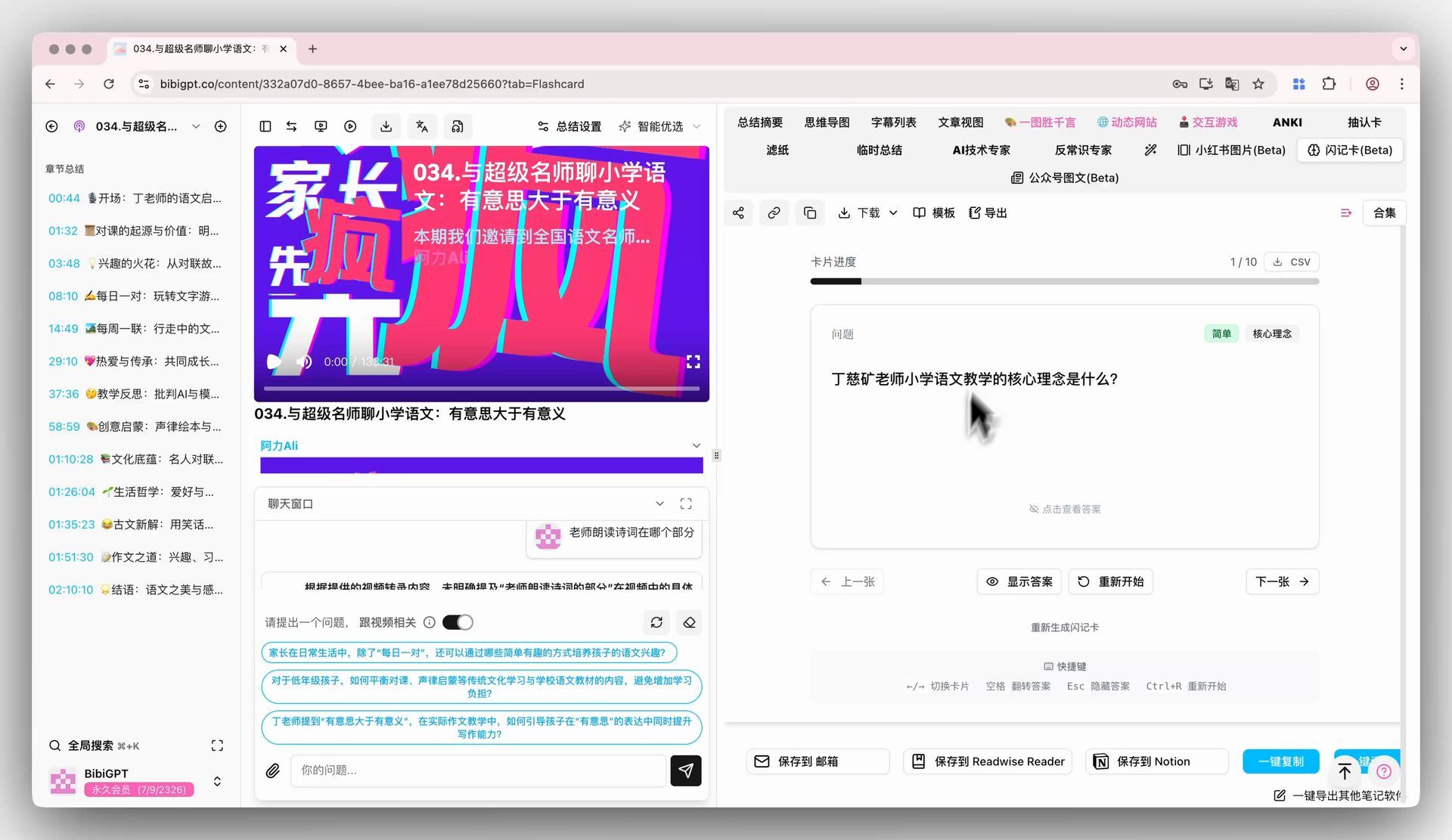 Flashcard Q&A Interface
Research in cognitive science shows that active recall improves long-term memory retention to 80% (source: Cognitive Psychology, 2024). Combined with BibiGPT flashcards, every video becomes a knowledge asset you truly own. Learn more about active recall for video learning in our Feynman technique + BibiGPT active recall guide.
BibiGPT vs NotebookLM: The Differentiated Advantage of AI Video Summarizers
Core answer: Compared to document-oriented tools like NotebookLM, BibiGPT offers significantly differentiated capabilities in all-platform video coverage, Agent automation skills, flashcards, and collection summaries — purpose-built for video learners.
| Capability | BibiGPT | NotebookLM |
|---|---|---|
| Video Platform Coverage | YouTube, Bilibili, TikTok, podcasts, local files | YouTube links only |
| AI Agent Skills | Supports OpenClaw / Claude Code automation | Not supported |
| AI Video Chat | Timestamped source tracing, verifiable citations | Document chat only |
| Collection Summary | Cross-video structured overview + mind maps | Not supported |
| Flashcards | Auto-generate + export Anki CSV | Not supported |
| Video-to-Article | One-click illustrated article generation | Not supported |
| AI Podcast Summarizer | Comprehensive support | Limited support |
If your primary information source is video rather than documents, BibiGPT is the more native and efficient choice. For more AI video summarizer comparisons, see our best AI audio-video summary tool guide for 2026.
From Sora 2 to BibiGPT: The Complete AI Video Ecosystem Loop
Core answer: Sora 2 solves the video "generation" problem; BibiGPT solves the video "digestion" problem — together they form the complete AI video ecosystem loop: Generate, Consume, Internalize.
The AI video ecosystem is forming a three-layer architecture:
- Generation Layer: Sora 2 Video API and similar tools drive video creation costs toward zero
- Consumption Layer: AI video summarizers like BibiGPT help users efficiently digest massive content volumes
- Internalization Layer: Flashcards combined with active recall methods convert video knowledge into long-term memory
In this loop, the more powerful the generation side becomes, the more urgent the consumption side needs become. When tens of thousands of AI-generated videos flood every platform daily, having an efficient AI video knowledge extraction tool is no longer a luxury — it is a necessity.
This is also why BibiGPT supports AI Agent skill-based automated video summarization — in an API-driven video explosion era, your content digestion needs API-level efficiency too.
Conclusion
The Sora 2 Video API launch marks the shift of AI video generation from experiment to industrial-scale production. For content consumers, this is not a moment to wait and see — it is a signal to upgrade your information processing tools immediately. BibiGPT delivers the complete solution through bibigpt-skill automated summarization, AI video chat with source tracing, collection summaries, and flashcards — keeping you efficient in the era of video content explosion.
Start your AI efficient learning journey now:
- 🌐 Official Website: https://aitodo.co
- 📱 Mobile Download: https://aitodo.co/app
- 💻 Desktop Download: https://aitodo.co/download/desktop
- ✨ Learn More Features: https://aitodo.co/features
BibiGPT Team