
xAI Imagine Video Ships + Sora Shuts Down: Do You Still Need BibiGPT AI Video Summary? 2026
xAI Imagine Video launches inside Grok and hits the top of public leaderboards; OpenAI Sora shuts down. AI video generation is exploding — where does BibiGPT's cross-platform AI video summary fit? 2026 landscape.
xAI Imagine Video Ships + Sora Shuts Down: Do You Still Need BibiGPT AI Video Summary? 2026
Table of Contents
- One-Line Answer
- What Happened This Week In AI Video Generation
- More Generation = More Demand For Summaries
- Cross-Platform AI Video Summary: BibiGPT's Neutral Position
- Three Practical Scenarios
- FAQ
One-Line Answer
With xAI Imagine Video shipping inside Grok subscriptions and OpenAI Sora shutting down, AI video generation goes from "OpenAI dominant" to a multi-player race: Grok, Gemini Veo, Runway, Luma, CapCut Seedance, Kling. The more AI video content gets generated, the more users need a cross-platform summary tool to turn it into searchable, reusable notes and artifacts — which is exactly where BibiGPT sits. The hotter the generation side, the steadier the value of the consumption side.
试试粘贴你的视频链接
支持 YouTube、B站、抖音、小红书等 30+ 平台
What Happened This Week In AI Video Generation
Core answer: According to llm-stats.com AI News, xAI Imagine Video launched inside the Grok ecosystem and rapidly topped public video generation leaderboards. In parallel, OpenAI Sora announced a public shutdown, forcing creators to migrate. Combine with Google Gemini Veo 3.1, Kling 3.0, Runway, Luma, and ByteDance Seedance 2.0 — now integrated into CapCut — and you have a genuine multi-model race.
1. xAI Imagine Video: Generation Bundled Into Grok
xAI folded video generation into the Grok subscription. Users stop bouncing between standalone video sites and can now produce short clips inside chat.
2. Sora Shutdown → Creator Migration
Sora's shutdown forces every user who grew up on text-to-video to switch platforms. That accelerates fragmentation — each competitor has its own UI, style, audio, and duration limits.
3. CapCut Plugs In ByteDance Seedance 2.0
CapCut is the dominant global editor; Seedance 2.0 integration means ordinary creators can generate AI assets inside their editing workflow. Expect AI video content to spill further into TikTok, Bilibili, Xiaohongshu, and Douyin as second-hop surfaces.
4. YouTube Shorts Opens Up AI-Generated Creator Likenesses
YouTube has announced that Shorts will support AI-generated creator likenesses alongside the NO FAKES Act stance — "AI generated" is becoming a default capability on major platforms.
More Generation = More Demand For Summaries
Core answer: As generation capability spreads, the volume of AI video content each user sees every day grows, but the average value per clip drops. The need to "quickly judge whether a video is worth watching" becomes more acute. BibiGPT's 30-second structured summary, timestamped transcript, and mind map are purpose-built for this information overload.
1. Content Explosion: Daily Volume Jumps By Orders Of Magnitude
With Grok / Veo / Kling / Seedance live in parallel, public video production steps up sharply. Watching everything is impossible and unnecessary.
2. Signal-To-Noise Drops: AI Content Quality Varies
AI-generated videos range from viral masterpieces to "generated because I could" filler. A generation + summary coordinated workflow is the active strategy to keep your signal high.
3. Neutral Cross-Platform Knowledge Base
No video generation platform wants to help you summarize competitors' videos. BibiGPT, as a neutral third party, accepts YouTube / Bilibili / TikTok / Xiaohongshu / podcast links with timestamped summaries in 30 seconds — that neutral cross-platform vantage point is something generation players cannot replicate.
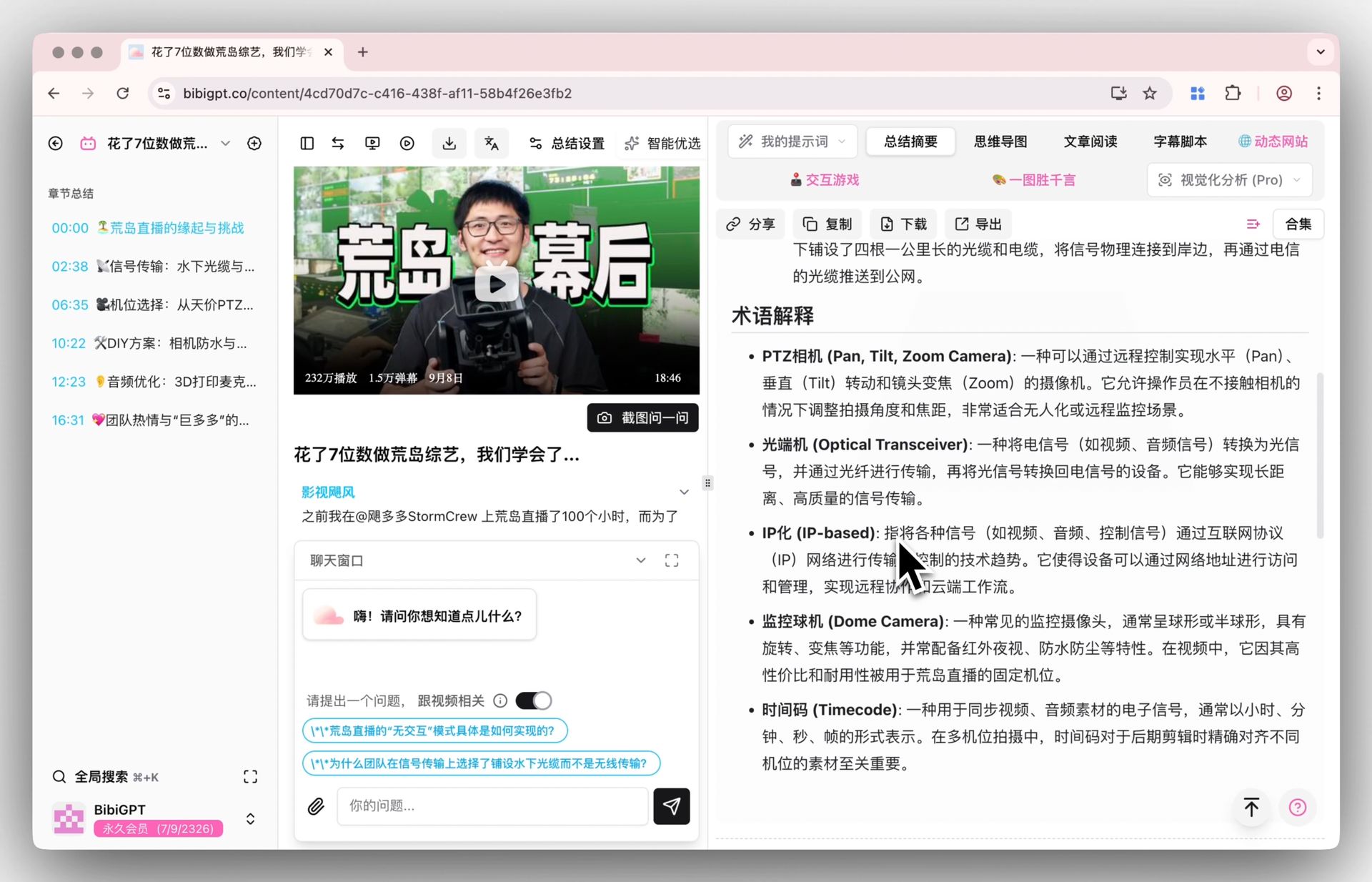 BibiGPT structured glossary output
Cross-Platform AI Video Summary: BibiGPT's Neutral Position
Core answer: BibiGPT doesn't compete in generation. It converts "videos others generate" into "knowledge you can use". Users generate on Grok or Veo, browse AI videos on YouTube / TikTok / Bilibili, and hand every "understand / save / repurpose" step to BibiGPT.
1. 30+ Platforms, One Entry Point
YouTube, Bilibili, Douyin, TikTok, Xiaohongshu, podcasts (Apple Podcasts, Spotify, Xiaoyuzhou), cloud drives (Google Drive, Alibaba Drive, Baidu Cloud, Zoom recordings). Paste any URL, get a summary.
2. Four-Language Output
Different platforms host different languages. BibiGPT outputs summaries in Chinese / English / Japanese / Korean natively, ideal for bilingual creators and cross-market researchers.
3. Creator Output Chain: Articles, Cards, Burn-In Subtitles
Summaries feed further into outputs: video into Chinese public-account articles, Xiaohongshu cards, short-video scripts, or translated subtitles burnt into the video. Generator outputs get digested and remixed in one place.
4. Verifiable Product Facts
BibiGPT supports 30+ platforms, over 5 million AI summaries generated, and is trusted by over 1 million users.
看看 BibiGPT 的 AI 总结效果

Bilibili: GPT-4 & Workflow Revolution
A deep-dive explainer on how GPT-4 transforms work, covering model internals, training stages, and the societal shift ahead.
Three Practical Scenarios
Core answer: Three personas gain the most from a "generation + summary" combo: creators, industry researchers, and students.
Scenario A: Creator Using Grok Imagine + BibiGPT
Generate a 15-second viral asset in Grok Imagine → post to TikTok → use BibiGPT to analyze script structure of competing top clips → feed the structure back to generate the next one. Creation flywheel closed.
Scenario B: Industry Researcher Tracking AI Video Model Launches
3-5 new models drop launch videos on YouTube each week. Use BibiGPT YouTube / Bilibili one-click summary to extract core capabilities, demos, pricing — a weekly brief in 30 minutes.
Scenario C: Students Digesting AI-Generated Explainer Videos
More teachers and edtechs are producing AI-generated explainer content. Students drop those videos into BibiGPT for timestamped notes + flashcards, then use the AI student study workflow for spaced-repetition review.
Related Reading
- NotebookLM 2026 deep dive: NotebookLM × Gemini App Integration vs BibiGPT
- End-to-end student workflow: AI Student Study Workflow MS Study Agent + BibiGPT 2026
- Sora alternatives (updated): Sora Alternatives Roundup 5+
FAQ
Q1: Can I use xAI Imagine Video directly inside my Grok subscription?
A: Yes. xAI Imagine Video launched as part of the Grok ecosystem. Subscribers invoke it inside the chat, and the generated short clips can be exported or shared to social platforms.
Q2: Where should creators migrate after Sora shuts down?
A: Depends on the use case. For short-form viral assets, xAI Imagine Video (inside Grok) or Gemini Veo 3.1 are the strongest picks. For editing-first workflows, CapCut (now with Seedance 2.0) is a natural fit. For academic and enterprise work, Runway or Luma keep leading. Regardless of choice, use BibiGPT to track competitors' videos across platforms to feed your asset pool.
Q3: Will BibiGPT add video generation too?
A: BibiGPT stays on the consumption side: paste link → AI summary → notes / flashcards / articles. Generation is the upstream war; BibiGPT is downstream, serving users who need to turn videos others generate into knowledge they own. Complementary lanes, not competing ones.
Q4: Isn't summarizing lower-quality AI videos a waste?
A: No. BibiGPT's first 30-second structured snapshot helps you decide whether to skip or read deeply. Filtering with BibiGPT saves more time than watching the whole generated clip through.
Q5: Do xAI and Google have their own video summary tools?
A: Grok has no consumer-facing cross-platform video summarizer today. Gemini's video summary is inside NotebookLM with URL sources limited to YouTube. A unified consumption experience across YouTube / Bilibili / TikTok / podcasts is currently most complete via BibiGPT.
Start your AI efficient learning journey now:
- 🌐 Official Website: https://aitodo.co
- 📱 Mobile Download: https://aitodo.co/app
- 💻 Desktop Download: https://aitodo.co/download/desktop
- ✨ Learn More Features: https://aitodo.co/features
BibiGPT Team