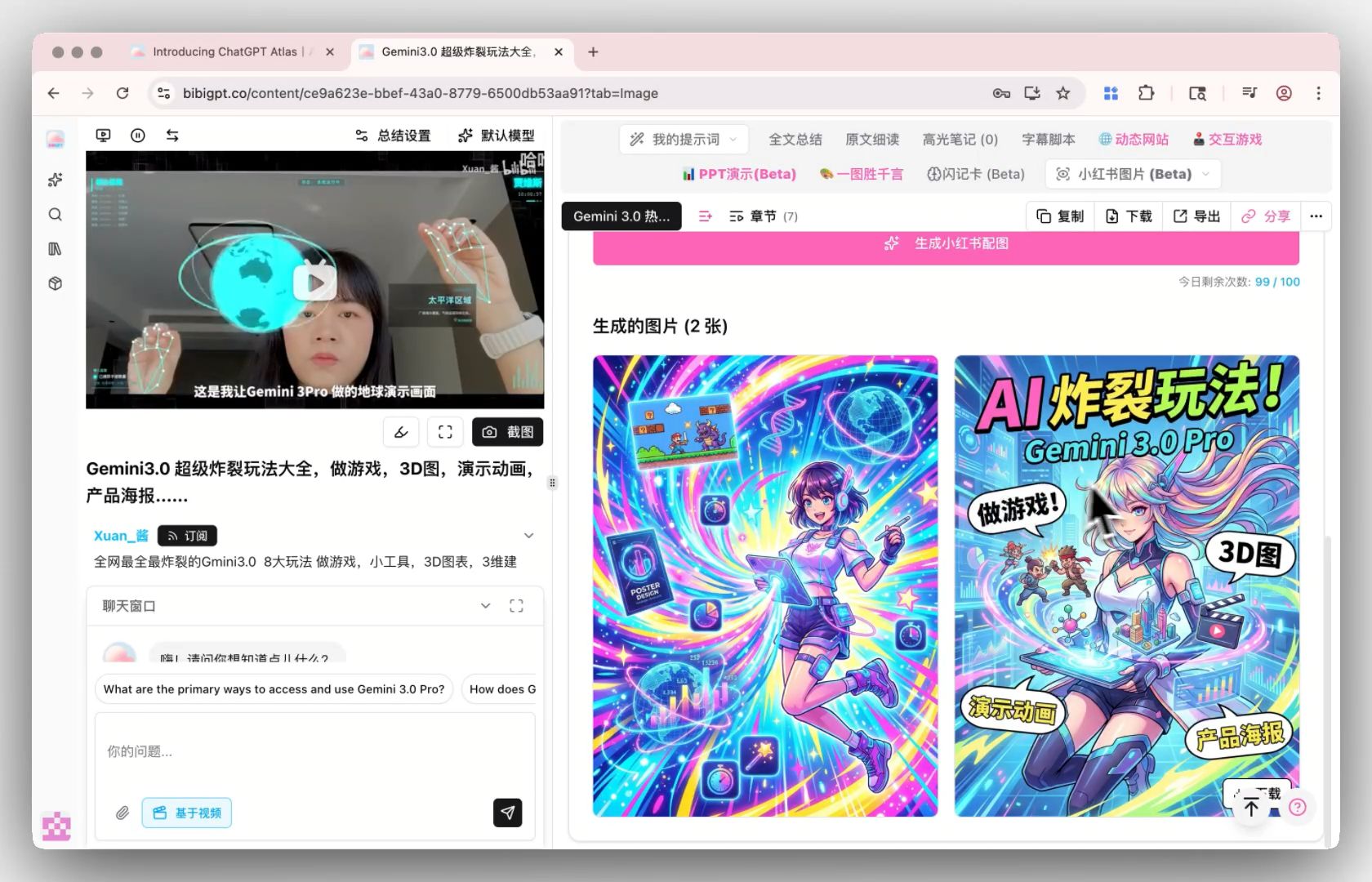
Xiaohongshu Elevates AI to Tier-1 Strategy + FireRed OpenStoryline Open-Sources: Creator Workflows for 2026 (BibiGPT Perspective)
Xiaohongshu AI Tier-1 Strategy + FireRed-OpenStoryline Open-Source: 2026 Creator Workflow
1. Background: as of 2026-05-20, two big things happened at Xiaohongshu
As of May 2026, Xiaohongshu (RED) has released two mutually reinforcing AI strategy signals:
Event 1: Organizational upgrade. Xiaohongshu recently lifted “AI” from a sub-team inside the growth org into a tier-1 strategic department that reports directly to the CEO. This kind of move isn’t a first in content-platform history — TikTok did the same in 2023, Pinterest in 2024 — but every time it signals AI resources getting promoted into the “annual narrative” tier.
Event 2: FireRed-OpenStoryline open-sourced. FireRed (Xiaohongshu’s AI lab, previously known for the RedSearcher retrieval model — see our earlier breakdown of FireRed RedSearcher) released a multimodal model in May 2026 trained specifically for “short-video / image-text narrative generation.” Model weights + inference code are on GitHub under Apache 2.0.
Put them together and Xiaohongshu is telling creators: future content supply on this platform will lean more on AI assistance, and we’re going to open-source the infrastructure. That “platform-strategy + open ecosystem” double signal is relatively rare.
Practical rule: When platform-level AI promotion + open model release happen together, the biggest winners aren’t paid creators — they’re creators already running an AI-driven workflow. Their existing pipeline plugs straight into the new model.
2. Deep analysis: three layers of impact
2.1 Technical impact: OpenStoryline drops the “video to post” barrier by one rung
OpenStoryline’s core training objective is “given a 1-3 minute video clip, generate a structured Xiaohongshu-style image-text post.” Its training data comes from Xiaohongshu’s internal anonymized high-quality posts + matched source videos, so the model fits “Xiaohongshu’s tone, rhythm, and emoji usage” much closer than a generic LLM.
According to the Hugging Face model card, OpenStoryline-7B beats GPT-4o-mini by ~18% BLEU on “video-to-post” tasks while costing 1/6 the inference. Two implications for creators:
- Individuals can run it locally: 7B parameters runs smoothly on RTX 4090 / M3 Max
- Tool-builder barrier drops: building “Xiaohongshu content assistant” products on open weights is meaningfully easier than in 2024
2.2 Market impact: content supply gets more “long-tail”
The combined effect of Xiaohongshu’s AI upgrade + OpenStoryline going open will spawn a wave of vertical AI tools targeting Xiaohongshu’s viral-post formulas. A 36Kr analysis from May 15, 2026 quotes one MCN exec: “By H2 2026, mid-tier Xiaohongshu creators (10K-100K followers) might double in count, but per-account output frequency won’t fall — AI dramatically lowers the threshold of going from ‘2 posts/week’ to ‘5 posts/week’.”
Second-order effect: content quality distribution will shift from normal to power-law. Median improves (every post is more formatted, visually unified), but apex content (genuinely scarce insight, real experience) becomes more visible, because “well-formatted but generic” posts become the default background.
Practical rule: When AI lowers content production barriers, winners aren’t the ones who “produce more” — they’re the ones who “produce still authentic and produce fast.”
2.3 Ecosystem impact: Xiaohongshu vs Bilibili/Douyin “content-form war” intensifies
By promoting AI to tier-1 strategy, Xiaohongshu is signaling differentiation on the “image-text + short-video mixed content” track, distinct from Bilibili (long-video mind share) and Douyin (short-video mind share). Open-sourcing OpenStoryline drops an ecosystem hook — letting external tools integrate around Xiaohongshu content forms.
The most direct cue to creators: multi-platform reposting is no longer “copy-paste” — it now requires per-platform AI rewriting based on each platform’s content form. That’s exactly the question cross-platform audio/video assistants like BibiGPT need to answer next.
3. What this means for BibiGPT users
3.1 Content creators: finally a one-stop cross-platform output
A substantial share of BibiGPT users are multi-platform content creators — they post long-form video breakdowns on Bilibili, sync English versions to YouTube, and also want to drop image-text posts on Xiaohongshu. The historic pain in this workflow: Bilibili/YouTube videos are long (30+ minutes), Xiaohongshu posts demand short, visual-friendly, emoji-stylized format — the gap between the two forms is too large, making reposting heavy lifting.
After Xiaohongshu’s AI elevation + OpenStoryline going open, BibiGPT users’ workflow becomes:
- Process a long video in BibiGPT, get structured summary + key-frame screenshots
- Feed the summary structure + key frames into OpenStoryline (or a tool built on it)
- Get a draft post that fits Xiaohongshu’s narrative rhythm
- Human polish + image selection, then publish
The whole motion shrinks from “30 minutes of manual rewriting” to “5 minutes AI draft + 5 minutes human polish.”
3.2 Students / learners: turn course videos into Xiaohongshu study notes fast
Lots of education accounts on Xiaohongshu publish “course summaries / book notes / language learning” content. BibiGPT’s ability to process YouTube/Bilibili course videos, paired with OpenStoryline converting summaries into Xiaohongshu style, turns “finish a lecture → publish a study note” into something completable within 10 minutes.
3.3 Enterprise users: industry insights propagate one rung faster
Finance / tech enterprise accounts subscribe to lots of industry podcasts and keynote videos. Converting these to Xiaohongshu “industry insight” posts used to demand a content operations writer doing manual rewrites. Now you can use BibiGPT auto-translate on upload + smart deep summary as the base, then layer Xiaohongshu ecosystem tools for the rewrite — 5-8 differently sliced posts from one keynote.
4. BibiGPT + Xiaohongshu workflow: 3 steps from source video to Xiaohongshu post
This section gives concrete actions, not abstract advice.
Step 1: process raw video material with BibiGPT
Open BibiGPT, paste a Bilibili / YouTube / Douyin / Xiaohongshu video link, or upload a local video file. Turn on Smart Deep Summary, and BibiGPT auto-generates:
- Structured summary (with H2/H3 sections)
- 5-8 key-frame screenshots (with timestamps)
- Thought questions and key term explanations
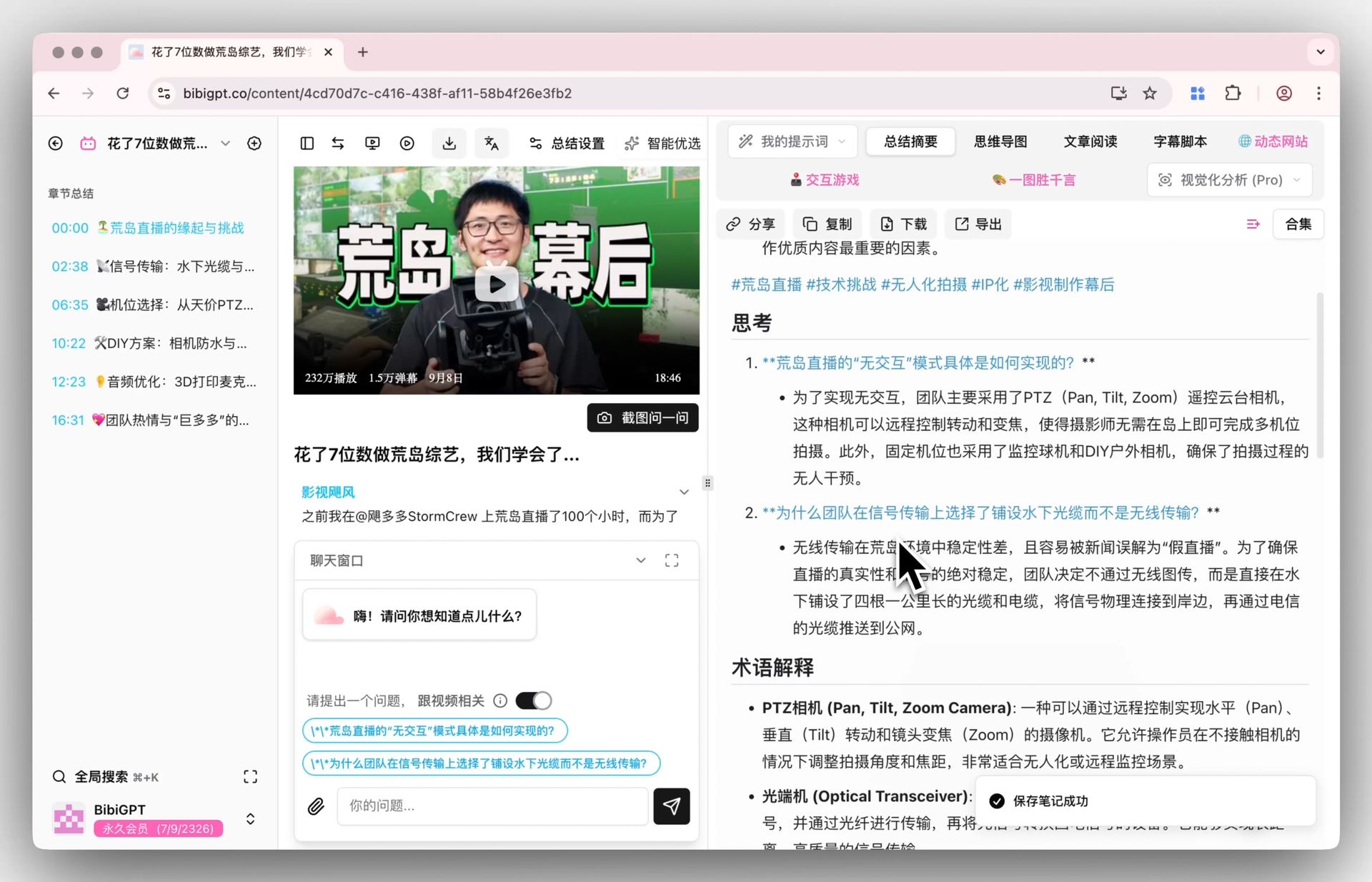
This step’s output is “structured raw material,” not “finished post” — and that’s precisely what the Xiaohongshu ecosystem tools downstream need as input.
Step 2: use video-to-article for image-text draft
BibiGPT’s “AI Video to Article” feature auto-converts video content into a structured image-text article. This is the “intermediate form” of a Xiaohongshu post — text and images already paired, but still needs tone/rhythm rewriting for Xiaohongshu native voice.
Step 3: rewrite into Xiaohongshu style with OpenStoryline (or similar)
Feed the BibiGPT image-text draft into a tool based on OpenStoryline (or directly prompt a generic LLM to mimic Xiaohongshu voice), and have it do:
- Rewrite paragraphs into emoji-friendly short lines
- Extract 3-5 hashtags (matching Xiaohongshu SEO habits)
- Turn the opening into a “hook line” (first two lines decide open rate on Xiaohongshu)
- Turn the ending into an “action prompt” (question / comment trigger)
Step 4: human polish + image selection, then publish
When the AI draft lands, read through it manually — even OpenStoryline can’t judge whether the post’s specific details are on-brand for your account. This step is non-skippable, otherwise you fall into the “well-formatted but generic” trap mentioned above.
Practical rule: The final 20% of edits on an AI-generated post decide whether it’s “high-volume mediocre” or “high-volume quality” — that 20% cannot be delegated to AI.
5. Forecast: 3 likely trends in the next 12 months
- Xiaohongshu will release an official “Creator AI Assistant” product. An internal OpenStoryline-based version will be packaged as “Xiaohongshu Creator Assist Pro,” surfaced in the creator backend. Free tier with limits, paid tier unlimited.
- Cross-platform audio/video tools will accelerate Xiaohongshu adapter dev. BibiGPT, CutFast, CapCut etc. will roll out “Export Xiaohongshu post” modes. The 3-step workflow above will get one-button-ized.
- “AI-content detection” on Xiaohongshu will become a new platform battlefront. When AI-generated content crosses some threshold (likely 30%), Xiaohongshu will be forced to add AI-content labels, similar to X / Douyin trajectories.
6. FAQ
Do regular creators need to switch workflows now?
No rush. If you currently publish ≤ 2 posts/week, your existing workflow is fine — AI’s leverage point is “2 → 5 posts,” not “2 → 0.5.” But if your account is climbing toward mid-tier (50K-100K followers), it’s worth spending one afternoon running the 3-step workflow end-to-end. Six months from now you’ll have saved enormous time vs peers.
Can ordinary users actually use FireRed-OpenStoryline?
Yes — local deployment works (RTX 4090 or M3 Max class hardware), and community web tools are emerging. There are already a few open-source frontends on GitHub (search “openstoryline ui”), but UX still trails mature products like BibiGPT. Practical recommendation: start with the 3-step workflow above (BibiGPT for raw material + generic LLM for rewriting), switch to dedicated community tools when they mature.
Will Xiaohongshu’s built-in AI eventually replace BibiGPT?
No. Xiaohongshu’s AI strategy is “content assistance within the Xiaohongshu ecosystem” — it will not handle cross-platform audio/video processing (Bilibili, YouTube, podcasts). That’s exactly BibiGPT’s long-term moat: 30+ platform input pipes + cross-video Q&A + multilingual. BibiGPT and Xiaohongshu AI are complementary, not substitutive.
Will Xiaohongshu’s AI upgrade affect image-text post search rankings?
Not significantly short-term — the upgrade is infrastructure-layer, ranking algo iteration runs on its own cycle. Mid-term (6-12 months) likely effect: as AI content supply explodes, platform search will increasingly favor “content scarcity” and “real-experience signals,” and pure AI-generated posts may lose ranking weight.
I already use ChatGPT for Xiaohongshu posts — should I switch to OpenStoryline?
Not necessarily switch. ChatGPT remains more flexible at “generating creative copy on demand.” OpenStoryline’s advantage is “fitting Xiaohongshu narrative rhythm.” So if your pain point is “AI output doesn’t feel like native Xiaohongshu content,” OpenStoryline is worth trying. If the pain is creative divergence, keep ChatGPT. They’re not mutually exclusive.
Can this workflow be reused for Douyin / Bilibili?
Partly. The BibiGPT raw-material step is fully reusable. Step 3 “Xiaohongshu style rewrite” needs to be swapped for “Douyin short script” or “Bilibili long-video script” — that step can be handled by a generic LLM with a prompt, no dedicated model needed. The key difference: each platform’s content rhythm differs, so maintain prompt templates separately.
7. Closing: run the 3-step workflow once first
Xiaohongshu’s AI elevation + OpenStoryline open-source are the two most significant consecutive signals in the content-creator tool space in the past six months. Their practical meaning isn’t “Xiaohongshu is about to change” — it’s “the content creator’s tool stack is about to expand.”
Don’t wait for the community to ship “out of the box” tools — those typically need another 3-6 months to mature. Run the 3-step workflow today with BibiGPT + a generic LLM, log the pain and time at each step. In 3 months when community tools mature, you’ll already know which steps deserve paid tools and which your own workflow handles fine.
If you haven’t tried BibiGPT for cross-platform video processing, try BibiGPT free, paste a video link you’ve been wanting to turn into a post, and experience the workflow starting from “source material organization.”