AI Student Study Workflow 2026: Microsoft Study Agent + Laxu AI + BibiGPT Combo — 5 Steps From Lecture Video To Anki Flashcards
AI Student Study Workflow 2026: Microsoft Study Agent + Laxu AI + BibiGPT Combo — 5 Steps From Lecture Video To Anki Flashcards
Table of Contents
- One-Line Workflow Pick
- Four AI Study Tools, Side By Side
- When To Use What
- 5 Steps: Lecture Video → Anki Flashcards
- Who Should Use What
- FAQ
One-Line Workflow Pick
The best student AI study loop in 2026: use BibiGPT to turn lecture videos and podcasts into timestamped notes + flashcards → use Microsoft Study and Learn Agent for adaptive practice → use NotebookLM Education as your semester knowledge base → use Anki for spaced repetition. Laxu AI is a light complement for single-shot uploads that spit out notes + flashcards + quizzes. The four tools are not competing — they are dividing labor.
Four AI Study Tools, Side By Side
Core answer: Microsoft Study and Learn Agent leans “adaptive practice from textbook content”, Laxu AI leans “single-upload flashcards”, NotebookLM Education leans “semester-scale research notebook”, and BibiGPT leans “audio/video URL → timestamped structured notes”. Input shape and output shape decide which stage of study each one fits.
1. Microsoft Study and Learn Agent (Microsoft 365 Copilot)
Shape: Copilot Agent. Per Google Education Blog’s April 2026 update and NerdBot’s 2026 education AI guide, Microsoft Study’s main value is adaptive practice (difficulty shifts based on student mastery) + flashcard / quiz generation inside the Microsoft 365 Copilot surface.
Strengths: Deep integration with Word / PowerPoint / OneNote; adaptive practice tuning.
Limits: Requires Microsoft 365 Education subscription; does not accept YouTube / Bilibili URLs directly.
2. Laxu AI
Shape: Web app. Ranked #1 in toolstack.net’s 2026 AI note-taking apps list and axis-intelligence’s 47 AI tool roundup. Core pitch: upload once → notes + flashcards + quizzes in one step.
Strengths: Zero setup; export flashcards to Anki / Quizlet; student-friendly UI.
Limits: Single-shot focused, lacks long-term semester organization; no URL-paste flow today.
3. NotebookLM Education Plus
Shape: Google service. The April 2026 upgrade added Cinematic Video Overviews, EPUB support, three-column layout, and Gemini App deep integration — see NotebookLM × Gemini App Integration vs BibiGPT for the deep dive.
Strengths: Doubled free tier for educators; EPUB good for textbooks; three-column layout fits papers and long research; Gemini chats as sources.
Limits: URL sources are YouTube-only; Bilibili / TikTok / podcasts / Xiaohongshu need manual transcript conversion; China access needs VPN.
4. BibiGPT
Shape: Web + browser extension + desktop + mobile. Paste YouTube, Bilibili, Douyin, TikTok, Xiaohongshu, podcasts (Apple Podcasts, Spotify, Xiaoyuzhou), cloud-drive recordings (Google Drive, Baidu Cloud, Alibaba Drive, Zoom) — 30+ audio/video platforms total.
Strengths: 30+ platform coverage; smart deep summary with highlights, reflective Q&A, and glossary; flashcard export to Anki CSV in one click; native 4-language output (Chinese / English / Japanese / Korean); no VPN required from mainland China.
Limits: Input side optimized for audio/video, not PDF research workflows; long-term projects benefit from pairing with NotebookLM.
When To Use What
Core answer: Map the four tools to “intake → process → memorize → review”: BibiGPT for intake from audio/video, NotebookLM for semester-scale organization, MS Study or Laxu AI for memorization material, Anki for review.
Stage 1: Intake
- Lecture videos / tutorials on Bilibili / YouTube / podcasts: BibiGPT (timestamped summary + highlights + reflective Q&A)
- Textbook PDF / EPUB / Word notes: NotebookLM Education or Microsoft Study
Stage 2: Process
- Consolidate multi-source notes into a semester notebook: NotebookLM three-column layout + multi-source Q&A
- Clarify tough concepts with AI: BibiGPT AI follow-up chat asks directly within video context
Stage 3: Memorize
- Auto-generate Q&A flashcards: BibiGPT flashcards OR Laxu AI (choose by source type — audio/video → BibiGPT; PDF/Word → Laxu AI)
- Adaptive practice problems: Microsoft Study and Learn Agent
Stage 4: Review
- Spaced repetition: Anki (import BibiGPT flashcards CSV directly)
5 Steps: Lecture Video → Anki Flashcards
Core answer: Full walkthrough from a single Bilibili / YouTube lecture video to active Anki review takes about 10 minutes.
Step 1: Paste The Lecture URL Into BibiGPT
Open aitodo.co, paste a Bilibili / YouTube / course platform URL. Within 30 seconds you get a summary + chapters with timestamps + highlights + reflective Q&A + glossary.
Step 2: Review The Smart Deep Summary
Use BibiGPT’s smart deep summary to check core takeaways and glossary. Switch to mind-map view for complex material to grasp structure quickly.
Step 3: Generate Flashcards
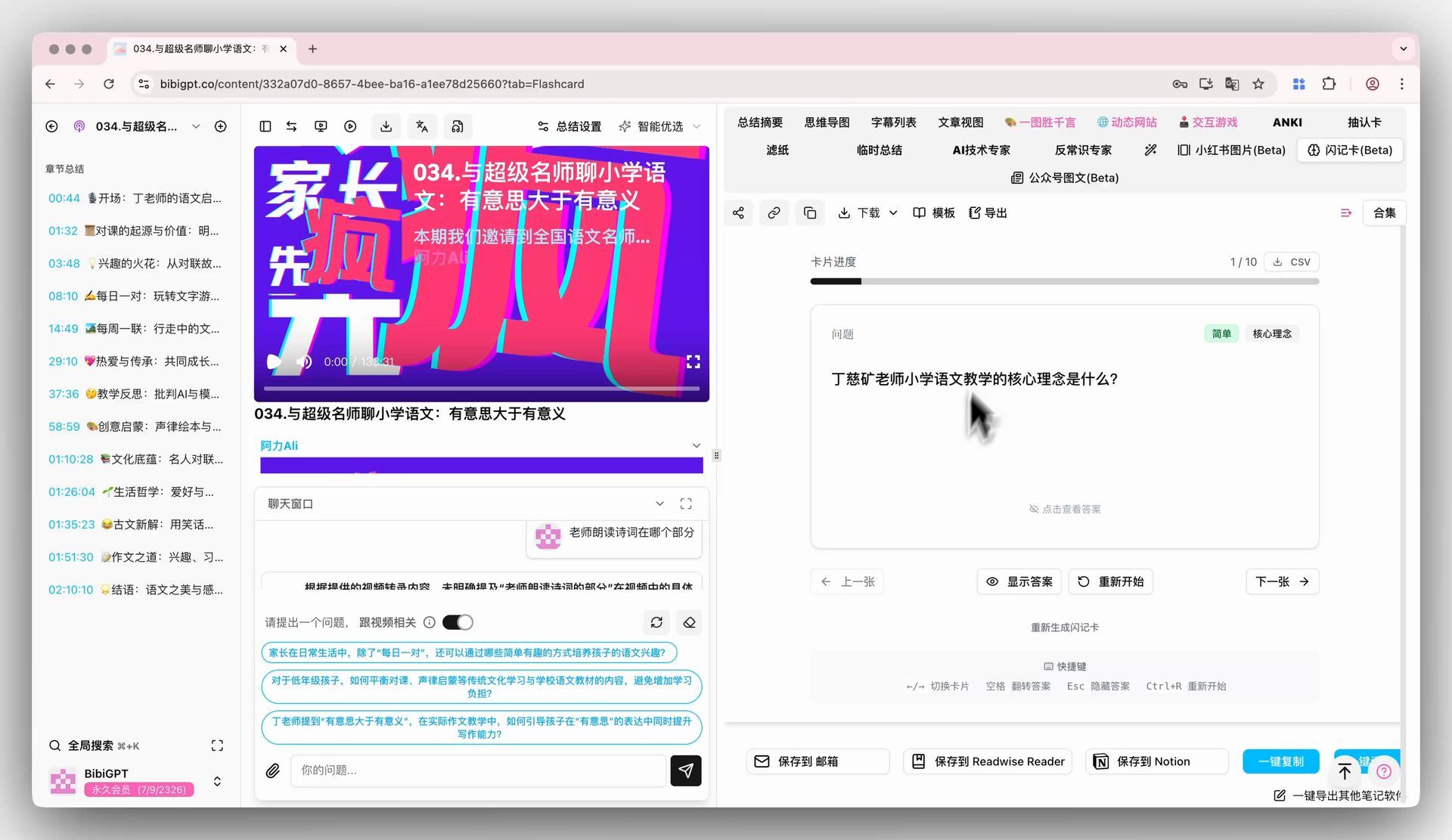
Open the “Flashcards” tab in the video summary detail page. BibiGPT auto-generates Q&A cards with difficulty tags and concept labels. Self-test by clicking through cards inside BibiGPT first.
Step 4: Export CSV To Anki
Hit “Export CSV” in the flashcards panel. In Anki desktop, File → Import, select the CSV — it is recognized as an Anki deck with questions, answers, and tags.
Step 5: Spaced Repetition In Anki
Run Anki daily. When concepts keep getting missed, return to BibiGPT and ask AI follow-up questions with that specific video’s context — or generate extra practice in Microsoft Study.
Who Should Use What
Core answer: Students should master the BibiGPT + Anki duo first, then add NotebookLM / MS Study based on subscription. Teachers lead with NotebookLM Education + MS Study. Self-learners lead with BibiGPT + Laxu AI.
Students (Exam Cram + Long-Term Subject Building)
BibiGPT processes lecture videos / supplementary materials → flashcards → Anki. That is the daily loop. Long-term disciplines (e.g. medical school, grad school) add NotebookLM as semester notebook.
Teachers (Lesson Prep + Materials + Adaptive Practice)
NotebookLM Education organizes textbooks and lecture notes; MS Study Agent generates adaptive practice to hand to students.
Self-Learners (Career Switchers / Language / Hobby)
Paste YouTube / podcast links into BibiGPT daily; occasional PDF upload to Laxu AI for flashcards. Those two cover the bulk of cases.
Educational Institutions (Batch Processing)
Use BibiGPT batch export on podcast / video collections to distribute to students; pair with MS Study Agent for mastery assessment.
Related Deep Dives
- NotebookLM deep comparison: NotebookLM × Gemini App Integration vs BibiGPT 2026
- Learning in the AI video generation era: xAI Imagine Video + Grok vs BibiGPT 2026
- Short-form learning method: Douyin AI Video Summary + Feynman Technique
FAQ
Q1: Does Microsoft Study and Learn Agent cost money?
A: Yes — it requires a Microsoft 365 Copilot subscription (Education Plus usually covers it). Students without a Microsoft 365 plan can still cover most scenarios with BibiGPT + Anki + Laxu AI, only missing adaptive practice.
Q2: Do Laxu AI and BibiGPT flashcards overlap?
A: Different input shapes. Laxu AI is strongest for PDFs, Word, and text-based material in a single upload; BibiGPT is strongest for audio/video URLs with timestamped notes and flashcards. The two together cover both text and audio/video sources.
Q3: Is NotebookLM Education Plus workable for students in mainland China?
A: Google account works, but access requires a connection to Google services. Students in China should rely on BibiGPT (no VPN needed) as primary, and add NotebookLM for long-term cross-semester research notebooks when possible.
Q4: Are auto-generated flashcards as good as hand-made Anki cards?
A: Close, as long as you skim them once. BibiGPT-generated flashcards cover the video’s key Q&A, and produce 10× faster than hand-writing. Spend 2 minutes skimming the CSV to mark important cards or merge duplicates before importing into Anki — that is the best-of-both flow.
Q5: How many lecture videos can I digest per week?
A: From BibiGPT user feedback: 3-5 lecture videos per day (30-90 minutes each) + 20 minutes of Anki review is a sustainable pace. More than that causes Anki queue pile-up; adjust intake rather than cram review.
Start your AI efficient learning journey now:
- 🌐 Official Website: https://bibigpt.co/en/desktop?utm_source=growth-pages&utm_medium=blog-inline-cta&utm_campaign=ai-student-study-workflow-ms-study-agent-bibigpt-2026
- 📱 Mobile Download: https://aitodo.co/app
- 💻 Desktop Download: https://aitodo.co/download/desktop
- ✨ Learn More Features: https://aitodo.co/features
BibiGPT Team