
Cornell Method × AI Video: A 5-Step Workflow From Watching to Publishing in 2026
Cornell Method × AI Video: A 5-Step Workflow From Watching to Publishing in 2026
For: blog / Substack / Medium / newsletter creators, and anyone who wants “watching a video” to mean more than passive consumption.
The Cornell note-taking method (designed by Walter Pauk at Cornell University in the 1950s) is a natural fit for video learning. Its three columns force you to “say it back in your own words” after watching. This piece shares a 5-step workflow: process the video with BibiGPT, organize with Cornell three-column notes, and ship a publishable article. Total time: 30 minutes to one hour. Turns “I watched another YouTube video” into “I shipped another article.”
Why Cornell Notes for Video
Cornell notes split a page into three regions:
| Region | Share | Purpose |
|---|---|---|
| Note Area | Right ~70% | Raw notes from the video/lecture |
| Cue Column | Left ~30% | Filled in after watching: questions, keywords, headings |
| Summary | Bottom 5-10% | Two or three sentences, in your own words |
Why is this especially good for video? Because video is one-way streaming information — unlike a book, you can’t easily flip back. Cornell’s “cue + summary” structure forces active reprocessing after the fact, which is the same engine that powers the Feynman technique.
The historical pain: video information density is high, you can’t write fast enough. As of 2025, BibiGPT fills that exact gap — the AI handles the “Note Area” so you can focus on the cognitive work of cue and summary.
The 5-Step Workflow
Step 1: Pick a video → Use BibiGPT to generate “Note Area” raw material
Paste any YouTube / Bilibili / podcast link into BibiGPT. After 1-2 minutes you get:
- Full transcript (with timestamps)
- Structured deep summary (key points + thinking prompts + glossary)
- Mind map (the video’s overall skeleton)
Smart Deep Summary is on by default and includes “thinking prompts” — those become your first draft of Cornell’s cue column.
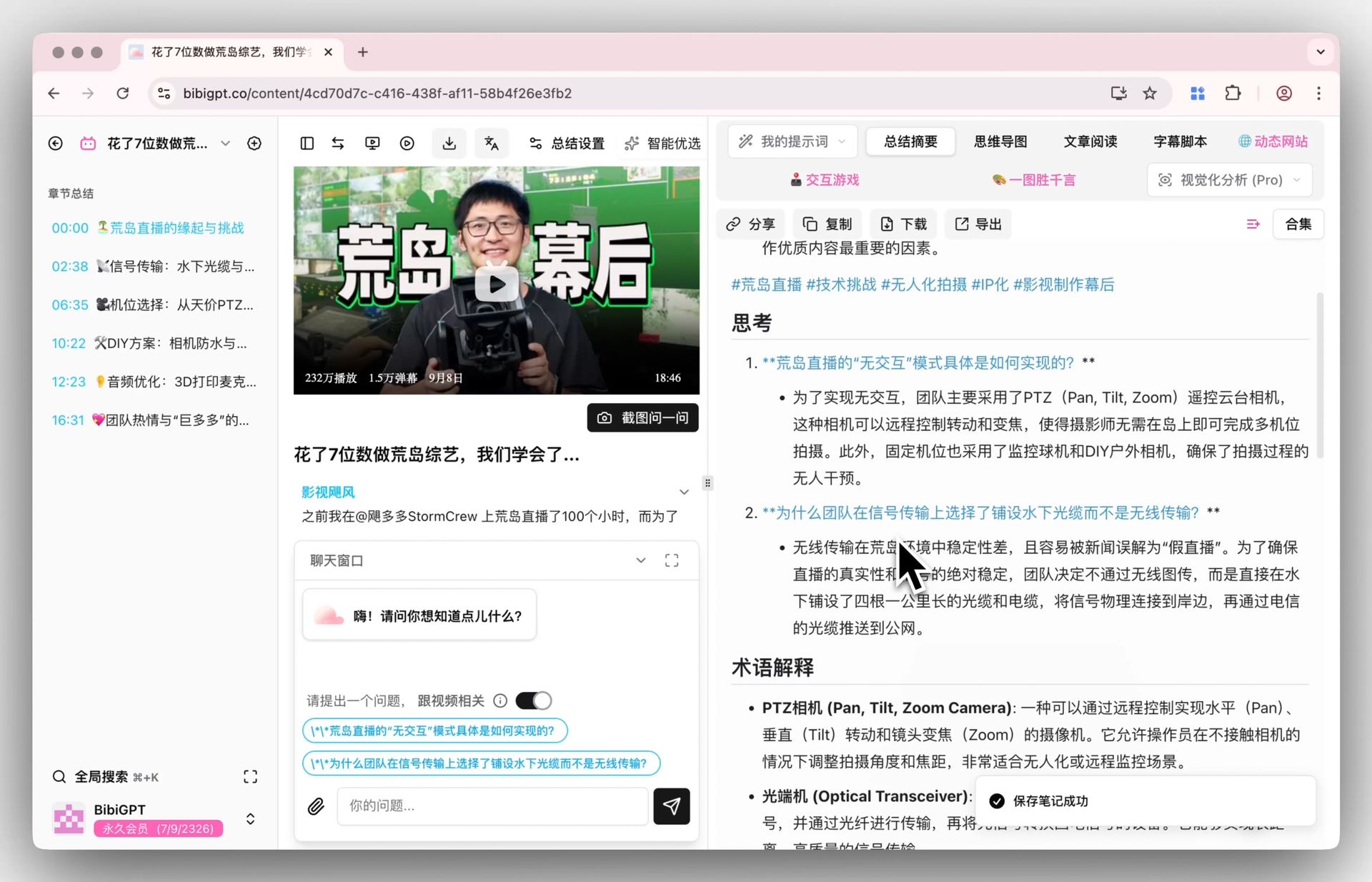
The point of this step: convert “video information” into “Note Area raw material.” AI handles the mechanical transcription and summarization; you focus on understanding.
Step 2: Fill the cue column → Write 5-10 of your own questions
Open your Cornell template (any notes app — I use Notion). Paste BibiGPT’s summary into the Note Area.
Then close BibiGPT, look at your Note Area, and ask yourself:
- What question is this section answering?
- Which parts are facts? Which are opinions?
- Do I agree? Why or why not?
- Does this conflict with what I learned about X earlier?
Write the questions into the cue column. No AI in this step. Cornell notes earn their value here — the cue column is your “active reprocessing trace.” It’s the mirror that tells you whether you actually understood.
Step 3: Internalize → Use BibiGPT’s “Collection AI Chat” for Feynman-style follow-ups
Some cue-column questions you can answer; others you can’t. Questions you can’t answer are your blind spots — that’s the whole point of Feynman’s technique.
Add the video to a BibiGPT collection (e.g. “Cornell Library”), open Collection AI Chat, and throw the unanswered cue questions at the AI:
- “How is X (from the video) fundamentally different from Y (from earlier learning)?”
- “If I had to explain this to a 10-year-old, what analogy should I use?”
AI answers based on the video content. This is the core Feynman drill — probe your understanding by interrogating it.
Step 4: Write the summary → Compress into 100-200 words in your own voice
After the cue column is filled and follow-ups are done, return to the bottom and force yourself to summarize the whole video in 100-200 words.
Do not copy BibiGPT’s summary here. Use your own voice. If you can’t, go back to Step 3 and probe more. If you can, congratulations — you passed the Feynman test.
Step 5: Ship → Use AI Video to Article to turn notes into a published piece
By now you have:
- BibiGPT’s structured summary
- 5-10 of your own cue-column questions
- 100-200 words of original synthesis
Stitched together, you already have an article skeleton. Open AI Video to Article, let BibiGPT convert the video itself into a structured illustrated article, then plug in your “cue questions + original synthesis.” The result is something AI can’t generate alone: your interrogation angle and your judgment.
Generate a few cover images with Xiaohongshu Image Generator and ship to your blog, Medium, Substack, etc.
Real Example: 2,000-Word Article in 30 Minutes
Scenario: You listened to a podcast about “counter-intuitive scientific decision-making” and want to publish a piece.
| Time | Step | Output |
|---|---|---|
| 0-5 min | Process podcast in BibiGPT | Transcript + deep summary + mind map |
| 5-15 min | Fill cue column, write 8 questions | 8 original prompts |
| 15-25 min | Use Collection AI Chat to follow up on 5 blind spots | 5 supplementary explanations |
| 25-30 min | Write summary + AI Video to Article | First draft of 2,000-word article |
Spend 30 more minutes polishing prose, layout, and images. Inside an hour, you have a publishable article.
Tool Stack Comparison
| Notes Tool | Native Cornell Template | BibiGPT Integration |
|---|---|---|
| Notion | No (build your own) | One-click send via BibiGPT |
| Obsidian | Community plugin | BibiGPT Obsidian Integration |
| Cubox | No (use tags) | Cubox Integration |
| Siyuan Notes | Yes (community template) | Siyuan Notes Integration |
| Paper notebook | Classic | Hand-copy only |
If you live in Obsidian or Notion, BibiGPT one-clicks the video summary into your library, and your template fills in the Cornell structure — that’s the smoothest workflow.
Try It
- New here → Try BibiGPT, start with a video you’ve been wanting to watch
- Existing user → try AI Video to Article plus your favorite notes tool (Notion / Obsidian / Cubox), drop a Cornell template on top
- Heavy learner → throw all “want-to-watch” videos into one collection and use Collection AI Chat for topic-level interrogation
FAQ
Q1: Are Cornell notes and the Feynman technique the same thing?
A: No. Cornell is a note-taking structure (how to organize a page); Feynman is a learning methodology (how to verify understanding). They pair perfectly: the cue + summary regions of Cornell give you a vehicle for Feynman’s “explain it to someone else.” Whatever you write there is, in effect, you teaching yourself. See the Feynman technique series.
Q2: I don’t have time to do this for every video — is that OK?
A: Yes. Three guidelines: (1) only run the full workflow on videos you plan to publish from; (2) for serious learning videos, run all 5 steps; (3) for pure entertainment, just read BibiGPT’s summary. The ROI is highest when the destination is “secondary creation.”
Q3: If the Note Area is BibiGPT’s summary, are the notes still “mine”?
A: Yes — as long as you write the cue and summary columns yourself. Cornell notes are designed around division of labor: Note Area = objective info, cue + summary = subjective reprocessing. Letting AI handle the Note Area is consistent with the methodology — it just frees you to invest more energy in the parts that matter.
Q4: Does this workflow work across languages?
A: Yes. BibiGPT supports 30+ platforms and Chinese / English / Japanese / Korean transcription and summarization. For bilingual learning, Auto-Translate on Upload gives you side-by-side source + target language.
Q5: Will the resulting article get flagged as AI-generated?
A: The workflow is “AI handles raw material + human handles processing.” The article’s soul lives in your cue questions and original synthesis — that’s the part AI can’t generate. To stay on the safe side of AI detectors, keep some of your own conversational phrasing and concrete examples; those are the parts AI cannot reproduce.
BibiGPT Team