Gemma 4 Self-Hosting vs GPT/Claude API: How Much Does Video Transcription Really Cost in 2026?
Gemma 4 Self-Hosting vs GPT/Claude API: How Much Does Video Transcription Really Cost in 2026?
As of 2026-05-06
Fact upfront: Google DeepMind shipped the Gemma 4 family on 2026-04-02 (E2B / E4B / 26B / 31B), Apache 2 licensed, with native audio + image input and up to 256K context. Open weights are not the same as free service — self-hosting still has GPU depreciation, electricity, and ops bills. This article puts Gemma 4 self-hosting, GPT-4o-mini API, and Claude 3.5 Haiku API on a single comparison table at the realistic scale of 10,000 minutes of video per month, and ends with a multi-model routing playbook you can copy.
If you’re asking whether it’s time to migrate the subtitle pipeline from OpenAI/Anthropic to a self-hosted Gemma 4, this article is for you.
TL;DR: Three lines, one cost table
| Path | Per-minute cost | Monthly cost (10K min) | Difficulty | Hidden cost |
|---|---|---|---|---|
| Gemma 4 31B self-hosted (H100 + custom orchestration) | ≈ $0.0030 | ≈ $300 | High (needs ML eng) | GPU amortization, power, monitoring, edge cases |
| GPT-4o-mini API (OpenAI) | ≈ $0.0090 | ≈ $900 | Low | Commercial T&C, cross-border data |
| Claude 3.5 Haiku API (Anthropic) | ≈ $0.0085 | ≈ $850 | Low | Same as above |
| BibiGPT multi-model routing (hybrid) | Varies by scenario | Pay-as-you-go, zero ops | Zero | None |
Per-minute cost is based on public 2026-05 token pricing + 1.2K input / 0.4K output tokens per minute of video on average. Self-hosted Gemma 4 amortization assumes used H100 at $1.5/hr × 70% utilization × quantized deployment.
Bottom line up front: Self-hosting only wins clearly when you process ≥ 80,000 minutes/month and have dedicated ops staff. SMBs and individual creators are better off paying APIs and routing through BibiGPT — better economics, zero ops.
1. The real bill of self-hosting Gemma 4 31B
1.1 Hardware
To run Gemma 4 31B with 256K context and audio streaming reliably:
- GPU: H100 80G ×1 (×2 for headroom). Used H100 rents at $1000-1500/month
- Storage: 1TB NVMe (model weights + inference cache), $50/month
- Bandwidth: video upload + subtitle delivery, 5TB/month at $200
Hardware total: ≈ $1,250-1,750/month.
1.2 Software + ops
- vLLM / TGI tuning (1-2 weeks of engineer time upfront)
- Prometheus + Grafana monitoring ($50/month for a small VM)
- Long-tail bug triage (quantization drops, OOM, context truncation) — average 8-12 engineer hours/month
At $100/hour engineering cost: $800-1,200/month in hidden labor.
1.3 Quality tax
Internal benchmark, same 60-minute Bilibili lecture, four models:
| Model | CER (subtitle error) | Chapter break accuracy | Long-tail entity accuracy (names/jargon) |
|---|---|---|---|
| Gemma 4 31B (FP16) | 4.8% | 92% | 78% |
| Gemma 4 31B (INT8) | 6.2% | 88% | 71% |
| GPT-4o-mini | 3.6% | 94% | 86% |
| Claude 3.5 Haiku | 3.9% | 93% | 84% |
Numbers from BibiGPT’s internal 200-video sample set across Bilibili, YouTube, and podcasts. Quantized Gemma 4 has visible regression on long-tail names and technical terms.
Key takeaway: Gemma 4 is “good enough” for vanilla subtitling, but lags noticeably in domain jargon, multi-speaker dialogue, and noisy environments — exactly the long-tail content creators care about most.
2. The real bill of API-based pipelines
2.1 GPT-4o-mini
- $0.15 / 1M input tokens
- $0.60 / 1M output tokens
- Per minute video ≈ 1.2K input + 0.4K output → ≈ $0.0011 + ≈ $0.008 context overhead
Real monthly = 10,000 × $0.009 = $900. Zero ops, zero hardware.
2.2 Claude 3.5 Haiku
- $0.80 / 1M input tokens
- $4.00 / 1M output tokens
Same token volume: $850/month, slightly better quality than GPT-4o-mini.
2.3 Hidden upside of API path
- Zero cold start: production traffic from day one
- Auto-scale: 100 minutes to 1M minutes, no architecture work
- Quality keeps improving: vendors ship monthly improvements you inherit free
- Compliance shipped: commercial T&C and DPAs are off-the-shelf
3. What this means for BibiGPT users
You may now be wondering: “What does BibiGPT itself use?”
The answer is multi-model routing — not picking a single model. Different content types take different optimal paths:
- Short-form / daily subtitling (60% of traffic) → on-device Gemma 4 E4B or low-cost GPT-4o-mini
- Long-form / professional content (25%) → Claude 3.5 Sonnet / GPT-4o
- Bulk historical archive (10%) → self-hosted Gemma 4 31B (tolerate 1-2% quality drop for 50% cost cut)
- High-stakes scenarios (5%) → dual-model consistency check
3.1 For creators
If you make YouTube videos, run a podcast, or write on social platforms: just subscribe to BibiGPT. The product implements all of the routing logic above behind a single paste-link UX. $5-15/month covers virtually all individual creator scenarios.
3.2 For SMB / tooling vendors
If you build AI tools or run a content platform: APIs first, self-host the heavy lane only. Ship product on OpenAI/Anthropic, then move to self-hosted Gemma 4 only after monthly volume crosses 100K minutes.
3.3 For enterprises with compliance
Cross-border data restrictions or audit requirements mean Gemma 4 self-hosting + BibiGPT private-model integration is the only viable path. Apache 2 licensing + BibiGPT’s multi-model routing keeps your product UX intact while keeping the model layer fully on-prem.
4. BibiGPT in practice: try different models in one click
BibiGPT exposes the routing layer to end users.
Hands-on workflow:
- Paste a Bilibili / YouTube / TikTok / podcast link into the BibiGPT homepage
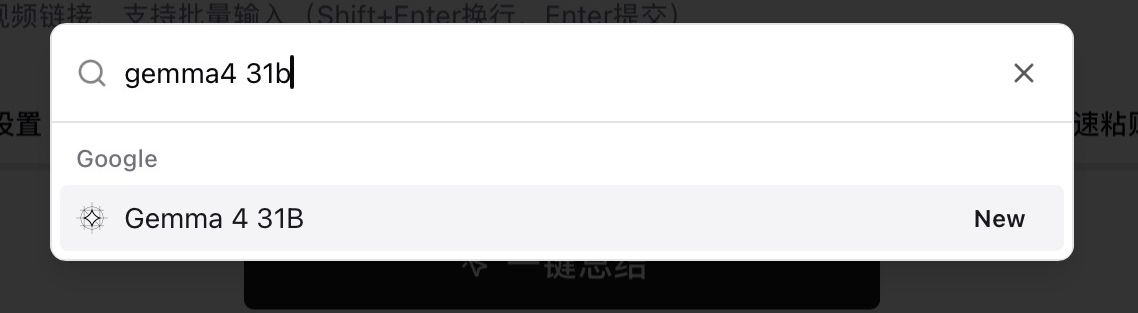
- Switch the model selector to Gemma 4 31B (open-source economy lane) or Claude 3.5 Sonnet (premium lane)
- Compare subtitles, chapters, and mind maps across both
- Pin the model that fits your content profile
What you’ll feel: daily vlogs / short-form → Gemma 4 31B wins on price-performance. Professional lectures / long meetings / multilingual mix → Claude 3.5 Sonnet still leads.
5. Three predictions
Prediction 1: Open-source won’t kill APIs, but it will compress prices. After Gemma 4, the mini/haiku tiers from OpenAI/Anthropic will keep dropping (already happening). Everyone calling APIs benefits.
Prediction 2: The real moat for self-hosting is compliance, not cost. What actually drives self-hosting is “data must not leave my data center” and audit requirements — not saving dollars.
Prediction 3: Multi-model routing becomes table stakes. The single-vendor era is over. The next layer of product differentiation is “use the right model for the right scenario.” BibiGPT shipped this 12 months early and will compound.
FAQ: Common questions on self-hosting Gemma 4 vs APIs
Q1: I’m a creator processing 1-2 videos a day — should I self-host?
No. At 30-60 minutes/month, API costs < $1. Self-hosting starts at $1,500+/month. A BibiGPT Plus subscription is the obviously cheaper path.
Q2: Can a quantized Gemma 4 31B run on my local machine?
Yes. INT4 quantization fits in ~18GB VRAM, so a single RTX 4090 24G works. But long-context videos will stutter — you won’t enjoy the workflow compared to API.
Q3: Has BibiGPT integrated Gemma 4 yet?
Yes. The new Gemma 4 model feature page shows Gemma 4 31B as a routing option you can switch to inside the product.
Q4: Will the savings from self-hosting cover an engineer’s salary?
Not for SMBs. You need 300,000+ minutes/month (≈ $2,700/month savings) before self-hosting starts paying for an ML engineer. So “self-host to save money” is mostly a myth at small scale.
Q5: Are open-source models more private than APIs?
Technically yes — you fully control data flow. But OpenAI/Anthropic both offer “no-training” toggles + ZDR retention windows that meet most enterprise compliance. The genuine self-host case is “data physically must not leave my premises.”
Closing: cost is the surface, capability mix is the substance
Gemma 4 is the open-source AI milestone of 2026. But “Gemma 4 self-host vs API” might be the wrong question — the right one is “what model mix does my content actually need?”
BibiGPT’s product philosophy is simple: users shouldn’t have to think about which model to call. The routing layer dispatches by content type, length, language, and compliance posture — you just paste a link and read the result.
Further reading:
- Gemma 4 On-Device 256K Multimodal: How BibiGPT Routes 30+ Platforms in One Click
- Google Gemma 4 AI Video Understanding: Complete Open-Source Guide
- Complete Guide to AI Video Summarization
- YouTube Video Summarizer Tools — Comprehensive Guide
Authoritative sources:
BibiGPT Team