YouTube Brandcast 2026: Veo3 Fast + AskStudio Close the Platform AI Loop — Where Does BibiGPT Still Differentiate?
YouTube Brandcast 2026: Veo3 Fast + AskStudio Close the Platform AI Loop — Where Does BibiGPT Still Differentiate?
TL;DR: YouTube Brandcast 2026 pulled generation, editing, Q&A, and live interaction into the platform — Veo3 Fast for fast video generation, AskStudio for channel-level Q&A, native auto-Shorts editing, and AI co-hosts for livestreams. The single-video, consumption-side experience is now genuinely tight inside YouTube. But the real creator workflow is multi-platform aggregation + cross-account knowledge stacking + downstream creation — and that is exactly where BibiGPT stays differentiated. This piece walks through what YouTube’s platform AI now owns, what gaps it leaves open, and how creators should compose their 2026 H2 stack.
What YouTube Brandcast 2026 Actually Shipped
Brandcast 2026 was YouTube’s big platform-AI moment. Four releases matter for creators:
- Veo3 Fast — A latency-optimized variant of Veo 3.1 designed for Shorts, ads, and B-roll. Creators can generate intros, transitions, and clips directly inside YouTube Studio in seconds.
- AskStudio — A channel-level AI Q&A surface. Viewers can ask the channel itself (“Which laptop did this creator recommend?” “Which episode covered that topic?”) and get answers grounded in the entire channel library plus the creator’s persona.
- Auto-Shorts editing — Studio now natively turns long videos into 30/60/90-second Shorts with captions and hooks, no external editor required.
- AI co-hosts for Live — In livestreams, AI can summarize super chats, answer common questions, and keep momentum during gaps.
Stitched together, the intent is obvious: let creators stay inside YouTube for the full loop — generate → edit → publish → engage with viewers.
What the Platform AI Loop Just Took Over
Looking only at the consumption side (“I’m a viewer trying to understand this video”), AskStudio plus YouTube’s built-in AI Summary and chapter generation have aggressively compressed third-party tool entry points. Specifically:
- Single-video Q&A and “find that thing in the video” — Viewers tap AskStudio on the watch page; no need to copy a link out to a third-party tool.
- Chapter detection + key-point extraction — YouTube’s native AI Summary has been rolling out broadly since late 2025.
- Shorts-side rapid generation + cutting — Veo3 Fast cuts generation cost to seconds; Studio’s auto-cut replaces external editors for many creators.
What this means: if your tool only does “YouTube link → single-video summary or single-video Q&A”, platform AI is now good enough. The differentiation lane in that exact slot is shrinking.
What the Platform AI Loop Left Open
But creator workflows are not exclusively on YouTube. Here are the gaps YouTube’s platform AI has no architectural or commercial reason to close:
Gap 1: Multi-platform source aggregation
A career-content creator might consume 30+ pieces of content per week across Bilibili, Xiaohongshu, Douyin, X, podcasts, and YouTube. YouTube platform AI only works inside YouTube — it cannot cross-reference a Bilibili long video with a podcast interview, and it cannot link a Xiaohongshu growth note with a YouTube tutorial. BibiGPT’s AI YouTube summary, AI Bilibili summary, podcast transcription, and Xiaohongshu note ingestion all land in the same workspace — cross-platform search and aggregation are the default mode.
Gap 2: Cross-account, cross-source knowledge stacking
AskStudio can only answer “what did this channel cover?” Creators actually want to ask: “What do the 20 channels I follow + my own raw footage + the PDFs and book reviews I’ve read say combined about this topic?” That’s the free video summarizer layered with Notion / Obsidian sync — and platform AI will never build it because it works against per-channel retention.
Gap 3: Downstream creation (not “watch it” but “produce something from it”)
YouTube platform AI helps you watch a video; BibiGPT helps you turn that video into raw material — frame analysis for newsletter cover images, key-quote extraction for short-form scripts, bilingual subtitles for international audiences, mind maps stored back in Obsidian. That’s the divide between consumer tools and creator tools.
Gap 4: Private / local / unpublished assets
Your meeting recordings, internal training videos, customer interviews, voice memos — none of those ever get uploaded to YouTube. Platform AI cannot help. BibiGPT’s macOS desktop client processes local media files directly, and that surface is growing more important in 2026, not less.
Gap 5: Cross-language depth
YouTube AI Summary is English-first. Chinese creator videos, Japanese podcasts, Korean variety shows — platform-AI summary quality drops noticeably. BibiGPT has spent years tuning specifically for Chinese / English / Japanese / Korean / Traditional Chinese, which makes it the actual multilingual knowledge tool.
Suggested 2026 H2 Creator Stack
Platform AI isn’t BibiGPT’s replacement — it perfects “single-platform single-video consumption.” BibiGPT perfects “multi-platform aggregation + creation output.” Different markets.
Consumption side (understanding others’ videos):
- Quick comprehension of a single YouTube video → use YouTube’s native AskStudio
- Cross-platform material comparison and cross-account synthesis → use BibiGPT
Creation side (producing your own content):
- Generating intros / transitions / Shorts B-roll → use Veo3 Fast / YouTube Studio auto-cut
- Turning videos and podcasts into long-form articles, mind maps, bilingual subtitles, newsletter graphics → use BibiGPT
Practical recommendations:
- Don’t kill your third-party tooling betting on platform AI to retain attention — platform AI locks viewer experience; creator tools compete on production capability. Different markets.
- Maintain both YouTube AskStudio (for viewers asking you) and a BibiGPT workspace (for you learning) — the former is a brand asset, the latter is creator productivity.
- Multi-platform creators should default to BibiGPT as the source-of-truth library — pull Bilibili / Douyin / Xiaohongshu / podcast material in one place; YouTube platform AI is a black box outside of YouTube itself.
How BibiGPT Absorbs Post-Brandcast Demand
We’ve seen two high-frequency questions since Brandcast:
- “YouTube has AI Summary built in — do I still need BibiGPT?” → See the five gaps above.
- “Veo3 Fast launched. Will BibiGPT ship generation features?” → Short term, no — generation belongs to the platforms and foundation-model companies. BibiGPT’s investment goes into “existing content → creator-usable raw material”: frame-level analysis, bilingual subtitle burn-in, AI dialog with source tracing, and tighter Notion / Obsidian / Readwise sync.
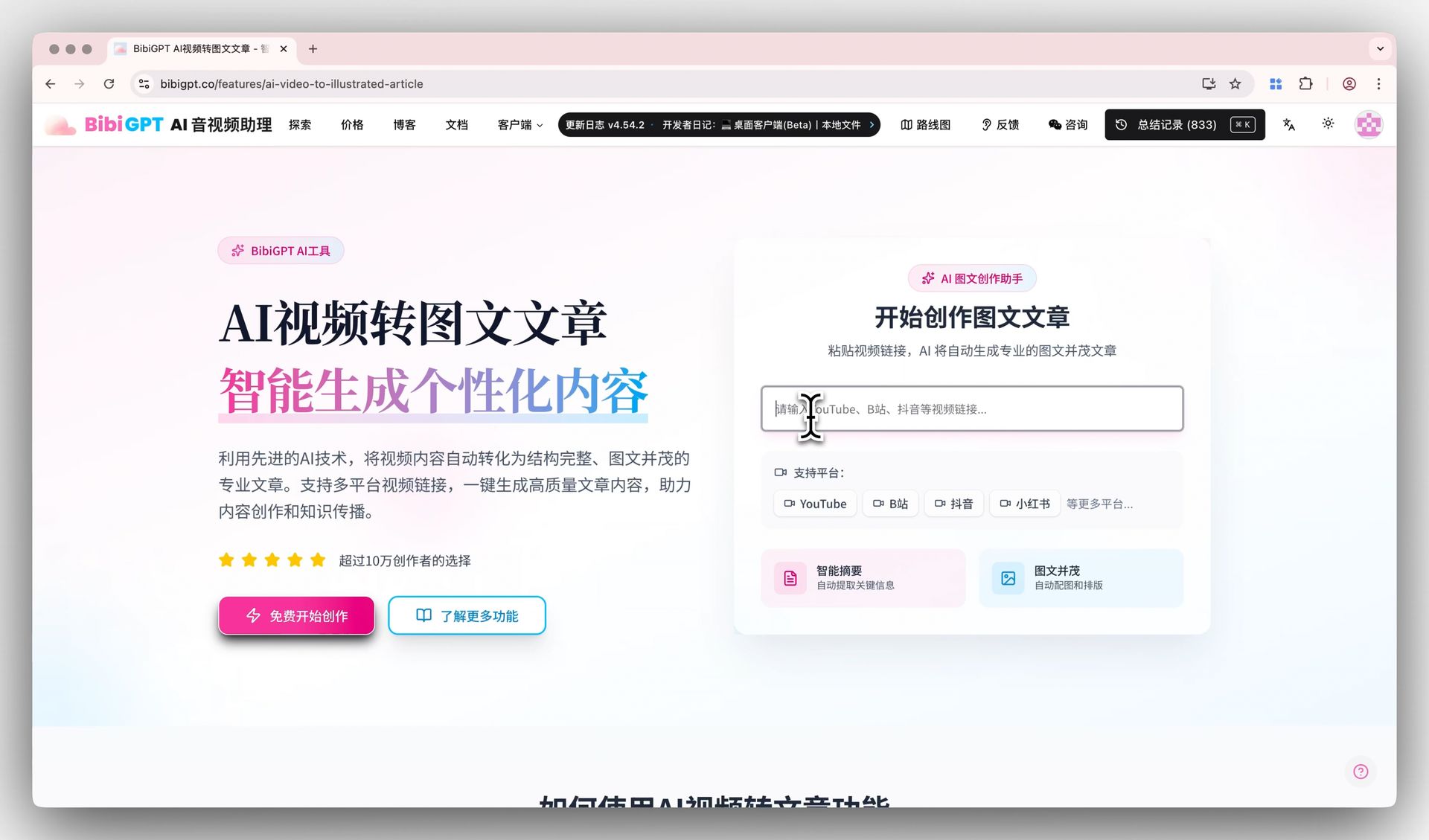
Try BibiGPT free — paste any YouTube / Bilibili / podcast / Xiaohongshu / Douyin link and get a timestamped summary, mind map, AI dialog, and bilingual subtitles in 30 seconds. This is the slice of the creator workflow platform AI can’t take.
FAQ
Q: After AskStudio, is there still market for third-party YouTube summary tools? A: Single-video consumption-side scenarios get compressed; multi-platform + creation-side scenarios expand.
Q: Is Veo3 Fast a competitor to BibiGPT? A: No. Veo3 Fast generates new video from scratch; BibiGPT extracts knowledge and creation material from existing video. Opposite directions.
Q: Will BibiGPT support full-channel Q&A across multiple YouTube channels? A: Already on the roadmap — a BibiGPT workspace can ingest videos from multiple subscribed channels and creators for cross-channel Q&A, broader than AskStudio’s single-channel scope.