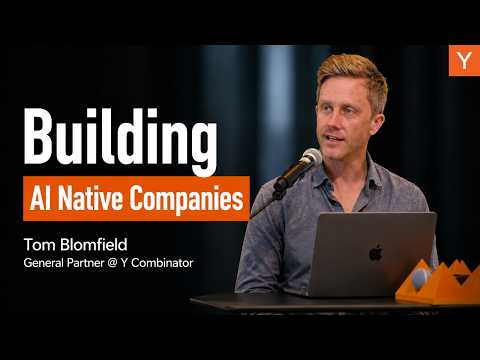
Traditional companies widely use hierarchical management modeled on Roman legions — relaying information through humans to make decisions — and this has become a bottleneck on modern economic value creation. The speaker argues that AI has fundamentally eliminated the need for such hierarchical structures. Treating AI merely as a personal productivity copilot is the wrong mental model; it just puts a faster engine on old ways of working. Instead, companies should rethink their fundamental nature through AI — restructuring into a set of recursive, self-improving intelligent feedback loops.
The core of a self-improving company is building "AI loops" across four key layers: a sensing layer that captures external signals like customer feedback or product data; a decision layer that sets behavioral rules and human-intervention thresholds; a tool layer that automates operations through deterministic API calls; and a quality-control and learning mechanism that diagnoses failures and automatically updates models or code. This architecture enables self-monitoring — when a task fails, AI automatically updates the knowledge base, adjusts the process, and deploys a fix, allowing the system to optimize itself overnight with no human intervention.
In the new AI-driven organization, the operational goal shifts from growing headcount to optimizing token usage per unit of value created. The speaker argues that middle management will become redundant — companies should flatten their structures so every member is an individual contributor directly building the business. Human roles are redefined as monitors and guardians of business "boundaries," handling complex ethical decisions, high-stakes interpersonal communication, and emotionally demanding critical moments that AI currently cannot manage well — focusing human productivity exactly where human judgment is needed most.
The prerequisite for self-improvement is making everything the company does "readable" to AI. This means digitally recording all conversations, decisions, and business knowledge, then using AI to structure and summarize these massive datasets. The speaker uses YC's user manual as an example: by converting hundreds of hours of consulting sessions into a continuously updated knowledge base, they generated a guide more comprehensive than anything a human could write. Software should be treated as disposable — business process know-how lives in the data, while execution-layer software can be dynamically generated and iterated by AI, keeping the company operating at peak performance.
Highlights
🔄 Self-improving companies run on four interlocking AI loops — sensing, decision, tool execution, and quality-control — allowing systems to diagnose failures and deploy fixes overnight without human intervention.
🏛️ Using AI merely as a personal productivity copilot is the wrong mental model; it just accelerates old hierarchical workflows instead of eliminating the bottleneck entirely.
📉 The metric for AI-era organizations shifts from headcount growth to token-per-value-created efficiency, making middle management structurally redundant as individual contributors connect directly to impact.
🧠 Making business operations "readable" to AI — by digitally recording all decisions, conversations, and processes — turns institutional knowledge into a continuously improving asset rather than a depreciating one.
💡 Treating software as disposable while keeping business process know-how in data enables AI to dynamically regenerate execution-layer code, keeping the company at peak performance as conditions change.