ChatGPT for Personal Finance Is Here — But Finance Videos Still Need BibiGPT (2026)
ChatGPT for Personal Finance Is Here — But Finance Videos Still Need BibiGPT (2026)
Quick answer: As of 2026-05-29, OpenAI has launched ChatGPT’s personal finance experience (powered by GPT-5.5), letting you connect your bank and brokerage accounts for conversational financial analysis. Its strength is “talking to your account data,” not “rapidly digesting an hour-long finance video.” If you follow investing podcasts, YouTube finance courses, and earnings calls every day, your real bottleneck isn’t a missing chatbot — it’s the pile of long videos you can’t finish. That’s exactly where BibiGPT is built to help: paste a link, get structured notes and a mind map in seconds.
Background: ChatGPT’s Personal Finance Experience Goes Live
Let’s get the news straight first.
On Friday, May 15, 2026, OpenAI launched a personal finance feature set in preview for ChatGPT Pro subscribers in the U.S. According to TechCrunch, users can connect their accounts and ask ChatGPT everything from “spending analysis” to “future financial planning.”
A few key facts, drawn from OpenAI’s official announcement and cross-referenced coverage (see TechCrunch and MacRumors):
- Account connection: OpenAI partnered with the financial connectivity service Plaid, supporting 12,000+ financial institutions, including Schwab, Fidelity, Chase, Robinhood, American Express, and Capital One.
- Dashboard: Once connected, you see a dashboard of portfolio performance, spending, subscriptions, and upcoming payments.
- Financial memory: You can share context like a mortgage, savings goal, or upcoming large purchase, which gets saved to “Financial memories” to inform future conversations.
- Model upgrade: The feature defaults to GPT-5.5 Thinking, which OpenAI says is “stronger at reasoning with context.” On its internal benchmark, GPT-5.5 Thinking scored 79/100 and GPT-5.5 Pro scored 82.5/100.
Practical rule: When a general AI starts taking over “your structured data” (accounts, tables, records), it gets strong in that domain — but “unstructured long content” (videos, audio, meetings) remains a different problem entirely.
The trajectory is clear: this is OpenAI’s key step in pushing ChatGPT from “chat assistant” to “financial manager that can act on your real accounts.” For finance and professional audiences — also the highest-paying group — it signals a noticeable acceleration in AI adoption.
Deep Dive: What ChatGPT for Finance Changes — and What It Doesn’t
Here’s a hand-drawn sketch laying out the relationship between the roles we just described:
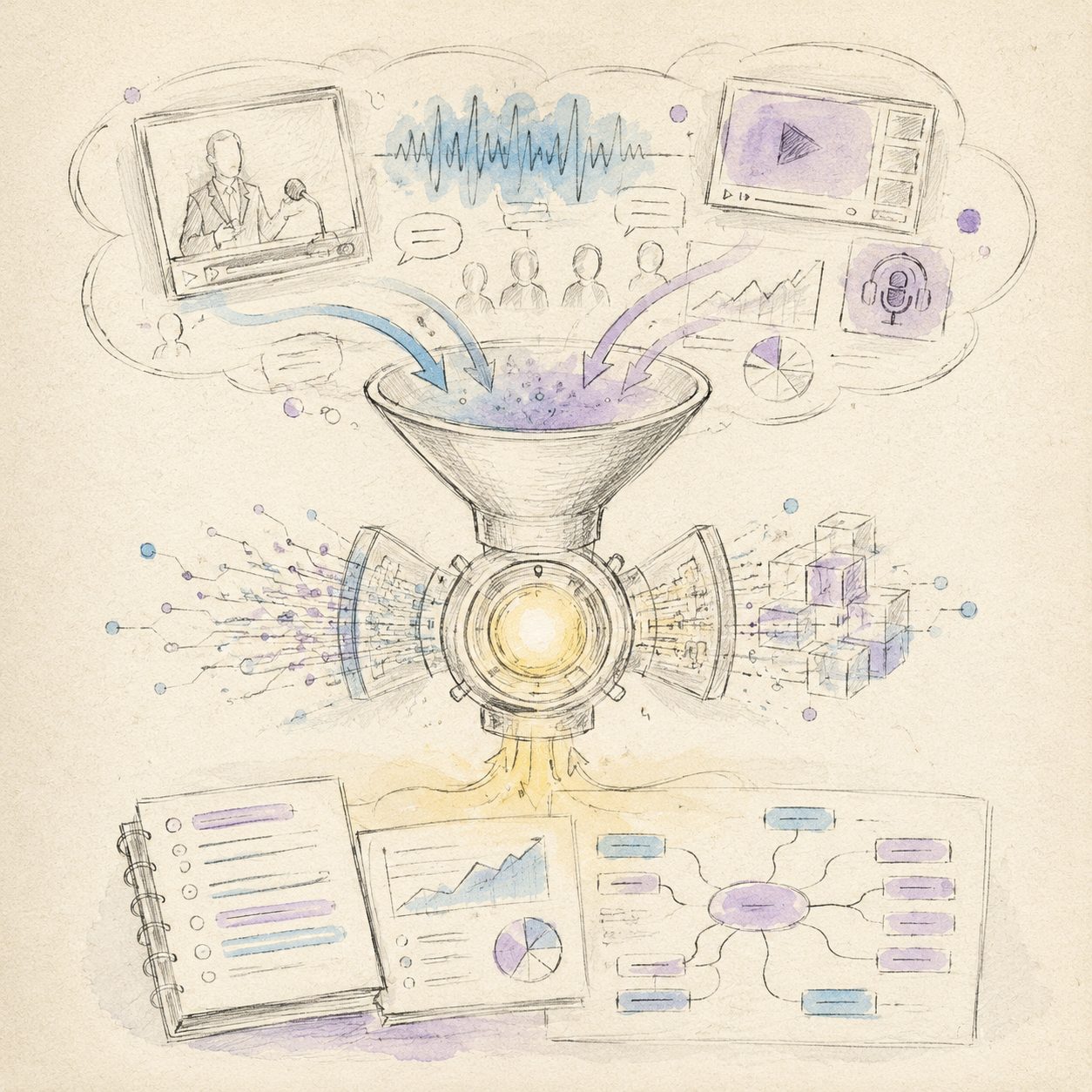
Illustration: drawn by the BibiGPT team for this article (hand-drawn style)
Technical impact: from “reading text” to “reading your money”
The biggest technical leap is expanding the model’s input from “public web pages + what you type” to “your real account activity.” Plaid solves “getting the data in”; GPT-5.5’s long-context reasoning solves “understanding the data.”
But note one detail: it handles structured financial data — individual transactions, holdings, bills. That kind of data is a natural fit for language models.
Market impact: the finance crowd’s AI anxiety just got louder
As Plaid’s blog points out, the signal of this partnership is that “AI is becoming a new gateway to digital finance.” For individuals — especially those tracking investments, watching markets, and doing career-stage financial planning — it’s a strong reminder: people who don’t use AI for financial information are falling behind on efficiency.
Ecosystem impact: but “finance content” is still video and audio’s turf
Here’s an overlooked blind spot.
The information finance audiences consume daily is mostly not account data — it’s content:
- A 90-minute investing podcast
- A 2-hour YouTube valuation course
- A 1-hour earnings call
- A finance creator’s market recap video
These are unstructured long videos and audio. No matter how strong ChatGPT for finance is, it won’t condense that one-hour earnings call into 10 actionable conclusions for you. That’s the home turf of a dedicated video summarizer.
Practical rule: To judge whether an AI tool helps you, look at where you spend 80% of your time. If it’s watching videos and listening to podcasts, you need a “video → notes” pipeline, not an “account → conversation” assistant.
What This Means for BibiGPT Users, by Audience
For investors / finance creators
Your biggest pain point is “information overload + not enough time.” Five must-watch finance videos a day, an hour each — you can’t watch them all. Paste a link into BibiGPT and get a Smart Deep Summary with a core summary, highlights, and timestamps in seconds — decide what’s worth a close watch, then jump to the key moment.
For professionals / financial planners
You’re switching careers, budgeting, or studying taxes, and need to absorb a whole course series systematically. BibiGPT’s selective playlist summary lets you pick the exact lessons you need from a finance course playlist and batch-generate notes — no going lesson by lesson.
For teams / enterprise users
During earnings season you have to track dozens of companies’ call recordings — listening manually is impossible. BibiGPT supports batch processing, structuring each call’s key points, then uses Collections AI Chat for cross-video Q&A — “How does each company’s guidance for next quarter differ?” answered in one question.
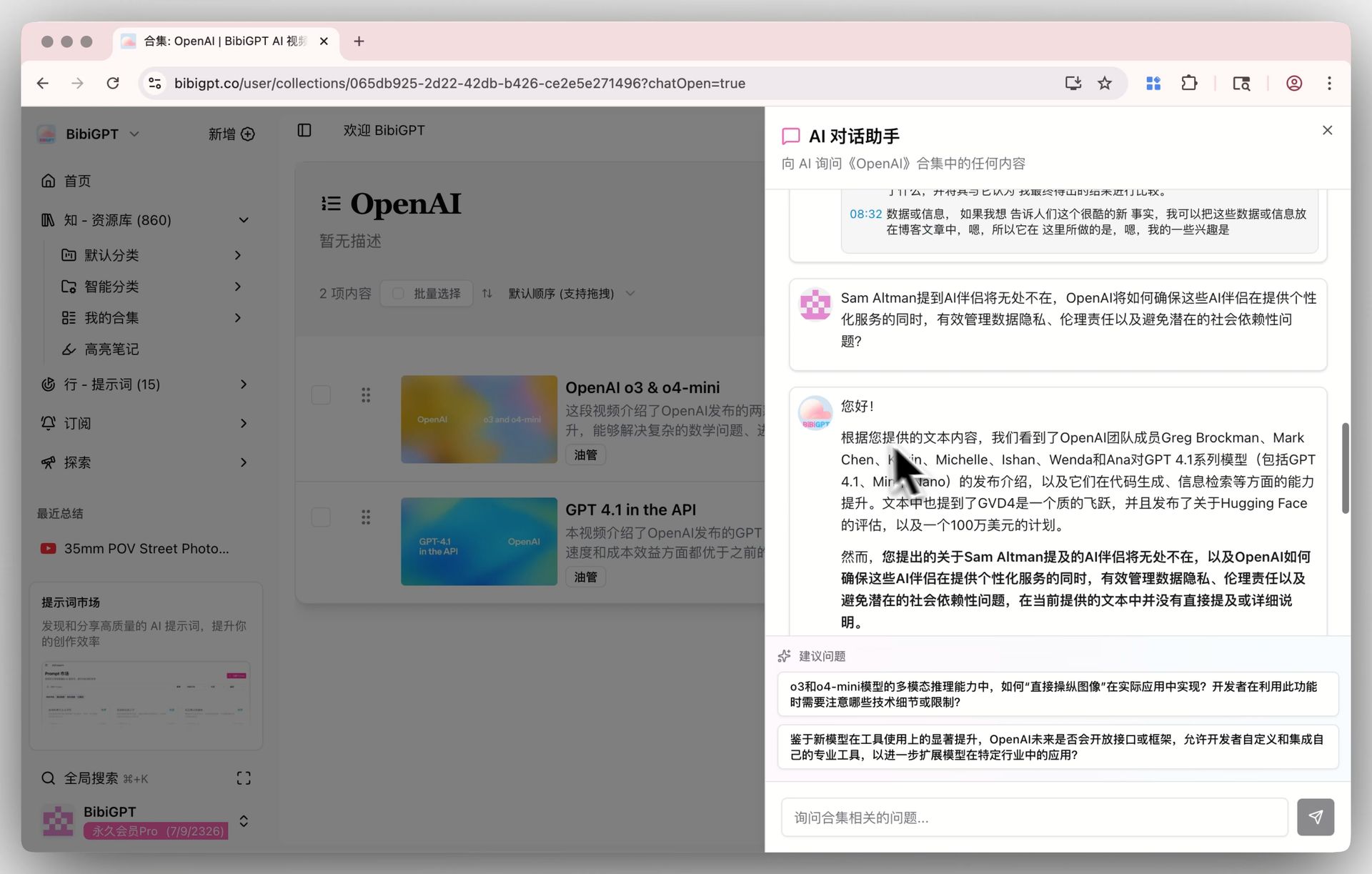
BibiGPT in Practice: Turn an Earnings Call into Actionable Notes
This workflow runs daily for finance users. Pair it with ChatGPT for finance — one handles “your accounts,” the other handles “the content you watch.” Complementary, not competing.
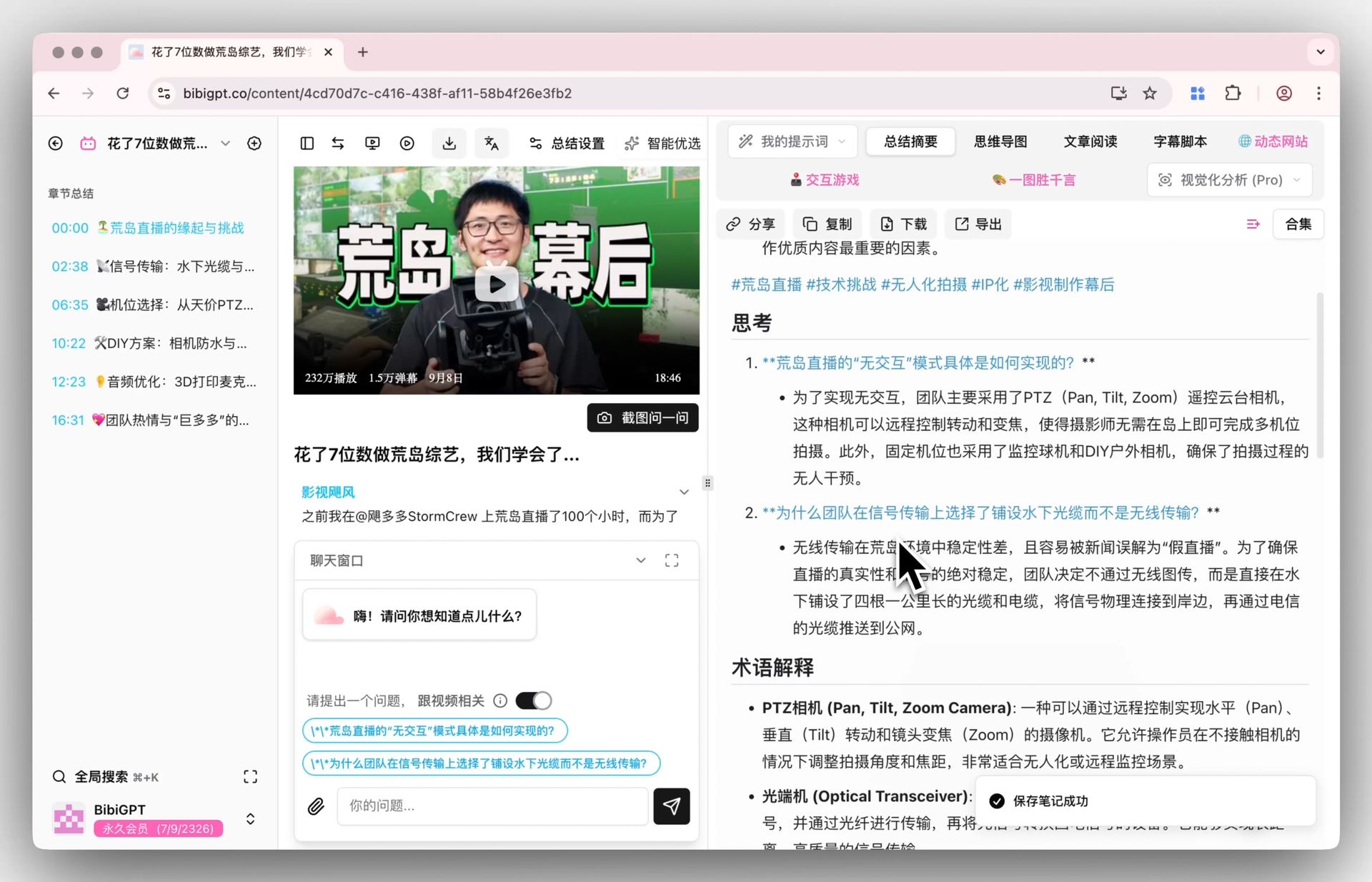
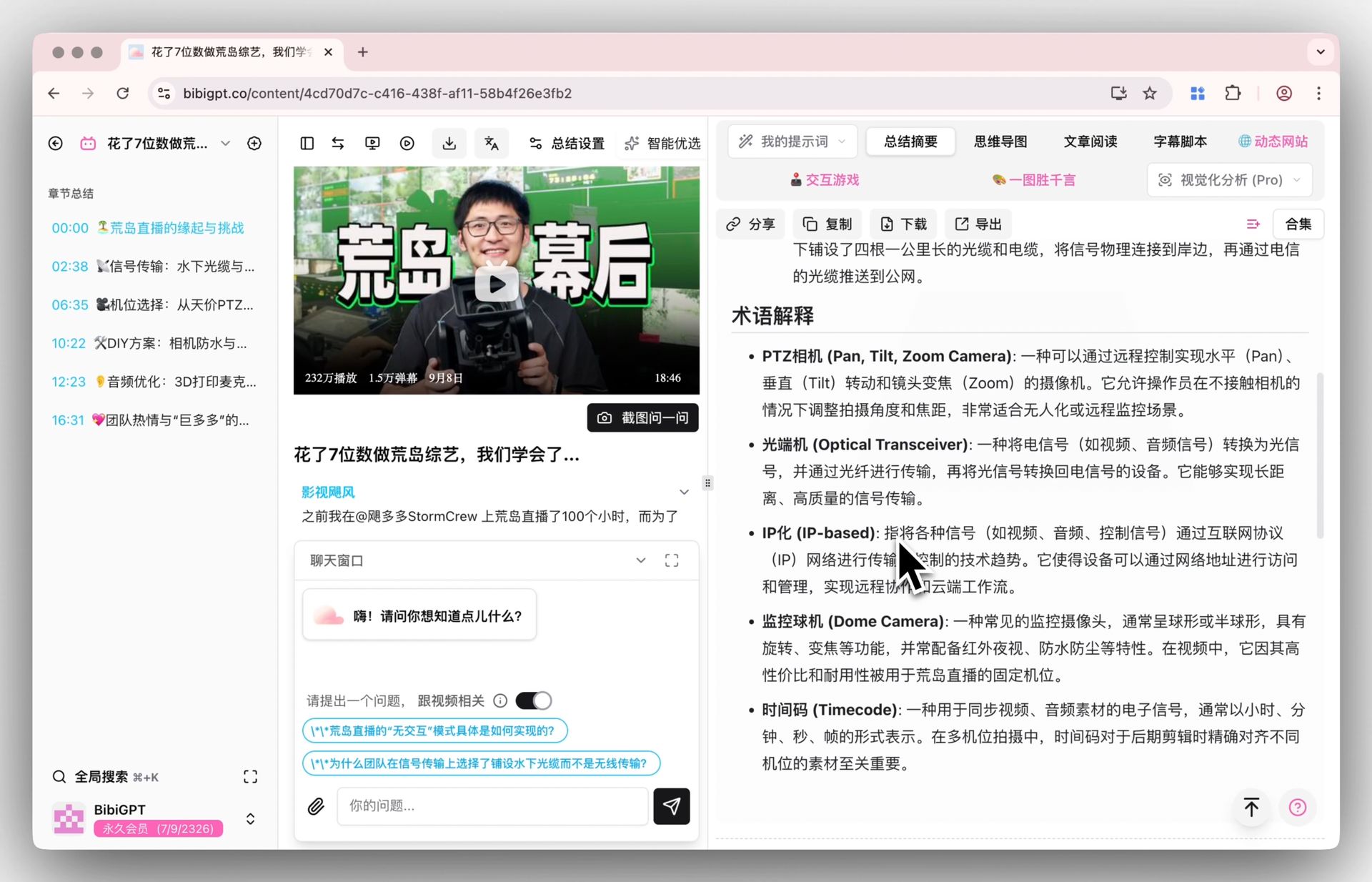
Step 1: Paste a link, get a structured summary. Copy a YouTube earnings call or investing podcast link, paste it into BibiGPT, and in seconds get a core summary, key highlights, thought-provoking Q&A, and term explanations. Those finance abbreviations and concepts (EBITDA, guidance, buyback) get explained automatically.
The image below shows the auto-generated Q&A and term explanations inside Smart Deep Summary — after reading it, you can immediately self-check “did I really understand this call?”
Step 2: Switch to the mind map and see the logical skeleton. An earnings call’s logic — results recap, segment performance, risk factors, next-quarter guidance — is far easier to grasp as a mind map than by listening linearly for an hour.
Step 3: Ask AI follow-ups, sourced back to the original timestamp. Ask about anything unclear in the summary, and BibiGPT answers while jumping to the corresponding moment in the original video, so you verify management’s actual words instead of a secondhand paraphrase.
Want to feel how fast this is? Paste a finance video link into BibiGPT video summary — results in seconds.
Step 4: Export and archive. Export notes as Markdown into your knowledge base, or one-click rewrite into an article — from watching videos to publishing content, end to end.
BibiGPT isn’t just another model wrapper. It serves over 1 million users, has generated over 5 million AI summaries, and supports 30+ platforms. On top of the model sit visual analysis, source tracking, and collection summarization — pipelines built specifically for “digesting long content.”
What’s Next: Content Digestion Becomes the Next AI Battleground
Three takeaways from this event:
- General AI will keep eating “structured data” scenarios — accounts, calendars, email, tables. That’s where ChatGPT for finance is heading (OpenAI has announced upcoming Intuit integration for tax analysis).
- “Long content digestion” will stay with dedicated tools — because video/audio processing involves transcription, segmentation, visual understanding, and timestamp alignment: a different tech stack a general assistant won’t go deep on soon.
- The real winners are those who “combine” — ChatGPT for accounts, BibiGPT for content, each doing its job. Far more efficient than using just one.
Practical rule: Models are no longer scarce; the speed of consuming content is. Whoever turns an hour of video into 10 actionable conclusions faster wins the information edge.
FAQ
Q1: Can ChatGPT for finance summarize finance videos? It’s designed to connect and analyze your account data, not digest long videos. For a one-hour earnings call or investing podcast, a dedicated video summarizer (like BibiGPT) is faster and more structured.
Q2: Can everyone use ChatGPT for finance now? Per 9to5Mac, it’s currently open to a small group of U.S. ChatGPT Pro users (web and iOS), with plans to expand to Plus and eventually all users.
Q3: What finance content sources does BibiGPT support? YouTube, Bilibili, podcasts, local uploads, and 30+ platforms — earnings call recordings, investing podcasts, and finance courses can all be summarized in one click.
Q4: Can BibiGPT handle English finance videos? Yes. BibiGPT supports multilingual output across Chinese, English, Japanese, and Korean — English earnings calls and investing courses can be summarized directly with key timestamps.
Q5: Can I use ChatGPT for finance and BibiGPT together? Recommended. ChatGPT handles “how are my accounts,” BibiGPT handles “what did the content say.” They’re complementary — combined, they form a finance professional’s complete AI workflow.
Try It Now
Paste the investing podcast, YouTube finance course, or earnings call recording you’re following — get a structured, timestamped summary in seconds, so you decide what’s worth a close watch before spending an hour.
Paste a finance video and try it
BibiGPT Team