
Qwen3.5 Omni for Long Video Summary: 10-Hour Audio + 400-Second Video Native Processing vs BibiGPT (2026)
Alibaba's Qwen3.5 Omni natively handles 10+ hours of audio, 400+ seconds of 720p video, 113 languages, and 256k context. We break down the model specs and compare the end-user experience against BibiGPT — the AI video assistant that wraps models like this into a single paste-and-go flow.
Qwen3.5 Omni for Long Video Summary: 10-Hour Audio + 400-Second Video Native Processing vs BibiGPT (2026)
Table of Contents
- What Qwen3.5 Omni means for AI video summaries
- Qwen3.5 Omni tech specs at a glance
- From model capability to end-user experience
- BibiGPT × open multimodal models in practice
- Why BibiGPT still matters
- FAQ
- Wrap-up
What Qwen3.5 Omni means for AI video summaries
Quick answer: Alibaba released Qwen3.5 Omni on March 30, 2026 — arguably the strongest open-source fully multimodal model to date. It natively handles 10+ hours of audio, 400+ seconds of 720p video, 113 languages, and a 256k context window, pushing the "ceiling" of AI video summaries to frontier closed-model territory. For end users it is best understood as a foundation-layer upgrade: open-source models give AI assistants like BibiGPT more engines to choose from, translating into longer, more accurate, and more multilingual summaries at lower cost.
试试粘贴你的视频链接
支持 YouTube、B站、抖音、小红书等 30+ 平台
If you've been frustrated the past year by "videos are too long for the AI," "non-English transcription is error-prone," or "summaries cut off after 30 minutes," Qwen3.5 Omni's generation of fully multimodal models is the direct remedy. This article dissects it from three angles: the model specs, what it takes to actually run it, and how products like BibiGPT turn it into a paste-and-go experience.
Qwen3.5 Omni tech specs at a glance
Quick answer: Qwen3.5 Omni's headline is "one model across text/image/audio/video," with native 10+ hour audio input, 400+ seconds of 720p video frame understanding, 256k token context, 113-language ASR, and Qwen's continued Thinker/Talker dual-brain architecture.
Based on Alibaba Qwen's official release coverage on MarkTechPost, the key specs are:
| Dimension | Spec | Why it matters for video summaries |
|---|---|---|
| Audio input | 10+ hours native | Full coverage of long podcasts, seminars, all-day lectures |
| Video input | 400+ seconds @ 720p | Frame-aware summaries that combine visuals and speech |
| Language ASR | 113 languages | Localization and cross-border meetings |
| Context | 256k tokens | Long video + citations + follow-up questions in one pass |
| Architecture | Thinker / Talker dual-brain | Reasoning and speech output decoupled; real-time interaction |
| License | Apache 2.0 | Commercial use, fine-tuning, and on-prem deployment |
For a broader benchmark across GPT, Claude, Gemini, and Qwen-series models, see our 2026 best AI audio/video summary tool review.
Why the open-source route matters
Qwen3.5 Omni landed the same week as InfiniteTalk AI, Gemma 4, Llama 4 Scout, and the Microsoft MAI family — the open multimodal space is now on a monthly release cadence. For users that translates into:
- Long-video summaries no longer require premium tiers — cheaper open bases let products lower pricing
- Non-English video finally works — 113 languages cover Spanish podcasts, Japanese lectures, Korean livestreams
- Privacy-sensitive use cases have options — Apache 2.0 allows on-prem, enterprise video doesn't have to leave the building
From model capability to end-user experience
Quick answer: Model specs are just the ceiling. Real end-user experience depends on engineering, platform adaptation, interaction design, and reliability. Qwen3.5 Omni's 256k context looks great in a paper, but between pasting a Bilibili link and getting a final summary there's URL parsing, subtitle extraction, hard-subtitle OCR, segmentation, prompt engineering, rendering, and export.
A production-grade AI video assistant solves at least seven engineering problems:
- URL parsing — YouTube / Bilibili / TikTok / Xiaohongshu / podcast apps each have their own URL and anti-scraping quirks
- Subtitle sourcing — use CC when available, run ASR when not, OCR for burned-in captions
- Long-content chunking — 256k sounds big, but 10 hours of audio will still saturate; you need smart chunking + summary merging
- Line-by-line translation — subtitle translation must keep timestamps, not lose them to wholesale paragraph translation
- Structured output — chapters / timestamps / summaries / mind maps require stable prompt engineering
- Export formats — SRT / Markdown / PDF / Notion / WeChat article each have their own conventions
- Reliability & cost — 10-hour podcasts are expensive; productization needs caching, queues, and priority
In other words, the frontier model alone isn't enough. Users don't want raw weights; they want a working product.
BibiGPT × open multimodal models in practice
Quick answer: BibiGPT is a leading AI audio/video assistant, trusted by over 1 million users with over 5 million AI summaries generated. Its role in a Qwen3.5 Omni-class world is to "wrap the frontier model into a paste-and-go experience" — users never see model names, chunking strategies, or deployment details.
From URL to structured summary
看看 BibiGPT 的 AI 总结效果
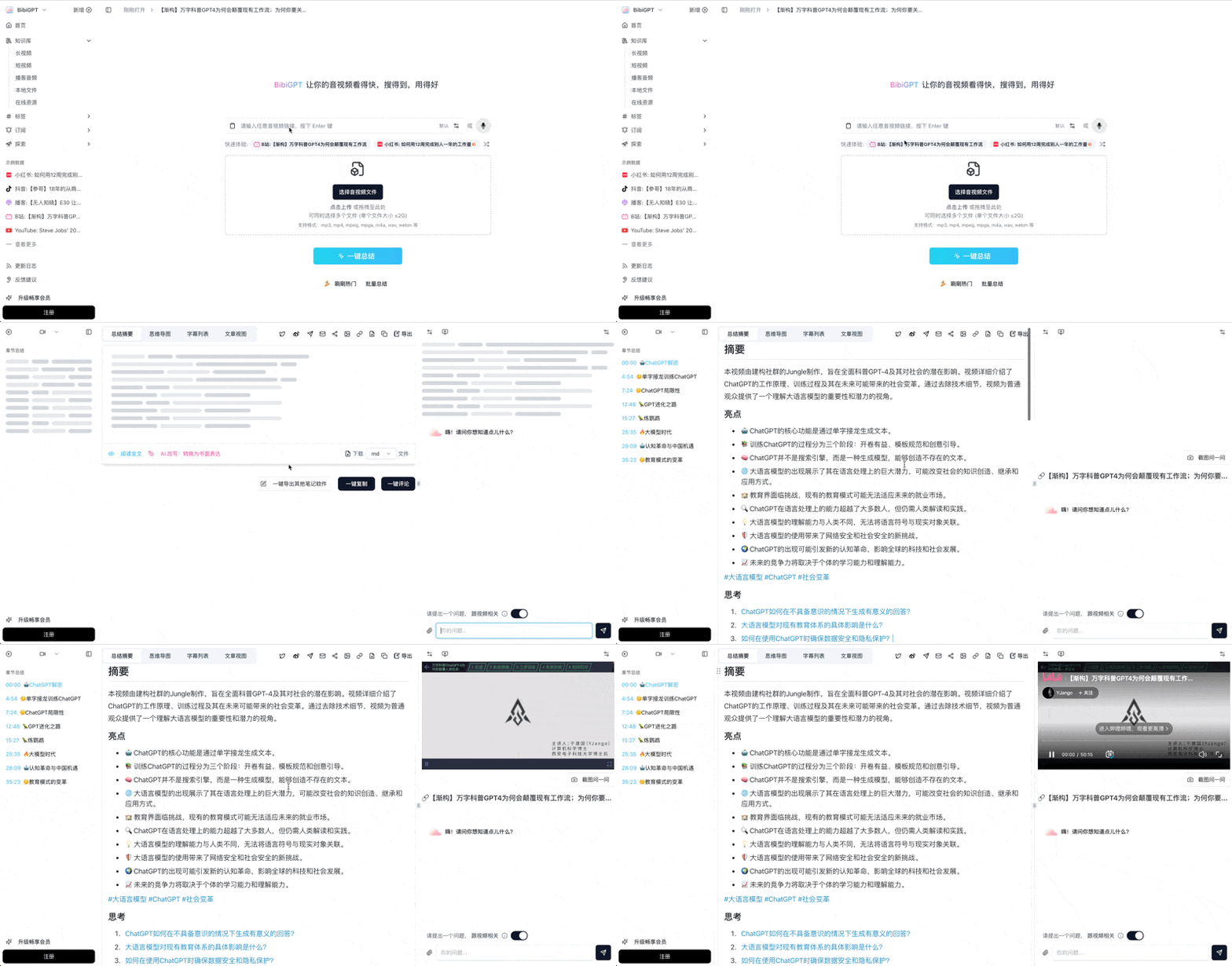
Bilibili: GPT-4 & Workflow Revolution
A deep-dive explainer on how GPT-4 transforms work, covering model internals, training stages, and the societal shift ahead.
How summarizing a 3-hour Bilibili tech talk actually looks:
- Open aitodo.co, paste the link
- The system auto-fetches captions (uses CC when available; ASR otherwise)
- Smart chunking → section summaries → chapter merging
- ~2 minutes later: full transcript, chaptered summary, mind map, AI chat with timestamps
The same flow works across platforms — Bilibili video summary, YouTube video summary, and podcast generation share the same pipeline.
What makes long-video UX actually work
Long audio/video is where Qwen3.5 Omni-class models shine, but "summarizing a 4-hour podcast without breaks" requires more than model context length:
- Smart subtitle segmentation — merges 174 choppy captions into 38 readable sentences, saving context
- Chapter deep-reading — integrates chapter summaries, AI polish, and captions in a focused reader
- AI chat with video — ask anything, with timestamp-traceable source citations
- Visual analysis — keyframe screenshots + content understanding for social cards, short-form videos, slides
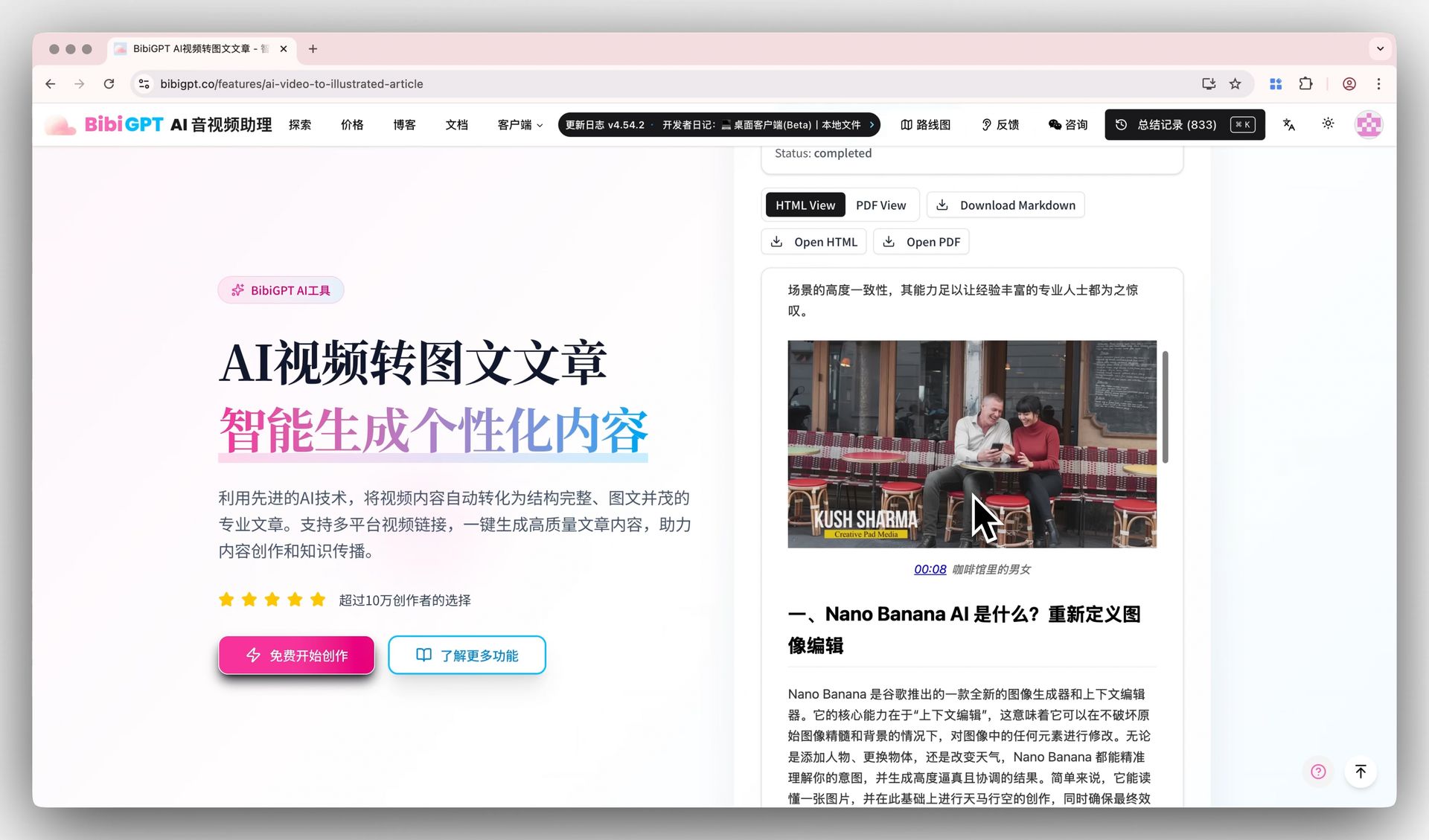 AI video to article output
Why BibiGPT still matters
Quick answer: Qwen3.5 Omni is a foundation model; BibiGPT is a product experience. They are complementary, not competing. BibiGPT's differentiation spans four layers: 30+ platform coverage, complete subtitle pipeline, depth in Chinese creator workflows, and deep integration with Notion/Obsidian-style knowledge stacks.
1. 30+ platforms & anti-scraping engineering
Open models don't solve Bilibili/Xiaohongshu/Douyin scraping. BibiGPT invests in platform adapters across 30+ video/audio sources — that's engineering value you can't reproduce by downloading Qwen3.5 Omni weights.
2. Complete subtitle pipeline
Extraction, translation, segmentation, hard-subtitle OCR, and export form a closed loop. Not just "give me a summary" but "captions + translation + SRT + AI rewrite in one go," saving 5-8 manual steps compared to naked model calls.
3. Creator-focused workflows
WeChat article rewriting, Xiaohongshu promo images, short-video generation — these are high-frequency needs for creators. Raw models don't solve "export to WeChat." BibiGPT's AI video to article targets the creator's second-distribution workflow directly.
4. Deep notes integration
Notion, Obsidian, Readwise, Cubox — BibiGPT ships multiple note-sync connectors. Paste a link; the summary lands in your personal knowledge base. That ecosystem value isn't something raw model calls can offer.
FAQ
Q1: Is Qwen3.5 Omni better than GPT-5 or Gemini 3? A: In the "open fully-multimodal" category, Qwen3.5 Omni is arguably the strongest option today, with 10-hour audio and 113-language ASR competitive with frontier closed models. For head-to-head closed-model comparisons see NotebookLM vs BibiGPT.
Q2: Can I run video summaries with Qwen3.5 Omni myself? A: Yes — Apache 2.0 allows commercial and on-prem use. But you still have to solve GPU costs, URL parsing, subtitle sourcing, long-video chunking, and structured output. If you don't have that engineering, packaged products like BibiGPT are a better value.
Q3: Does BibiGPT use Qwen3.5 Omni under the hood? A: BibiGPT selects models dynamically based on scene and cost. The principle is "give users the fastest, most reliable, most accurate result" — specific backends are transparent to the user.
Q4: Can you really summarize 10 hours of audio in one pass? A: The model supports it on paper; real UX depends on implementation. BibiGPT uses smart chunking + summary merging to keep 3-5 hour podcasts at a stable 2-3 minutes end-to-end. For 10-hour content we recommend chunking the upload.
Q5: Will open models replace products like BibiGPT? A: Quite the opposite — stronger open models make the productization layer more valuable. Most users don't want weights; they want paste-and-go. Better models make BibiGPT faster, more accurate, and cheaper, not obsolete.
Wrap-up
Qwen3.5 Omni signals that AI video summarization is graduating from a luxury to a utility. The model ceiling keeps rising, but for end users the decisive factor is still "can I paste a link and get a result" — that's the productization layer.
If you're a researcher, creator, student, or knowledge worker, the highest-leverage move is not chasing open weights — it's using a polished AI video assistant:
- 🎬 Visit aitodo.co and paste any video link
- 💬 Need batch API access? Check out the BibiGPT Agent Skill overview
- 🧠 Bring your video knowledge into Notion / Obsidian through the built-in sync connectors
BibiGPT Team