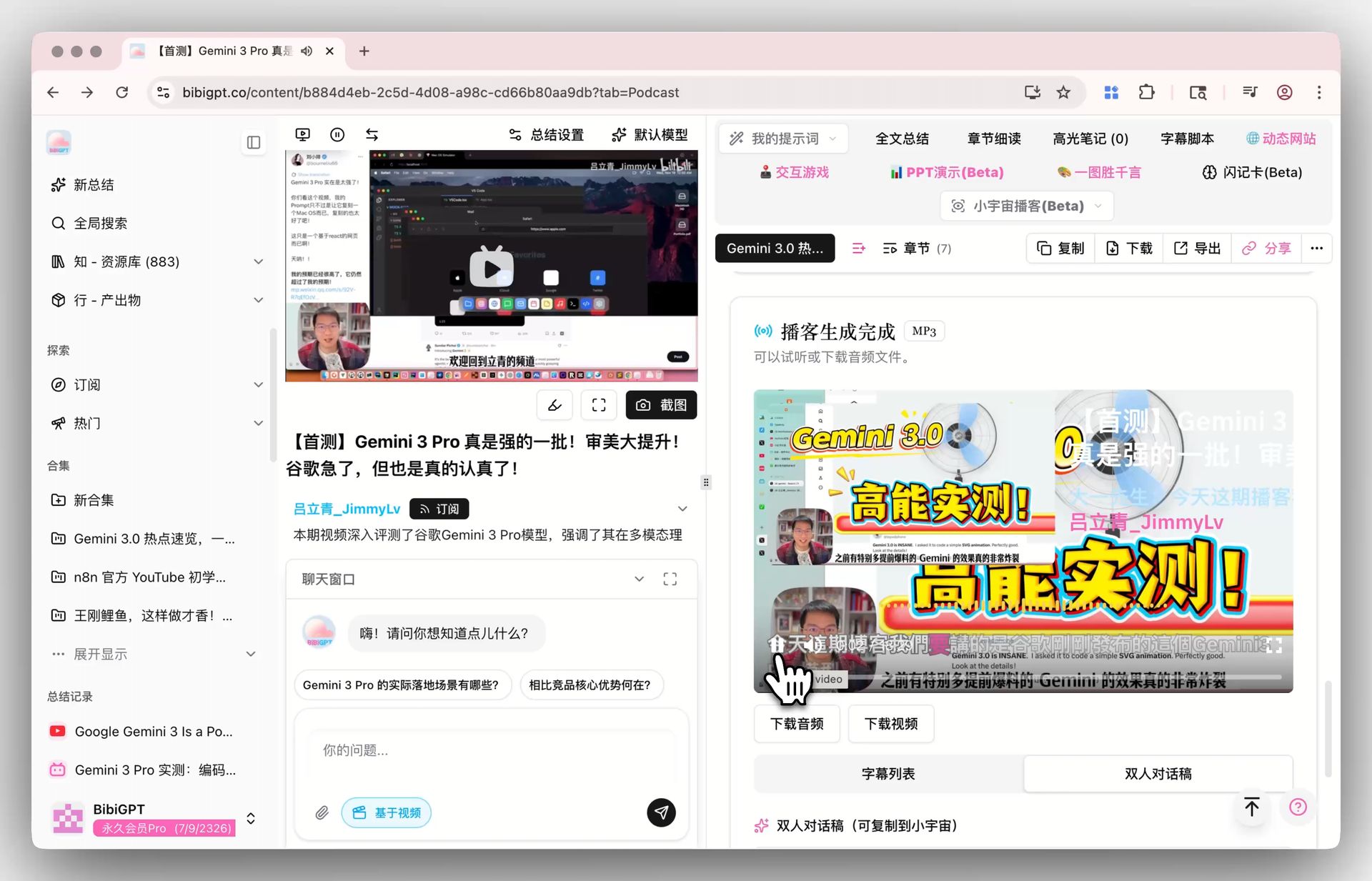
Can Gemini 3.1 Flash TTS Replace BibiGPT? Why 'AI Speaks' and 'AI Understands' Are Different Problems
Can Gemini 3.1 Flash TTS Replace BibiGPT? Why “AI Speaks” and “AI Understands” Are Different Problems
Short answer: Gemini 3.1 Flash TTS makes AI speak more affordably and expressively. Gemini Embedding 2 GA makes semantic retrieval production-ready. BibiGPT solves the hardest upstream step — turning a one-hour video, podcast, or meeting into readable, searchable, remixable knowledge. Synthesis (TTS) + Retrieval (Embedding) + Understanding (ASR+LLM) are three complementary things. This post separates them and shows how they compose.
Table of Contents
- What Gemini 3.1 Flash TTS brings
- Why Gemini Embedding 2 GA matters
- Role comparison across the pipeline
- Where BibiGPT sits: making “understand and produce” one-click
- Combined workflow: TTS + Embedding + BibiGPT
- FAQ
What Gemini 3.1 Flash TTS brings
According to the Google Gemini API changelog (2026-04-15), Gemini 3.1 Flash TTS Preview focuses on three pillars: low cost, strong expressiveness, and controllability. “Controllable” means natural-language prompts can tune tone, pace, emotion, and even accent — a meaningful level-up for podcast producers, audiobook makers, and video voice-over creators.
But here is the key distinction: TTS synthesizes already-written text into audio. Its input is text, its output is audio. It solves “AI speaks”; it does not solve “AI understands a raw recording.” This is easily conflated.
Why Gemini Embedding 2 GA matters
On 2026-04-22, Gemini Embedding 2 went GA. Embedding models project text into vectors, enabling semantic search — e.g. “find the meeting notes where we discussed Q2 growth targets” across a thousand documents.
Embedding solves “find what’s relevant”. It assumes you already have text to embed. Raw video, podcasts, and meeting recordings are audio and visual frames — not text. So before Embedding can do its job, you need high-quality transcripts and summaries.
Role comparison across the pipeline
Three fundamentally different steps:
| Capability | Input | Output | Solves |
|---|---|---|---|
| TTS (Gemini 3.1 Flash TTS) | Text | Audio | AI reads captions aloud |
| Embedding (Gemini Embedding 2) | Text | Vector | Semantic search over existing text |
| ASR + LLM summary (BibiGPT) | Audio/video file or URL | Captions + structured summary + mindmap + cards | Compress a one-hour video into 5 minutes of readable content |
In other words: you need something like BibiGPT to turn raw A/V into structured text first; only then do TTS and Embedding have something to work with.
Where BibiGPT sits: making “understand and produce” one-click
BibiGPT is a top AI audio/video assistant with 1M+ users, 5M+ AI summaries, and support for 30+ major platforms. We focus on the hardest part of the pipeline: understanding and producing.
- AI Podcast Summary: compress a two-hour interview into 5 minutes of readable content with timestamp links
- AI YouTube Summary: paste a link, get chapter-aware summary + mindmap in 30 seconds
- Visual Content Analysis: not only captions — BibiGPT also reads slides, charts, and frames, ideal for product launches and lectures

Outputs include captions, summaries, mindmaps, AI Q&A, Xiaohongshu/WeChat rewrites, and PPT extraction — things neither TTS nor Embedding do directly.
Combined workflow: TTS + Embedding + BibiGPT
A real end-to-end loop:
- Understand: Paste a 90-minute launch event link into BibiGPT → get full captions, chapterized summary, and idea cards
- Retrieve: Embed the summary and transcript chunks into a vector store (Gemini Embedding 2 or pgvector) → next time you can search by meaning
- Synthesize: Feed the structured summary into Gemini 3.1 Flash TTS → produce a “5-minute audio brief” version for commute listening
BibiGPT handles the hardest upstream step; TTS is the last-mile packaging; Embedding is the middle retrieval layer. Three layers, complementary, not competitive.
If you want to turn video into an article, see How to repurpose video to blog posts; for bilingual subtitle burn-in, see AI subtitle translation bilingual workflow.
FAQ
Q1: Can Gemini 3.1 Flash TTS turn a video into a summary directly? No. TTS only handles text → audio. To derive a summary from a video, you need ASR (speech recognition) + LLM summarization — that is what BibiGPT does.
Q2: With Gemini Embedding 2, do I still need BibiGPT? Embedding requires text. Raw video/podcast is audio — BibiGPT converts it into structured text first.
Q3: Which models does BibiGPT use? BibiGPT routes across multiple models (Gemini, GPT, Claude, DeepSeek) and lets users switch freely. See BibiGPT integrates DeepSeek V4 1M context.
Q4: Does a TTS “audio summary” make sense? Very much so for commuting, workouts, chores — a 5-minute audio recap of a long video is a proven consumption pattern.
Q5: Can an individual developer afford this pipeline? Yes. BibiGPT handles comprehension with a subscription; Gemini Embedding and TTS are pay-per-call and cheap for personal usage.
The scarce resource in the AI era is not models — it’s the speed at which you consume content. More models, cheaper TTS, better Embedding — they all increase demand for the step that comes first: understanding raw long-form content. That step is BibiGPT. Paste a long video or podcast link and try it now: aitodo.co.
BibiGPT Team