Top 10 AI Podcast Summarizer Tools in 2026: Which One Actually Listens for You
Top 10 AI Podcast Summarizer Tools in 2026: Which One Actually Listens for You
Updated April 2026. Filtered to tools that actually ship and integrate with notes — early-stage demos excluded.
Bottom line: if you want one tool to handle “podcast → notes → ask follow-ups” end-to-end, BibiGPT is the strongest all-rounder. If you only record meetings, Otter is more focused. If you live in Apple/Spotify and don’t need Chinese podcast platforms, Snipd’s transcription is worth a try. This piece compares the 10 across three real use cases: commuter listener, researcher, and creator.
Five Dimensions That Actually Matter
Most podcast tool roundups stop at “transcription accuracy” and “price.” That’s not enough. Podcasts differ from meeting recordings in one big way: you listen to understand a topic, not to find “who said what at 12:34.” The five dimensions that actually decide the experience:
- Platform coverage — Apple Podcasts, Spotify, Xiaoyuzhou, Ximalaya, YouTube — multi-source matters
- Summary depth — timestamped paragraphs or structured highlights + key terms + thinking prompts?
- Follow-up Q&A — can you have a back-and-forth on the content?
- Multi-episode handling — can it handle 10 episodes of one show in a single sweep?
- Notes integration — Notion / Obsidian / Cubox / Readwise direct send?
The Comparison Table
| Tool | Platform Coverage | Summary Depth | Follow-up Q&A | Multi-episode | Notes Integration | Best For |
|---|---|---|---|---|---|---|
| BibiGPT | 30+ platforms (Xiaoyuzhou/Apple/Spotify/Ximalaya/YouTube) | Structured deep summary (terms + thinking prompts) | Yes (Collection AI Chat) | Yes (Collection Summary) | Notion/Obsidian/Cubox/Siyuan/Readwise | Strongest end-to-end |
| Otter.ai | Mostly meetings/English | Paragraph summary | Limited | None | Basic export | Meetings specialist |
| Snipd | Apple/Spotify | Highlight clips + AI summary | Yes | Weak | Notion/Readwise | Heavy Apple/Spotify listeners |
| Podsqueeze | RSS podcasts | Show notes | No | No | Basic | Creator-first |
| NoteGPT | YouTube-leaning | Chapter summary | Yes | Weak | Basic | YouTube-centric |
| Glasp YouTube Summary | YouTube only | Paragraph summary | No | None | Basic | Quick single video |
| AssemblyAI Playground | Custom upload | Transcript-focused, light summary | No | No | None | Developers |
| Spotify AI Summary | Spotify only | Brief description | No | No | None | Native platform |
| Mindgrasp | YouTube + local | Multi-mode summary | Yes | Weak | Basic | Students |
| Riverside Magic Clips | Self-recorded | Short clips + transcript | No | No | Basic | Creator clipping |
Real performance depends on use case — recommendations below.
Use Case 1: Commuters (30-60 min/day, want to retain what they hear)
If you listen to one or two episodes a day on the commute, the pain is almost always the same: you forget what you heard. The minimum bar is:
- Coverage of the platforms you actually listen on (Spotify/Apple in the West, Xiaoyuzhou/Ximalaya in China)
- Structured notes, not just transcripts
By that bar, BibiGPT is the top pick for Chinese listeners and Snipd for English listeners.
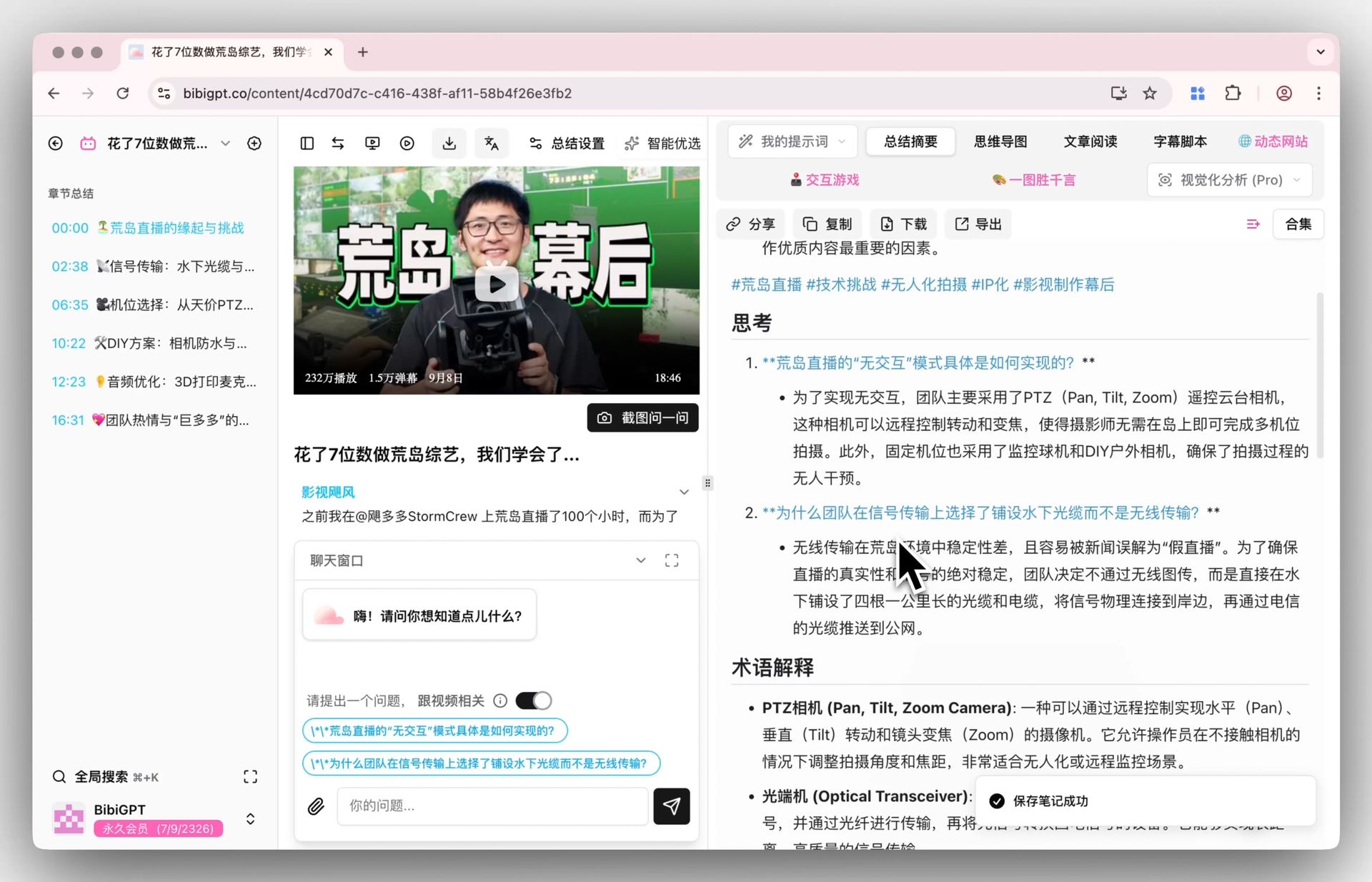
BibiGPT covers Xiaoyuzhou, Ximalaya and other Chinese podcast hosts, and its Smart Deep Summary outputs key takeaways, thinking prompts, and term explanations — far more useful for retention than plain paragraph summaries.
Snipd does English podcast highlight clips well (audio snippets straight to Readwise), but its Chinese podcast coverage is essentially zero, and its annual fee is higher than BibiGPT Plus.
Use Case 2: Researchers (Multi-Episode + Cross-Episode Q&A)
A common research task: digest 10 podcast episodes around a single topic and surface “where the guests agree and disagree.” Single-episode tools can’t do this. You need collection-level capability.
Of the 10 tools listed, only BibiGPT offers a complete collection-level workflow:
- Use Global Search or import links to gather related podcasts into one collection
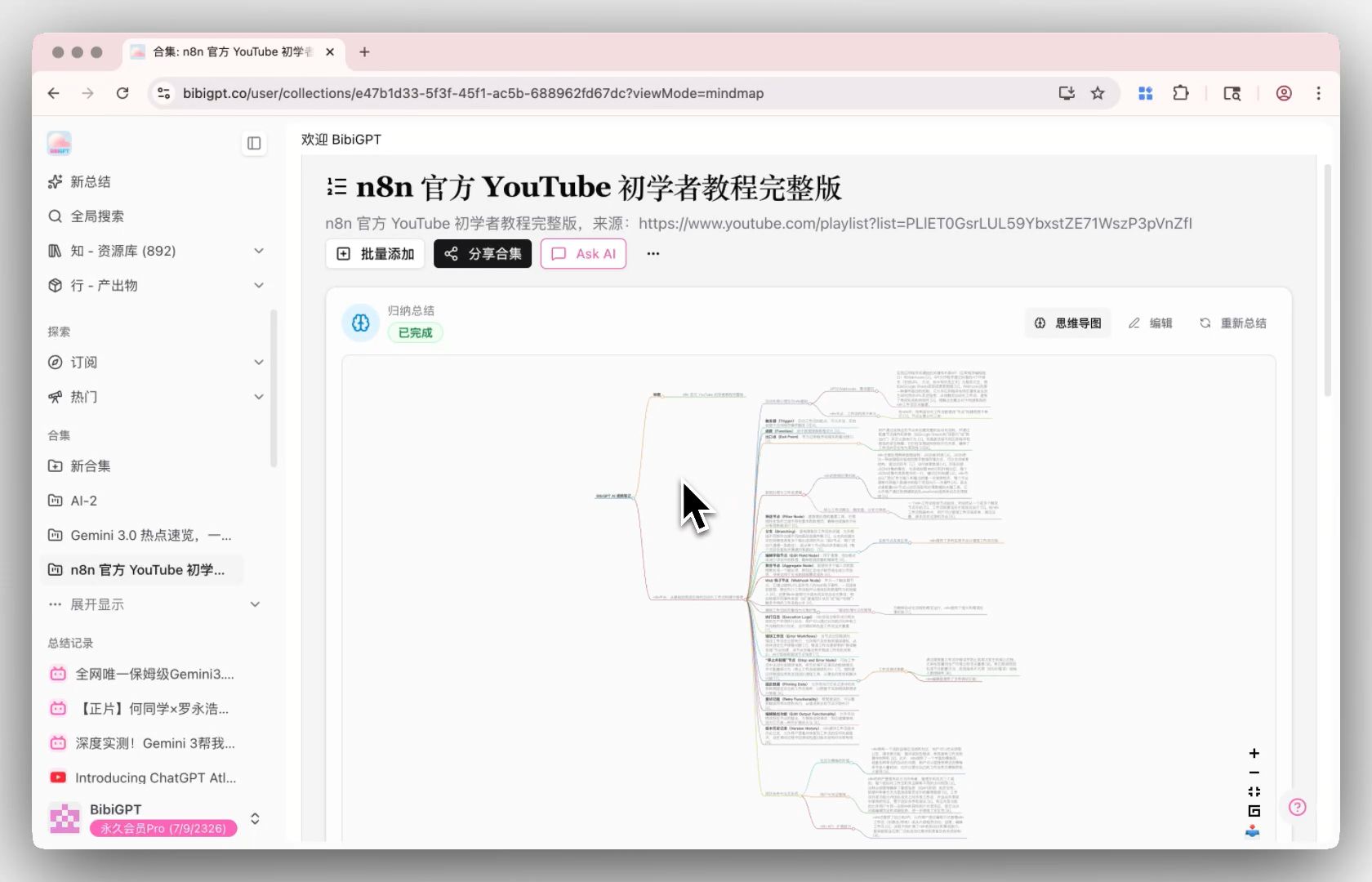
- Hit Collection Summary for a cross-episode synthesis + mind map
- Open Collection AI Chat and ask “where do guests in these 10 episodes diverge on X?” — AI answers across the whole set
NoteGPT and Mindgrasp support limited multi-video processing but only stitch summaries together — no cross-episode comparison or follow-up Q&A. This is the dividing line: research workflows essentially require BibiGPT.
Use Case 3: Creators (Turn Other People’s Podcasts Into Your Content)
If you publish on Substack / Medium / TikTok / Xiaohongshu, you need more than summaries:
- Convert podcast content to formatted articles
- Pull pull-quotes and turn them into social images
- One-click send to your notes app for further editing
BibiGPT owns this chain end-to-end:
- AI Video to Article turns podcast transcripts into structured articles
- Xiaohongshu Image Generator generates multi-image social posts
- Cubox Integration / Notion / Obsidian one-click send
Riverside Magic Clips is for re-clipping your own podcast, not consuming others’. Snipd’s highlights are for personal collection, not content creation.
Pricing Snapshot (April 2026)
| Tool | Free Tier | Monthly | Chinese Podcast Coverage |
|---|---|---|---|
| BibiGPT | Yes (daily allowance) | Plus / Pro tiers | Full |
| Otter.ai | Yes (300 min/mo) | From $16.99/mo | Weak |
| Snipd | Yes (limited) | $5/mo (annual) | Almost none |
| Podsqueeze | Yes (trial) | From $9/mo | Limited |
| NoteGPT | Yes | From $9.99/mo | Moderate |
| Mindgrasp | Yes | From $19/mo | Weak |
Pricing per public site; verify before purchase.
Try BibiGPT
Across “Chinese podcast coverage + summary depth + collection workflow + notes integration,” BibiGPT is the strongest 2026 pick — especially if your listening lives across English and Chinese platforms.
- New user → Try BibiGPT
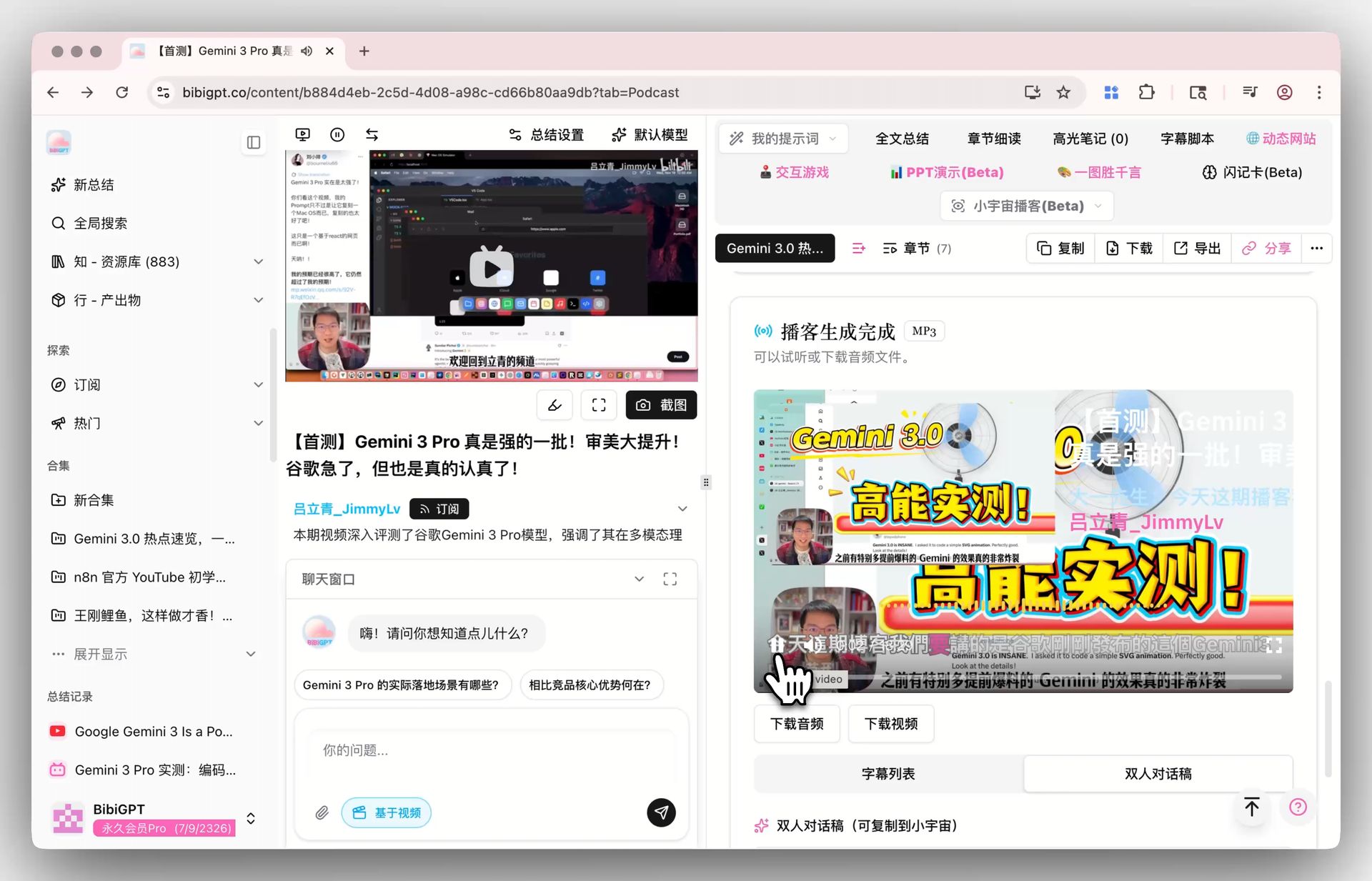
- Existing user → try Xiaoyuzhou Podcast Generation to convert videos into podcasts
- Heavy listener → drop your favorite shows into a collection and try cross-episode chat
FAQ
Q1: Do these tools require official podcast captions?
A: No. BibiGPT, Snipd and Otter all ship with ASR engines and handle audio without captions. BibiGPT’s custom transcription engine lets you switch between Whisper and ElevenLabs Scribe for professional-grade accuracy.
Q2: What about Apple Podcasts copyright?
A: All of these tools are for personal study, not commercial redistribution. BibiGPT keeps summaries private by default; sharing is opt-in. Creators repurposing content should cite the original podcast and link back.
Q3: How accurate is Chinese podcast transcription (Xiaoyuzhou/Ximalaya)?
A: BibiGPT internal benchmarks on common Chinese podcasts (talk shows, conversation formats) reach 95%+ accuracy. Tech and medical content with dense terminology runs slightly lower; smart subtitle segmentation plus a custom term dictionary closes the gap.
Q4: Why aren’t ChatGPT or Claude on the list?
A: ChatGPT and Claude don’t ingest podcasts — you’d have to paste transcripts manually. They’re general-purpose LLMs, not vertical podcast tools, so the comparison isn’t apples-to-apples.
Q5: Why is multi-episode handling such a big deal?
A: Most learning isn’t “listen to one episode” — it’s “digest a topic.” Researchers consume 10 guest interviews; students consume an entire course; creators track a podcast series across releases. Single-episode tools handle the basics; collection-level capability is where real time savings live — most visible in Collection Summary + Collection AI Chat.
BibiGPT Team