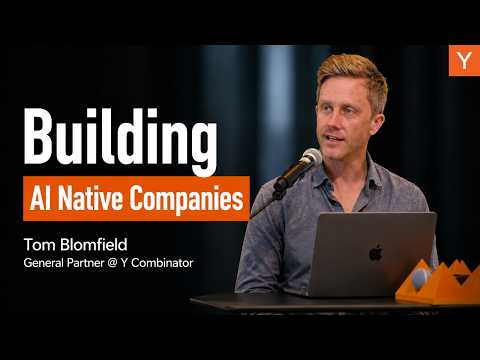
The video opens with how YC shifted from a traditional organization to an AI-native one. Pete Kumman recounts a project launched about a year earlier, aimed at eliminating the inefficient back-and-forth between the finance team and software engineers. By building internal agent infrastructure, YC successfully transformed complex, code-heavy processes into automated workflows driven by natural language and AI agents, dramatically improving operational efficiency across the organization.
The key to YC's success was centralizing all core business context in a single Postgres database. This eliminated time barriers to cross-team data queries, enabling non-technical staff to quickly extract key insights via AI agents. Pete emphasized that this "single source of truth" architecture dramatically lowered the bar for asking questions, allowing the team to conduct data analysis with unprecedented depth and breadth — significantly improving both the quality and speed of decision-making.
The video details the central role of the Tool Registry in YC's AI ecosystem. By converting specific work tasks into callable tools for agents, YC has accumulated over 350 functional modules. This design not only supports individual developer productivity but also enables AI agents to automatically optimize skills through "Skillify" and "Resolver" mechanisms — allowing organizational knowledge to be dynamically captured and self-evolving.
🧠 "Democratizing" Organizational Collaboration and Knowledge
The essence of AI-empowered organizations is building a shared "org brain." By making agent conversations public and using transcripts for skill feedback loops, YC achieved rapid onboarding for new employees and automatic propagation of best practices. This high-transparency, high-trust culture ensures employees can access the experience of senior partners through AI, greatly elevating the organization's overall capability — and drove standardization of core skills like the Two-Sentence Pitch.
The video closes by exploring a philosophical choice in AI development. Pete argues that AI should not be a "black box" tool that restricts users and is controlled by large corporations — like Gmail — but rather an empowering tool like the personal computer revolution. Developers and companies need to choose the decentralized path: by owning their own prompts, software controls, and private data storage, AI can truly become an extension of human intelligence. This is not just a technical question but a societal and entrepreneurial one, deciding whether the future trends toward corporate centralization or a full explosion of individual capability.
Highlights
🗄️ Centralizing all business data in a single Postgres database eliminated cross-team information silos and let non-technical staff run deep analyses via AI agents with no engineering bottleneck.
🛠️ Accumulating 350+ callable tools in a shared registry allowed organizational knowledge to become self-evolving, with AI agents automatically optimizing skills rather than relying on human documentation.
🧠 Making agent conversations public and using transcripts as skill feedback loops dramatically accelerated new-employee onboarding and propagated best practices across the entire organization.
🔮 The pivotal design choice is whether AI empowers individuals (like the PC revolution) or centralizes control in corporations — founders who own their own prompts and data retain durable competitive advantage.
🚀 Treating AI as the foundational operating logic — not a productivity add-on — is what separates a truly AI-native organization from one that simply uses AI tools.