AI Video Knowledge Retention Workflow: Stop Forgetting What You Watch
AI Video Knowledge Retention Workflow: Stop Forgetting What You Watch
You have 17 “watch later” videos backed up in your browser tabs. The three podcasts you finished last week? You can’t remember what they were about. That AI development video you scrolled through yesterday left just a vague impression — “something about a new model dropping.”
This isn’t laziness. It isn’t a bad memory. It’s the fundamental limit of how the human brain handles asynchronous content: inputs without structure never make it to long-term memory. The brain isn’t a recorder — it only keeps what you’ve processed, connected, and retrieved multiple times. No matter how densely you consume passively, you stay stuck at the level of “knowing about it,” while “being able to use it” requires a completely different processing path.
This article isn’t recommending you download another tool. It’s a system SOP for “video → knowledge retention” — smart capture, active processing, and periodic internalization — three stages that close a real knowledge loop from video to brain.
Why You’ve Watched So Much and Remembered So Little
Cognitive science has a counterintuitive finding: repeated input barely produces long-term memory. Rewatching or re-listening makes you feel “more familiar,” but familiarity is “recognition,” not “recall.” What actually stores knowledge in the brain is retrieval — the act of actively pulling information back out of your memory.
The Ebbinghaus forgetting curve delivers a brutal number: without any review intervention, new knowledge is forgotten by about 70% within 24 hours, and over 80% within a week. The video you watched yesterday has only about 30% left in your brain today — and tomorrow it’s even less.
Video content has a particularly high forgetting rate for several reasons:
- Fluency creates a false “I get it”: Videos are vivid and smooth. You nod along as you watch, but nodding means “I kept up with the pace,” not “I truly understood.”
- Passive consumption has no resistance: Reading forces you to pause; video just carries you along. No resistance means no processing, and no processing means no memory.
- Information density is too high: A 20-minute explainer video can pack the information equivalent of an 8,000-word article. Your brain gets filled by the next video before it can process the last.
Practical rule: Consuming content doesn’t equal learning content. Without the step of “retrieval + application,” the brain clears out most of it within 48 hours.
Between “knowing about” and “being able to use” stands a wall. “Knowing about” means you can recognize — when someone mentions the concept, you nod and say “yes, I’ve seen videos on that.” “Being able to use” means you can retrieve — when facing a new problem, you proactively recall the concept and apply it. Crossing that wall requires active processing, not more consumption.
The Three Stages of a Knowledge Retention Workflow
This workflow breaks “watching a video” into three cognitive actions: capture, process, and internalize. Each step does something passive consumption simply can’t.
Stage 1: Capture — Not “Watch the Video,” but “Extract the Key Questions”
Capture isn’t finishing the video; it’s watching with questions in mind and being able to state the core argument afterward.
Before opening a video, spend 30 seconds asking yourself: what do I want to get from this? What problem does this video solve? What do I already know about this topic — and what don’t I know?
Watching with questions shifts your brain from “passive receiving mode” to “active search mode.” As you watch, you automatically filter noise and focus your attention on the parts that answer your questions.
After you finish, do one thing: without looking at any materials, write down 3 key points from memory about what the video covered. What you can write is what you actually captured; what you can’t write reveals that you were “watching without thinking.”
Stage 2: Process — Restate in Your Own Words + Ask About What You Don’t Understand
Processing is the most important stage — and the one most people skip.
Restating in your own words means you can’t copy a summary or paste the AI-generated abstract. You need to “translate” the video’s concepts into terms you can explain yourself. If you can’t translate it, you haven’t truly understood it. That friction is normal — even necessary — because it’s forcing you to build understanding, not just memorize vocabulary.
Asking about what you don’t understand is the second step. After watching a video, you’ll always have points that felt “heard but can’t explain.” Those are your follow-up entry points. Turn them into specific questions and find answers: through AI conversation, by rewatching the relevant segment, or through supplemental research.
Practical rule: For every video, ask at least 3 questions you want to explore further, then follow up with AI — that action itself is “active processing.”
The quality of your questions determines the depth of your processing. “What does this concept mean?” is shallow. “How does this concept relate to X that I already know?” and “Under what conditions does this conclusion break down?” are deep. Deep questions make new knowledge grow on the root system of what you already know, rather than floating in isolation.
Stage 3: Internalize — Connect to Existing Knowledge + Find Application Scenarios
Internalization is the process of making knowledge “grow into your system,” and it has two actions: connection and application.
Connect to existing knowledge: What does this new concept intersect with what you already know? Did it update any prior understanding? Did it create a connection to a question you previously couldn’t crack? Writing these connections down — even a sentence or two — dramatically increases memory stability.
Find application scenarios: Where could I use this in my work or life? What specific problem I’ve encountered can I reframe through this lens? When you land an abstract piece of knowledge in a concrete scenario, it transforms from “knowledge” into a “tool.”
Research in PKM (Personal Knowledge Management) shows that networked note-taking with bidirectional links increases knowledge activation precisely by enforcing connections. You don’t need a complex tool — just one question: “What does this new idea remind me of?”
BibiGPT’s Role in the Workflow: The Smart Capture Layer
In this workflow, BibiGPT serves as the “capture layer” — rapidly converting video content into raw material ready for processing.
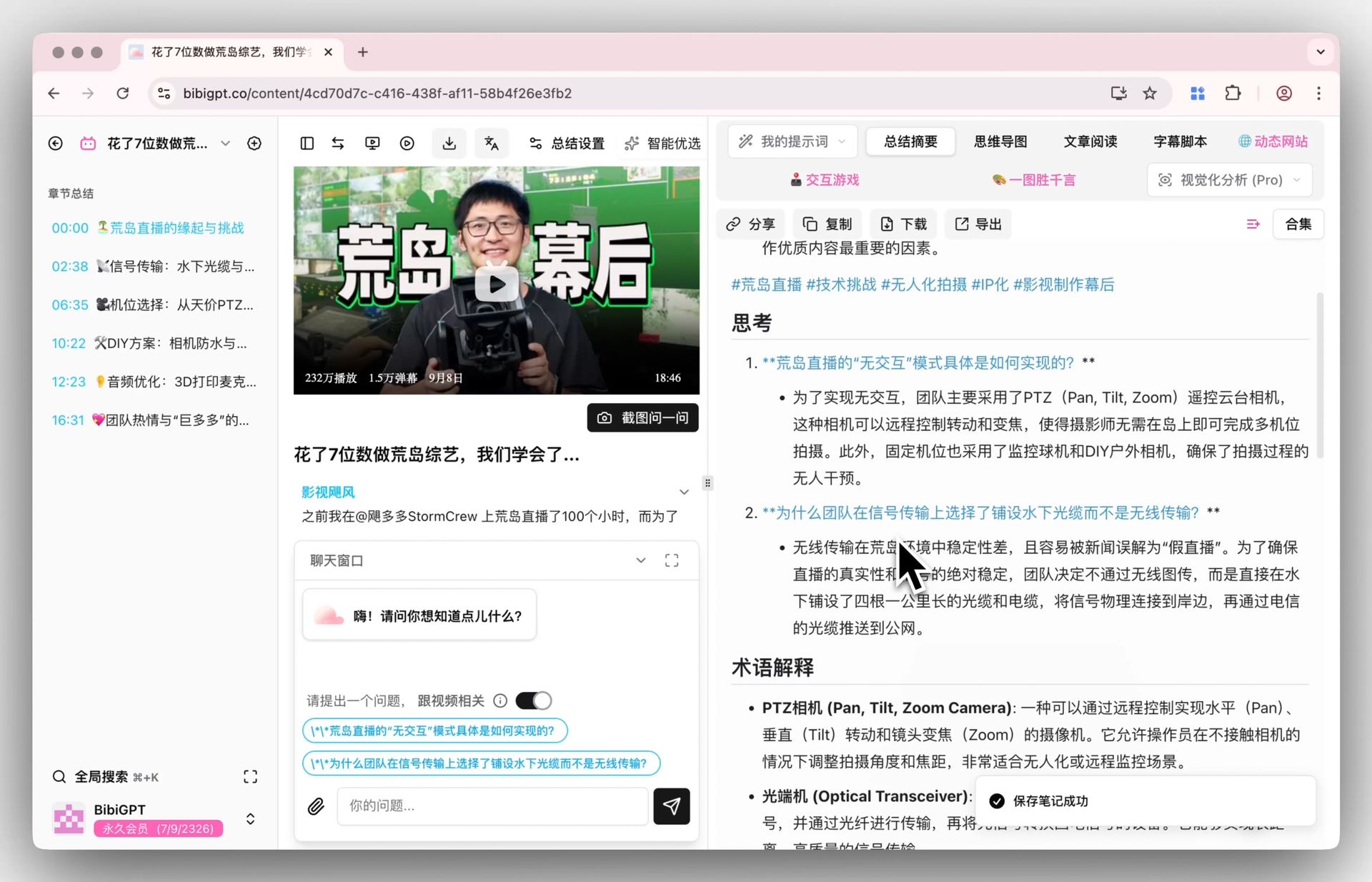
Generating summaries and timestamps in one click means you don’t need to watch an entire 30-minute video before deciding whether it’s worth going deeper. Read the summary first, judge whether the content hits your question, then decide whether to read carefully or skip. Timestamps let you precisely locate a specific argument in the video without scrubbing the progress bar repeatedly.
The AI follow-up feature forces “active processing.” Typing a question into the chat means you’re doing a “retrieval exercise” — actively pulling answers out of the video content, rather than passively receiving them through the summary. Every question is an act of processing; every act of processing reinforces memory.
Exporting summaries to note apps (Notion, Obsidian, etc.) moves your capture results into your knowledge system, rather than leaving them as isolated records inside BibiGPT. What you export isn’t just the summary — it’s raw material with your follow-up notes attached, ready to be processed further, linked, and indexed in your note app.
Five-step workflow:
- Paste the link: Drop the video URL into BibiGPT and wait for the AI summary to generate
- Read the summary, identify key questions: Scan the summary and mark 2–3 points you want to follow up on
- Ask AI 3 questions: Use the AI conversation feature to follow up on each point you marked, writing the answers alongside your own understanding
- Export to notes: Export the summary + follow-up notes to Notion or Obsidian and tag the note with its topic
- Set a review reminder for 7 days later: Put a reminder in your calendar or task manager to come back for a 5-minute self-test
Practical rule: For every video, ask at least 3 questions you want to explore further, then follow up with AI — that action itself is “active processing.”
Workflow Variants for Different Contexts
The same three-stage structure has different emphases depending on content type.
Context A: Learning content (courses/tutorials) → Generate review flashcards
Technical courses and skill tutorials are about “being able to operate and apply.” The best processing method for this content is turning key concepts and steps into flashcards: the front has a question (“What does this function do?”), the back has the answer (with an explanation pulled from the video summary). BibiGPT’s AI conversation can quickly decompose a summary into Q&A pairs for direct export to Anki or a Notion database.
Context B: News content (news/industry analysis) → Build topic folders
The value of news-style videos isn’t in any single piece — it’s in what you can see once they accumulate. Collect summaries from multiple videos on the same topic into one Notion database or Obsidian folder. Scan it weekly, look for connections, track changes. One video might not offer much; after ten, you may spot a trend others haven’t noticed yet.
Context C: Inspiration content (talks/ideas) → Connect to existing frameworks
TED talks and idea-driven podcasts are valuable because they trigger your own thinking. The best processing approach for this content isn’t recording “what they said,” but “what thought this triggered in me.” After each piece, write a connecting note: “This made me think of…” — grafting the new perspective onto your existing thinking frameworks.
Weekly Review Rhythm
The final piece of the workflow is the review rhythm. Capture and processing can happen one video at a time; review needs to be systematic.
Daily — 5 minutes: Organize the day’s summaries
Quickly scan the video summaries you processed with BibiGPT that day. Make sure each one has a topic tag and follow-up notes saved. This isn’t review — it’s organization. Getting the day’s processed outputs into your knowledge system, rather than scattered in different places.
Weekly — 15 minutes: Review the week’s summaries and find connections
Go through all the summaries you processed that week and ask yourself two questions: Which pieces from this week connect to each other? What does what I learned this week intersect with from last week or last month? Finding connections means you’re building a knowledge network, not just stacking isolated notes.
Monthly — 30 minutes: Discard low-value content, distill the essentials
Browse through the notes you’ve accumulated that month and ask: Will I still need this note in three months? Keep what passes; delete or archive what probably won’t. For the essentials that remain, do a deeper processing pass: write one paragraph on “my key insight this month on this topic.” Only the essentials are worth occupying your attention.
Practical rule: Knowledge management isn’t accumulation — it’s filtering. Regularly discarding low-value content is what allows high-value content to surface.
See also: AI conversation feature helps you quickly re-engage a video’s content during review; AI mind map can integrate summaries from multiple related videos into one relationship diagram, giving you a full view of a topic.
FAQ
Q: Is this workflow suitable for people who watch a lot of videos every day?
It was designed precisely for those people. The biggest problem for high-volume viewers isn’t too little content — it’s too-high information density and not enough processing time. The core of this workflow is using AI to lower capture costs, then reinvesting that saved time into “processing” — not into watching more videos. Deeply processing 3–5 per day builds more effective knowledge than passively consuming 20.
Q: Are BibiGPT’s summaries accurate enough to use directly in notes?
Summaries are raw material for processing, not finished notes. Copying a summary directly into a note app is close to “storing the video content again” — without your processing, it won’t reach long-term memory. The correct approach is to use the summary as a reference, restate it in your own words, then save it. The summary’s accuracy helps you locate key information quickly; the quality of your final notes depends on the depth of your processing.
Q: How do I handle videos in languages I’m learning?
BibiGPT automatically detects language and can translate. For foreign-language videos, summaries can be output directly in your native language. You can also ask follow-up questions in your native language and get answers based on the video content. Language isn’t a barrier. If the video is in a language you’re also trying to practice, you can keep the summary in that language and ask follow-ups in it too — making it an immersive learning session.
Q: Which works better with this workflow — Notion or Obsidian?
Depends on your style. Notion suits people who need collaboration, cross-device sync, and database-style management — importing BibiGPT summaries into a Notion database lets you search by topic, date, or source. Obsidian suits local-first users who value bidirectional links and want to own their data — connecting summary notes to your existing knowledge graph increases activation rates. Both support BibiGPT’s export formats. Pick one and start; don’t let the tool choice delay you.
Q: Does this method work for podcasts too?
Absolutely. BibiGPT supports podcast links (including major platforms in China and internationally) and generates summaries and timestamps the same way; AI follow-up works identically. Podcasts tend to be more conversational and information-scattered, so summaries are arguably even more valuable for them — filtering out large amounts of conversational filler and going straight to the core arguments.
Start Now
Pick one video you watched this week but can’t remember — paste it into BibiGPT and ask yourself 3 follow-up questions with AI. This single step is more effective than reading any article about knowledge management, because you’re actually doing active processing instead of accumulating meta-knowledge about what you should be doing.
Paste a video and start your knowledge retention workflow
BibiGPT Team