Tencent Hunyuan 3.0 Comes to WeChat: The Era of AI Assistants for 1.4 Billion Users — How BibiGPT Keeps You a Step Ahead
Tencent Hunyuan 3.0 Comes to WeChat: The Era of AI Assistants for 1.4 Billion Users — How BibiGPT Keeps You a Step Ahead
Key takeaway: Hunyuan 3.0 integrating with WeChat isn’t “just another AI assistant” — it’s an entry-level event that connects the everyday chats, video feed browsing, and article reading of 1.4 billion WeChat users to AI capabilities. Understanding what it really means is what lets you decide whether your own workflow needs to change.
1. Background: The Hunyuan 3.0 Launch Timeline
In late April 2026, Tencent officially launched Hunyuan 3.0, its most capable flagship multimodal large model to date. The release marks a pivotal shift in Tencent’s AI strategy — from “building infrastructure” to “deploying AI inside social scenarios.”
1.1 Core Capability Upgrades in Hunyuan 3.0
According to Tencent’s official technical documentation, Hunyuan 3.0 delivers significant improvements across several dimensions:
- Multimodal understanding: Simultaneous processing of text, images, audio, and video — no longer a single text-to-text pipeline
- Long context window: Extended conversation memory designed for complex, multi-turn interactions
- Chinese language optimization: Deep fine-tuning for Chinese semantics and context, with notably improved understanding of Cantonese and regional dialects
- Reasoning capability: Chain-of-thought-style reasoning that delivers more consistent performance on complex tasks
These capabilities combine to give Hunyuan 3.0 the underlying capacity to handle the vast amount of unstructured information flowing through the WeChat ecosystem.
1.2 Into WeChat: What “Social AI Entry Point” Really Means
The core of Hunyuan 3.0 entering WeChat isn’t “adding a chatbot inside WeChat” — it’s embedding AI capabilities into three of WeChat’s most-used contexts:
- Private and group chat assistance: Summarizing long message threads, drafting replies quickly, breaking down professional content
- Video Channels AI summaries: When a user comes across a video in the WeChat Video Channels feed, they don’t need to watch the whole thing — Hunyuan delivers the key points directly
- Deep reading for Official Accounts: Distilling what would normally take 15 minutes to read down to key insights in 30 seconds
Seen this way, Hunyuan 3.0 isn’t just a model upgrade for Tencent — it’s the starting gun for “the WeChat ecosystem entering the AI era.”
Sources: Tencent Official Hunyuan Introduction, 36Kr: Deep Analysis of Tencent Hunyuan 3.0 Launch
2. Deep Analysis: Hunyuan 3.0’s Technical, Market, and Ecosystem Impact
Key takeaway: When analyzing a major AI development, you need to look at three layers simultaneously — technical, market, and ecosystem. Focusing only on model specs means missing the business implications; focusing only on market means missing the technical constraints.
2.1 Technical Layer: The Real Value of Multimodal Capability in Social Contexts
The most noteworthy technical feature of Hunyuan 3.0 is its real-time video content understanding.
Within the WeChat ecosystem, the volume of video content consumed daily is enormous: Video Channels alone sees hundreds of millions of videos watched per day, ranging from 30 seconds to 30 minutes each. Historically, AI handled video by first transcribing it to text and then understanding the text — losing significant semantic information from the visual and audio layers.
Hunyuan 3.0’s multimodal capability changes this:
- Visual content can be “read” directly — recognizing people, scenes, actions, and on-screen text overlays
- Audio and video tracks are understood in sync — eliminating the mismatches that arise when subtitles don’t align with what’s actually on screen
- Cross-modal correlation — a product name mentioned in a video can be associated with the physical object appearing on screen at the same moment
But there is an important technical constraint: Hunyuan 3.0’s video understanding capability within WeChat is designed for “rapid summarization,” not “deep note-taking.” It gives you a one-sentence summary — not a granular, timestamp-level breakdown.
That constraint is precisely what defines the boundary between BibiGPT and Hunyuan 3.0.
2.2 Market Layer: What a 1.4 Billion User Entry Point Actually Means
To understand the market significance of Hunyuan 3.0, you first need to understand what makes WeChat unique.
WeChat isn’t an ordinary social app — it’s the “digital operating system” for the daily lives of most people in China: messaging, watching videos, reading articles, payments, mini-program shopping, and work communication all happen inside a single app. WeChat’s DAU exceeds 1.3 billion, and a substantial share of those users spend more time consuming content inside WeChat than in any other single app.
Hunyuan 3.0 integrating into this ecosystem means:
- Extremely low distribution cost for AI capabilities: Users don’t need to download a new app, sign up for a new account, or learn a new tool — AI simply appears inside WeChat as they already use it
- AI penetrating the social layer: Previously, AI was something you actively sought out. Hunyuan 3.0 makes AI something that passively appears where you already are
- Shifting content consumption habits: Video Channels users may start defaulting to “read the summary first, then decide whether to watch” — a fundamentally new content consumption pattern
For content creators, this means: when you publish a video to WeChat Video Channels, an AI summary version will coexist alongside the original. The first thing a user sees might not be your video — it might be an AI-generated summary of your video.
This is a significant signal — the AI summary layer is becoming middleware for content distribution.
2.3 Ecosystem Layer: Which Puzzle Piece Did Tencent’s AI Ecosystem Just Complete?
Before Hunyuan 3.0, Tencent’s position in the AI race looked like this:
- Strong infrastructure: Tencent Cloud’s compute, data, and deployment capabilities rank among the best in China
- Solid model capabilities: The Hunyuan model series has been steadily improving, though it had been slightly slower than ByteDance or Baidu in terms of real-world deployment speed
- Missing a killer entry point: No “nationally ubiquitous app” was pushing AI capabilities in front of ordinary users
WeChat’s integration completes that final puzzle piece.
More importantly, Tencent’s AI ecosystem is a closed loop: Hunyuan 3.0 isn’t just integrated into WeChat — it’s simultaneously being integrated into Tencent Docs, Tencent Meeting, WeCom (Enterprise WeChat), and QQ. Tencent is building an ecosystem of “one AI brain, spanning all Tencent products.”
This mirrors Google’s strategy exactly — Google used Gemini to take over Google Search, YouTube, Gmail, and Google Meet; Tencent is using Hunyuan to take over WeChat, Tencent Docs, Tencent Meeting, and Video Channels.
Platform-level AI entry points are taking shape. Third-party AI tools must find their own differentiated positioning.
2.4 Hunyuan 3.0’s Limitations: Three Ceilings for Video Summarization
Hunyuan 3.0’s video summarization capability within WeChat runs into three clear limitations:
Limitation 1: Coverage is limited to the WeChat ecosystem Hunyuan 3.0 can process content from WeChat Video Channels, but not from YouTube, Bilibili, Douyin, Xiaohongshu, podcasts, or other platforms. A typical user’s “information diet” spans 5–10 platforms, so single-platform AI coverage falls well short.
Limitation 2: Shallow depth — output is consumable, not archivable Hunyuan 3.0 delivers “rapid summaries” suited for in-the-moment consumption, not long-term retention. It gives you an answer, but it won’t help you build a searchable, reusable knowledge base that connects with your other notes.
Limitation 3: No creator workflows For content creators, a video summary is just the starting point. Converting video to illustrated articles, extracting highlight clips, generating bilingual subtitles, outputting mind maps — these “processed artifacts” are not available in the WeChat version of Hunyuan 3.0.
These three limitations are precisely where BibiGPT’s core value lies.
3. What This Actually Means for BibiGPT Users
Key takeaway: When a platform-level AI entry point emerges, don’t ask “will it replace the tool I’m using?” Ask instead: “What pain points does it solve, and what gaps does it leave?” Those gaps are the opportunities.
3.1 What Hunyuan 3.0 Does for You
The appearance of Hunyuan 3.0 inside WeChat has one direct benefit for BibiGPT users: it lowers the cognitive barrier to AI-assisted content consumption.
In the past, many users were unfamiliar with “using AI to process video” — they felt that “just watching the video is more direct, why go through the AI detour?” Hunyuan 3.0’s embedded use in WeChat will gradually normalize the “let AI filter it first” pattern for more users.
This is a market education effect — once users are used to “the 30-second summary on Video Channels,” they’ll naturally start wondering “can Bilibili/YouTube/podcasts work the same way?” And that cross-platform, deeper version is exactly BibiGPT’s core use case.
3.2 What Hunyuan 3.0 Can’t Do — BibiGPT Can
A unified cross-platform entry point
BibiGPT supports 30+ major audio and video platforms: YouTube, Bilibili, Douyin, TikTok, Xiaohongshu, podcasts (Apple Podcasts, Spotify, Xiaoyuzhou), Zoom recordings, local files, and more — all accessible with a single paste. This is coverage Hunyuan 3.0 cannot match in the near term.
Use the BibiGPT Free Video Summarizer — paste any platform link and get a structured, timestamped summary in 30 seconds.
Deep artifacts, not just consumable summaries
BibiGPT doesn’t just give you a “summary” — it gives you a full set of knowledge artifacts:
- Chapter outlines with timestamps (jump directly to any point in the original video)
- Mind maps (great for visual learners)
- Bilingual subtitles (Chinese, English, Japanese, Korean — ideal for cross-language study)
- AI video dialogue and intelligent source tracing — ask follow-up questions about any detail in the video, and AI not only gives you the answer but tells you exactly which minute of the video it came from
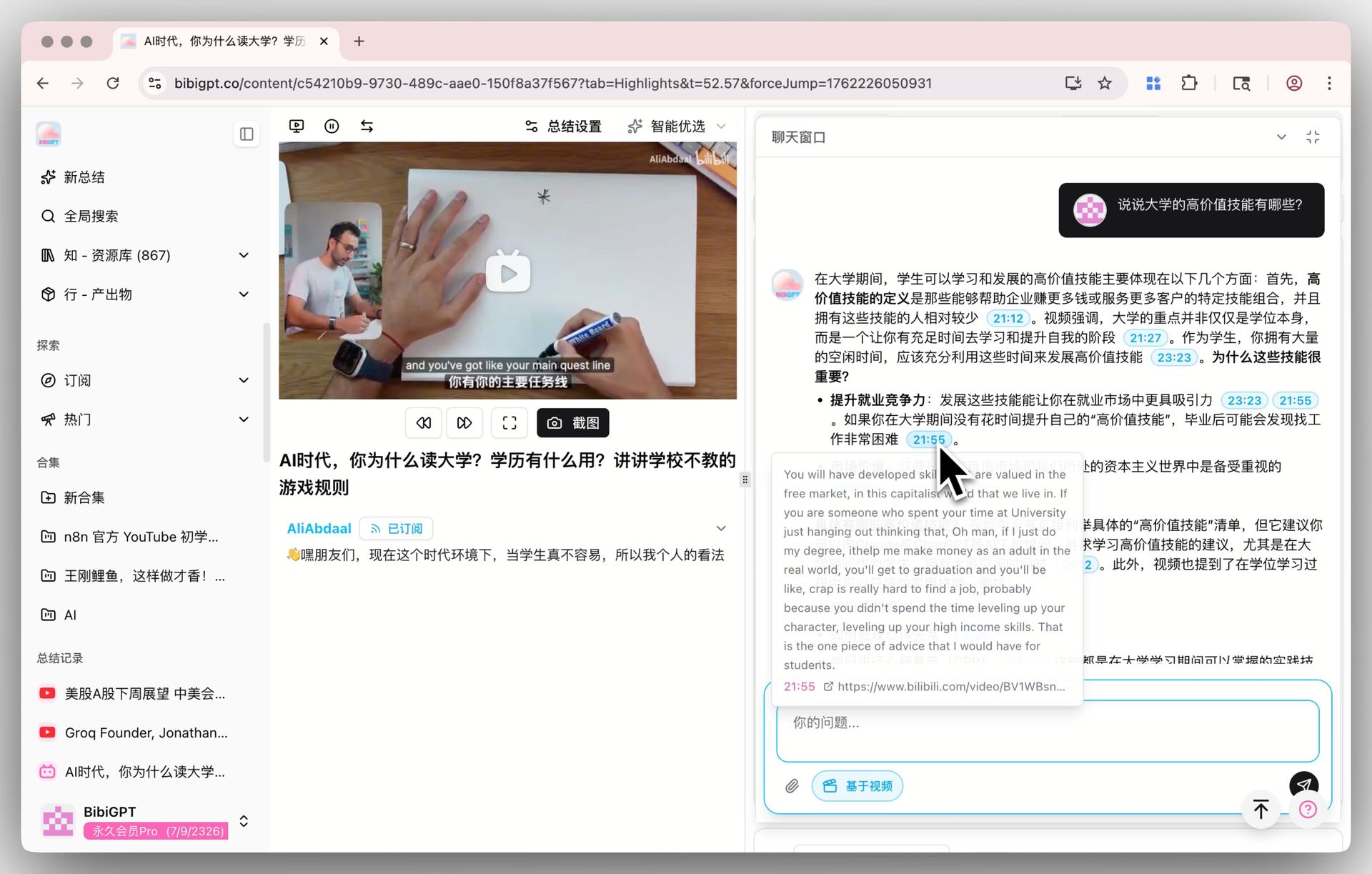
Knowledge as a lasting asset, not one-time consumption
Hunyuan 3.0’s summaries are built for “in-the-moment” consumption — they don’t save, search, or connect. BibiGPT content can:
- Sync to Notion, Obsidian, Readwise, and other knowledge management tools in one click
- Build a searchable video note library inside BibiGPT
- Cross-video synthesis (aggregate the content from 5 related videos into a single in-depth note)
A complete creator workflow
For content creators, BibiGPT provides an end-to-end pipeline from video to finished output:
- Convert competitor videos into illustrated analytical write-ups
- Extract complete transcripts with the Video to Text Converter, ready to use as writing source material
- Deep-dive with AI video dialogue to pinpoint the exact source of any argument
- Generate cover images for Official Accounts, image cards for Xiaohongshu, and short video scripts
4. BibiGPT in Practice: Upgrading Your Content Workflow in the Hunyuan 3.0 Era
Key takeaway: More tools isn’t better — the goal is to find combinations that complement rather than overlap. The best pairing of Hunyuan 3.0 and BibiGPT is “fast filtering inside the platform + deep processing across platforms.”
4.1 Workflow A: WeChat Video Channels Quick Filter + BibiGPT Deep Archiving (Information Consumers)
Best for: Scrolling Video Channels daily, finding content worth diving into, but not wanting to spend all your time watching every video in full.
Steps:
- Come across an interesting video on Video Channels → use Hunyuan 3.0’s summary feature to quickly judge whether it’s worth a deeper look (30-second decision)
- Content that’s worth it → find the equivalent Bilibili/YouTube version (usually longer and more detailed)
- Paste the link into BibiGPT → get a full timestamped deep summary + mind map
- Highlight key content → export to Obsidian/Notion in one click, building a reusable note asset
The core logic of this workflow: Hunyuan 3.0 handles the quick “is this worth watching?” filter; BibiGPT handles the deep processing of “the content that is worth watching.” Two steps, more efficient than either tool alone.
4.2 Workflow B: Deep Learning from Bilibili Knowledge Videos (Students / Professionals)
Best for: Systematically learning a field where Bilibili has a large collection of high-quality courses and knowledge-sharing videos.
Steps:
- Find your target course or knowledge series on Bilibili (typically a playlist of 10–30 videos)
- Use BibiGPT’s Bilibili Video Search feature to quickly identify which videos are worth the deepest attention
- Generate a detailed summary + mind map for the selected videos with BibiGPT
- Use the “AI dialogue and source tracing” feature to follow up on concepts you don’t understand, pinpointing the exact timestamp in the original video
- Consolidate notes from multiple videos into a complete, cohesive study resource
Key takeaway: Learning isn’t finished when you’ve watched something. Knowledge is only truly retained when it’s “searchable, reproducible, and connected.” BibiGPT’s Obsidian/Notion sync turns video notes into part of your knowledge base, linking with your reading notes and work notes alike.
4.3 Workflow C: Creator Competitor Monitoring + Content Production (Official Accounts / Xiaohongshu / Video Bloggers)
Best for: Content creators who need to continuously monitor competitors and industry-leading creators while quickly transforming video source material into illustrated written output.
Steps:
- Use BibiGPT to batch-process the latest videos from target creators (supports bulk URL input)
- Use the “playlist synthesis” feature to aggregate the core insights from multiple videos into a single industry overview
- Use AI video dialogue to deep-dive key videos, extracting quotable lines and supporting arguments
- Use “video to article” to rewrite video content in the style of an Official Account or Xiaohongshu post
- Pair with Hunyuan 3.0’s WeChat ecosystem features to monitor audience feedback after publishing to Official Accounts
Key takeaway: The biggest time cost for creators is “finding and understanding source material.” BibiGPT compresses “watching a 20-minute video” into “reading a 5-minute structured summary” — the productivity gain is multiplicative.
4.4 Workflow D: Enterprise Multimedia Content Management (Teams / Organizations)
Best for: Corporate training, industry research, meeting summaries — any scenario requiring bulk processing of large volumes of audio and video content.
Steps:
- Submit industry conference recordings, training videos, competitor product launches, and similar content to BibiGPT for batch processing
- Receive a complete text version with timestamps for each video (suitable for full-text search)
- Export complete transcripts with the Video to Text Converter to serve as raw documents for the corporate knowledge base
- Sync key content to the company’s Notion / Feishu / Yuque knowledge base for the whole team to search and reuse
BibiGPT has served 1 million+ users, generated 5 million+ AI summaries, and covers 30+ platforms — fully capable of handling enterprise-scale batch processing needs.
5. Looking Ahead: How Content Consumption Will Diverge in the AI Assistant Era
Hunyuan 3.0 entering WeChat marks the moment “platform-level AI assistants” officially entered everyday life in China. This is an irreversible trend.
5.1 The Next 3 Months (Q3 2026)
- WeChat Video Channels AI summary rolls out to all users; consumers start defaulting to “read the summary first, then decide whether to watch”
- Other domestic platforms (Douyin, Bilibili, Xiaohongshu) follow with their own native AI summary features
- The “AI summary layer” becomes standard middleware for content distribution; platform algorithms begin optimizing for AI summary quality
5.2 The Next 6 Months (Q4 2026)
- Video content consumption splits into two tiers: “rapid filtering layer” (platform-native AI) + “deep archiving layer” (specialized tools)
- “Cross-platform aggregation” becomes a core need for high-value users — their information sources extend far beyond WeChat to the entire web
- Content creators start systematically thinking about the impact of “the AI summary version,” optimizing their videos for “AI-summary friendliness”
5.3 The Long-Term Trend (12+ Months)
The broader the platform AI coverage, the higher the value of cross-platform specialized tools. This seems paradoxical, but it’s actually a pattern: when AI summaries become a standard feature on every platform, user demand for a “cross-platform unified knowledge base” actually strengthens.
Today, WeChat Video Channels AI summaries only cover Video Channels. Douyin AI summaries only cover Douyin. YouTube’s “Ask AI” only covers YouTube. A heavy content consumer subscribed to five platforms faces five mutually isolated AI summary systems — cross-platform integration remains an unsolved need.
Key takeaway: Hunyuan 3.0 entering WeChat is an accelerator for “AI assistant adoption” — not a signal that “specialized content tools are disappearing.” What will disappear are content tools that don’t integrate AI. BibiGPT has always been iterating in an AI-native direction; this trend is tailwind, not headwind.
6. Frequently Asked Questions
Q1: Can Hunyuan 3.0 in WeChat summarize Bilibili videos?
Not at the moment. Hunyuan 3.0’s video understanding capability within the WeChat ecosystem primarily covers content from WeChat’s own products (Video Channels). To process videos from Bilibili, YouTube, Douyin, and other platforms, you need a cross-platform tool. BibiGPT supports one-click summarization across 30+ platforms and is currently the most comprehensive cross-platform solution — try the free video summarizer now.
Q2: What’s the fundamental difference between Hunyuan 3.0 and BibiGPT video summaries?
The WeChat version of Hunyuan 3.0 prioritizes “instant consumption” — it gives you a quick summary to help you decide whether to watch. BibiGPT prioritizes “deep artifacts” — it gives you chapter outlines with timestamps, mind maps, bilingual subtitles, exportable note assets, and AI dialogue and source tracing (which lets you ask follow-up questions about video details and pinpoint the exact timestamp). The target users and use cases of the two tools barely overlap.
Q3: Will AI summaries on WeChat Video Channels affect creators’ traffic?
This is worth watching closely. In the short term, AI summaries will likely help content get discovered more easily — users who read a summary and find it valuable are more likely to watch the full video. Over the longer term, “AI-summary friendliness” may become a new dimension of algorithmic distribution, with videos that are clearly structured and information-dense performing better in AI summaries. BibiGPT’s video-to-text feature can help creators analyze the text quality of their own videos and optimize for AI-summary performance.
Q4: I’m already using Hunyuan 3.0 — why do I still need BibiGPT?
Because your content doesn’t only come from WeChat. If you follow Bilibili courses, English YouTube videos, podcasts, and Douyin short videos simultaneously, Hunyuan 3.0 can’t help you on those platforms. BibiGPT’s value is “cross-platform unification” — 30+ platforms, one entry point, one note library. Add in bilingual subtitles, AI follow-up dialogue, and Obsidian/Notion sync, and you’re in use cases the WeChat version of Hunyuan 3.0 simply doesn’t cover.
Q5: How will the domestic AI assistant market shift after Hunyuan 3.0 enters WeChat?
Tencent Hunyuan 3.0 has secured a “nationally ubiquitous entry point” through WeChat — an advantage no startup can replicate. But the characteristic of entry-point products is “broad and shallow” — serving the basic needs of most users, not the specialized needs of power users. The deeper needs of heavy content consumers (students, researchers, content creators, knowledge workers) still require specialized tools. BibiGPT is positioned at the “specialized tool” layer, and a substantial share of our 1 million+ users fall into this heavy-user category.
Q6: Does Hunyuan 3.0 support multilingual video summarization?
Hunyuan 3.0 has been deeply optimized for Chinese, but its native support for Japanese, Korean, and English video content remains limited at this stage. BibiGPT supports output in four languages — Chinese, English, Japanese, and Korean — making it suitable for cross-language learning (watch English YouTube, get a Chinese summary), international content research, and foreign language study. For users who need cross-language content processing, the Bilibili video search and multilingual subtitle output features are things Hunyuan 3.0 currently can’t offer.
Q7: Does BibiGPT have plans to integrate with Hunyuan 3.0 or the WeChat ecosystem?
BibiGPT, as an independent cross-platform tool, has always maintained a “platform-neutral” positioning — we serve not only users in the WeChat ecosystem, but users across YouTube, Bilibili, podcasts, and all other platforms. We’ve served 1 million+ users to date, generated 5 million+ AI summaries, and span 30+ platforms. For any future integration plans with specific platforms, please follow official announcements.
Final Thoughts
Tencent Hunyuan 3.0 integrating with WeChat is one of the most significant entry-point events in domestic AI development in 2026. Its importance lies not in how powerful the model’s parameters are, but in delivering AI capabilities to the fingertips of 1.4 billion WeChat users — with no additional steps required.
But “entry point” and “tool” are two different things.
Hunyuan 3.0 is the entry point — it gets more people accustomed to “using AI to process content.” BibiGPT is the tool — it helps you turn that habit into “knowledge assets that accumulate and compound.”
They’re not in competition. They’re a relay race: from introduction to depth.
If you’ve already started using Hunyuan 3.0’s summary feature in WeChat, the natural next step is: bring your Bilibili, YouTube, and podcast content into an AI-assisted workflow too. Paste a link, let BibiGPT turn a 30-minute video into a deep-dive note you can store in Obsidian and search whenever you need it.
Try BibiGPT Free Today — 1 million+ users are already using AI to save time on video, leaving more energy for what truly matters.
— BibiGPT Team