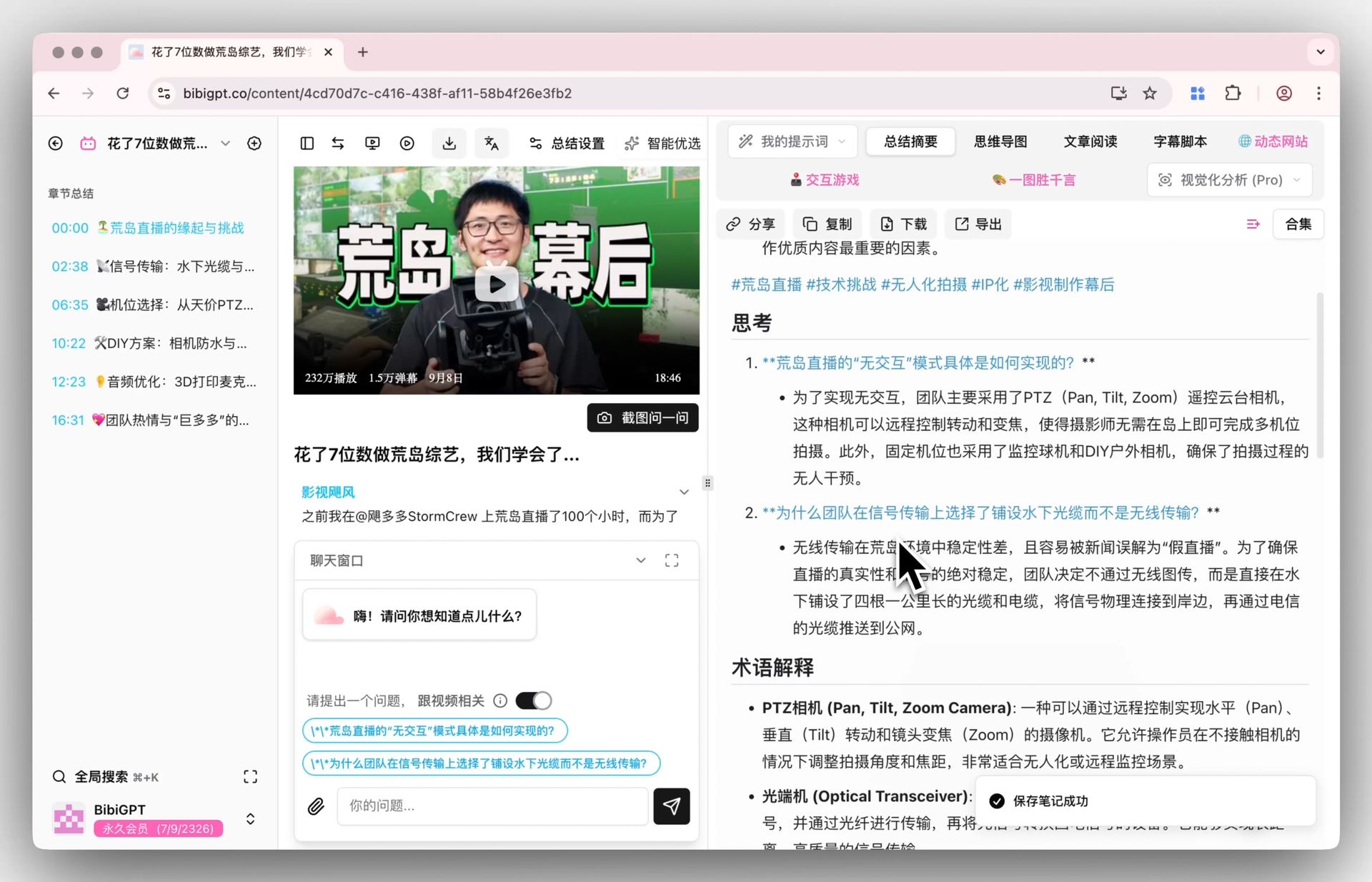
Ask YouTube AI Search Is Here — Does BibiGPT Still Matter? (Deep Analysis, 2026-05)
Ask YouTube AI Search Is Here — Does BibiGPT Still Matter? (Deep Analysis, 2026-05)
80-word direct answer (as of 2026-05-07): YouTube is testing Ask YouTube — type a natural-language question, get a step-by-step answer with stitched video clips. It’s great for fact-style instant answers, but doesn’t store knowledge, doesn’t export notes, doesn’t span platforms. BibiGPT is the deep-summarization, note-export, 30+ platform aggregator. The two are complementary: Ask YouTube is fast Q&A; BibiGPT is knowledge consolidation. If you watch across YouTube + podcasts + B站/Bilibili + Xiaohongshu, take notes in Notion/Obsidian, or operate in Chinese — BibiGPT remains essential.
Background: What Is Ask YouTube?
In late April 2026, TechCrunch reported YouTube is testing a new AI search experience called Ask YouTube:
- Users type natural-language questions in the search bar (no longer just keywords)
- AI extracts relevant clips from the global YouTube library
- Results are presented as step-by-step answers + embedded video segments
- Mechanics resemble Google AI Overviews, but anchored to video content
Source: TechCrunch — YouTube is testing an AI-powered search feature that shows guided answers (2026-04-28)
This is YouTube’s biggest search overhaul since launch — Google has pushed SGE (Search Generative Experience) logic down into the video layer.
1. Why Is This a P0-Level Event?
1.1 A Fundamental Shift in Content Consumption
For 18 years, YouTube search worked as: keyword → video list → user picks one. Ask YouTube collapses this to: question → answer + clip stitching.
| Dimension | Traditional YouTube Search | Ask YouTube AI Search |
|---|---|---|
| Input | Keywords | Natural-language question |
| Output | List of videos | Step-by-step answer + embedded clips |
| User decision cost | Pick one full video | AI gives the answer directly |
| Avg. consumption time | 10-20 min | 30s - 2 min |
Implication: Answers become direct, but long-tail video traffic concentrates further on videos that are “AI-sliceable.”
1.2 Two-Sided Impact on Creators
- Positive: Being cited by AI = a new traffic entry point, similar to a featured snippet on blogs
- Negative: CTR may drop — users get the answer in the Ask YouTube panel and never click through
This mirrors how Google AI Overview impacted website traffic: AI answers the question and the source loses the visit.
1.3 Relationship with BibiGPT: Complementary, Not Replacement
Many ask: “With Ask YouTube here, does BibiGPT still matter?”
Yes — and arguably more so. Reasoning:
| Use case | Ask YouTube | BibiGPT |
|---|---|---|
| ”What is Sora 2?” (fact-type quick Q&A) | ✅ Strong | ⚠️ Heavy |
| ”Summarize this 90-min Lex Fridman podcast” | ❌ Weak | ✅ Core scenario |
| ”Chapter notes for an Andrej Karpathy lecture” | ❌ Not supported | ✅ Mind map + chapter deep-read |
| ”Export this Bilibili video to Obsidian” | ❌ Not supported | ✅ One-click |
| ”Cross-platform aggregation (YouTube + Spotify + B站)” | ❌ YouTube only | ✅ 30+ platforms |
| ”Native non-English video understanding” | ⚠️ Limited | ✅ zh/ja/ko first-class |
Conclusion: Ask YouTube solves “fast Q&A”. BibiGPT solves “deep consolidation”. The two scenarios barely overlap.
2. Deep Analysis: Tech / Market / Ecosystem
2.1 Technical Impact
Behind Ask YouTube, Google connects three stacks end-to-end: multimodal embeddings (Gemini Embedding 2) + video timeline alignment + LLM generation:
- Videos are sliced and indexed (transcript + visual keyframes)
- User question → embedding retrieval → matching segments
- LLM aggregates segments into a structured answer with cited clips
This pipeline is structurally similar to BibiGPT’s summarization stack, but the optimization targets diverge:
- Ask YouTube: retrieval-first (one-line answer + a few clips)
- BibiGPT: comprehension-first (one structured summary, mind map, free model switching)
2.2 Market Impact
- Spotify Podcasts / Apple Podcasts: will fast-follow with similar AI search (already in internal tests)
- B站/Bilibili / 小红书 / 抖音: likely to ship “smart Q&A” search (Douyin AI news daily already shipping)
- Third-party tools: forced to pivot into “what platforms can’t do” — cross-platform aggregation, deep consolidation, note integration
2.3 Ecosystem Impact
Video SEO enters the era of “AI citation optimization”. Creators need:
- Clean transcripts and clear chapters
- Structure key arguments so AI can slice them
- Summarize the core conclusion in the first 30 seconds (vastly increases citation probability)
3. What This Means for BibiGPT Users
Creators
- Ask YouTube delivers new citation traffic (work on rigorous video structure)
- BibiGPT helps you turn other people’s videos into your own content — distill 5 industry videos into a long-form newsletter, still the core workflow
Students / Learners
- Ask YouTube: quick lookup (“How do I write a Lambda expression?”)
- BibiGPT: master a whole course (mind map + chapter deep-read + Anki flashcards + cross-episode comparison)
Knowledge Workers
- Ask YouTube: solves ad-hoc questions (“How do I configure a Kubernetes Ingress?”)
- BibiGPT: solves deep research (aggregate 5 competitor demo videos into a comparison report)
4. The New BibiGPT Workflow After Ask YouTube
Step 1: Use Ask YouTube for topic discovery
Ask broad questions in YouTube’s search bar (e.g., “2026 AI agent framework comparison”). AI shows you 5-7 relevant clips.
Step 2: Drop the high-value full videos into BibiGPT
Copy the URL → paste at bibigpt.co → 30 seconds to 3 minutes for a structured summary + mind map.
Step 3: Cross-platform supplementation
Throw same-topic Bilibili videos, Xiaohongshu reviews, podcasts into BibiGPT to get a multi-source aggregated knowledge graph — something Ask YouTube cannot do.
Step 4: AI follow-up + Notion / Obsidian export
Ask follow-up questions on the summary, confirm key details; one-click export to your notes tool. This step turns “what you watched” into “what you know.”
Step 5: Use BibiGPT to write a newsletter / Twitter thread / short-video script
Based on the multi-video aggregated outline, let BibiGPT draft long-form content / threads / video scripts.
5. Forecast
- YouTube will roll out creator-side tools next: showing “how often your video was AI-cited,” similar to search-rank tooling. Video SEO Engineer will become a new job title.
- Apple / Spotify / Asia platforms will follow within 6-12 months: AI search is no longer optional — without it user time leaks to YouTube.
- Cross-platform AI aggregators rise in value: Stronger Ask YouTube → easier single-platform search → bigger demand for cross-platform knowledge work → tools like BibiGPT become more valuable.
6. FAQ
Q1: Is Ask YouTube available globally?
A: As of 2026-05-07 it’s still in testing, visible to a subset of US users. Global rollout expected within 6-12 months.
Q2: Will Ask YouTube replace BibiGPT?
A: No. Ask YouTube solves “fast Q&A”. BibiGPT solves “deep summary + note consolidation + cross-platform aggregation”. User scenarios barely overlap.
Q3: How should I combine BibiGPT with Ask YouTube for content work?
A: Use Ask YouTube for topic discovery (like a “tutor recommending related videos”), then use BibiGPT for deep digestion (like a “student taking their own notes”).
Q4: How well does Ask YouTube work for non-English videos?
A: It’s English-first today. Recall on Chinese / Japanese / Korean videos is limited. Non-English users still need BibiGPT for B站, 小红书, 抖音, 小宇宙, and more.
Q5: As a creator, what should I do?
A: ① Clean transcripts; ② Clear chapters (≤5 min each); ③ Core conclusion in the first 30 seconds; ④ Use BibiGPT to turn your own videos into long-form articles for additional search exposure.
Q6: Will BibiGPT integrate Ask YouTube data?
A: BibiGPT already supports native YouTube summarization. We’ll prefer Ask YouTube cited segments as a complementary source — not as a replacement for the user’s input video, but as a cross-video understanding aid.
The core competence of the AI era: Models are no longer scarce; the speed at which we consume content is. Ask YouTube makes “finding” faster; BibiGPT makes “digesting” faster — one is the entrance, the other is the flywheel. Stack them, and video learning shifts from “watch and forget” to “understand, retain, apply.”
Try BibiGPT for multi-platform AI video summarization → bibigpt.co