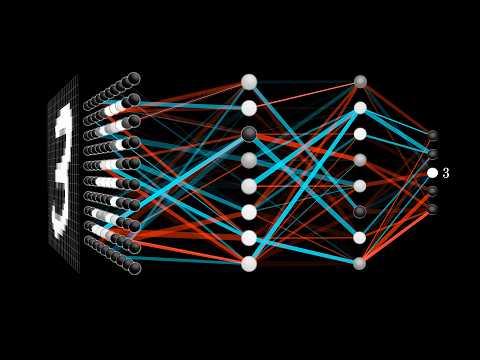
The goal of learning and a quick architecture recap
This chapter recaps the basic structure of a neural network, focusing on how adjusting some 13,000 weights and biases enables handwritten-digit recognition. The input layer takes pixel values, the hidden layers apply weighted sums and a non-linear activation (ReLU or Sigmoid), and the output layer produces a prediction. Learning is essentially the process of using large amounts of labeled training data to keep tuning these parameters for higher accuracy — and in principle the layered structure can build from simple edge detection up to complex digit recognition.
The cost function: measuring how good a prediction is
To quantify how 'bad' the network is, the author introduces the cost function. By summing the squared differences between the network's outputs and the true labels, you get an intuitive score: small when the network is confident and correct, large when it is wrong. Crucially, the cost isn't measured on one example but averaged over many thousands, producing a single, extremely high-dimensional function of all the weights and biases. Understanding the shape of that function and where it bottoms out is the key to making the computer 'learn'.
Gradient descent is framed as a ball rolling downhill. With thousands of input parameters, computing the gradient at the current point tells you the direction of steepest decrease. The algorithm iterates, taking a small step along the negative gradient each time, gradually approaching a local minimum. The author stresses step-size control — steps should scale with the gradient's magnitude to avoid overshooting near the bottom. This calculus-based optimization is the core engine that lets a network adjust itself and improve.
What learning really is — features or memorization?
The author probes what the network has really learned. Even at 96% test accuracy, visualizing the trained weights rarely matches the human intuition of 'edge detection'. This suggests the network found some local optimum in a vast parameter space without truly understanding what a 'digit' is — and it can be overconfident even on noisy input. Drawing on academic research, the section asks whether deep networks extract genuine features or simply memorize the training data, prompting a deeper reflection on the nature of machine intelligence.
In closing, the author urges viewers to go beyond passive watching and deepen their understanding through practice. He recommends Michael Nielsen's classic free book as the best next step and points to code and data resources for hands-on parameter tweaking. He also briefly surveys recent research — why optimization is sometimes surprisingly easy, and where the line between 'memorization' and 'learning' falls during training. With these resources, learners can cross from theory into implementation and grasp deep learning more fully.
Highlights
📉 A cost function adds up how far the network's output is from the desired answer across many training examples — a single number that says "how wrong are we right now?"
🏔️ Gradient descent treats that cost as a landscape and repeatedly steps downhill; the negative gradient points the direction of steepest decrease.
⚙️ The gradient's components tell you not just which way to nudge each weight and bias, but which adjustments matter most.
🧠 A trained network can hit ~96–98% accuracy on digits, yet inspecting its hidden layers shows it doesn't cleanly learn "edges then loops" — a humbling reality check.
📚 Learning here is continuous optimization, which is exactly why the weighted sums are squished by smooth functions rather than hard on/off thresholds.
Summary
This chapter explains the core learning mechanism of neural networks —
gradient descent. A network tunes thousands of weights and biases by
measuring how badly it currently performs (the cost), then taking small steps
that reduce that cost. Over many steps, the network settles into a configuration
that classifies handwritten digits well.
Terminology
Cost function: a measure of how poorly the network is performing, summed over training examples — the thing gradient descent minimizes.
Gradient descent: an optimization method that iteratively steps in the direction that most reduces the cost.
Gradient: the vector of partial derivatives; its negative points toward the steepest local decrease of the cost.
Weights & biases: the ~13,000 tunable parameters the learning process adjusts.