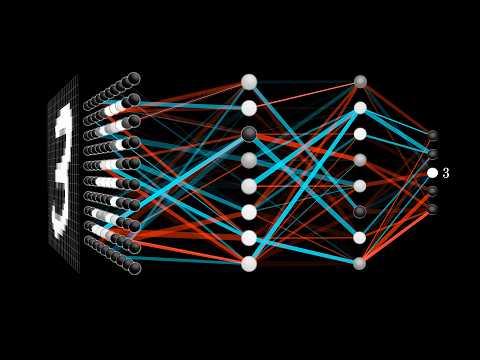
But what is a neural network? | Deep learning chapter 1

3Blue1Brown Artificial Intelligence 19-minute summary
But what is a neural network? | Deep learning chapter 1
3Blue1Brown

Chapters

  1. 0s Neural networks: the intuition and the challenge
  2. 2m56s The layered structure of a neural network
  3. 8m26s Activation: weights and biases
  4. 13m37s Matrix operations and what comes next

In-depth Summary

0s

Neural networks: the intuition and the challenge

The video opens from the human intuition for recognizing handwritten digits — the brain's remarkable knack for making sense of blurry visual information. By contrast, converting a 28×28-pixel image into a machine-readable form and deciding which digit it shows turns out to be remarkably hard. The author stresses that a neural network is more than a buzzword: it is fundamentally a mathematical structure capable of deep learning, able to capture and process the complex patterns inside an image — a capability that sits at the heart of modern AI.

2m56s

The layered structure of a neural network

The author walks through the layered architecture of a neural network, using digit recognition as the running example to show how information flows through successive layers of neurons. Each layer captures a different level of abstraction: the input layer takes raw pixels, the hidden layers try to detect edges, lines and small shapes, and the output layer delivers the final classification. This progressive, layer-by-layer abstraction is exactly what lets a network parse complex data efficiently.

8m26s

Activation: weights and biases

This section digs into the core math — how a neuron decides whether to 'fire'. Every connection carries a weight that measures how much it should count toward the decision, while a bias shifts the activation threshold. By taking a weighted sum of all inputs and squashing it into the 0–1 range with the Sigmoid function, the network performs non-linear logic, letting it flexibly handle the many shapes a handwritten digit can take.

13m37s

Matrix operations and what comes next

To make computation efficient, neural networks express the activations passing from one layer to the next as matrix–vector multiplication. The author shows how matrices compactly encode huge numbers of parameters — simplifying the code and tapping into the heavy optimizations modern math libraries provide for matrix operations. The video closes with an expert discussion of Sigmoid's limitations and introduces ReLU, the activation function far more common in modern deep learning, illustrating how the techniques keep evolving.

Highlights

  • 🧠 A neural network's core idea is to turn image information into numbers, cascade them through a multi-layer structure, and let the most active output neuron decide which digit the image represents.
  • 🧱 The layered structure works like progressive abstraction — each layer of neurons recognizes higher-level patterns, from low-level pixel edges up to complex shapes and finally whole digits.
  • ⚖️ A weight measures the strength of a connection; a bias decides how easily a neuron activates. Together they are the "knobs" the network uses to process information.
  • 📉 The Sigmoid function maps the weighted sum into the 0–1 range, simulating a neuron's non-linear activation from "inhibited" to "active".
  • 🧮 A modern neural network is essentially one complex function — efficient matrix operations and linear algebra give the computer powerful pattern-recognition ability.

Summary

This video gives an accessible introduction to the structure and working principles of a neural network. Through the classic case of recognizing handwritten digits, it shows how a neural network processes image-pixel information through multiple layers (input, hidden, output). The key is understanding how the weights and biases between neurons work together to turn raw data into abstract features, ultimately achieving precise recognition of complex patterns.

Questions

  1. Why is a neural network built with multiple layers instead of mapping input straight to output?
  • The layered structure encodes a logic of “abstraction levels.” Lower-level neurons capture simple features (lines, edges); later layers combine these into more complex patterns (loops, curves). This layered processing greatly increases the network’s flexibility and accuracy on hard problems.
  1. Is the Sigmoid function mentioned in the video the only usable activation function?
  • No. Although Sigmoid was a classic choice, modern deep learning more often uses ReLU (Rectified Linear Unit). ReLU trains more efficiently in deep networks, is cheaper to compute, and helps mitigate problems like vanishing gradients.

Terminology

  • Neuron: the basic computing unit of the network — essentially a function that stores a number and applies a non-linear transformation, deciding its own degree of activation based on input.
  • Weights: parameters connecting neurons; their magnitude determines how much the previous layer influences the current neuron, and they are the main thing tuned during learning.
  • Bias: an extra number added after the weighted sum, used to adjust the threshold at which a neuron fires — i.e. how “easily” it activates.
  • Sigmoid function: a logistic curve that squishes any real number into the (0, 1) range, simulating a neuron being “on” or “off”.
  • Matrix multiplication: the efficient mathematical representation a neural network uses to handle large numbers of connections, organizing weights into matrices and leveraging linear algebra for speed.

More from 3Blue1Brown

Browse all from 3Blue1Brown →