After "Ask Xiaoyuzhou": As Every Podcast Platform Races to Add AI, How Can Anyone Turn Any Podcast into a Readable, Listenable Summary (2026)
After “Ask Xiaoyuzhou”: As Every Podcast Platform Races to Add AI, How Can Anyone Turn Any Podcast into a Readable, Listenable Summary (2026)
You subscribe to thirty podcasts. Dozens of unlistened episodes sit in your saved folder. Each one runs over an hour. You can’t finish them during your commute, and hunting for a specific quote means dragging a progress bar for ages. So you often give up entirely — not because the content isn’t good, but because “listen to the whole episode just to get the core idea” costs too much.
In 2026, podcast platforms are collectively answering this problem. Xiaoyuzhou launched “Ask Xiaoyuzhou” (问问小宇宙) — instead of listening from the start, you ask a question directly against the entire podcast library, and AI finds the answer and tells you exactly which minute it appears. Podcast AI has shifted from “an experimental feature in one app” to a standard capability every platform needs to ship.
Most coverage frames this as industry news. But for ordinary people drowning in audio content every day, it answers a much more practical question: Can you actually get the core of a podcast or long video without listening all the way through? This article skips the jargon and the hype, and focuses on three things — how this wave of podcast AI got started, why it matters to you, and how to genuinely put “any audio or video → readable, listenable summary” in your own hands.
Quick answer: Podcast AI means using AI to automatically transcribe an entire episode into text, compress it into structured key points, and let you “ask” rather than “listen from the start.” Xiaoyuzhou’s “Ask Xiaoyuzhou” is a prime example — ask a question and it jumps to the exact timestamp. But platform tools only cover their own content; to have this power over any podcast, video, or long audio, paste a link into BibiGPT and get a timestamped structured summary instantly.
Rather than just reading the conclusion, see the complete flow of “long audio/video → a few minutes of readable, listenable summary” for yourself — pick one of the samples below and try it right in your browser:
Summarize any video in seconds
Pick a sample below to see the AI summary — TL;DR, key points, and jump-to timestamps.
TL;DR: Karpathy builds a GPT-style language model from scratch in code, explaining every piece — from a tiny character-level model up to the full Transformer.
Key points
- Start with a bigram model, then add self-attention so tokens can "talk" to each other
- A Transformer block = multi-head attention + feed-forward + residual connections + layer norm
- Training is just predicting the next token; scale and data do the rest
- The same architecture behind nanoGPT is what scales up to ChatGPT
Jump to
- 00:07 Why build GPT from scratch
- 08:23 Self-attention, intuitively
- 1:00:00 Assembling the Transformer block
- 1:35:00 From nanoGPT to ChatGPT
1. What Is Actually Happening: A Timeline of Podcast AI Adoption
Let’s get the facts straight. The move to turn “podcasts → AI text and Q&A” into a real product has clearly accelerated over the past year:
- Xiaoyuzhou launched “Ask Xiaoyuzhou.” This is Xiaoyuzhou’s official AI podcast search tool (ask.xiaoyuzhoufm.com): you type a question in the search box, it performs deep analysis across the platform’s vast podcast library, delivers a precise answer, and uses a “timestamp” feature to mark exactly when that answer appears in the audio — click it and you jump straight there, no more dragging from minute 1 to minute 47.
- Platforms are universally adding transcription. Xiaoyuzhou and other platforms have rolled out episode transcripts as a baseline feature, making “reading a podcast” a normal alternative to “listening to a podcast.”
- Third-party tools have exploded. A wave of tools focused on “batch podcast transcription + auto-segmentation + key point extraction” has emerged, all promising to eliminate manual transcription and deliver results in minutes.
Taken together, the conclusion is clear: Podcast AI has crossed the “experiment” threshold. It is no longer a flashy feature in one app — it is a content consumption mode that sits alongside subscribing and downloading.
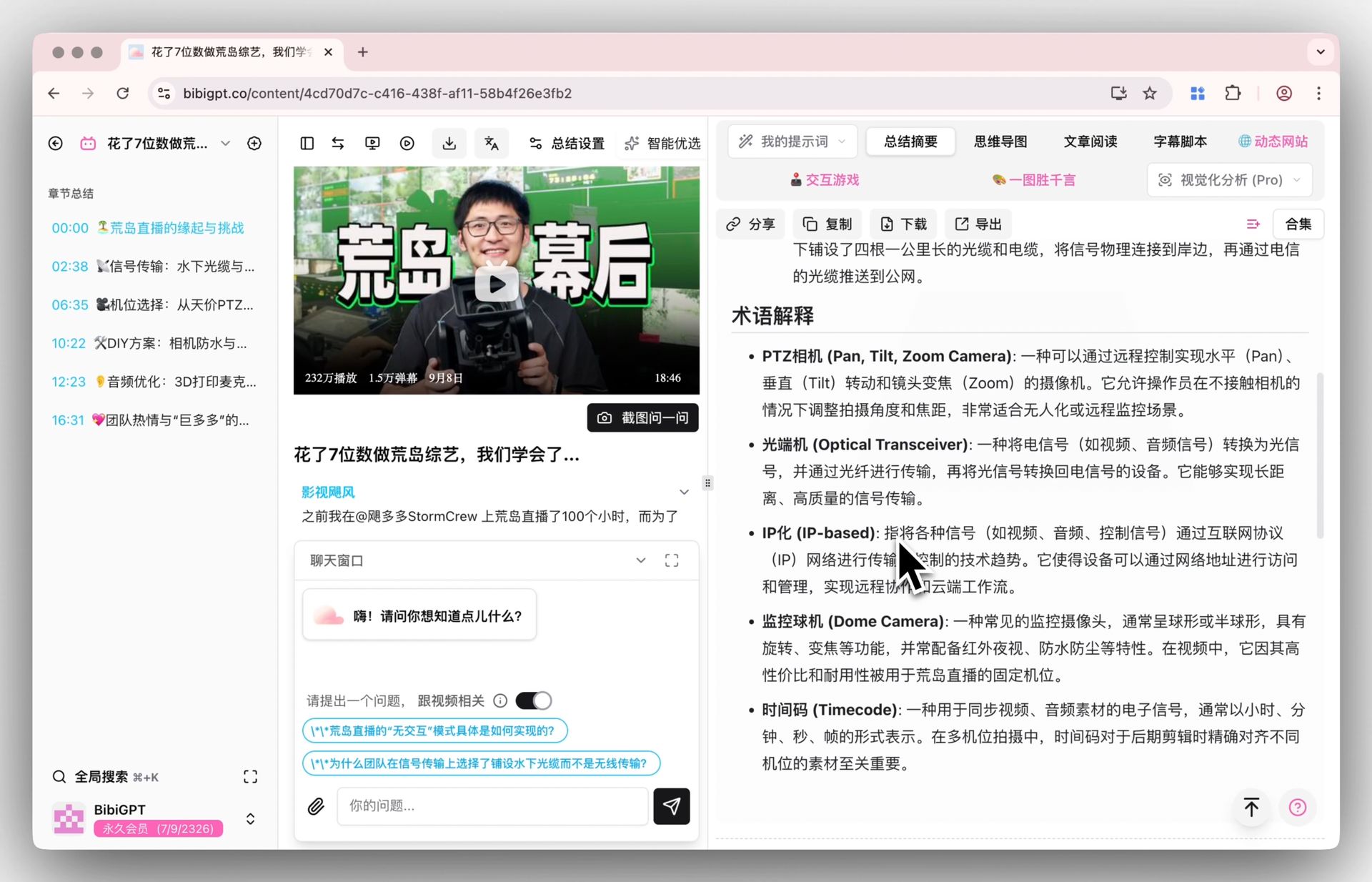
The product screenshot below shows what a full long-audio episode looks like after being compressed into structured key points — this is the foundational step in podcast AI, turning content into something shorter and readable before you can even think about “asking it questions”:
Screenshot: BibiGPT · Smart Deep Summary in action
Practical rule: To judge whether a content format will go mainstream, don’t fixate on a single product — look for whether several major players are betting on the same thing simultaneously. When both the platform itself and a cluster of third-party tools are building the same capability, it has shifted from “optional” to “default.”
A larger behavioral shift underpins this wave: according to the Edison Research Infinite Dial 2024 report, roughly 47% of Americans aged 12 and older listened to a podcast in the past month, with about 98 million weekly listeners — “consuming content with your ears” is already a mainstream habit. Podcast AI simply adds two missing pieces on top of that habit: “also being able to scan with your eyes” and “being able to ask questions directly.”
2. Why Every Platform Is Racing to Add AI: From “Finished Listening” to “Done Asking”
For the past few years, podcast competition was about “volume of content” — who had the most shows, who had the most exclusives. Now the competition has shifted to “retrieval efficiency”: given the same content library, who can help users get to the exact quote they need fastest.
Three layered shifts are driving this:
- From linear listening to random access. Audio is inherently linear — you can only follow the timeline forward. AI transcription plus timestamps turns audio into something searchable and navigable — essentially giving podcasts a “table of contents” and a “search box.”
- From “finding shows” to “finding answers.” In an “Ask Xiaoyuzhou”-style experience, you no longer choose a show first and then listen — you ask a question and let AI locate the answer across shows. The unit of consumption has shrunk from “a whole episode” to “a single insight.”
- From passively waiting for updates to actively extracting value. Listening to whatever the platform pushes is giving way to “pulling key points from any content on demand.” Control has shifted from platform editors to you.
Experiencing this directly makes it more intuitive — the product screenshot below shows what it looks like to ask follow-up questions directly against content that has already been structured:
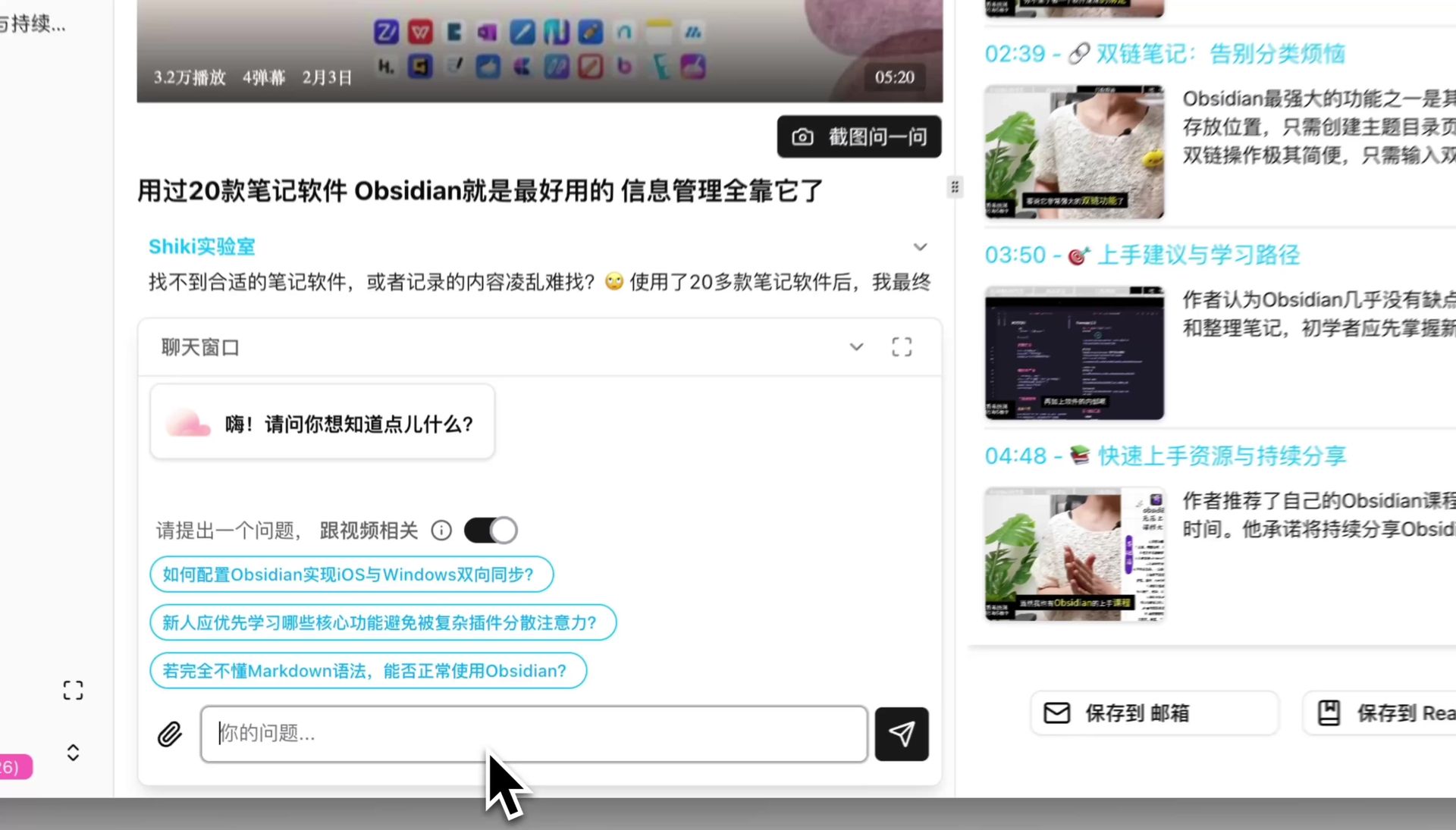
Screenshot: BibiGPT · AI Follow-up Conversation in action
Turning “finished listening” into “done asking” saves not just time but attention. The interactive demo below lets you try what “asking questions about content” actually feels like:
Ask the video a question
Watched it but still unsure? Ask follow-ups and get answers grounded in the transcript.
Tap a question:
Practical rule: When evaluating an AI content tool, don’t just check whether it can “summarize” — check whether it can be “questioned.” Many tools summarize; few let you keep asking follow-up questions based on the conclusion and jump to the exact timestamp in the original. That’s the real brain-saver.
3. What This Means for You: Three Types of Users, Three Use Cases
Podcast AI is not an abstract trend — it means entirely different solutions for different people.
- Commuters and information hoarders. Your core pain point is “subscribing to more than you can ever listen to.” The approach: drop the link of a show you want but don’t have time for into the tool, get a few hundred words of structured key points first, and decide whether the episode is worth an hour of your time — turning “listen to it all” into “scan first, then choose.”
- Students and researchers. What you need is “something I can cite and review.” The approach: convert podcasts or lectures into timestamped transcripts, send key points directly to your notes, and click a timestamp when reviewing to jump back to the exact moment in the audio — no need to re-listen to entire segments.
- Creators and content producers. What you want is “turn what you heard into something you can publish.” The approach: extract an interview episode into structured key points, then repurpose them into a long-form article, a social media post, or a short-video script — one listen, multiple outputs.
Notice a key distinction: platform AI (like “Ask Xiaoyuzhou”) only covers its own platform’s content. But the content you need to process every day often spans Bilibili, YouTube, various podcast apps, and local recordings. The real leverage is having a tool that is not picky about the source and can extract from any link.
Practical rule: When choosing a podcast AI tool, ask one question first — does it only serve its own content, or does it support any link? The former is a platform retention feature; the latter is a capability that belongs to you.
4. Beyond Xiaoyuzhou: Using BibiGPT to Turn Any Podcast into a Readable, Listenable Summary
If you agree that “the capability should be in your own hands,” how do you actually make that happen? Here is a practical workflow that does not depend on any single platform.
Step 1: Paste any link. Whether it’s Xiaoyuzhou, Apple Podcasts, YouTube, Bilibili, or a local recording, paste the link into BibiGPT’s AI Podcast Summary. It supports 30+ platforms and delivers a full transcript plus structured key points in one click.
Step 2: Use the timestamped mind map to navigate quickly. Once transcription is done, you get a clickable mind map where every key point is linked to a timestamp in the original audio — this is exactly the “timestamp jump” experience, but not limited to any single platform.
The product screenshot below shows what a timestamped mind map looks like — click any key point to jump to the corresponding position in the original audio:
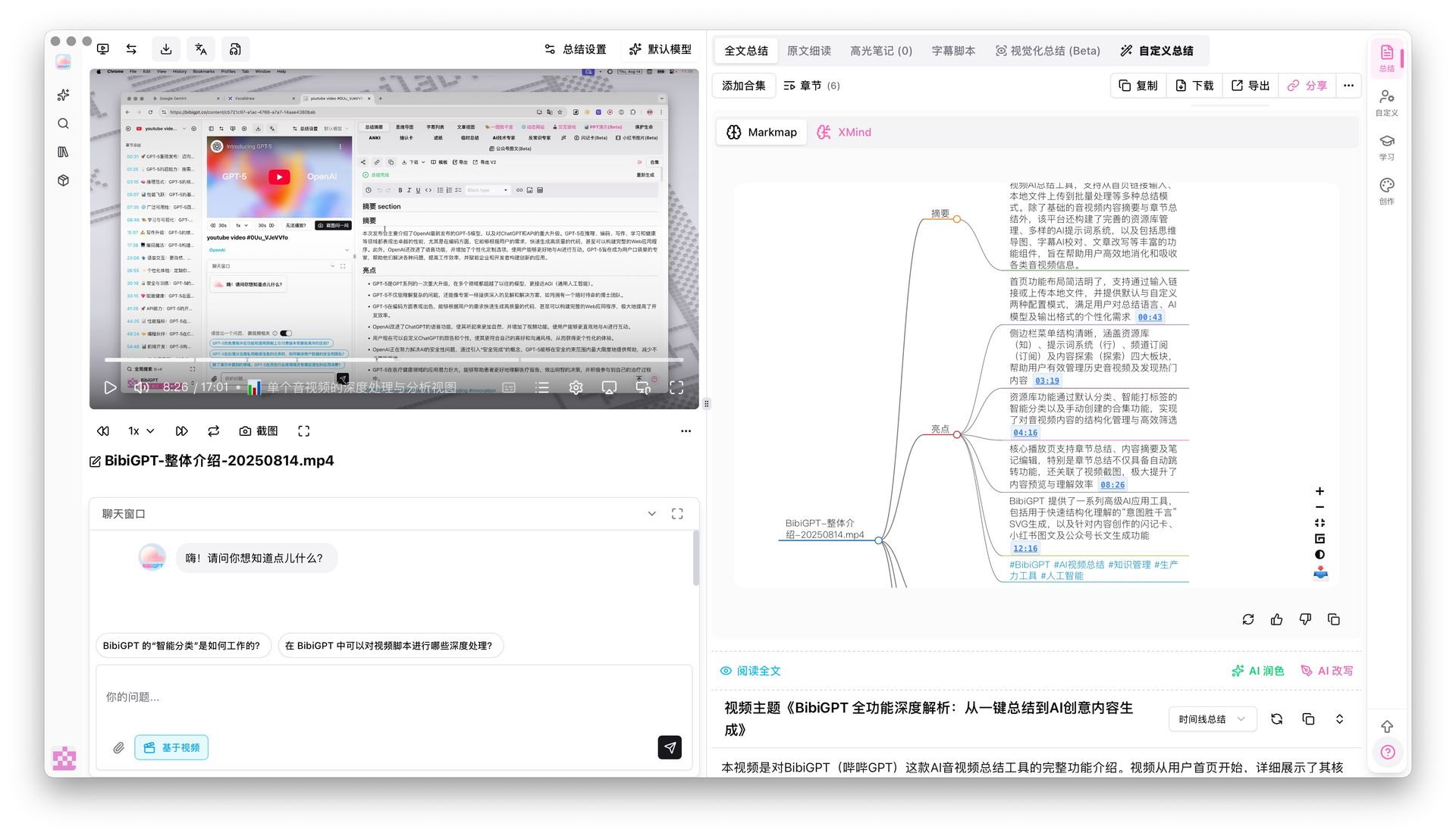
Screenshot: BibiGPT · Mind Map Timestamp Navigation in action
Step 3: Keep asking follow-up questions. Still have questions after getting the key points? Ask them directly in the chat — AI will answer based on this specific episode, not generic information — essentially bringing the “Ask Xiaoyuzhou” experience to any episode on any platform.
Step 4: Batch through an entire series. Following more than one episode? BibiGPT supports extracting an entire podcast series or a creator’s full list in bulk, perfect for people who need to scan a large volume of content every day.
The product screenshot below shows the key-point summary view after batch-processing multiple links:
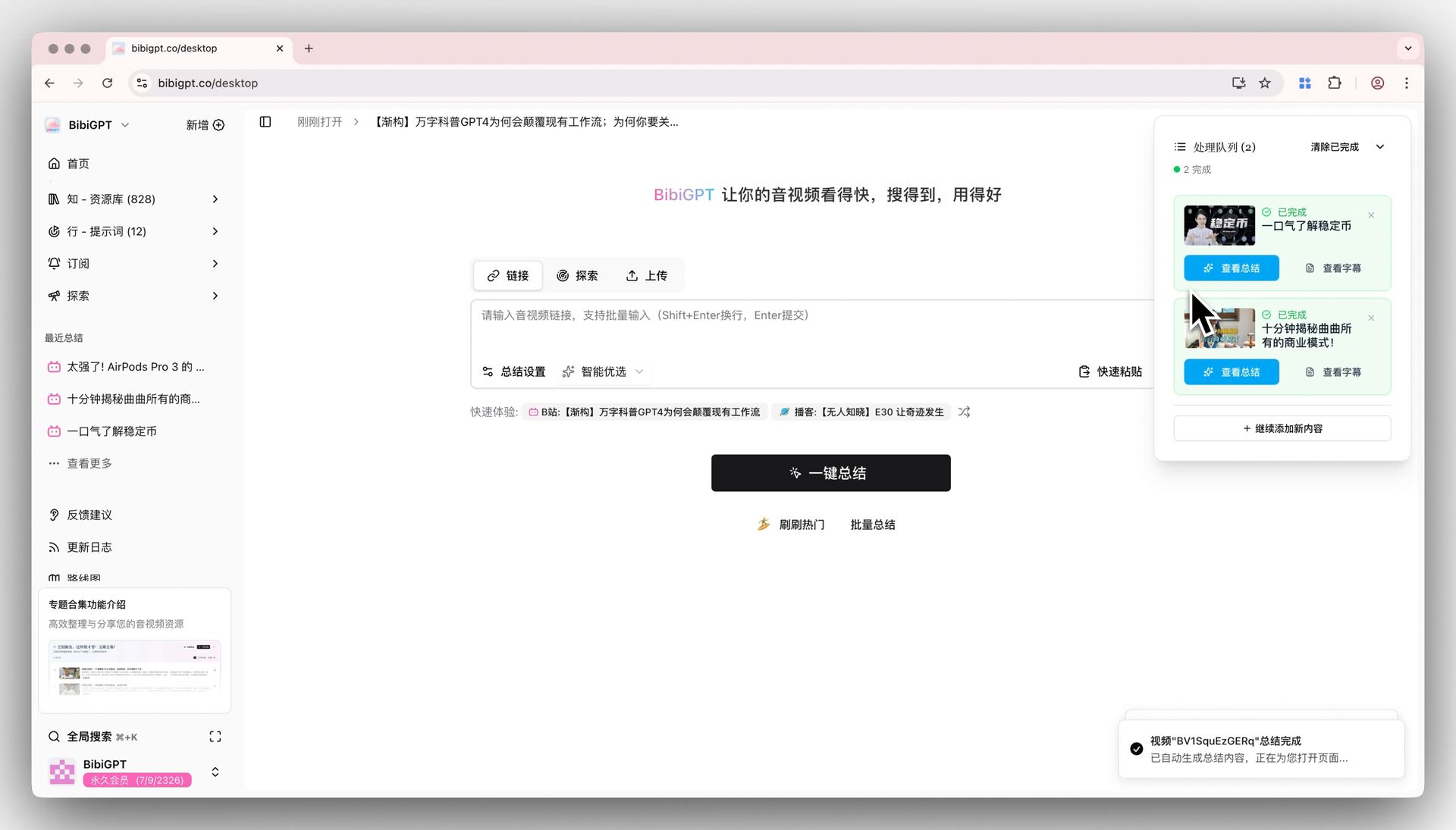
Screenshot: BibiGPT · Multi-link Batch Summary in action
Step 5: Turn what you heard into something you can publish. After extracting, you can do more than just read — one click rewrites it into a written article, or apply the same flow to YouTube video summaries — one listen, published content.
To get an intuitive sense of what “AI transforming long content into a listenable, readable format” actually feels like, the video below demonstrates the same idea from a different angle:
Video: YouTube · Tech Research · How to Convert Content to Audio Using AI
Practical rule: A good podcast consumption workflow should satisfy three criteria simultaneously — source-agnostic, supports timestamp navigation, and can be questioned. Miss any one of them, and you’re still “working around the tool” instead of “the tool working around you.”
If you prefer pure listening, you can also go the other direction — use free online audio-to-text conversion to get an accurate transcript first, then generate a listenable summary, ensuring content reliability from the source.
5. What’s Next for Podcast AI: Three Trend Predictions
Based on this wave of change, here are three actionable predictions:
- “Q&A” will replace “search box” as the podcast entry point. When AI can pinpoint a specific timestamp across shows, the old habit of browsing keyword lists will fade fast. You will get used to asking directly rather than hunting for a show first.
- “Cross-platform extraction” will become a core need. Platform AI only manages its own content, but users’ attention is cross-platform. Tools that can unify extraction from any source will only become more valuable.
- The line between “consumption” and “creation” will blur further. When a podcast episode can be turned into structured key points in minutes, “listen and immediately produce an article” will evolve from a niche skill into the default behavior for most people.
Practical rule: Models and features will keep updating, but the underlying principle stays the same — what’s scarce has never been content, it’s the speed of consuming content. Whoever turns “too much to listen to, too much to watch” into “extract anything on the fly” holds the upper hand.
6. Frequently Asked Questions (FAQ)
Q1: Is “Ask Xiaoyuzhou” the same as converting a podcast to a transcript? Not exactly. “Ask Xiaoyuzhou” is AI-powered Q&A plus timestamp navigation across the platform’s podcast library; converting to a transcript means turning a single episode’s audio into readable text. The former helps you “find answers,” the latter helps you “read the full content” — they’re often used together.
Q2: The platform’s built-in AI already does the job — why would I need an extra tool? Because platform AI typically only covers content on its own platform. The podcasts and videos you need to process every day often span multiple sources, and you need a tool that isn’t picky about where content comes from and can extract from any link to handle everything.
Q3: Can I extract a two-hour-plus long podcast in one click? Yes. Full interview episodes and entire podcast series are all supported. BibiGPT generates a timestamped structured summary, so you can jump directly to the section you care about without dragging the progress bar from the beginning.
Q4: How accurate are the extracted key points? Key point quality depends on how clearly the source content is delivered and how accurately it’s transcribed. BibiGPT offers free online audio-to-text conversion that handles heavy accents and background noise as well as possible, ensuring summary reliability from the source.
Q5: I follow a lot of podcasts every day — can I process them in bulk? Yes. In addition to single links, BibiGPT supports batch extraction of an entire podcast series or a creator’s full list, making it ideal for people who need to scan a large volume of content daily.
Q6: Can I try it without signing up? Yes. Just paste a link into the homepage input box to get partial results right away. Experience the full “long audio/video → readable key points” flow first, then decide whether you want to go further.
Platforms are using AI to redefine how podcasts are consumed, and the smartest move isn’t to passively wait for some app to ship a feature — it’s to own the capability of “extracting from any source on the fly,” turning the podcasts you can’t finish, the interviews you can’t get to, and the long content you can’t read, into formats you can rapidly absorb.
If you want to turn any podcast episode or video into a private summary you can read or listen to, paste the link into BibiGPT to get started right away — it supports 30+ platforms, and a single paste gives you a timestamped AI summary.
Further reading: for a systematic comparison of podcast AI summarizer tools, see our complete guide to AI podcast summarizer tools.
BibiGPT Team
Popular tools
More in this series
- The AI Audio Briefing Wave: From Forbes Daily Top 3 to Turning Any Long Content Into a Listenable Podcast (2026)
- AI Podcast Summarizer Complete Guide 2026: From Transcript to Quote Cards
- AI Podcast Summarizer: 6 Tools Compared + BibiGPT Workflow (2026 Comprehensive Guide)
- AI Podcast Transcription Guide (2026): Turn Any Podcast Into Searchable Text With BibiGPT
- Best AI Lecture Summarizer Tools 2026: Compared for Students, Teachers & Self-Learners