DeepSeek Launches Speech-to-Text and Text-to-Speech APIs: We Benchmarked Them Against 5 Providers

As of November 13, 2026, DeepSeek has added a set of tool APIs: web search, file reading, OCR, and the two this post covers, speech to text (ASR) and text to speech (TTS). BibiGPT wired DeepSeek TTS into its narration engine on day one and ran the same audio through five other speech-to-text providers.
The short version: DeepSeek ASR is accurate on Chinese, fast and cheap, but it takes at most 120 seconds per request and returns no timestamps, so it suits voice input rather than subtitles. DeepSeek TTS starts speaking quickly, is mid-priced, and has two voices.
Full numbers, audio samples and curl examples are on our DeepSeek ASR / TTS benchmark page. This post walks through the results and the trade-offs.
Pricing: cheap ASR, and Chinese TTS counts double
| API | List price | Promo (50% off) | Billing |
|---|---|---|---|
| Speech to text | $0.116/hour | $0.058/hour | Per second, partial seconds round up |
| Text to speech | $0.45 per 10K chars | $0.225 per 10K chars | A Chinese character counts as 2; letters, digits and spaces count as 1 |
At the promo price, ASR costs less than half of ElevenLabs Scribe ($0.22/hour), but more than StepAudio 2.5 or Qwen-Audio-3.1.
For TTS that is about $22.5 per million English characters, or about $45 per million Chinese characters because of the double count. That is still less than half of MiniMax Speech 2.8 HD ($100 per million).
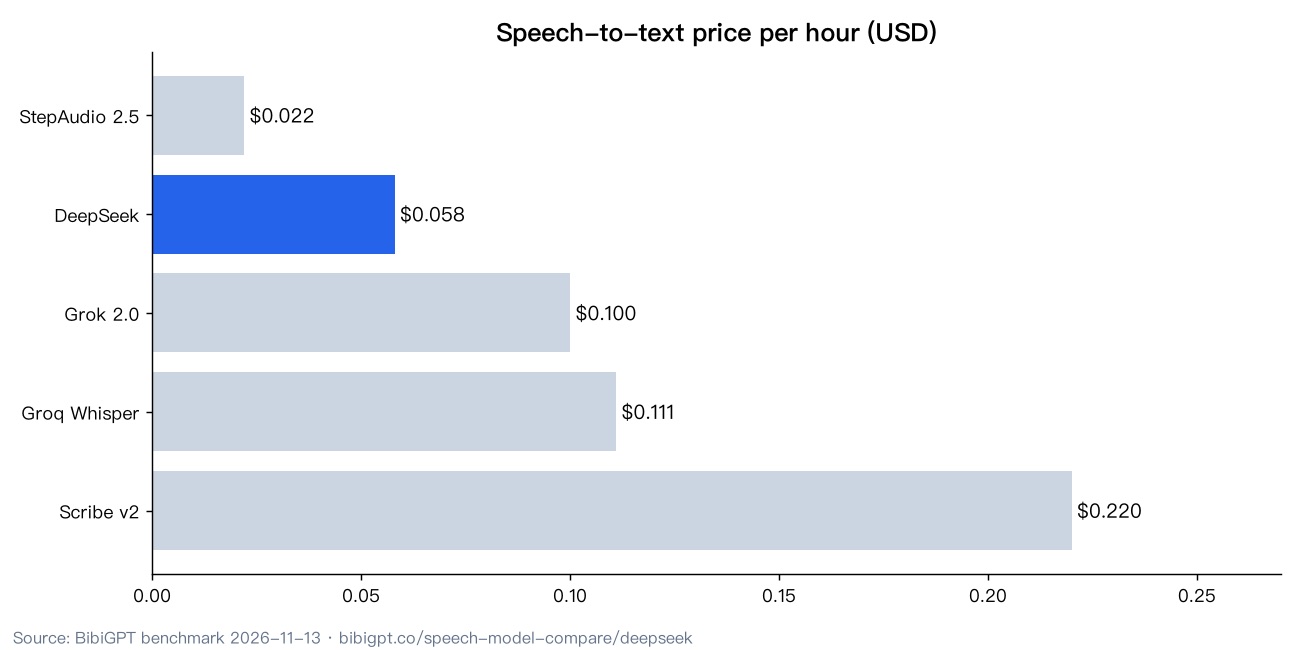
In one line: DeepSeek ASR is not the cheapest, but it is the cheapest of the three most accurate engines.
Sources: DeepSeek ASR docs, DeepSeek TTS docs. For every provider side by side, see our speech-to-text price comparison.
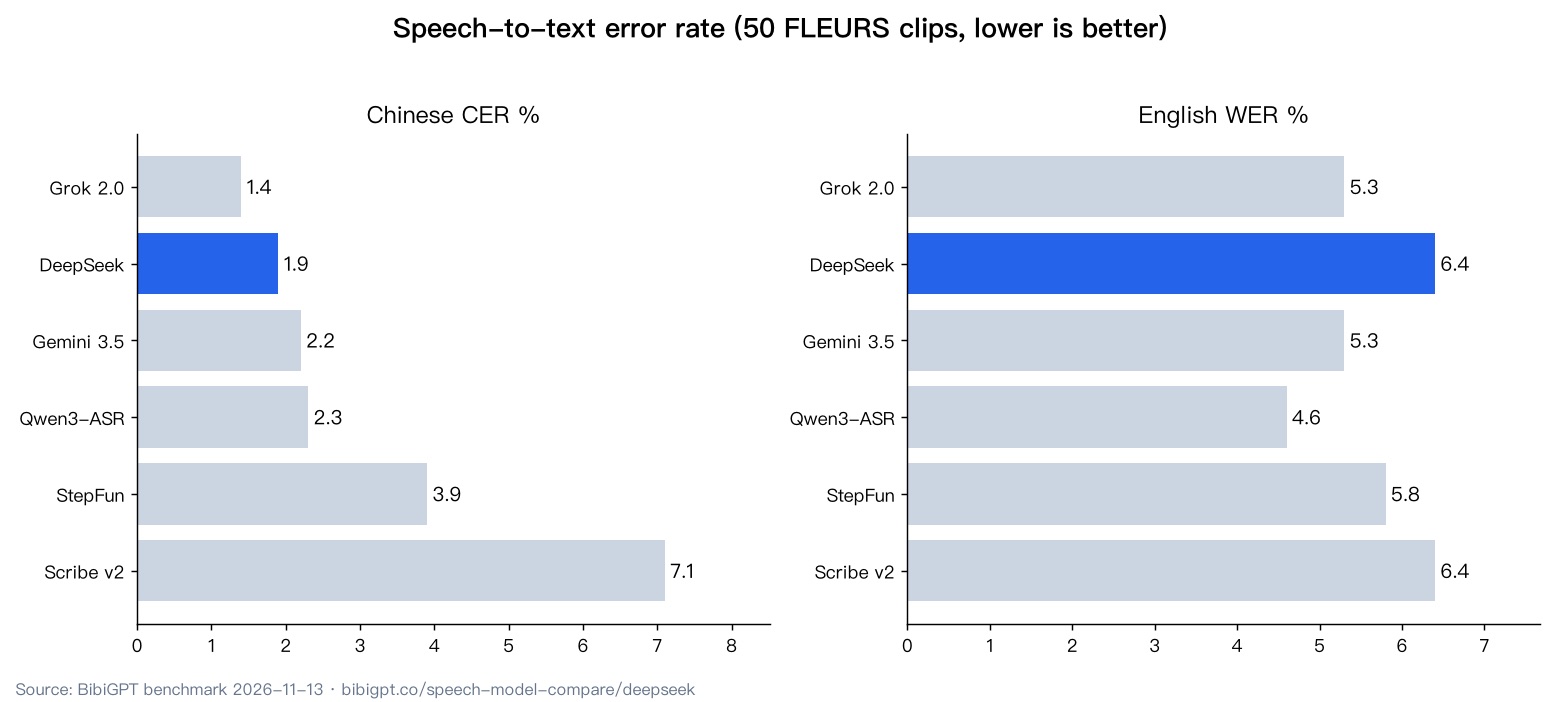
Accuracy: 2nd on Chinese, mid-pack on English
We drew 25 Mandarin and 25 US English clips at random from Google’s FLEURS test set (about 9 minutes in total) and sent the same files to all six engines:
| Engine | Chinese CER | English WER | Latency | Timestamps |
|---|---|---|---|---|
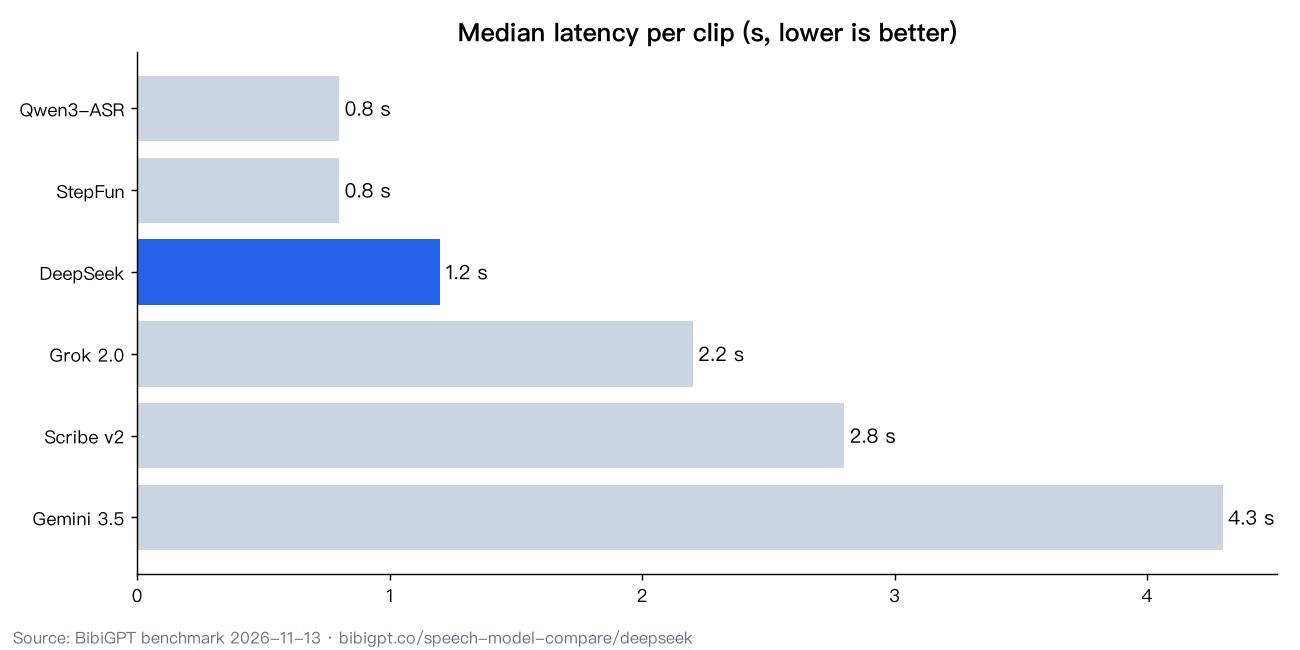
| Grok Voice Transcribe 2.0 | 1.4% | 5.3% | 2.2 s | Yes |
| DeepSeek ASR | 1.9% | 6.4% | 1.2 s | No |
| Gemini 3.5 Transcribe | 2.2% | 5.3% | 4.3 s | Yes |
| Qwen3-ASR-Flash | 2.3% | 4.6% | 0.8 s | Yes |
| StepFun ASR | 3.9% | 5.8% | 0.8 s | Yes |
| ElevenLabs Scribe v2 | 7.1% | 6.4% | 2.8 s | Yes |
Lower is better. Chinese is scored by character error rate and English by word error rate, with punctuation, case and script normalised. All audio was loudness-normalised first.
DeepSeek is the most consistent on Chinese. Its worst clip scored 12% CER, compared with 26% for Grok and 21% for Qwen. Most of its errors were transliterated foreign names.
Turn quiet recordings up first. FLEURS has a dozen near-silent clips. Without loudness normalisation, DeepSeek dropped the start or end of some English sentences and its WER rose from 6.4% to 17.5%. Grok did worse on the same clips and returned empty strings.
Brand names drift. “BibiGPT” came back as “BB GPT”, and there is no hotword parameter to fix it.
Practical rule: Normalise loudness before sending audio to DeepSeek ASR, or quiet sentence starts and endings get dropped.
Limits: why it is not a subtitle engine yet
| ASR | TTS | |
|---|---|---|
| Format | 16-bit PCM WAV or Ogg Opus only; MP3 is rejected | wav or 24 kHz pcm |
| Length | ≤ 120 s and ≤ 8 MiB per file | ≤ 10,000 billed characters per request |
| Output | Full text and duration only; no timestamps, no speakers | Audio stream |
| Options | No language or hotword parameter; 21 languages auto-detected | Two voices (Stella, Tide), no speed control |
Subtitles need start and end times for every line. DeepSeek ASR returns one block of text, so an hour of video would have to be split into 30 chunks and the timing guessed. That is why BibiGPT has not added DeepSeek ASR as a subtitle engine yet. Long videos still use Auto.
Where it shines is voice input: say something, get text back in about a second, send it to an AI.
How to choose: Use DeepSeek for voice input under two minutes. For long videos that need subtitles and timestamps, use an engine that returns timestamps.
One more catch: stereo files use only the left channel, and a silent left channel returns an empty string instead of an error.
DeepSeek TTS: first audio in about a second
We had both voices read the same Chinese, English and Japanese script:
- First audio in 0.8–1.3 s, synthesis at about 5× realtime, which makes it good for streaming playback.
- Chinese numbers are read naturally. In English, “$0.06” is read as “zero point oh six dollars”.
- It speaks 10 languages, including Mandarin, Cantonese, English, Japanese and Korean, detected from the text.
- There are only two voices, Stella (female) and Tide (male), with no emotion control and no voice cloning. For more expressive narration, MiniMax or ElevenLabs are still the better pick.
The benchmark page has the raw audio we generated (Chinese, English, Japanese and Cantonese) so you can listen yourself.
Using DeepSeek voices in BibiGPT
- Open any video summary, article or PDF and go to Image video or Document explainer.
- Pick DeepSeek TTS as the voice engine, then choose Stella or Tide.
- Generate. Pro members do not need their own DeepSeek API key.
Why not just call the DeepSeek API?
If you are a developer and only need a sentence read aloud, call the API directly. The benchmark page has a ready-made curl command.
If you want an hour of video or a long article turned into a narrated short video, the voice model is only the last step. Before it come fetching the transcript, summarising, rewriting for speech, adding visuals and aligning narration to the timeline. BibiGPT runs all of that as one pipeline. As models multiply and get cheaper, the time saving comes from the layer that combines them.
FAQ
Does DeepSeek have a speech-to-text and text-to-speech API?
Yes. Both launched in November 2026 under Tool APIs in the DeepSeek docs, as Speech to Text and Text to Speech, and they use the same API key as the chat models.
How accurate is DeepSeek ASR?
In our FLEURS test it scored 1.9% CER on Chinese, 2nd of six and just behind Grok, and 6.4% WER on English, mid-pack. See the DeepSeek ASR / TTS benchmark for details.
Can DeepSeek ASR make video subtitles?
Not directly. It accepts at most 120 seconds per request and returns no timestamps. For subtitles, paste the video link into BibiGPT and let Auto pick a transcription engine.
How much does DeepSeek TTS cost?
List price is $0.45 per 10K characters, and $0.225 during the promotion. A Chinese character counts as 2, so Chinese works out to about $45 per million characters.
Why use DeepSeek TTS inside BibiGPT instead of calling the API directly?
The API gives you an audio file. Picking DeepSeek TTS in BibiGPT gives you a finished short video: it fetches the content from a link, summarises it, rewrites it for narration, adds visuals and aligns the voice line by line in one go. Pro members do not need to manage an API key either.
Popular tools
More in this series
- GPT-Transcribe vs Whisper vs Grok Voice 2.0 vs MAI-Transcribe:2026 语音转文字模型怎么选
- Apple iOS 27 Opens Third-Party AI: The Era of Switchable Assistants Is Here — How to Choose for Audio and Video (2026)
- DeepSeek R1 + BibiGPT: A Practical Guide to AI-Powered Audio/Video Understanding in 2025
- DeepSeek-V4 Is Here! BibiGPT Ships Four New Models + 1M Context on Day One — AI Video & Podcast Summarizing Just Leveled Up
- BibiGPT vs DeepSeek-V4 + Granite Speech Plus 2026: Self-Hosted Open Source vs Productized Stack
View all 44 articles in Model Updates →